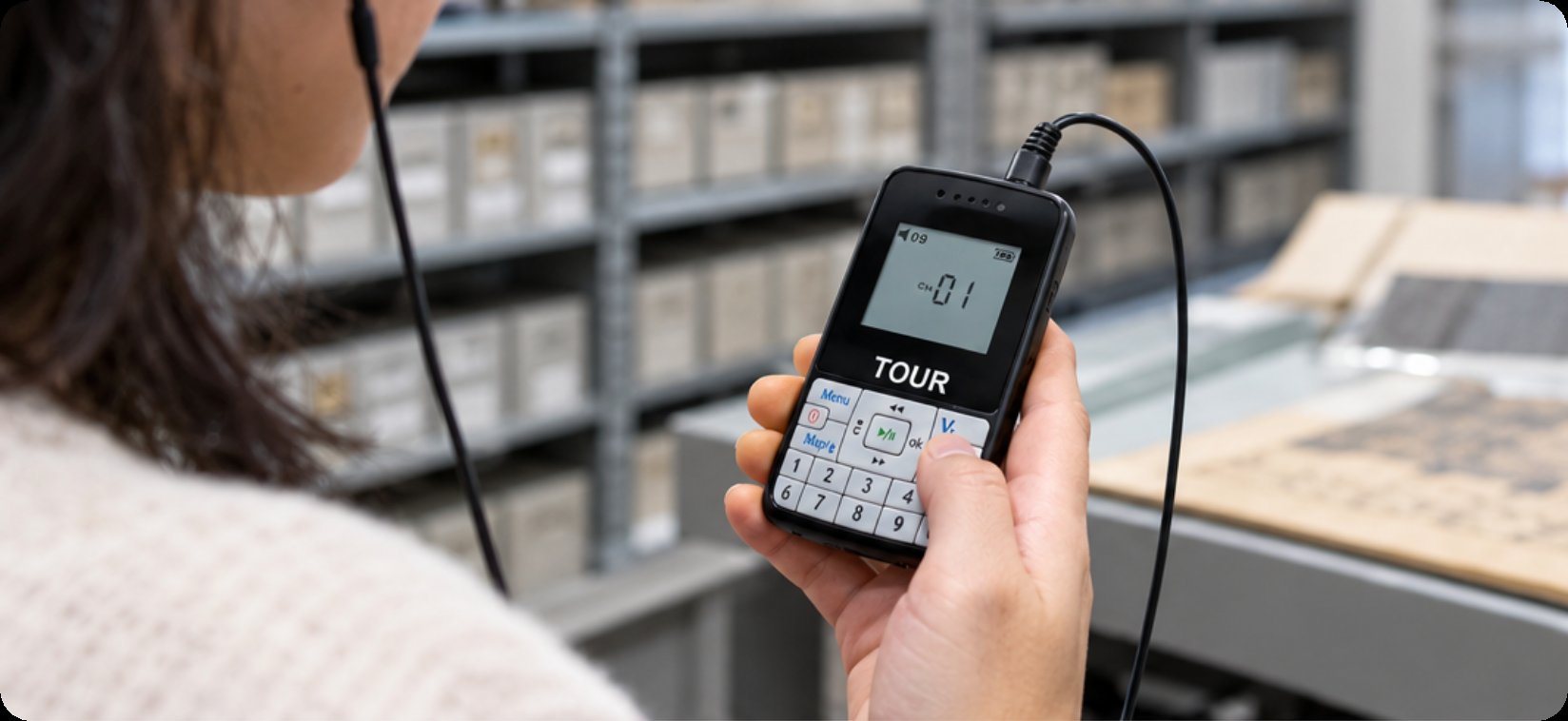
Matriculation week is the hardest single week a campus audio system will ever work, and it is nothing like the museum shifts most purchase arguments are built on. Freshmen arrive in hundreds, nobody knows the geography, every faculty wants to be heard at the same hour, and the equipment has to survive being handed to a teenager who has never held anything more fragile than a phone. The decisions that look settled on a distributor's price list get re-opened in real time on the lawn, in the clubs marquee, and outside the laboratories.
This article follows one European university's intake morning through three venues, each of which asked a different purchasing question and got answered by a different kit from the same 2.4 GHz family: the flagship RC2500, the eighty-channel RC2406, and the standard RC2401. The university had already shortlisted all three from the education audio guide system range; what follows is how the week itself sorted them into roles, because a campus buys one fleet and asks it to do three jobs at once.
One Intake, Three Venues, Three Answers
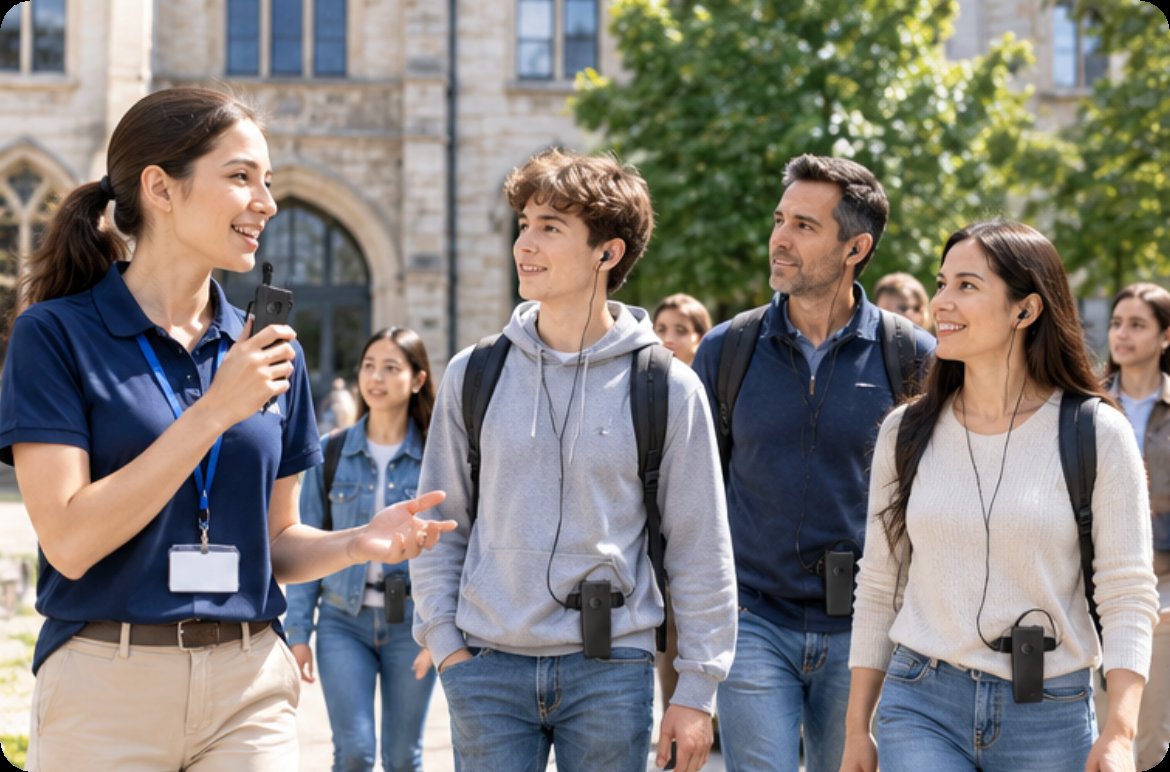
The shape of the week is always the same. A few hundred new students gather on the main lawn for the vice-chancellor's opening speech, where the machine problem is volume and simultaneity: one voice, one very wide crowd, and a second cohort arriving behind the first. Two hours later the same students scatter into the clubs marquee, where a dozen societies pitch simultaneously from adjoining tents and the audio problem becomes one of separation. By afternoon the groups rotate through departmental laboratories in batches of twenty, and the problem flips again: dozens of short, repeating tours, delivered by tutors who are researchers first and speakers second, on a budget that has already been spent twice.
No single specification wins all three. What wins is a fleet that places three strengths where the three pressures land: management features where the crowd is largest, channel capacity where the air is most crowded, and unit economics where the repetition is endless. The university settled it venue by venue, and the logic is worth walking through in the order the morning actually unfolded.
RC2500 at the Opening Lawn: One-Key Sync Before the Dean Speaks
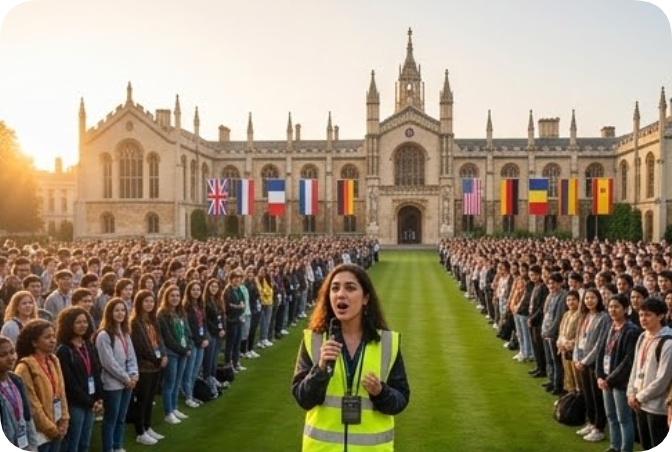
The lawn speech decided the flagship question first: how do three hundred receivers, freshly unboxed the night before, get onto one frequency before the dean finishes his coffee? The RC2500's answer is the one-key sync button — every receiver in the crate follows the transmitter onto the working channel with a single press, and the same button handles fleet shutdown and mute at the end of the hour. The student marshals, who had budgeted ninety minutes for pairing the old mixed fleet, finished the new one in the time it took the chairs to be set out.
The rest of that morning belonged to the RC2500's endurance numbers. The transmitter runs fifteen hours on a 3.7V 1800mAh cell, so the unit charged on Sunday carried the whole opening day without a lunchtime swap, and the receivers' 35-hour-plus standby meant the fleet stayed paired and ready through the entire week between events instead of being re-paired each morning. At 104 grams per unit, both transmitter and receiver are the heaviest of the three kits on test, but on a lanyard over a jacket on a cold September lawn, nobody in the front three rows or the back ten noticed the difference. The Type-C charging port on both units also let the AV office standardise on the same cable bank the university already runs for its tablets.
RC2406 in the Clubs Marquee: Eighty Channels Against Twelve Loud Rooms
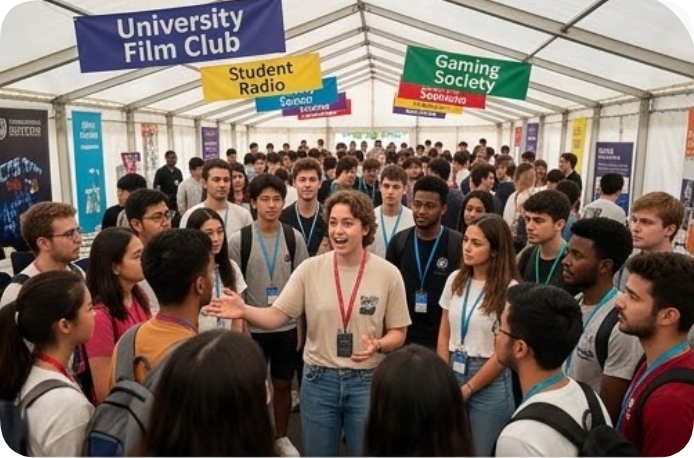
The clubs marquee broke the calm. Twelve societies, each with a megaphone-grade enthusiasm and an adjoining pitch, wanted to present at the same hour, and the year before, three of them had fought over two borrowed frequencies until the geography society presented to the debate club. This year the marquee ran on the RC2406, whose eighty channels on the 2403-2483 MHz band let every society hold its own frequency with room to spare, and the receiver's fifty grams disappeared into a jacket pocket between pitches.
The deeper reason the eighty-channel kit belongs here is interference discipline. A marquee of twelve transmitters at ten milliwatts each is exactly the environment where a fifty-channel fleet starts feeling crowded once guests, staff and security radios are counted in, and the RC2406's extra headroom turned channel allocation from a negotiation into a worksheet. The kit's wide multicolour customisation, arranged in bulk, let each society's ten receivers arrive trimmed in the society's own colour, which cut the end-of-day sort into a glance. Ten-hour transmitter runtime covered the whole fair from a morning charge on the 3.7V 1500mAh cell, and the twenty-hour receiver figure meant the units the students pocketed mid-afternoon still had charge for the evening social.
✅ RC2401 for the Laboratory Carousel: The Standard Kit at Volume
The afternoon laboratory carousel is where budgets break. Forty tours a week, twenty students each, delivered by a rotating cast of PhD tutors — multiply that across a term and the arithmetic demands the cheapest credible hardware, not the best. The university placed the RC2401 here deliberately: it is the family's standard 2.4 GHz edition, fifty channels, ten milliwatts, the same 2403-2483 MHz band as its stablemates, priced for volume. Inside a laboratory, the transmission range on paper runs to two hundred metres but the real rooms are thirty, and the PLL-locked signal never had to fight anything more hostile than a fume hood.
The tutoring staff noticed three practical things. First, at 59 grams for the transmitter and 50 grams for the receiver, this is the lightest full-size kit of the three, which matters when the person wearing it is thinking about a spectrometer and not about a lanyard. Second, the multicolour bulk customisation let each department take its own faculty colour, so a wandering freshman can be returned to the right group without a roll call. Third, the twenty-hour receiver battery and the simple DC-port charging cradle survived being operated by people who will never read a manual, which is the real durability test in a teaching lab.

The Table the Registrar Kept
By Friday the registrar's office had distilled the week into the grid below, which is reproduced here with the figures that decided each row. The three kits share one RF family and one logic: buy the feature the venue demands, not the feature the brochure leads with.
| Dimension | RC2500 (opening lawn) | RC2406 (clubs marquee) | RC2401 (laboratory carousel) |
|---|---|---|---|
| Channels on the 2.4 GHz band | 50 | 80 | 50 |
| Transmitter / receiver runtime | 15 h / 35 h plus standby | 10 h / 20 h | 10 h / 20 h |
| Unit weight (TX / RX) | 104 g / 104 g | 59 g / 50 g | 59 g / 50 g |
| Fleet management | One-key sync, shutdown and mute | Channel headroom for concurrent groups | Standard PLL operation, volume pricing |
| Charging port | Type-C | DC port | DC port |
| Colour options in bulk | Black | Multicolour custom | Multicolour custom |
Which Kit Answers Which Question
Two rows deserve the registrar's pen. The runtime row is why the flagship guards the opening: a transmitter that cannot die mid-speech and receivers that hold their pairing across a whole week remove the two failure modes that embarrass an institution in public. The channel row is why the eighty-channel unit owns the marquee: capacity is only expensive until twelve groups go live at once, at which point it is the cheapest thing in the room.
For campuses planning the same three-venue pattern, the practical sequence is to size the lawn first, the marquee second and the carousel last, because the first two set hard technical floors while the third is a procurement exercise. The full wireless tour guide system range lists the figures for every model in the family, and the standing solutions by scenario pages on this site show how the same three kits are paired to other one-fleet-many-venues buildings.