
A leading China factory specializing in Wireless Tour Guide Systems, Church Audio Guides, and Translation Headphones with premium OEM/ODM solutions.

Tel:+86 18922879583

Email:tiger.wang@richitek.com

RC8860 and RC2406 at a Border Crossing: Where Each Device Earns Its Line in the Visitor Budget

A border crossing is not one venue but three stacked inside a single security perimeter: a joint-inspection building of poured concrete and steel doors, an inspection hall where vehicle checks run bays in parallel, and an open freight yard that stretches past the line of sight. Venue operators who host delegations there — port authority counterparts, customs working groups, logistics partners, ministerial study visits — inherit a hardware question with real money behind it, because every device issued at the perimeter gate has to be counted back in at the end of the day.

The operator whose numbers shape this article runs such a program on two visit days a month and settles its accounts by delegation, not by device. Their fleet pairs the RC8860 Tour Guide Transmitter For Teaching inside the building, the RC2406 80-Channel 2.4G Tour Guide System in the hall, and a third, longer-range system out in the yard. What follows is how each line of that fleet earns its keep, in the only currency the operator tracks: delegations served per issue-and-return cycle, at zero crosstalk, with nothing left at the gate.

The Building, the Hall and the Yard: Three Venues in One Stop

The routing follows the inspection flow, and the flow does not negotiate. Delegations are received in the joint-inspection building's briefing lobby, walk the vehicle inspection hall behind a glazed gallery, then cross the apron to the freight yard where scanning gantries and container stacks mark the last third of the visit. Each third punishes a different weakness in an audio system: reinforced concrete eats higher frequencies, a hall running four vehicle bays runs four competing audio groups, and an open yard makes 200 meters feel short.

The operator's first tender covered all three thirds with one 2.4GHz system, and the delegation feedback singled out the building segment as the weak link — audio that arrives through a steel door frame and a concrete stairwell needs penetration, not just power. That single finding split the fleet into three lines, and the split is where the budget arithmetic in the rest of this article begins.

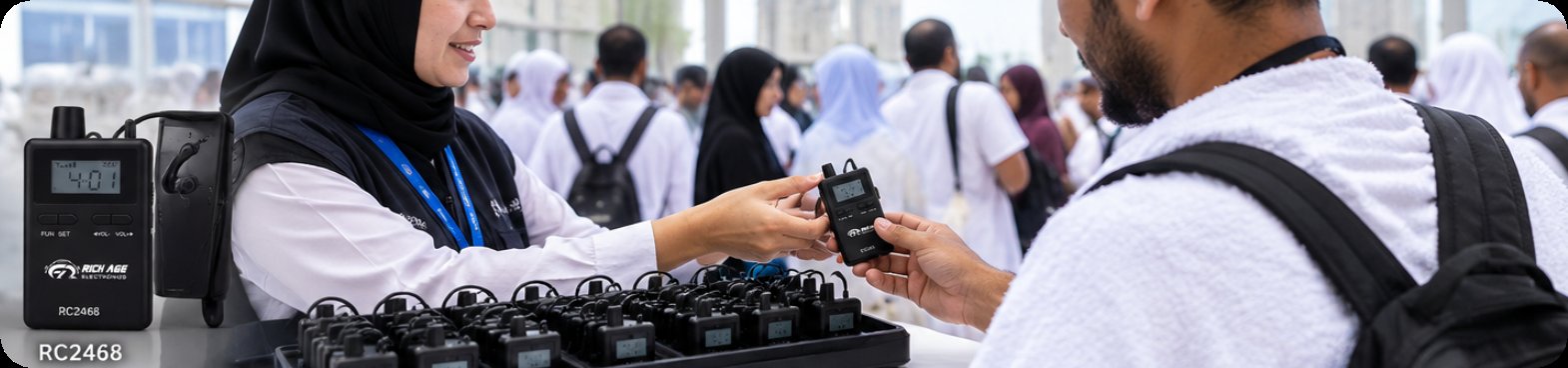
A briefing for a visiting delegation with wireless tour guide receivers in the lobby of a joint-inspection building at a border crossing

The 860-870MHz Band Reads the Building

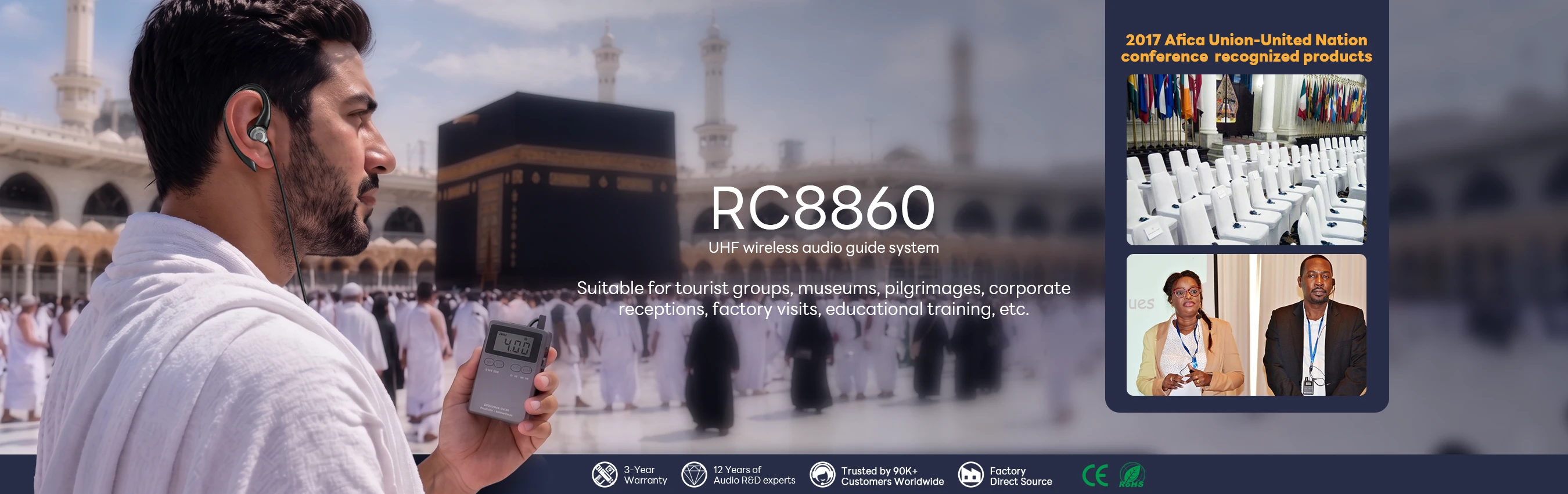
Inside the joint-inspection building, the RC8860 does the work its frequency band was chosen for. The 860-870MHz UHF range penetrates walls, machinery and steel framing far better than the 2.4GHz alternatives, which is precisely the property a concrete briefing lobby with steel doors demands. Its 20 PLL-synthesized channels let the operator run a second delegation's briefing in an adjacent room without a trace of crosstalk, and the 200-meter open-area reach covers the lobby-to-gallery transfer without anyone switching devices.

The carrying side of the fleet favors it too. At 59 grams for the transmitter and 50 grams for the receiver, units clear the perimeter gate in a single carry case, and the receiver's 1000mAh battery runs 20 hours, so a morning issue returns at full charge the next day. The transmitter's 1500mAh cell holds 10 hours. An IPX4 rating covers the apron drizzle that this latitude produces without warning, and the operator's record shows exactly one unit lost across the whole season — recovered, the log notes, behind a scanning gantry.

Eighty Channels Keep the Halls Independent

The vehicle inspection hall is the most concurrent space on the route: four bays can run four separate briefings when a working group wants to see document checks, scanner operation and secondary screening at the same time. The RC2406's 80 PLL anti-interference channels on the 2.4GHz band exist for exactly this arithmetic — four groups on adjacent channel blocks, zero crosstalk, one coordinator issuing and recovering every unit from a single table at the hall door.

Four parallel briefing groups wearing 80-channel wireless tour guide receivers inside a vehicle inspection hall at a border crossing

The delegation count is where this line of the fleet justifies itself financially. On split-hall days the operator serves up to four delegations with one coordinator instead of four guides, and each of the 80 channels is a slot in that equation — the operator books channel blocks the way a hotel books floors. At 50 grams per unit on both transmitter and receiver, with a 1500mAh battery and one-click pairing, the issue-and-return cycle at the hall door runs under six minutes for a forty-person delegation, and the coordinator's log confirms the number across the season.

Five Hundred Meters Across the Open Yard

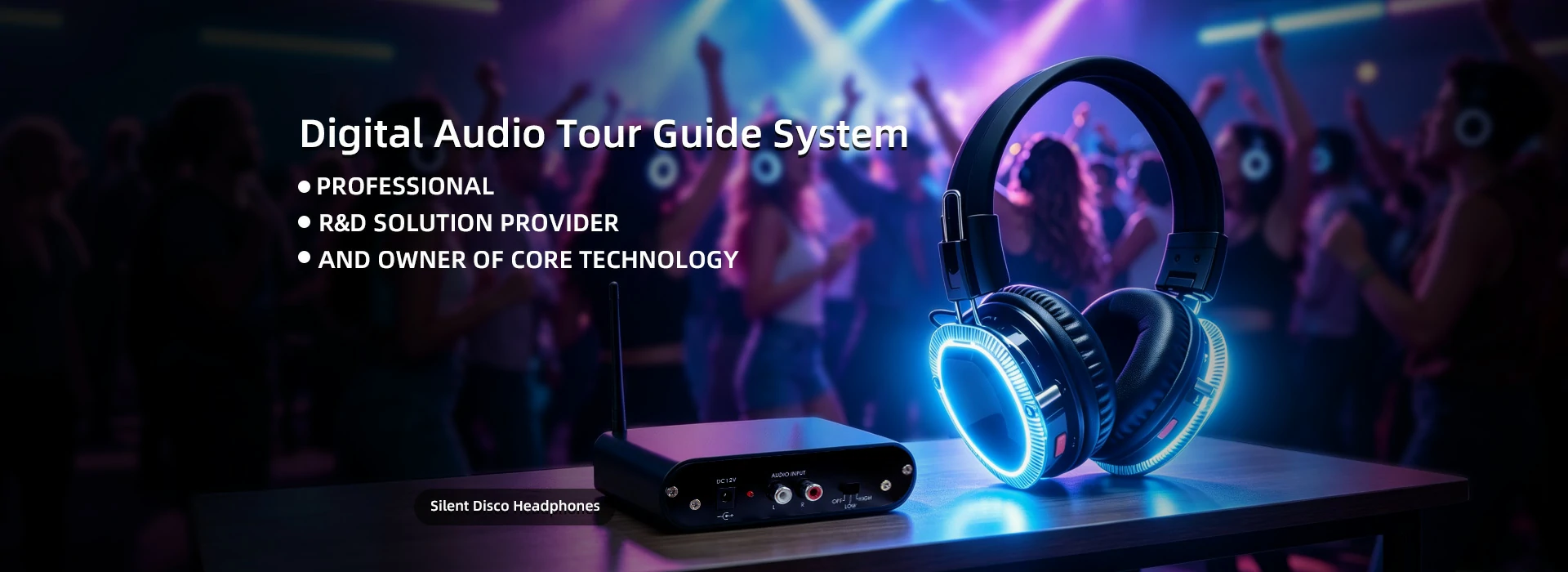
The freight yard defeats anything tuned for rooms. Container stacks, gantry frames and two hundred meters of apron between the hall door and the reefer plug-in bays swallow a 200-meter envelope long before the far corner. The Silent Disco Wireless Headphone System answers with the RC-50RF high-power transmitter: over 500 meters in open areas, through walls and steel, with the ten-channel FM stereo link keeping the signal stable across the whole yard.

The yard segment is broadcast, not dialogue — a single guide narrates the gantry flow while forty sets of RC-409 headphones follow at their own pace, each listener adjusting volume independently through onboard controls. The 40mm Mylar drivers with a 30-20000Hz response and better than 75dB signal-to-noise ratio carry narration over the yard's constant gantry hum, and the five-color LED channel indicators let the coordinator confirm at a glance that every returned headset is on the right channel block for tomorrow's first delegation. A 500mAh battery per headphone runs the 10-hour visit day with 3-hour recharge turnover on the yard's charging tray.

Visitors wearing silent disco headphones follow a guide across the open freight yard of a border crossing past container stacks and scanning gantries

🗺️ The Batch Math Behind the Visitor Season

The operator settles the program in delegation batches, and the three lines of the fleet resolve to the table below. Nothing in it is theoretical: the issue counts come from the perimeter gate log, the coordinator minutes come from the issue-and-return sheet, and the crosstalk column is blank because no incident has ever filled it.

Route segmentDevice on the lineCapacity actually usedCoordinator time per delegation
Joint-inspection building lobby and galleryRC8860, 20 channels on 860-870MHzTwo concurrent briefings, 200m transfer coveredAbout 8 minutes issue-and-return
Vehicle inspection hall, up to four baysRC2406, 80 channels on 2.4GHzFour independent groups, one coordinatorUnder 6 minutes for forty units
Open freight yard past the gantriesSilent Disco, RC-50RF plus RC-409 sets500m-plus broadcast across the full apronTray-based, 10 listeners per minute

Licence-Free Bands, Documented Once

A cross-border venue cannot gamble on spectrum paperwork, and both primary lines of this fleet clear the question permanently. The 860-870MHz band is globally accepted and licence-free in most regions, and the 2.4GHz ISM band needs no licence anywhere — which means the same fleet crosses to the operator's second site in another jurisdiction with no re-permitting, a fact the procurement file records once and never revisits.

The documentation that does matter is internal: the gate log ties every serial number to a delegation, the charging tray log ties every battery to a shift, and the annual review ties both to the budget line. The operator's auditor asked for exactly those three artefacts at the last review, found them complete, and closed the file in an afternoon. Devices that need spectrum licences would have added a fourth artefact the site has no staff to maintain.

What the First Season Teaches the Procurement File

Twelve months and twenty-four visit days settled three procurement questions the original tender had left open. The building line never needed a second RC8860 transmitter — twenty channels absorbed every overlapping-briefing request, so the expansion budget moved to headphone sets instead. The hall line absorbed its peak, four bays on one afternoon, without reaching a third of its channel capacity. And the yard line, the only one purchased as an experiment, became permanent after a single afternoon when a ministerial delegation watched forty visitors spread across the full apron and hear every word over the gantries.

The operator's closing note for peers is short: buy penetration for the concrete, buy channels for the hall, buy range for the yard, and settle the fleet in delegation batches rather than device counts — then let the explore our solutions desk pressure-test the plan against venues of the same size. For teams assembling a comparable program, the wireless tour guide system platform behind all three lines shares one charging discipline, and the simultaneous interpretation system page details how multilingual relays extend the same fleet when delegations bring their own interpreters.

Frequently Asked Questions

1. Can one fleet really cover concrete interiors, a busy hall and an open yard without gaps?

Only if the fleet is split by segment, the way this operator split it. A single 2.4GHz system that works in the hall loses clarity inside reinforced concrete and loses range across an open apron, so the three demands are satisfied by three different properties: UHF penetration in the building, channel count in the hall, and transmitter power in the yard. Matching the property to the segment is what keeps the delegation feedback sheet free of audio complaints.

2. How do multiple delegations avoid hearing each other in the same building?

Through channel separation, not scheduling. The RC8860's twenty PLL-synthesized channels hold two concurrent briefings in adjacent rooms with no crosstalk, and the RC2406's eighty channels carry the same principle further in the hall, where up to four groups run on independent channel blocks at once. Coordinators book channel blocks in advance the way a venue books rooms, which removes frequency negotiation from the arrival routine entirely.

3. What happens when a delegation arrives without its own interpreters?

The multilingual relay runs on the same fleet. The interpretation-system configuration feeds a translated channel to visitors who need it while the main channel continues in the working language, so a mixed delegation shares one route and one timing with no second guide. The operator treats interpretation as a channel allocation rather than a hardware purchase, which is why the fleet count has not changed since the first season.

4. How is equipment accounted for at a security perimeter?

By serial number against the gate log, every issue and every return. Units travel in closed carry cases, the coordinator signs the case out and back in, and the charging tray log closes the loop overnight. Across the season described here the loss count was zero — the single missing receiver was recovered behind a scanning gantry the same day, which is the kind of outcome a signed case list produces and an unsupervised handout does not.


2026年10月22日 10:42
ꄘ click: 34

Get the spec sheet, MOQ and a factory-direct quote

Tell us the venue, the group size and how many languages you need. An engineer at our Shenzhen factory replies within one business day with the matching model, a written quote, lead time and the CE / RoHS / ISO 9001 documents.

Talk to an engineer WhatsApp +86 189 2287 9583

Prefer email? tiger.wang@richitek.com  |  OEM / ODM, custom tooling and neutral packaging available  |  send the enquiry through our contact page

Shenzhen Rich Age Electronics Co., Ltd. (Richitek) - manufacturing wireless tour guide systems, church translation headsets and museum audio guide equipment since 2007.

no data

RC8860 and RC2406 at a Border Crossing: Where Each Device Earns Its Line in the Visitor Budget

time: 2026年10月22日 click:34

A border crossing is not one venue but three stacked inside a single security perimeter: a joint-inspection building of poured concrete and steel doors, an inspection hall where vehicle checks run bays in parallel, and an open freight yard that stretches past the line of sight. Venue operators who host delegations there — port authority counterparts, customs working groups, logistics partners, ministerial study visits — inherit a hardware question with real money behind it, because every device issued at the perimeter gate has to be counted back in at the end of the day.

The operator whose numbers shape this article runs such a program on two visit days a month and settles its accounts by delegation, not by device. Their fleet pairs the RC8860 Tour Guide Transmitter For Teaching inside the building, the RC2406 80-Channel 2.4G Tour Guide System in the hall, and a third, longer-range system out in the yard. What follows is how each line of that fleet earns its keep, in the only currency the operator tracks: delegations served per issue-and-return cycle, at zero crosstalk, with nothing left at the gate.

The Building, the Hall and the Yard: Three Venues in One Stop

The routing follows the inspection flow, and the flow does not negotiate. Delegations are received in the joint-inspection building's briefing lobby, walk the vehicle inspection hall behind a glazed gallery, then cross the apron to the freight yard where scanning gantries and container stacks mark the last third of the visit. Each third punishes a different weakness in an audio system: reinforced concrete eats higher frequencies, a hall running four vehicle bays runs four competing audio groups, and an open yard makes 200 meters feel short.

The operator's first tender covered all three thirds with one 2.4GHz system, and the delegation feedback singled out the building segment as the weak link — audio that arrives through a steel door frame and a concrete stairwell needs penetration, not just power. That single finding split the fleet into three lines, and the split is where the budget arithmetic in the rest of this article begins.

A briefing for a visiting delegation with wireless tour guide receivers in the lobby of a joint-inspection building at a border crossing

The 860-870MHz Band Reads the Building

Inside the joint-inspection building, the RC8860 does the work its frequency band was chosen for. The 860-870MHz UHF range penetrates walls, machinery and steel framing far better than the 2.4GHz alternatives, which is precisely the property a concrete briefing lobby with steel doors demands. Its 20 PLL-synthesized channels let the operator run a second delegation's briefing in an adjacent room without a trace of crosstalk, and the 200-meter open-area reach covers the lobby-to-gallery transfer without anyone switching devices.

The carrying side of the fleet favors it too. At 59 grams for the transmitter and 50 grams for the receiver, units clear the perimeter gate in a single carry case, and the receiver's 1000mAh battery runs 20 hours, so a morning issue returns at full charge the next day. The transmitter's 1500mAh cell holds 10 hours. An IPX4 rating covers the apron drizzle that this latitude produces without warning, and the operator's record shows exactly one unit lost across the whole season — recovered, the log notes, behind a scanning gantry.

Eighty Channels Keep the Halls Independent

The vehicle inspection hall is the most concurrent space on the route: four bays can run four separate briefings when a working group wants to see document checks, scanner operation and secondary screening at the same time. The RC2406's 80 PLL anti-interference channels on the 2.4GHz band exist for exactly this arithmetic — four groups on adjacent channel blocks, zero crosstalk, one coordinator issuing and recovering every unit from a single table at the hall door.

Four parallel briefing groups wearing 80-channel wireless tour guide receivers inside a vehicle inspection hall at a border crossing

The delegation count is where this line of the fleet justifies itself financially. On split-hall days the operator serves up to four delegations with one coordinator instead of four guides, and each of the 80 channels is a slot in that equation — the operator books channel blocks the way a hotel books floors. At 50 grams per unit on both transmitter and receiver, with a 1500mAh battery and one-click pairing, the issue-and-return cycle at the hall door runs under six minutes for a forty-person delegation, and the coordinator's log confirms the number across the season.

Five Hundred Meters Across the Open Yard

The freight yard defeats anything tuned for rooms. Container stacks, gantry frames and two hundred meters of apron between the hall door and the reefer plug-in bays swallow a 200-meter envelope long before the far corner. The Silent Disco Wireless Headphone System answers with the RC-50RF high-power transmitter: over 500 meters in open areas, through walls and steel, with the ten-channel FM stereo link keeping the signal stable across the whole yard.

The yard segment is broadcast, not dialogue — a single guide narrates the gantry flow while forty sets of RC-409 headphones follow at their own pace, each listener adjusting volume independently through onboard controls. The 40mm Mylar drivers with a 30-20000Hz response and better than 75dB signal-to-noise ratio carry narration over the yard's constant gantry hum, and the five-color LED channel indicators let the coordinator confirm at a glance that every returned headset is on the right channel block for tomorrow's first delegation. A 500mAh battery per headphone runs the 10-hour visit day with 3-hour recharge turnover on the yard's charging tray.

Visitors wearing silent disco headphones follow a guide across the open freight yard of a border crossing past container stacks and scanning gantries

🗺️ The Batch Math Behind the Visitor Season

The operator settles the program in delegation batches, and the three lines of the fleet resolve to the table below. Nothing in it is theoretical: the issue counts come from the perimeter gate log, the coordinator minutes come from the issue-and-return sheet, and the crosstalk column is blank because no incident has ever filled it.

Route segmentDevice on the lineCapacity actually usedCoordinator time per delegation
Joint-inspection building lobby and galleryRC8860, 20 channels on 860-870MHzTwo concurrent briefings, 200m transfer coveredAbout 8 minutes issue-and-return
Vehicle inspection hall, up to four baysRC2406, 80 channels on 2.4GHzFour independent groups, one coordinatorUnder 6 minutes for forty units
Open freight yard past the gantriesSilent Disco, RC-50RF plus RC-409 sets500m-plus broadcast across the full apronTray-based, 10 listeners per minute

Licence-Free Bands, Documented Once

A cross-border venue cannot gamble on spectrum paperwork, and both primary lines of this fleet clear the question permanently. The 860-870MHz band is globally accepted and licence-free in most regions, and the 2.4GHz ISM band needs no licence anywhere — which means the same fleet crosses to the operator's second site in another jurisdiction with no re-permitting, a fact the procurement file records once and never revisits.

The documentation that does matter is internal: the gate log ties every serial number to a delegation, the charging tray log ties every battery to a shift, and the annual review ties both to the budget line. The operator's auditor asked for exactly those three artefacts at the last review, found them complete, and closed the file in an afternoon. Devices that need spectrum licences would have added a fourth artefact the site has no staff to maintain.

What the First Season Teaches the Procurement File

Twelve months and twenty-four visit days settled three procurement questions the original tender had left open. The building line never needed a second RC8860 transmitter — twenty channels absorbed every overlapping-briefing request, so the expansion budget moved to headphone sets instead. The hall line absorbed its peak, four bays on one afternoon, without reaching a third of its channel capacity. And the yard line, the only one purchased as an experiment, became permanent after a single afternoon when a ministerial delegation watched forty visitors spread across the full apron and hear every word over the gantries.

The operator's closing note for peers is short: buy penetration for the concrete, buy channels for the hall, buy range for the yard, and settle the fleet in delegation batches rather than device counts — then let the explore our solutions desk pressure-test the plan against venues of the same size. For teams assembling a comparable program, the wireless tour guide system platform behind all three lines shares one charging discipline, and the simultaneous interpretation system page details how multilingual relays extend the same fleet when delegations bring their own interpreters.
Frequently Asked Questions

1. Can one fleet really cover concrete interiors, a busy hall and an open yard without gaps?

Only if the fleet is split by segment, the way this operator split it. A single 2.4GHz system that works in the hall loses clarity inside reinforced concrete and loses range across an open apron, so the three demands are satisfied by three different properties: UHF penetration in the building, channel count in the hall, and transmitter power in the yard. Matching the property to the segment is what keeps the delegation feedback sheet free of audio complaints.

2. How do multiple delegations avoid hearing each other in the same building?

Through channel separation, not scheduling. The RC8860's twenty PLL-synthesized channels hold two concurrent briefings in adjacent rooms with no crosstalk, and the RC2406's eighty channels carry the same principle further in the hall, where up to four groups run on independent channel blocks at once. Coordinators book channel blocks in advance the way a venue books rooms, which removes frequency negotiation from the arrival routine entirely.

3. What happens when a delegation arrives without its own interpreters?

The multilingual relay runs on the same fleet. The interpretation-system configuration feeds a translated channel to visitors who need it while the main channel continues in the working language, so a mixed delegation shares one route and one timing with no second guide. The operator treats interpretation as a channel allocation rather than a hardware purchase, which is why the fleet count has not changed since the first season.

4. How is equipment accounted for at a security perimeter?

By serial number against the gate log, every issue and every return. Units travel in closed carry cases, the coordinator signs the case out and back in, and the charging tray log closes the loop overnight. Across the season described here the loss count was zero — the single missing receiver was recovered behind a scanning gantry the same day, which is the kind of outcome a signed case list produces and an unsupervised handout does not.


Get the spec sheet, MOQ and a factory-direct quote

Tell us the venue, the group size and how many languages you need. An engineer at our Shenzhen factory replies within one business day with the matching model, a written quote, lead time and the CE / RoHS / ISO 9001 documents.

Talk to an engineer WhatsApp +86 189 2287 9583

Prefer email? tiger.wang@richitek.com  |  OEM / ODM, custom tooling and neutral packaging available  |  send the enquiry through our contact page

Shenzhen Rich Age Electronics Co., Ltd. (Richitek) - manufacturing wireless tour guide systems, church translation headsets and museum audio guide equipment since 2007.

no data
×

Contact us

email:
name:
subject:
content: