
A leading China factory specializing in Wireless Tour Guide Systems, Church Audio Guides, and Translation Headphones with premium OEM/ODM solutions.

Tel:+86 18922879583

Email:tiger.wang@richitek.com

RC2402, RC9150 and a Silent Disco Kit: Maintenance That Follows the Garment

Every pilgrimage operator running Hajj and Umrah packages eventually learns the same lesson: the maintenance manual written in the office stops working the moment the group lands in Jeddah. The garment every pilgrim wears during the rites has no sewn pockets, no belt loops and no place to clip anything, so each unit spends its working life wrapped inside a cloth bundle, hung against the chest or handed from one shoulder to another. Hajj and Umrah audio guide kits therefore wear out in places no product page thinks to mention, and the maintenance round has to be written around that reality.

This article walks through that round with three kits that sit on the same rental shelf: the RC2402 wireless tour guide system as the volume baseline, the RC9150 as the long-standby unit for multi-day programmes, and a Silent Disco headphone kit pressed into service where groups need channels that survive a loud courtyard. None of the numbers below are laboratory claims; they come from the published specification sheets and from what actually breaks when two hundred receivers travel through five days of rites.

🔧 Why the Garment Rewrites the Maintenance Round

A standard maintenance schedule is organized around hours of use and exposure to weather. The pilgrimage schedule has to be organized around handling, because handling is the dominant stress. A receiver that never leaves a chest wrap still gets pressed, squeezed and re-tied several times a day; a headphone that survives the morning crowd gets folded by someone else in the evening. When the garment removes every pocket and clip point, the crew inherits three carrying states, and each state attacks a different part of the unit.

The practical consequence is a reversed inspection order. Where a museum rental checks battery health first and cosmetics last, a pilgrimage round checks the points that touch fabric and skin first, because those are the ones that fail by Friday even when the electronics are perfect. The three sections that follow take the three states in the order the crew actually walks them.

Wrapped, Hung or Handed Over: Three Units, Three Habits

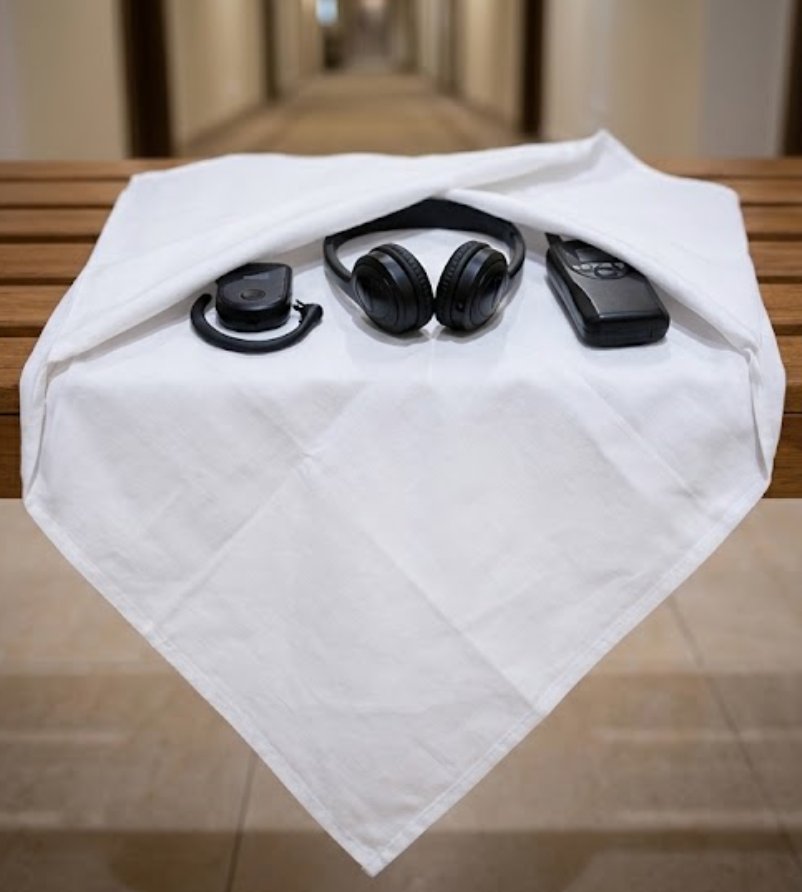
The wrapped state is the gentlest but the least inspected. Receivers tucked inside a knotted cloth rub against the knot, not the air, so the abrasion shows up on the earpiece loop and the seam of the body clip. On the RC2402 wireless tour guide system, whose receiver weighs about 50 g and hangs on a comfortable earpiece, that loop is the first thing the crew flexes at the morning count; a loop that has gone white from friction is scheduled for replacement that evening, not next week. The transmitter side tells its own story: at 59 g with a 10 hour operating window, it changes hands between guides several times a day, and the crew treats the belt clip as a consumable.
Three audio guide units wrapped in a white cloth bundle on a wooden bench

The hung state belongs to heavier hardware. Anything approaching 100 g cannot live on an earhook, so it travels on a cord against the sternum, swinging with every step. The handed-over state is the harshest: units passed shoulder to shoulder through a crowd pick up drops, twists and the occasional yank that no specification covers. Crews that separate the three states on the checklist catch failures at the tie-off point instead of at the gate.

Where Sweat Pools Inside a Cushion

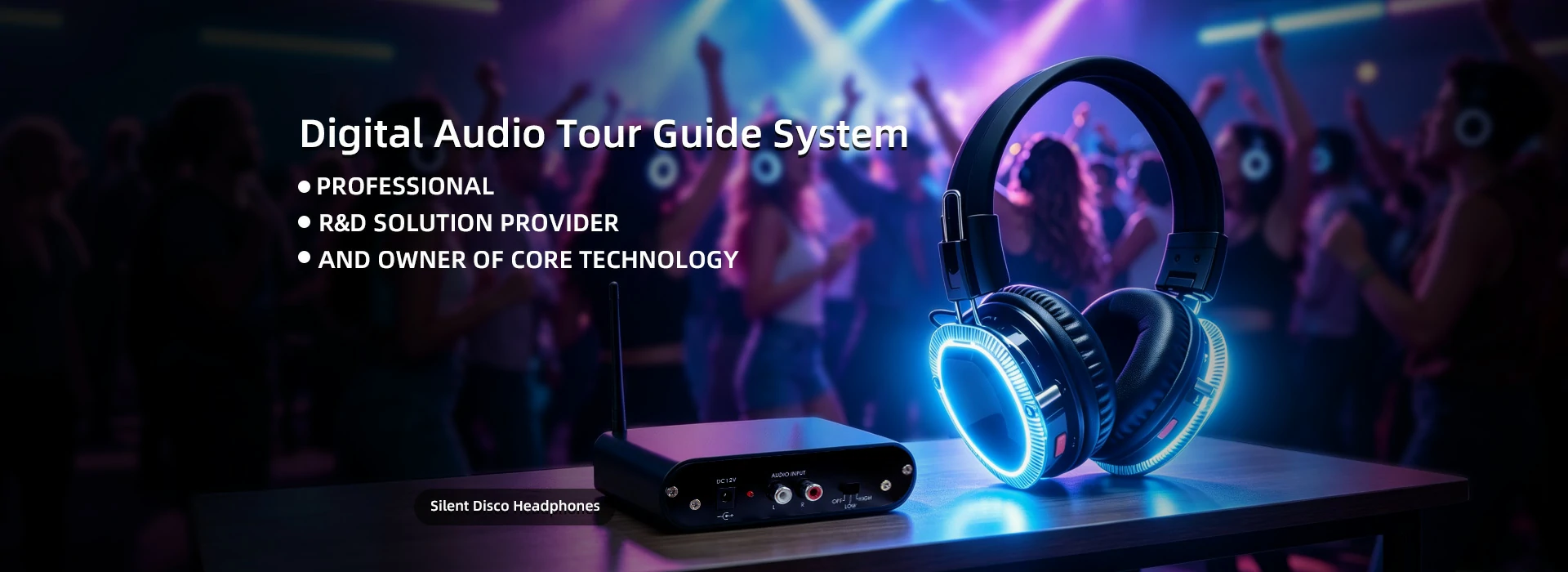
Headphones collect what earhooks escape. The Silent Disco kit pairs RC-409 headphones with an RC-50RF transmitter, and each headphone carries 40 mm Mylar drivers behind a foam cushion that sits flush against the ear through hours of heat. Silent Disco headphone systems publish an SNR above 75 dB and distortion under 1%, but no specification sheet will tell you how quickly a shared cushion compresses; in peak-season rotation the crew swaps foam well before the acoustic seal audibly changes, because by the time a guest complains the cushion has already been flat for days.

The cleaning routine that survived contact with reality is deliberately boring: cushions wiped with a mildly damp cloth at midday, a proper alcohol-based wipe at the evening count, and a full cushion rotation between groups rather than a spot clean. Each headphone has its own volume knob and power switch, so the crew also walks the knobs during the same pass; a knob that has lost its click is logged at the same inspection as the cushion, because both fail gradually and both are invisible from two metres away.

🔋 One Power Strip, Three Different Plugs

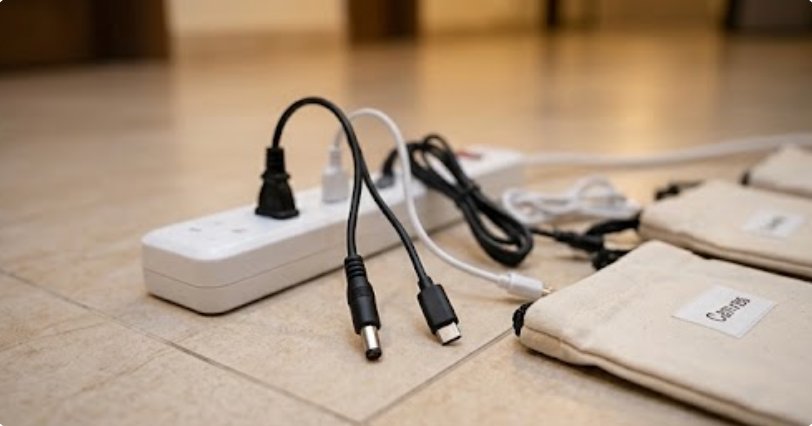
Charging is where the three kits stop being interchangeable. The RC9150 audio guide system charges over Type-C and runs a 3.7 V 1800 mAh cell on both transmitter and receiver, with receiver standby quoted at 35 hours and up, so a single overnight bank covers a two-day programme with margin. The RC2402 charges through a DC barrel plug, which means the crew bags its adapters separately, because a lost barrel adapter idles a transmitter no matter how healthy its 1500 mAh cell is. The Silent Disco headphones take a Micro USB port and a 500 mAh battery: ten hours of run time but only three hours to a full charge, which makes them the only kit in the room that can be revived mid-afternoon.
Three charging cable types plugged into one power strip on a hotel floor

The strip discipline that works is physical, not electronic: three labelled bags, one per plug family, and the strip loaded so the three-hour kit goes last. Mixing the plugs into one unsorted bag is how a barrel adapter ends up in Medina while the transmitter waits in Makkah, and that mistake costs a full day, not a spare part.

🔍 The Knob and the Grille Fail Before the Battery Does

Battery life is the specification everyone checks and the failure nobody sees. Across a season of rental rotation, the parts that actually send units back to the shelf are the small mechanical ones: the volume knob that stops clicking, the grille over the transmitter microphone that packs solid, the fold hinge on a headphone that loosens until the band no longer clamps. The RC-50RF transmitter is metal-cased, which protects the electronics inside but gives nothing to the mesh in front of the microphone, and a grille packed with cloth fibres quietly thins the voice long before anyone reports a fault.

So the round assigns these parts their own line items with their own cadence. Knobs are exercised on every unit at the weekly count. Grilles are brushed, not washed, because moisture wicks into the capsule behind them. Fold hinges on the Silent Disco headphones are opened and closed five times at inspection, and any unit whose hinge creaks is retired from the front line into the spare pool. None of this appears on a specification sheet, and all of it decides whether a 10 hour battery figure ever gets used.

What the Specification Sheet Cannot Tell You

The published numbers below are the ones the crew can actually plan a maintenance calendar around. Everything the sheets leave out, from cushion compression to hinge wear, has to be earned on the shelf, which is why the table sits next to the round instead of replacing it.

ItemRC2402RC9150Silent Disco Kit
Frequency band2403 to 2483 MHz (2.4G ISM)2403 to 2483 MHz (2.4G ISM)UHF/RF stereo FM
Channels5010010, five-colour LED indicators
Battery run timeTransmitter 10 h, receiver 20 hTransmitter 15 h, receiver standby 35 h and up10 h per charge, 3 h recharge
Battery capacityTransmitter 1500 mAh, receiver 1000 mAh1800 mAh at both ends500 mAh built-in
Charging portDC barrelType-CMicro USB

Two omissions matter to a maintenance planner. Neither the RC2402 nor the RC9150 publishes a unit weight beyond the transmitter and receiver figures already quoted, so hanging hardware is planned from handling trials rather than the sheet. And the warranty both RC models publish, three years on the mainboard, explicitly excludes the parts this article has been about: the headset, the microphone and the battery are all listed as vulnerable parts outside coverage, which is exactly why the crew inspects them on its own schedule instead of trusting the factory's.

The wireless tour guide system line-up page keeps the full specification set for both RC units, and the certifications they carry, CE, EMC, LVD, RED and RoHS, matter to a different kind of planning: they are what let the same kit cross borders with a group instead of being replaced halfway through a season.

Counting Units Back at the Return Desk

The return desk is where maintenance either starts or gets skipped. A ten-second functional test per unit at hand-back, power on, channel light lit, knob turning, catches the majority of damage while the guest is still reachable, and it converts the evening from a pile of unknowns into a short repair list. On the Silent Disco headphones the five-colour LED does half the work: a quick glance down the tray shows which units powered off cleanly and which were switched off by draining their batteries, and the second group gets a recharge before the first group's complaints arrive.
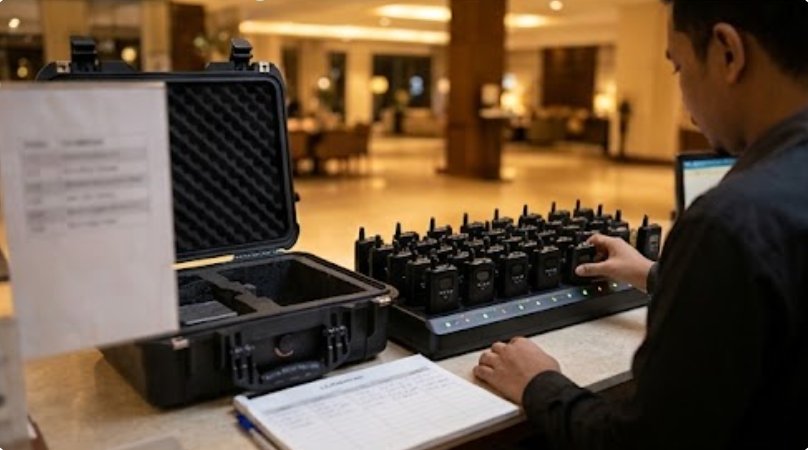
A crew member counting audio guide units back into a labelled case at a return desk

The count itself is physical. Units are tallied against the issue sheet in the same sub-groups they left in, wrapped bundles separately from hung units, because mixing them at the desk is how a loose receiver survives in a cloth fold until the next package finds it. A unit that fails the ten-second test goes into the red tray, not back on the shelf, and the red tray is emptied before the strip is loaded, not after.

The Reset That Sends the Kit Back Out Ready

Between bookings, the crew runs one consolidated reset rather than piecemeal fixes: cushions rotated, knobs exercised, grilles brushed, plug bags repacked against a photo of the correct contents, and every battery bank topped from empty rather than half-full. The reset takes one technician one afternoon for a hundred-and-twenty-unit shelf, and it is the difference between a kit that starts a package at full strength and one that spends the first morning catching up with itself. Operators who want to see how these routines map onto other routes and venues can browse the deployment solutions collected from other programmes.

The last habit is documentation. A single page per kit, updated at every reset, recording which cushions were swapped and which units were demoted to the spare pool, turns next season's quotation into arithmetic instead of guesswork. The garment writes the wear pattern; the ledger decides whether the same three kits come back for another season or quietly become someone else's spare parts.


Frequently Asked Questions

1. Can one power strip safely charge all three systems overnight?

In practice yes, but only with the loads staggered. The Silent Disco headphones are the light load at 500 mAh and finish in three hours on Micro USB, while the RC9150's 1800 mAh cells want the whole night on Type-C. The crew loads the barrel-plug and Type-C bags first and puts the Micro USB bag on last, which also keeps the three plug families from being mixed in one unsorted drawer.

2. What does the three-year warranty actually cover on the RC units?

Both the RC2402 and the RC9150 publish a three-year warranty on the mainboard. The product pages state plainly that headset, microphone and battery are excluded as vulnerable parts. That is the opposite of a maintenance-free promise: it tells the crew exactly which components to stock as spares, because those are the ones the factory will not replace for free.

3. How do you keep ten FM channels from drifting onto another operator's frequency?

Discipline at hand-back, not technology. Each Silent Disco headphone shows its channel on a five-colour LED, so the evening count includes a colour check: any unit whose light does not match its assigned channel goes to the red tray for a re-pair, and the transmitter is re-synced before the next booking rather than trusted from memory.

4. Is the 500 metre high-power mode on the RC-50RF transmitter a maintenance liability?

The transmitter is metal-cased and the high-power mode, quoted above 500 metres with wall penetration, is a selectable setting rather than a constant state. The crew runs the low-power 200 metre mode indoors and reserves high-power for open courtyards, which keeps transmit duty cycles short and leaves more margin on the 500 mAh receiver batteries that cannot be swapped mid-event.


2026年10月22日 12:46
ꄘ click: 12

Get the spec sheet, MOQ and a factory-direct quote

Tell us the venue, the group size and how many languages you need. An engineer at our Shenzhen factory replies within one business day with the matching model, a written quote, lead time and the CE / RoHS / ISO 9001 documents.

Talk to an engineer WhatsApp +86 189 2287 9583

Prefer email? tiger.wang@richitek.com  |  OEM / ODM, custom tooling and neutral packaging available  |  send the enquiry through our contact page

Shenzhen Rich Age Electronics Co., Ltd. (Richitek) - manufacturing wireless tour guide systems, church translation headsets and museum audio guide equipment since 2007.

no data

RC2402, RC9150 and a Silent Disco Kit: Maintenance That Follows the Garment

time: 2026年10月22日 click:12

Every pilgrimage operator running Hajj and Umrah packages eventually learns the same lesson: the maintenance manual written in the office stops working the moment the group lands in Jeddah. The garment every pilgrim wears during the rites has no sewn pockets, no belt loops and no place to clip anything, so each unit spends its working life wrapped inside a cloth bundle, hung against the chest or handed from one shoulder to another. Hajj and Umrah audio guide kits therefore wear out in places no product page thinks to mention, and the maintenance round has to be written around that reality.

This article walks through that round with three kits that sit on the same rental shelf: the RC2402 wireless tour guide system as the volume baseline, the RC9150 as the long-standby unit for multi-day programmes, and a Silent Disco headphone kit pressed into service where groups need channels that survive a loud courtyard. None of the numbers below are laboratory claims; they come from the published specification sheets and from what actually breaks when two hundred receivers travel through five days of rites.

🔧 Why the Garment Rewrites the Maintenance Round

A standard maintenance schedule is organized around hours of use and exposure to weather. The pilgrimage schedule has to be organized around handling, because handling is the dominant stress. A receiver that never leaves a chest wrap still gets pressed, squeezed and re-tied several times a day; a headphone that survives the morning crowd gets folded by someone else in the evening. When the garment removes every pocket and clip point, the crew inherits three carrying states, and each state attacks a different part of the unit.

The practical consequence is a reversed inspection order. Where a museum rental checks battery health first and cosmetics last, a pilgrimage round checks the points that touch fabric and skin first, because those are the ones that fail by Friday even when the electronics are perfect. The three sections that follow take the three states in the order the crew actually walks them.

Wrapped, Hung or Handed Over: Three Units, Three Habits

The wrapped state is the gentlest but the least inspected. Receivers tucked inside a knotted cloth rub against the knot, not the air, so the abrasion shows up on the earpiece loop and the seam of the body clip. On the RC2402 wireless tour guide system, whose receiver weighs about 50 g and hangs on a comfortable earpiece, that loop is the first thing the crew flexes at the morning count; a loop that has gone white from friction is scheduled for replacement that evening, not next week. The transmitter side tells its own story: at 59 g with a 10 hour operating window, it changes hands between guides several times a day, and the crew treats the belt clip as a consumable.

Three audio guide units wrapped in a white cloth bundle on a wooden bench

The hung state belongs to heavier hardware. Anything approaching 100 g cannot live on an earhook, so it travels on a cord against the sternum, swinging with every step. The handed-over state is the harshest: units passed shoulder to shoulder through a crowd pick up drops, twists and the occasional yank that no specification covers. Crews that separate the three states on the checklist catch failures at the tie-off point instead of at the gate.

Where Sweat Pools Inside a Cushion

Headphones collect what earhooks escape. The Silent Disco kit pairs RC-409 headphones with an RC-50RF transmitter, and each headphone carries 40 mm Mylar drivers behind a foam cushion that sits flush against the ear through hours of heat. Silent Disco headphone systems publish an SNR above 75 dB and distortion under 1%, but no specification sheet will tell you how quickly a shared cushion compresses; in peak-season rotation the crew swaps foam well before the acoustic seal audibly changes, because by the time a guest complains the cushion has already been flat for days.

The cleaning routine that survived contact with reality is deliberately boring: cushions wiped with a mildly damp cloth at midday, a proper alcohol-based wipe at the evening count, and a full cushion rotation between groups rather than a spot clean. Each headphone has its own volume knob and power switch, so the crew also walks the knobs during the same pass; a knob that has lost its click is logged at the same inspection as the cushion, because both fail gradually and both are invisible from two metres away.

🔋 One Power Strip, Three Different Plugs

Charging is where the three kits stop being interchangeable. The RC9150 audio guide system charges over Type-C and runs a 3.7 V 1800 mAh cell on both transmitter and receiver, with receiver standby quoted at 35 hours and up, so a single overnight bank covers a two-day programme with margin. The RC2402 charges through a DC barrel plug, which means the crew bags its adapters separately, because a lost barrel adapter idles a transmitter no matter how healthy its 1500 mAh cell is. The Silent Disco headphones take a Micro USB port and a 500 mAh battery: ten hours of run time but only three hours to a full charge, which makes them the only kit in the room that can be revived mid-afternoon.

Three charging cable types plugged into one power strip on a hotel floor

The strip discipline that works is physical, not electronic: three labelled bags, one per plug family, and the strip loaded so the three-hour kit goes last. Mixing the plugs into one unsorted bag is how a barrel adapter ends up in Medina while the transmitter waits in Makkah, and that mistake costs a full day, not a spare part.

🔍 The Knob and the Grille Fail Before the Battery Does

Battery life is the specification everyone checks and the failure nobody sees. Across a season of rental rotation, the parts that actually send units back to the shelf are the small mechanical ones: the volume knob that stops clicking, the grille over the transmitter microphone that packs solid, the fold hinge on a headphone that loosens until the band no longer clamps. The RC-50RF transmitter is metal-cased, which protects the electronics inside but gives nothing to the mesh in front of the microphone, and a grille packed with cloth fibres quietly thins the voice long before anyone reports a fault.

So the round assigns these parts their own line items with their own cadence. Knobs are exercised on every unit at the weekly count. Grilles are brushed, not washed, because moisture wicks into the capsule behind them. Fold hinges on the Silent Disco headphones are opened and closed five times at inspection, and any unit whose hinge creaks is retired from the front line into the spare pool. None of this appears on a specification sheet, and all of it decides whether a 10 hour battery figure ever gets used.

What the Specification Sheet Cannot Tell You

The published numbers below are the ones the crew can actually plan a maintenance calendar around. Everything the sheets leave out, from cushion compression to hinge wear, has to be earned on the shelf, which is why the table sits next to the round instead of replacing it.

ItemRC2402RC9150Silent Disco Kit
Frequency band2403 to 2483 MHz (2.4G ISM)2403 to 2483 MHz (2.4G ISM)UHF/RF stereo FM
Channels5010010, five-colour LED indicators
Battery run timeTransmitter 10 h, receiver 20 hTransmitter 15 h, receiver standby 35 h and up10 h per charge, 3 h recharge
Battery capacityTransmitter 1500 mAh, receiver 1000 mAh1800 mAh at both ends500 mAh built-in
Charging portDC barrelType-CMicro USB

Two omissions matter to a maintenance planner. Neither the RC2402 nor the RC9150 publishes a unit weight beyond the transmitter and receiver figures already quoted, so hanging hardware is planned from handling trials rather than the sheet. And the warranty both RC models publish, three years on the mainboard, explicitly excludes the parts this article has been about: the headset, the microphone and the battery are all listed as vulnerable parts outside coverage, which is exactly why the crew inspects them on its own schedule instead of trusting the factory's.

The wireless tour guide system line-up page keeps the full specification set for both RC units, and the certifications they carry, CE, EMC, LVD, RED and RoHS, matter to a different kind of planning: they are what let the same kit cross borders with a group instead of being replaced halfway through a season.

Counting Units Back at the Return Desk

The return desk is where maintenance either starts or gets skipped. A ten-second functional test per unit at hand-back, power on, channel light lit, knob turning, catches the majority of damage while the guest is still reachable, and it converts the evening from a pile of unknowns into a short repair list. On the Silent Disco headphones the five-colour LED does half the work: a quick glance down the tray shows which units powered off cleanly and which were switched off by draining their batteries, and the second group gets a recharge before the first group's complaints arrive.

A crew member counting audio guide units back into a labelled case at a return desk

The count itself is physical. Units are tallied against the issue sheet in the same sub-groups they left in, wrapped bundles separately from hung units, because mixing them at the desk is how a loose receiver survives in a cloth fold until the next package finds it. A unit that fails the ten-second test goes into the red tray, not back on the shelf, and the red tray is emptied before the strip is loaded, not after.

The Reset That Sends the Kit Back Out Ready

Between bookings, the crew runs one consolidated reset rather than piecemeal fixes: cushions rotated, knobs exercised, grilles brushed, plug bags repacked against a photo of the correct contents, and every battery bank topped from empty rather than half-full. The reset takes one technician one afternoon for a hundred-and-twenty-unit shelf, and it is the difference between a kit that starts a package at full strength and one that spends the first morning catching up with itself. Operators who want to see how these routines map onto other routes and venues can browse the deployment solutions collected from other programmes.

The last habit is documentation. A single page per kit, updated at every reset, recording which cushions were swapped and which units were demoted to the spare pool, turns next season's quotation into arithmetic instead of guesswork. The garment writes the wear pattern; the ledger decides whether the same three kits come back for another season or quietly become someone else's spare parts.

Frequently Asked Questions

1. Can one power strip safely charge all three systems overnight?

In practice yes, but only with the loads staggered. The Silent Disco headphones are the light load at 500 mAh and finish in three hours on Micro USB, while the RC9150's 1800 mAh cells want the whole night on Type-C. The crew loads the barrel-plug and Type-C bags first and puts the Micro USB bag on last, which also keeps the three plug families from being mixed in one unsorted drawer.

2. What does the three-year warranty actually cover on the RC units?

Both the RC2402 and the RC9150 publish a three-year warranty on the mainboard. The product pages state plainly that headset, microphone and battery are excluded as vulnerable parts. That is the opposite of a maintenance-free promise: it tells the crew exactly which components to stock as spares, because those are the ones the factory will not replace for free.

3. How do you keep ten FM channels from drifting onto another operator's frequency?

Discipline at hand-back, not technology. Each Silent Disco headphone shows its channel on a five-colour LED, so the evening count includes a colour check: any unit whose light does not match its assigned channel goes to the red tray for a re-pair, and the transmitter is re-synced before the next booking rather than trusted from memory.

4. Is the 500 metre high-power mode on the RC-50RF transmitter a maintenance liability?

The transmitter is metal-cased and the high-power mode, quoted above 500 metres with wall penetration, is a selectable setting rather than a constant state. The crew runs the low-power 200 metre mode indoors and reserves high-power for open courtyards, which keeps transmit duty cycles short and leaves more margin on the 500 mAh receiver batteries that cannot be swapped mid-event.


Get the spec sheet, MOQ and a factory-direct quote

Tell us the venue, the group size and how many languages you need. An engineer at our Shenzhen factory replies within one business day with the matching model, a written quote, lead time and the CE / RoHS / ISO 9001 documents.

Talk to an engineer WhatsApp +86 189 2287 9583

Prefer email? tiger.wang@richitek.com  |  OEM / ODM, custom tooling and neutral packaging available  |  send the enquiry through our contact page

Shenzhen Rich Age Electronics Co., Ltd. (Richitek) - manufacturing wireless tour guide systems, church translation headsets and museum audio guide equipment since 2007.

no data
×

Contact us

email:
name:
subject:
content: