
A leading China factory specializing in Wireless Tour Guide Systems, Church Audio Guides, and Translation Headphones with premium OEM/ODM solutions.

Tel:+86 18922879583

Email:tiger.wang@richitek.com

RC2402 and RC2501: Staffing a Three-Boat Coastal Pier Without Doubling the Kit

A harbour operator running three glass-fibre boats out of one pier does not schedule people by the day — it schedules them by the sailing. First boat leaves at 09:40, the next at 10:05, the third at 10:30, and each departure needs a voice that reaches every passenger over engine hum and gull noise. This guide walks through how one coastal crew of eleven sailings a day divides its guides across a dispatch desk, an open deck and an island walking loop, using the coastal and city sailing programme as the booking backbone and three distinct devices to match three very different posts. The operator's fleet is small — two forty-seat launches and one twelve-seater water taxi — but the equipment decisions are the same ones a much larger pier would face, just compressed into a single shed beside the pontoon.

Sailings Set the Rhythm, and the Roster Follows

The arithmetic starts with the timetable, not the headcount. A single circuit lasts forty-five minutes out to the lighthouse and back, while the full island loop takes two hours and forty minutes including the shore landing. On a peak summer Saturday the pier pushes eleven departures; in shoulder season it drops to seven. That spread means the crew cannot simply hire one guide per boat and stand them around all day — the same guide who briefs the 09:40 sailing walks the island loop at noon, and a volunteer who only works mornings needs equipment that pairs itself and survives being handed to a stranger. Every post on the pier therefore gets defined by what happens during one sailing, not by what the job title says. In practice the roster has three fixed posts and one floating one: the dispatch desk, the largest boat's open deck, the island walking loop, and a relief guide who covers lunch breaks and the two afternoon charters that appear without notice. Nine of the eleven daily sailings repeat seven days a week, so the same voice, the same route and the same equipment pairing meet the same passengers' expectations every single morning. Payroll follows the same shape: two full-time guides cover the fixed posts, the relief guide works four afternoons, and the summer-only volunteer slot exists purely because the equipment asks so little of its users that a new face can be trusted with a crate after one briefing. The ledger from last August backs this up: forty-one of the season's forty-three sailings ran with at least one crew member under two weeks into the job, and the complaint log stayed empty.

⚓ Open Decks Belong to the UHF Unit

The bow bench on the largest boat is the loudest post on the water: twin engines below, wind across the rail, and a dozen phones broadcasting music in the stern. The guide on that bench carries the RC8860 tour guide transmitter, whose 860-870 MHz UHF band sits completely clear of the 2.4 GHz traffic that a busy marina generates — passenger Wi-Fi, phone hotspots and the harbour office's own radios all crowd the higher band by mid-morning. Twenty channels is enough because each open-deck sailing claims exactly one, and the unit's IPX4 splash-proof rating shrugs off the spray that comes over the rail when the wind turns cross-shore. The transmitter weighs 59 grams and its receiver 50 grams, so a guide wearing both on a lanyard and a belt forgets them within the first ten minutes of the crossing. Battery numbers close the argument: the transmitter's 3.7V 1500 mAh cell runs ten hours against a deck shift of barely six, and the receiver's 3.7V 1000 mAh cell doubles that, so neither unit comes off the boat before the last crossing docks. The crew tried the open deck with a 2.4 GHz unit one July and logged three complaints of broken speech per crossing; the same guide on the UHF unit has logged none since the switch, which is the whole review the post needs.

Guide on the open deck of a coastal ferry briefing passengers through a UHF tour guide transmitter

Channel Blocks Keep Three Boats From Talking Over Each Other

At the dispatch desk under the ticket kiosk sits the person who actually runs the pier. Their kit is the RC2402 wireless tour guide system, and its fifty channels are the reason three boats can load passengers at the same pontoon without a word of crosstalk. The channel plan is written on a laminated sheet taped to the desk: hull one holds channels 01-15, hull two takes 16-30, hull three runs 31-45, and the remaining five stay reserved for training sessions and the occasional private charter. A dispatcher hands each boarding guide a transmitter already set to its hull's block, and the 2.4 GHz signal holds a stable lock across the full two hundred metres between the pontoon and the far breakwater. The transmitter's ten-hour battery covers the 08:30 to 18:30 shift with a lunchtime swap, while each receiver runs twenty hours — the entire peak-day roster on one morning charge. The dispatch post also absorbs the pier's awkward traffic: school groups arriving by coach at 10:15, a dive club charter that needs its own quiet channel at noon, and the water taxi's single guide who boards wherever the queue is longest. Each of those gets lent a unit from the reserve block, logged on the laminated sheet, and handed back at the kiosk window, so the three hull blocks stay untouched no matter how strange the day becomes.
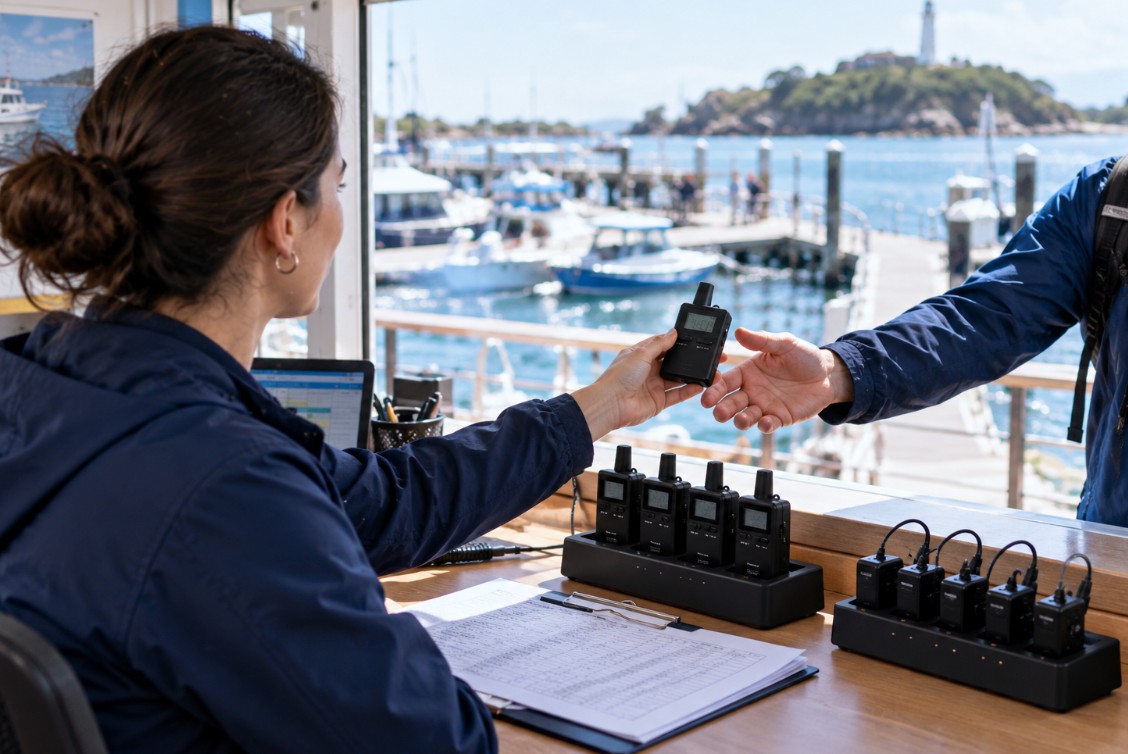
Pier dispatcher handing a channelled tour guide transmitter to a boarding guide at the ticket kiosk

The Island Walk Goes to the Lightest Pair

Once the boat noses into the island's lee anchorage, the walking guide takes over, and this is where the RC2501 wireless tour guide system earns its slot on the roster. Both its transmitter and receiver weigh 47 grams, the lightest pair the crew carries, and the whole unit measures just 86×50×19 mm — small enough that a passenger climbing the island's stone stair with a camera in one hand and a rail in the other never notices the receiver clipped at the collar. Its transmitter runs fifteen hours and the receiver thirty-five or more, which matters because the walking guide's day is the longest on the roster: the 09:40 sailing out, three loop walks on the island, and the 17:15 return before the battery is swapped. At 13 mW output the voice still reaches every earpiece across two hundred metres of gorse and rock, and the 20 Hz-200 kHz frequency response keeps the guide's briefing clear when the wind drops. Passengers keep the earhook receivers on for the full loop — the crew's count of hand-backs at the half-way shelter fell to near zero once the island post moved to the 47-gram pair — and the guide's own transmitter clips inside a jacket pocket rather than on a lanyard, because the walking section crosses two stiles where a dangling unit would catch. Type-C charging means the whole island fleet shares the same cable family as the office phones, which removed one more crate of mixed cables from the bench.

Walking guide leading visitors up an island stone path while they listen on lightweight earhook receivers

What the Whole Roster Weighs in Numbers

On this pier the roster is decided by figures faster than by job descriptions. The table below is the one-page version the operator keeps in the dispatch office, and a relief guide who has never worked the pier can read it in ninety seconds and pick the correct crate. Every figure comes from the current specification sheet, so a buyer comparing quotes can hold this table against any supplier's claim and see immediately where an offer drifts from the factory numbers. The three columns also explain why the crew never mixes units within a post: a lighter receiver on the open deck would give up nothing but would not survive the spray, and a heavier dispatch pair on the island stair would start getting handed to parents before the first shelter.

Comparison DimensionRC8860 — Open DeckRC2402 — Pier DispatchRC2501 — Island Walk
Core frequency band860-870 MHz (UHF)2403-2483 MHz (2.4G)2403-2483 MHz (2.4G)
Number of channels205050
Transmission distance1-200 m1-200 m1-200 m
Output power10 mW10 mW13 mW
Transmitter battery life10 h10 h15 h
Receiver battery life20 h20 h35+ h
Transmitter / receiver weight59 g / 50 g59 g / 50 g47 g / 47 g
Transmitter / receiver battery3.7V 1500 mAh / 3.7V 1000 mAh3.7V 1500 mAh / 3.7V 1000 mAh3.7V 1500 mAh / 3.7V 1000 mAh
Standout field detailIPX4 splash-proof; USB charging50-channel block plan; USB charging86×50×19 mm; Type-C charging

When Another Hull Joins the Schedule

Growth arrives as a fourth boat, and the channel math is what makes that growth cheap. Hull four simply inherits channels 46-50 from the reserve block — or the operator rewrites the sheet into four blocks of twelve — and because the RC2402 fleet already covers fifty channels, no new dispatch hardware is needed for the fourth hull's tour groups. The open-deck post scales differently: a fourth boat means a fourth UHF channel out of twenty, which still leaves sixteen spare, but the real constraint becomes transmitters in the crate, so the operator buys one extra RC8860 transmitter-receiver pair per added hull and nothing else. On the island side, the walking loop simply runs the RC2501 fleet longer between charges, since thirty-five hours of receiver life absorbs even a doubled holiday timetable. The operator's rule of thumb, written under the laminated sheet, is one transmitter-receiver pair per new hull plus forty receivers per forty seats, and nothing else changes — the desk, the blocks and the charging bench stay exactly as they were. To see how the same logic extends to other venues, crews can explore our solutions beyond the pier.

Charging Routine After the Last Ferry Docks

The pier closes its equipment bench at 19:00, and the routine takes one person twenty minutes. Open-deck units and dispatch units charge through their USB ports on a ten-port brick behind the kiosk, while the island-walk fleet docks onto a six-slot Type-C hub — two cable families, two crates, no adapters to lose in a drawer. Receivers come back at between forty and seventy percent after a normal sailing day, so a full overnight top-up is a formality rather than a necessity; the transmitters, which work hardest, land closer to twenty percent and get checked against a chalkboard column before the crate lid closes. Salt is the only real enemy: once a week the crew wipes every unit with a fresh-water-dampened cloth and leaves the crates open overnight in the ticket office, a habit that has kept the oldest fleet units in service past three full seasons. Spare units are not a mystery either; the operator keeps one spare transmitter per post on the shelf above the bench, all drawn from the full tour guide system range, so a failed unit is swapped in ninety seconds and sent for repair rather than improvising a reshuffle mid-morning.

Frequently Asked Questions

1. How many channels does a three-boat operation actually need?

Fewer than most buyers assume. Each hull needs one live channel per simultaneous sailing, so three boats running staggered departures occupy three channels at any moment; the rest of the fifty-channel RC2402 fleet exists so that blocks can be reserved per hull, training can run without touching live channels, and a private charter never collides with the public timetable. Twenty channels — as on the UHF unit — is also comfortable for one open deck, because that post only ever claims one channel per departure. The operator reviews the block sheet every April before the season opens, and in three years the reserve block has never run out, even on regatta weekend when the water taxi doubles its sailings.

2. Will a UHF transmitter and a 2.4 GHz fleet interfere at the same pontoon?

No. The RC8860 transmits between 860 and 870 MHz, a band physically distant from the 2403-2483 MHz range the other fleets use, so the two systems can operate on the same pontoon at the same time without any coordination. The crew keeps the crates on separate shelves only for packing discipline, not for electrical reasons. The one habit that does matter is antenna discipline: the UHF transmitter's stub antenna stays vertical during the briefing, because a guide holding it horizontal against a clipboard can halve the usable range on the far breakwater.

3. What battery routine covers a 09:00 to 18:00 sailing day?

Receivers finish the day with charge to spare — twenty hours of life on the dispatch and open-deck fleets, thirty-five or more on the island-walk pair, against a working day of at most ten. Transmitters are the units that get swapped: the ten-hour dispatch and open-deck transmitters take a midday dock for forty-five minutes, and the fifteen-hour island transmitter usually finishes untouched.

4. Can a seasonal volunteer run the equipment without training?

The pier's induction for a new volunteer is one demonstration and one supervised boarding. The dispatcher hands over a transmitter already set to the correct channel block, the passenger receiver has exactly two controls — power and volume — and there is nothing to pair, because each crate is pre-channelled to its hull. The only rule that must be remembered is that units live on their lanyards or collars from boarding to landing. Average time from gate to first briefing is under four minutes for a full forty-seat loading, and the dispatcher times it once a week to keep the figure honest. The same log records which crate came back with a flat unit, which is how the crew caught a charging brick with a worn socket before it quietly failed an entire morning's top-up.

5. How does salt air change storage and maintenance?

Salt residue corrodes contacts slowly and invisibly, so the routine is a weekly fresh-water wipe-down and overnight crate drying in the ticket office, plus a monthly check that every charging port still seats its cable firmly. Units are never left on the boats overnight; the whole fleet returns to the office bench after the last docking, which is also when the chalkboard charge check happens. The weekly wipe-down takes one person about half an hour across all three fleets, and the crew pairs it with the lifejacket inspection so neither job gets skipped when the season gets busy.


2026年10月23日 09:21
ꄘ click: 41

Get the spec sheet, MOQ and a factory-direct quote

Tell us the venue, the group size and how many languages you need. An engineer at our Shenzhen factory replies within one business day with the matching model, a written quote, lead time and the CE / RoHS / ISO 9001 documents.

Talk to an engineer WhatsApp +86 189 2287 9583

Prefer email? tiger.wang@richitek.com  |  OEM / ODM, custom tooling and neutral packaging available  |  send the enquiry through our contact page

Shenzhen Rich Age Electronics Co., Ltd. (Richitek) - manufacturing wireless tour guide systems, church translation headsets and museum audio guide equipment since 2007.

no data

RC2402 and RC2501: Staffing a Three-Boat Coastal Pier Without Doubling the Kit

time: 2026年10月23日 click:41

A harbour operator running three glass-fibre boats out of one pier does not schedule people by the day — it schedules them by the sailing. First boat leaves at 09:40, the next at 10:05, the third at 10:30, and each departure needs a voice that reaches every passenger over engine hum and gull noise. This guide walks through how one coastal crew of eleven sailings a day divides its guides across a dispatch desk, an open deck and an island walking loop, using the coastal and city sailing programme as the booking backbone and three distinct devices to match three very different posts. The operator's fleet is small — two forty-seat launches and one twelve-seater water taxi — but the equipment decisions are the same ones a much larger pier would face, just compressed into a single shed beside the pontoon.

Sailings Set the Rhythm, and the Roster Follows

The arithmetic starts with the timetable, not the headcount. A single circuit lasts forty-five minutes out to the lighthouse and back, while the full island loop takes two hours and forty minutes including the shore landing. On a peak summer Saturday the pier pushes eleven departures; in shoulder season it drops to seven. That spread means the crew cannot simply hire one guide per boat and stand them around all day — the same guide who briefs the 09:40 sailing walks the island loop at noon, and a volunteer who only works mornings needs equipment that pairs itself and survives being handed to a stranger. Every post on the pier therefore gets defined by what happens during one sailing, not by what the job title says. In practice the roster has three fixed posts and one floating one: the dispatch desk, the largest boat's open deck, the island walking loop, and a relief guide who covers lunch breaks and the two afternoon charters that appear without notice. Nine of the eleven daily sailings repeat seven days a week, so the same voice, the same route and the same equipment pairing meet the same passengers' expectations every single morning. Payroll follows the same shape: two full-time guides cover the fixed posts, the relief guide works four afternoons, and the summer-only volunteer slot exists purely because the equipment asks so little of its users that a new face can be trusted with a crate after one briefing. The ledger from last August backs this up: forty-one of the season's forty-three sailings ran with at least one crew member under two weeks into the job, and the complaint log stayed empty.

⚓ Open Decks Belong to the UHF Unit

The bow bench on the largest boat is the loudest post on the water: twin engines below, wind across the rail, and a dozen phones broadcasting music in the stern. The guide on that bench carries the RC8860 tour guide transmitter, whose 860-870 MHz UHF band sits completely clear of the 2.4 GHz traffic that a busy marina generates — passenger Wi-Fi, phone hotspots and the harbour office's own radios all crowd the higher band by mid-morning. Twenty channels is enough because each open-deck sailing claims exactly one, and the unit's IPX4 splash-proof rating shrugs off the spray that comes over the rail when the wind turns cross-shore. The transmitter weighs 59 grams and its receiver 50 grams, so a guide wearing both on a lanyard and a belt forgets them within the first ten minutes of the crossing. Battery numbers close the argument: the transmitter's 3.7V 1500 mAh cell runs ten hours against a deck shift of barely six, and the receiver's 3.7V 1000 mAh cell doubles that, so neither unit comes off the boat before the last crossing docks. The crew tried the open deck with a 2.4 GHz unit one July and logged three complaints of broken speech per crossing; the same guide on the UHF unit has logged none since the switch, which is the whole review the post needs.

Guide on the open deck of a coastal ferry briefing passengers through a UHF tour guide transmitter

Channel Blocks Keep Three Boats From Talking Over Each Other

At the dispatch desk under the ticket kiosk sits the person who actually runs the pier. Their kit is the RC2402 wireless tour guide system, and its fifty channels are the reason three boats can load passengers at the same pontoon without a word of crosstalk. The channel plan is written on a laminated sheet taped to the desk: hull one holds channels 01-15, hull two takes 16-30, hull three runs 31-45, and the remaining five stay reserved for training sessions and the occasional private charter. A dispatcher hands each boarding guide a transmitter already set to its hull's block, and the 2.4 GHz signal holds a stable lock across the full two hundred metres between the pontoon and the far breakwater. The transmitter's ten-hour battery covers the 08:30 to 18:30 shift with a lunchtime swap, while each receiver runs twenty hours — the entire peak-day roster on one morning charge. The dispatch post also absorbs the pier's awkward traffic: school groups arriving by coach at 10:15, a dive club charter that needs its own quiet channel at noon, and the water taxi's single guide who boards wherever the queue is longest. Each of those gets lent a unit from the reserve block, logged on the laminated sheet, and handed back at the kiosk window, so the three hull blocks stay untouched no matter how strange the day becomes.

Pier dispatcher handing a channelled tour guide transmitter to a boarding guide at the ticket kiosk

The Island Walk Goes to the Lightest Pair

Once the boat noses into the island's lee anchorage, the walking guide takes over, and this is where the RC2501 wireless tour guide system earns its slot on the roster. Both its transmitter and receiver weigh 47 grams, the lightest pair the crew carries, and the whole unit measures just 86×50×19 mm — small enough that a passenger climbing the island's stone stair with a camera in one hand and a rail in the other never notices the receiver clipped at the collar. Its transmitter runs fifteen hours and the receiver thirty-five or more, which matters because the walking guide's day is the longest on the roster: the 09:40 sailing out, three loop walks on the island, and the 17:15 return before the battery is swapped. At 13 mW output the voice still reaches every earpiece across two hundred metres of gorse and rock, and the 20 Hz-200 kHz frequency response keeps the guide's briefing clear when the wind drops. Passengers keep the earhook receivers on for the full loop — the crew's count of hand-backs at the half-way shelter fell to near zero once the island post moved to the 47-gram pair — and the guide's own transmitter clips inside a jacket pocket rather than on a lanyard, because the walking section crosses two stiles where a dangling unit would catch. Type-C charging means the whole island fleet shares the same cable family as the office phones, which removed one more crate of mixed cables from the bench.

Walking guide leading visitors up an island stone path while they listen on lightweight earhook receivers

What the Whole Roster Weighs in Numbers

On this pier the roster is decided by figures faster than by job descriptions. The table below is the one-page version the operator keeps in the dispatch office, and a relief guide who has never worked the pier can read it in ninety seconds and pick the correct crate. Every figure comes from the current specification sheet, so a buyer comparing quotes can hold this table against any supplier's claim and see immediately where an offer drifts from the factory numbers. The three columns also explain why the crew never mixes units within a post: a lighter receiver on the open deck would give up nothing but would not survive the spray, and a heavier dispatch pair on the island stair would start getting handed to parents before the first shelter.

Comparison DimensionRC8860 — Open DeckRC2402 — Pier DispatchRC2501 — Island Walk
Core frequency band860-870 MHz (UHF)2403-2483 MHz (2.4G)2403-2483 MHz (2.4G)
Number of channels205050
Transmission distance1-200 m1-200 m1-200 m
Output power10 mW10 mW13 mW
Transmitter battery life10 h10 h15 h
Receiver battery life20 h20 h35+ h
Transmitter / receiver weight59 g / 50 g59 g / 50 g47 g / 47 g
Transmitter / receiver battery3.7V 1500 mAh / 3.7V 1000 mAh3.7V 1500 mAh / 3.7V 1000 mAh3.7V 1500 mAh / 3.7V 1000 mAh
Standout field detailIPX4 splash-proof; USB charging50-channel block plan; USB charging86×50×19 mm; Type-C charging

When Another Hull Joins the Schedule

Growth arrives as a fourth boat, and the channel math is what makes that growth cheap. Hull four simply inherits channels 46-50 from the reserve block — or the operator rewrites the sheet into four blocks of twelve — and because the RC2402 fleet already covers fifty channels, no new dispatch hardware is needed for the fourth hull's tour groups. The open-deck post scales differently: a fourth boat means a fourth UHF channel out of twenty, which still leaves sixteen spare, but the real constraint becomes transmitters in the crate, so the operator buys one extra RC8860 transmitter-receiver pair per added hull and nothing else. On the island side, the walking loop simply runs the RC2501 fleet longer between charges, since thirty-five hours of receiver life absorbs even a doubled holiday timetable. The operator's rule of thumb, written under the laminated sheet, is one transmitter-receiver pair per new hull plus forty receivers per forty seats, and nothing else changes — the desk, the blocks and the charging bench stay exactly as they were. To see how the same logic extends to other venues, crews can explore our solutions beyond the pier.

Charging Routine After the Last Ferry Docks

The pier closes its equipment bench at 19:00, and the routine takes one person twenty minutes. Open-deck units and dispatch units charge through their USB ports on a ten-port brick behind the kiosk, while the island-walk fleet docks onto a six-slot Type-C hub — two cable families, two crates, no adapters to lose in a drawer. Receivers come back at between forty and seventy percent after a normal sailing day, so a full overnight top-up is a formality rather than a necessity; the transmitters, which work hardest, land closer to twenty percent and get checked against a chalkboard column before the crate lid closes. Salt is the only real enemy: once a week the crew wipes every unit with a fresh-water-dampened cloth and leaves the crates open overnight in the ticket office, a habit that has kept the oldest fleet units in service past three full seasons. Spare units are not a mystery either; the operator keeps one spare transmitter per post on the shelf above the bench, all drawn from the full tour guide system range, so a failed unit is swapped in ninety seconds and sent for repair rather than improvising a reshuffle mid-morning.

Frequently Asked Questions

1. How many channels does a three-boat operation actually need?

Fewer than most buyers assume. Each hull needs one live channel per simultaneous sailing, so three boats running staggered departures occupy three channels at any moment; the rest of the fifty-channel RC2402 fleet exists so that blocks can be reserved per hull, training can run without touching live channels, and a private charter never collides with the public timetable. Twenty channels — as on the UHF unit — is also comfortable for one open deck, because that post only ever claims one channel per departure. The operator reviews the block sheet every April before the season opens, and in three years the reserve block has never run out, even on regatta weekend when the water taxi doubles its sailings.

2. Will a UHF transmitter and a 2.4 GHz fleet interfere at the same pontoon?

No. The RC8860 transmits between 860 and 870 MHz, a band physically distant from the 2403-2483 MHz range the other fleets use, so the two systems can operate on the same pontoon at the same time without any coordination. The crew keeps the crates on separate shelves only for packing discipline, not for electrical reasons. The one habit that does matter is antenna discipline: the UHF transmitter's stub antenna stays vertical during the briefing, because a guide holding it horizontal against a clipboard can halve the usable range on the far breakwater.

3. What battery routine covers a 09:00 to 18:00 sailing day?

Receivers finish the day with charge to spare — twenty hours of life on the dispatch and open-deck fleets, thirty-five or more on the island-walk pair, against a working day of at most ten. Transmitters are the units that get swapped: the ten-hour dispatch and open-deck transmitters take a midday dock for forty-five minutes, and the fifteen-hour island transmitter usually finishes untouched.

4. Can a seasonal volunteer run the equipment without training?

The pier's induction for a new volunteer is one demonstration and one supervised boarding. The dispatcher hands over a transmitter already set to the correct channel block, the passenger receiver has exactly two controls — power and volume — and there is nothing to pair, because each crate is pre-channelled to its hull. The only rule that must be remembered is that units live on their lanyards or collars from boarding to landing. Average time from gate to first briefing is under four minutes for a full forty-seat loading, and the dispatcher times it once a week to keep the figure honest. The same log records which crate came back with a flat unit, which is how the crew caught a charging brick with a worn socket before it quietly failed an entire morning's top-up.

5. How does salt air change storage and maintenance?

Salt residue corrodes contacts slowly and invisibly, so the routine is a weekly fresh-water wipe-down and overnight crate drying in the ticket office, plus a monthly check that every charging port still seats its cable firmly. Units are never left on the boats overnight; the whole fleet returns to the office bench after the last docking, which is also when the chalkboard charge check happens. The weekly wipe-down takes one person about half an hour across all three fleets, and the crew pairs it with the lifejacket inspection so neither job gets skipped when the season gets busy.


Get the spec sheet, MOQ and a factory-direct quote

Tell us the venue, the group size and how many languages you need. An engineer at our Shenzhen factory replies within one business day with the matching model, a written quote, lead time and the CE / RoHS / ISO 9001 documents.

Talk to an engineer WhatsApp +86 189 2287 9583

Prefer email? tiger.wang@richitek.com  |  OEM / ODM, custom tooling and neutral packaging available  |  send the enquiry through our contact page

Shenzhen Rich Age Electronics Co., Ltd. (Richitek) - manufacturing wireless tour guide systems, church translation headsets and museum audio guide equipment since 2007.

no data
×

Contact us

email:
name:
subject:
content: