A leading China factory specializing in Wireless Tour Guide Systems, Church Audio Guides, and Translation Headphones with premium OEM/ODM solutions.

Tel:+86 18922879583

Email:tiger.wang@richitek.com

RC9150, RC8860 and RC2406: Staffing a Bike Tour That Never Rides as a Single Block

A cycling tour is the one format where the group never stays where the microphone is. Thirty riders leave the gate together and within four kilometers the road has sorted them into a lead cluster pushing the pace, a middle mass chatting at a steadier tempo, and a tail of riders soft-pedaling the last climb. One guide with one transmitter cannot serve all three from a fixed spot, so the staffing question stops being about headcount and becomes about radio positions.

This article follows a 30-rider road club that runs three staff on every tour: a ride leader at the front, a floater working the middle, and a back marker holding the rear. Each position runs a different Richitek system — the RC9150 up front, the RC2406 through the middle, and the RC8860 at the back — and the reasoning behind each assignment comes down to band congestion, battery arithmetic and grams on a full riding day.

💡 Why a Peloton Needs a Ride Leader, a Floater and a Back Marker

On foot, a guide walks at the center of the group and the 200-meter transmission range covers everyone at once. A bike tour breaks that assumption in the first hour. The lead riders crest a rise while the tail is still out of sight below it, and the straight-line distance between them stretches well past what any single link is specified to hold. The club stopped measuring staff in guides and started measuring them in positions.

Three positions proved sufficient for a 30-rider column. The ride leader owns the route narrative and every junction call. The floater drifts between sub-groups, ferrying late instructions from front to middle without a full stop. The back marker rides with the slowest cluster and reports pace, mechanicals and regroup times. Each carries a system matched to the block they serve, and the next three sections explain why the units are not interchangeable. Operators planning a mixed-fleet rollout can compare the wireless guide system for Cycling Tour deployments city operators run on similar three-post layouts.

The Ride Leader Rides With the RC9150

The front post demands the most from its hardware, because the ride leader talks for the whole tour: departure briefings, traffic calls, the mid-morning history stop and the lunch countdown. The club assigns the RC9150 2.4G Wireless Audio Guide System here, and the transmitter specs read like they were drafted for this exact seat. Its 2403-2483 MHz link carries 100 channels, so the leader locks channel 10 and never has to renegotiate when another club unloads at the same trailhead. The 1800mAh transmitter battery is rated at 15 hours, which brackets an 8 a.m. to 6 p.m. riding day with margin to spare.

RC9150-cycling_tour

The receiver side matters just as much for the 27 riders behind. Each RC9150 receiver weighs 97.5 grams and its 1800mAh pack is quoted at more than 35 hours, so a full season day passes without a single rider thinking about charging. The 20Hz-8kHz audio band keeps junction calls intelligible over wind, and the encryption feature means a sponsors' briefing stays inside the club. One honest gap: no ingress protection rating is published for the RC9150, so the leader rides with the unit zipped into a jersey pocket when spray comes off the road, taking it out at stops.

Middle-of-the-Pack Riders Link Up on the RC2406

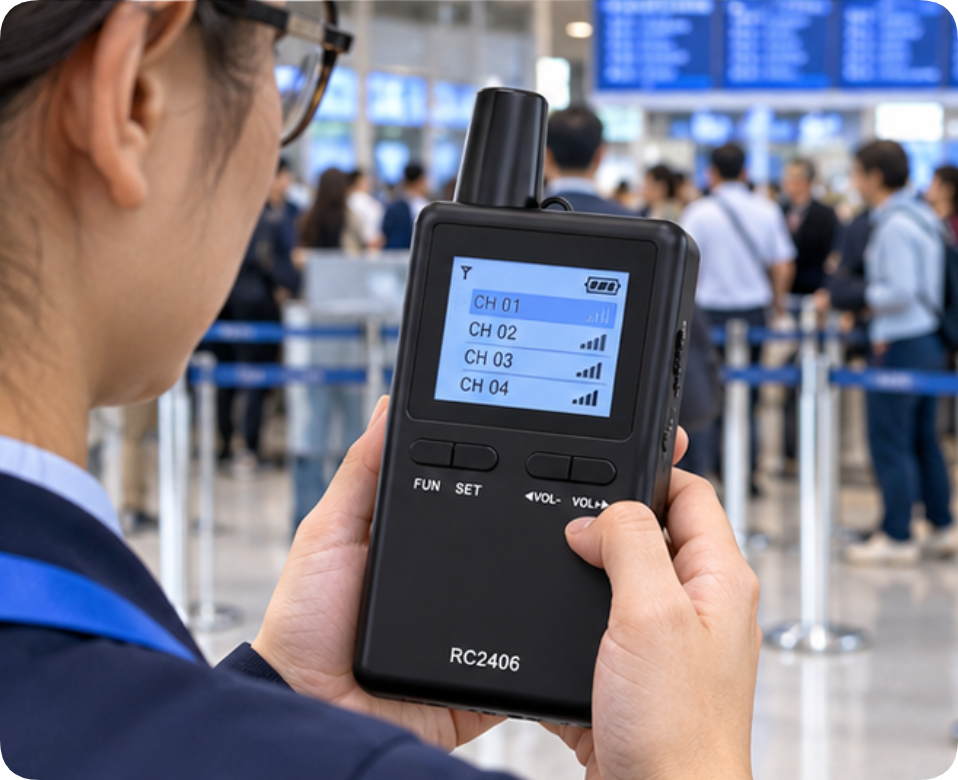
The middle block is where a tour quietly fails. Riders there hear pieces of the leader's calls, fill the gaps with guesswork, and miss regroup instructions entirely. The floater's job is to close that gap in person, and the RC2406 80-Channel 2.4G Tour Guide System is the tool the club hands this position. Its 80 channels run on PLL anti-interference technology, which holds a clean channel even at a rest stop where three tour groups cluster within a hundred meters of each other.

RC2406-cycling_tour

The weight profile is why the floater keeps it all day. Transmitter and receiver come in at 59 grams and 50 grams respectively, so the floater's kit disappears into a rear pocket and never pulls on a jersey collar across eight hours in the saddle. The transmitter budget is 10 hours from a 1500mAh pack against 20 hours for the 1000mAh receiver — the floater talks less than the leader, in short relay bursts, and the arithmetic lands comfortably inside a single charge. Splash resistance is rated IPX4, which covers road spray and the occasional water-bottle shower at the finish.

The Back Marker Stakes Out the Road With the RC8860

The rear post has one overriding problem: everything ahead of it transmits on 2.4 GHz. The club solved the back marker's link by moving it to a different band entirely, pairing the position with the RC8860 Tour Guide Transmitter For Teaching. The RC8860 works the 860-870 MHz UHF band, license-free in most regions, so the tail of the tour runs on spectrum the two forward systems never touch. Crosstalk between the leader's channel and the tail's channel is not a management problem here; it is physically designed out.

RC8860-cycling_tour

The UHF unit gives up some channel count for that clean air — 20 channels against the 100 up front — but the back marker needs exactly one, and UHF's reputation for punching through obstructions suits a position that spends the day behind a rotating wall of riders. The transmitter's 59 grams matches the floater's kit, the 1500mAh pack is good for 10 hours, and the receiver sips 20 hours from 1000mAh. The frequency response of 50Hz-12kHz keeps the tail's report of a slow flat tire audible over drivetrain noise, and one-touch pairing lets a substitute back marker bind a borrowed receiver at a regroup stop without a laptop.

Three Jersey Pockets and What Goes in Each

PositionSystemBandChannelsTX Run TimeRX Run TimeTX WeightRX WeightCharging PortCertifications
Ride leaderRC91502403-2483 MHz 2.4G10015h (3.7V 1800mAh)35+h (3.7V 1800mAh)97.5g97.5gType-CCE, EMC, LVD, RED, RoHS
FloaterRC24062403-2483 MHz 2.4G8010h (3.7V 1500mAh)20h (3.7V 1000mAh)59g50gDC PortRoHS; IPX4 splash resistant
Back markerRC8860860-870 MHz UHF2010h (3.7V 1500mAh)20h (3.7V 1000mAh)59g50gDC PortCE, RoHS; IPX4 splash-proof

Two rows of that table shape the staffing math more than the rest. The RC9150's transmitter-runtime advantage — 15 hours against 10 — exists because its 1800mAh pack outweighs the others' 1500mAh, and that same capacity is why the leader's unit and every rider's receiver tip the scales at 97.5 grams rather than 50. The club accepts the extra grams at the front, where the transmitter works the longest shift, and takes the lighter 50-gram receivers everywhere else. All three systems carry a 3-year warranty on the mainboard, with headsets, microphones and batteries excluded as wear parts — the club keeps one spare of each in the van.

Two Clubs at the Same Gate

The channel plan earned its keep on a Saturday when another club launched from the same gate twenty minutes after this one. The two 2.4G fleets never heard each other: the leader's 100-channel RC9150 held channel 10 while the visitors' units hunted for space, and the floater's 80-channel RC2406 sat far enough away on channel 55 that no receiver ever locked onto the wrong brief. The UHF tail was never in the conversation at all. This is the unglamorous reason the club mixed bands instead of buying three of the same system — a wireless tour guide system chosen per position doubles as interference planning, and the staging area is where that decision pays off.

🔋 Battery Shifts Across a Full Riding Day

The club runs the day as two battery shifts. The morning shift belongs to every pack as shipped: the leader's 15-hour transmitter budget opens at 8 a.m. and the 27 receivers at more than 35 hours are effectively infinite for one day. The afternoon shift is where discipline matters. The floater and back marker both run 10-hour transmitters, and a 8 a.m. start puts their packs at roughly 20 percent by the 5 p.m. finish if they talk freely, so the van carries a charged spare for each and the swap happens at the 15-kilometer regroup point, not at the roadside. Receivers never swap — no rider in three seasons has emptied a 1000mAh pack inside a single tour.

🔮 Back at the Support Van Before the Next Loop

Charging logistics decide whether tomorrow's tour starts on time. The leader's RC9150 refills through Type-C, which means any of the power banks in the van tops it up during the lunch stop; the two DC-port units charge from the van's adapter while the group eats. The club's routine is unglamorous and strict: all seven packs on charge by 7 p.m., a channel log updated with the day's assignments, and any unit that ran a full shift marked for a battery-health check at month end. Fleet operators weighing a mixed-band rollout can explore our solutions for layout templates beyond cycling.

The mixed fleet earns its complexity at the margins. A full day on a bike tour produces exactly the failures single-system groups complain about — missed regroup calls, crosstalk at crowded gates, a guide whose transmitter dies mid-afternoon — and each of the three posts here is armored against one of them by design. The club's own accounting puts it simply: three staff, three bands, and a tour that finishes with every rider having heard every call that mattered. A shore-excursion team documented the same pattern at scale in RC9150 and RC8860 at the Terminal Gate, and their compliance checklist transfers to a support van almost line for line.

Frequently Asked Questions

1. Why not give every staff member the same RC9150 and save the mixing?

Cost is not the issue — coverage geometry is. The leader's channel carries 27 receivers on channel 10, and if the floater and back marker both transmit on the same band, their calls land in every rider's earpiece whether they should or not. Three bands let each post speak to its own block: 100 channels on 2.4 GHz up front, 80 in the middle, and a UHF tail that physically cannot reach the riders' receivers.

2. Is 200 meters of range enough when a climb strings the group past 400 meters?

Range is a position problem, not a hardware problem. The specification is 1-200 meters in open ground for all three systems, and the club plans around it by placing transmitters at the front, middle and rear of the column instead of asking one link to span the whole string. On the two climbs where the gap historically blew past 300 meters, the floater's mid-column position kept every rider within about 120 meters of a live transmitter.

3. What happens if the back marker's UHF unit fails mid-tour?

The van carries a spare RC8860 transmitter and the one-touch pairing rebinds a receiver at the next regroup point, which the club has rehearsed at under four minutes. The tail's protocol degrades gracefully: no tail call means the ride leader holds the next junction until visual contact returns, and the 20-hour receiver budget means the marker's earpiece is never the failure point.

4. How do you keep seven battery packs straight across a season?

A written rotation, not memory. The two 1800mAh packs in the leader's kit cycle on a 15-hour budget, the four 1500mAh and 1000mAh packs on 10 and 20 hours, and the log marks every full-shift unit for a monthly capacity check. Batteries are excluded from the 3-year mainboard warranty, so the club treats them as consumables with a two-season replacement rule and orders spares with the autumn fleet audit.


The staffing plan that survives contact with a real cycling season is the one that assigns radios by position rather than by inventory. Front, middle and back each face a different failure mode, and the RC9150, RC2406 and RC8860 each answer one of them — 100 encrypted channels for the voice that talks all day, 80 anti-interference channels for the block that drifts, and a clean UHF lane for the tail that guards it. Weigh the pockets, plan the shifts, and the tour stops relying on luck.


2026-11-04 11:49
ꄘ click: 23

Get the spec sheet, MOQ and a factory-direct quote

Tell us the venue, the group size and how many languages you need. An engineer at our Shenzhen factory replies within one business day with the matching model, a written quote, lead time and the CE / RoHS / ISO 9001 documents.

Talk to an engineer WhatsApp +86 189 2287 9583

Prefer email? tiger.wang@richitek.com  |  OEM / ODM, custom tooling and neutral packaging available  |  send the enquiry through our contact page

Shenzhen Rich Age Electronics Co., Ltd. (Richitek) - manufacturing wireless tour guide systems, church translation headsets and museum audio guide equipment since 2007.

no data

RC9150, RC8860 and RC2406: Staffing a Bike Tour That Never Rides as a Single Block

time: 2026年11月04日 click:23

A cycling tour is the one format where the group never stays where the microphone is. Thirty riders leave the gate together and within four kilometers the road has sorted them into a lead cluster pushing the pace, a middle mass chatting at a steadier tempo, and a tail of riders soft-pedaling the last climb. One guide with one transmitter cannot serve all three from a fixed spot, so the staffing question stops being about headcount and becomes about radio positions.

This article follows a 30-rider road club that runs three staff on every tour: a ride leader at the front, a floater working the middle, and a back marker holding the rear. Each position runs a different Richitek system — the RC9150 up front, the RC2406 through the middle, and the RC8860 at the back — and the reasoning behind each assignment comes down to band congestion, battery arithmetic and grams on a full riding day.

💡 Why a Peloton Needs a Ride Leader, a Floater and a Back Marker

On foot, a guide walks at the center of the group and the 200-meter transmission range covers everyone at once. A bike tour breaks that assumption in the first hour. The lead riders crest a rise while the tail is still out of sight below it, and the straight-line distance between them stretches well past what any single link is specified to hold. The club stopped measuring staff in guides and started measuring them in positions.

Three positions proved sufficient for a 30-rider column. The ride leader owns the route narrative and every junction call. The floater drifts between sub-groups, ferrying late instructions from front to middle without a full stop. The back marker rides with the slowest cluster and reports pace, mechanicals and regroup times. Each carries a system matched to the block they serve, and the next three sections explain why the units are not interchangeable. Operators planning a mixed-fleet rollout can compare the wireless guide system for Cycling Tour deployments city operators run on similar three-post layouts.

The Ride Leader Rides With the RC9150

The front post demands the most from its hardware, because the ride leader talks for the whole tour: departure briefings, traffic calls, the mid-morning history stop and the lunch countdown. The club assigns the RC9150 2.4G Wireless Audio Guide System here, and the transmitter specs read like they were drafted for this exact seat. Its 2403-2483 MHz link carries 100 channels, so the leader locks channel 10 and never has to renegotiate when another club unloads at the same trailhead. The 1800mAh transmitter battery is rated at 15 hours, which brackets an 8 a.m. to 6 p.m. riding day with margin to spare.

RC9150-cycling_tour

The receiver side matters just as much for the 27 riders behind. Each RC9150 receiver weighs 97.5 grams and its 1800mAh pack is quoted at more than 35 hours, so a full season day passes without a single rider thinking about charging. The 20Hz-8kHz audio band keeps junction calls intelligible over wind, and the encryption feature means a sponsors' briefing stays inside the club. One honest gap: no ingress protection rating is published for the RC9150, so the leader rides with the unit zipped into a jersey pocket when spray comes off the road, taking it out at stops.

Middle-of-the-Pack Riders Link Up on the RC2406

The middle block is where a tour quietly fails. Riders there hear pieces of the leader's calls, fill the gaps with guesswork, and miss regroup instructions entirely. The floater's job is to close that gap in person, and the RC2406 80-Channel 2.4G Tour Guide System is the tool the club hands this position. Its 80 channels run on PLL anti-interference technology, which holds a clean channel even at a rest stop where three tour groups cluster within a hundred meters of each other.

RC2406-cycling_tour

The weight profile is why the floater keeps it all day. Transmitter and receiver come in at 59 grams and 50 grams respectively, so the floater's kit disappears into a rear pocket and never pulls on a jersey collar across eight hours in the saddle. The transmitter budget is 10 hours from a 1500mAh pack against 20 hours for the 1000mAh receiver — the floater talks less than the leader, in short relay bursts, and the arithmetic lands comfortably inside a single charge. Splash resistance is rated IPX4, which covers road spray and the occasional water-bottle shower at the finish.

The Back Marker Stakes Out the Road With the RC8860

The rear post has one overriding problem: everything ahead of it transmits on 2.4 GHz. The club solved the back marker's link by moving it to a different band entirely, pairing the position with the RC8860 Tour Guide Transmitter For Teaching. The RC8860 works the 860-870 MHz UHF band, license-free in most regions, so the tail of the tour runs on spectrum the two forward systems never touch. Crosstalk between the leader's channel and the tail's channel is not a management problem here; it is physically designed out.

RC8860-cycling_tour

The UHF unit gives up some channel count for that clean air — 20 channels against the 100 up front — but the back marker needs exactly one, and UHF's reputation for punching through obstructions suits a position that spends the day behind a rotating wall of riders. The transmitter's 59 grams matches the floater's kit, the 1500mAh pack is good for 10 hours, and the receiver sips 20 hours from 1000mAh. The frequency response of 50Hz-12kHz keeps the tail's report of a slow flat tire audible over drivetrain noise, and one-touch pairing lets a substitute back marker bind a borrowed receiver at a regroup stop without a laptop.

Three Jersey Pockets and What Goes in Each

PositionSystemBandChannelsTX Run TimeRX Run TimeTX WeightRX WeightCharging PortCertifications
Ride leaderRC91502403-2483 MHz 2.4G10015h (3.7V 1800mAh)35+h (3.7V 1800mAh)97.5g97.5gType-CCE, EMC, LVD, RED, RoHS
FloaterRC24062403-2483 MHz 2.4G8010h (3.7V 1500mAh)20h (3.7V 1000mAh)59g50gDC PortRoHS; IPX4 splash resistant
Back markerRC8860860-870 MHz UHF2010h (3.7V 1500mAh)20h (3.7V 1000mAh)59g50gDC PortCE, RoHS; IPX4 splash-proof

Two rows of that table shape the staffing math more than the rest. The RC9150's transmitter-runtime advantage — 15 hours against 10 — exists because its 1800mAh pack outweighs the others' 1500mAh, and that same capacity is why the leader's unit and every rider's receiver tip the scales at 97.5 grams rather than 50. The club accepts the extra grams at the front, where the transmitter works the longest shift, and takes the lighter 50-gram receivers everywhere else. All three systems carry a 3-year warranty on the mainboard, with headsets, microphones and batteries excluded as wear parts — the club keeps one spare of each in the van.

Two Clubs at the Same Gate

The channel plan earned its keep on a Saturday when another club launched from the same gate twenty minutes after this one. The two 2.4G fleets never heard each other: the leader's 100-channel RC9150 held channel 10 while the visitors' units hunted for space, and the floater's 80-channel RC2406 sat far enough away on channel 55 that no receiver ever locked onto the wrong brief. The UHF tail was never in the conversation at all. This is the unglamorous reason the club mixed bands instead of buying three of the same system — a wireless tour guide system chosen per position doubles as interference planning, and the staging area is where that decision pays off.

🔋 Battery Shifts Across a Full Riding Day

The club runs the day as two battery shifts. The morning shift belongs to every pack as shipped: the leader's 15-hour transmitter budget opens at 8 a.m. and the 27 receivers at more than 35 hours are effectively infinite for one day. The afternoon shift is where discipline matters. The floater and back marker both run 10-hour transmitters, and a 8 a.m. start puts their packs at roughly 20 percent by the 5 p.m. finish if they talk freely, so the van carries a charged spare for each and the swap happens at the 15-kilometer regroup point, not at the roadside. Receivers never swap — no rider in three seasons has emptied a 1000mAh pack inside a single tour.

🔮 Back at the Support Van Before the Next Loop

Charging logistics decide whether tomorrow's tour starts on time. The leader's RC9150 refills through Type-C, which means any of the power banks in the van tops it up during the lunch stop; the two DC-port units charge from the van's adapter while the group eats. The club's routine is unglamorous and strict: all seven packs on charge by 7 p.m., a channel log updated with the day's assignments, and any unit that ran a full shift marked for a battery-health check at month end. Fleet operators weighing a mixed-band rollout can explore our solutions for layout templates beyond cycling.

The mixed fleet earns its complexity at the margins. A full day on a bike tour produces exactly the failures single-system groups complain about — missed regroup calls, crosstalk at crowded gates, a guide whose transmitter dies mid-afternoon — and each of the three posts here is armored against one of them by design. The club's own accounting puts it simply: three staff, three bands, and a tour that finishes with every rider having heard every call that mattered. A shore-excursion team documented the same pattern at scale in RC9150 and RC8860 at the Terminal Gate, and their compliance checklist transfers to a support van almost line for line.

Frequently Asked Questions

1. Why not give every staff member the same RC9150 and save the mixing?

Cost is not the issue — coverage geometry is. The leader's channel carries 27 receivers on channel 10, and if the floater and back marker both transmit on the same band, their calls land in every rider's earpiece whether they should or not. Three bands let each post speak to its own block: 100 channels on 2.4 GHz up front, 80 in the middle, and a UHF tail that physically cannot reach the riders' receivers.

2. Is 200 meters of range enough when a climb strings the group past 400 meters?

Range is a position problem, not a hardware problem. The specification is 1-200 meters in open ground for all three systems, and the club plans around it by placing transmitters at the front, middle and rear of the column instead of asking one link to span the whole string. On the two climbs where the gap historically blew past 300 meters, the floater's mid-column position kept every rider within about 120 meters of a live transmitter.

3. What happens if the back marker's UHF unit fails mid-tour?

The van carries a spare RC8860 transmitter and the one-touch pairing rebinds a receiver at the next regroup point, which the club has rehearsed at under four minutes. The tail's protocol degrades gracefully: no tail call means the ride leader holds the next junction until visual contact returns, and the 20-hour receiver budget means the marker's earpiece is never the failure point.

4. How do you keep seven battery packs straight across a season?

A written rotation, not memory. The two 1800mAh packs in the leader's kit cycle on a 15-hour budget, the four 1500mAh and 1000mAh packs on 10 and 20 hours, and the log marks every full-shift unit for a monthly capacity check. Batteries are excluded from the 3-year mainboard warranty, so the club treats them as consumables with a two-season replacement rule and orders spares with the autumn fleet audit.


The staffing plan that survives contact with a real cycling season is the one that assigns radios by position rather than by inventory. Front, middle and back each face a different failure mode, and the RC9150, RC2406 and RC8860 each answer one of them — 100 encrypted channels for the voice that talks all day, 80 anti-interference channels for the block that drifts, and a clean UHF lane for the tail that guards it. Weigh the pockets, plan the shifts, and the tour stops relying on luck.

Get the spec sheet, MOQ and a factory-direct quote

Tell us the venue, the group size and how many languages you need. An engineer at our Shenzhen factory replies within one business day with the matching model, a written quote, lead time and the CE / RoHS / ISO 9001 documents.

Talk to an engineer WhatsApp +86 189 2287 9583

Prefer email? tiger.wang@richitek.com  |  OEM / ODM, custom tooling and neutral packaging available  |  send the enquiry through our contact page

Shenzhen Rich Age Electronics Co., Ltd. (Richitek) - manufacturing wireless tour guide systems, church translation headsets and museum audio guide equipment since 2007.

no data
×

Contact us

email:
name:
subject:
content: