A leading China factory specializing in Wireless Tour Guide Systems, Church Audio Guides, and Translation Headphones with premium OEM/ODM solutions.

Tel:+86 18922879583

Email:tiger.wang@richitek.com

Richitek RC2408, RC2401 and RC2501 vs Tourtalk TT 300 and Listen LK-1 for Accessible Museum and Heritage Tours

Inclusion Is a Logistics Problem Before It Is an Audio Problem

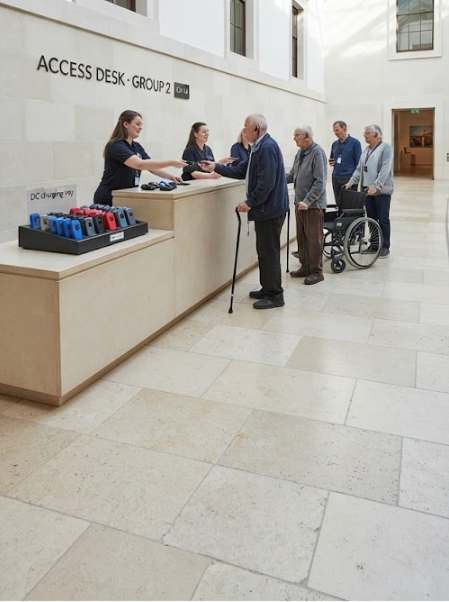
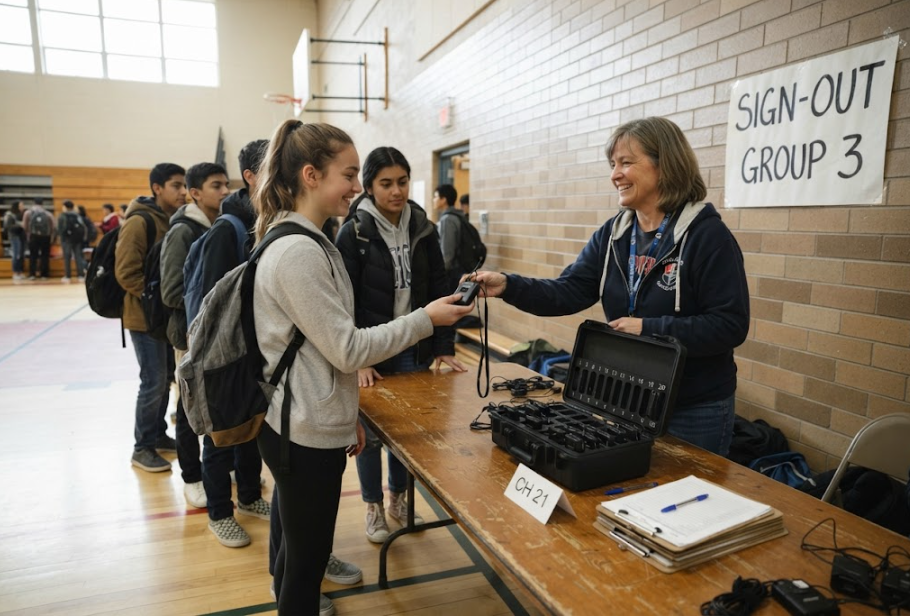
Ask three venue managers what limits an accessible tour and none of them will mention loudspeakers. The first is the handover desk, where thirty people arrive at thirty different speeds and a queue is the one thing a wheelchair user cannot join comfortably. The second is the route, which breaks the moment a lift or a narrow doorway appears. The third is the return table at four o'clock, where tomorrow's schedule is decided by how many devices are back on charge. Everything else — including the audio guide itself — is downstream of those three moments, so we file our museum work under museum audio guide rather than under a speaker specification.

What an Inclusive Tour Day Asks of a Wireless System

Accessible tours are not quieter versions of ordinary tours. They run at a different tempo: device issue takes longer, groups re-form more often, and staff are usually volunteers rather than technicians. A system that needs a trained operator to pair it will fail here, no matter how good it sounds. For this comparison we put three Richitek models — RC2408, RC2401 and RC2501 — against two imported systems, the Tourtalk TT 300 from the United Kingdom and the Listen LK-1 from the United States, and judged all five against the desk, the route and the return table.

The Handover Desk Sets the Day's Tempo

A busy inclusive morning is a queuing problem disguised as an AV problem. Someone needs a receiver that clips to a lapel rather than a headband. Someone else needs to be shown twice how the volume wheel works, and will not be rushed the second time. The desk therefore needs three things that have nothing to do with signal strength: devices that are visually sortable at a glance, pairs already matched when they leave the tray, and a charging arrangement that lets staff top up one unit without dismantling the rack. Every minute saved here is returned to the group.

Colour as a Sorting Tool

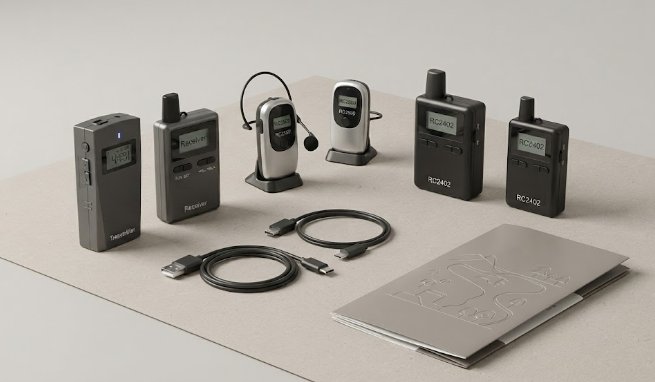
The RC2408 is the model we would put behind a busy counter first. It carries 80 channels with an anti-interference design, which matters less for the visitor than for the desk: with that much separation you can stage several groups on one tray without anyone reasoning about which receiver belongs to which party. It ships in multiple colours, and colour is the cheapest sorting technology ever invented — a staff member hands out "the blue ones" without checking a list. The transmitter weighs 59 g and the receiver 50 g, they run 10 h and 20 h, and the charging system is DC based.
richitek accessible tour vs tourtalk listen 1

Built for the Visitor Who Cannot Queue

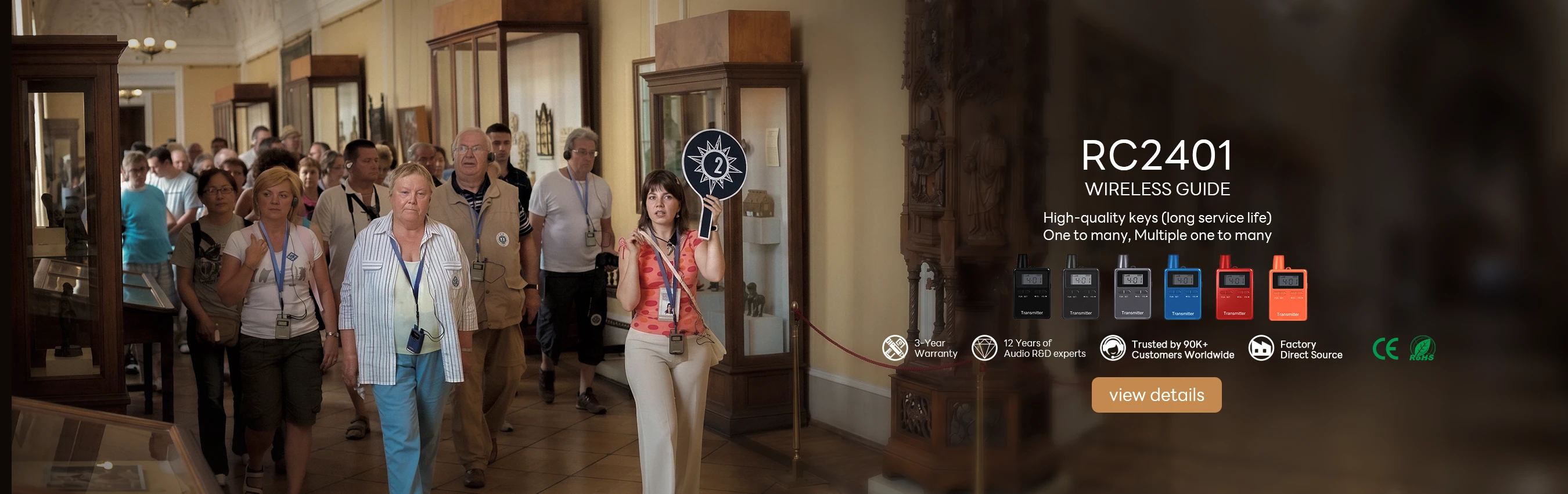
The RC2401 answers a different problem: it is a 2.4 GHz system built around one transmitter and unlimited receivers, with 50 PLL digital channels and a range of up to 200 m in open area. Its published protection level is IPX4, which matters when you issue devices on a wet doorstep or wipe a receiver down between groups. Charging is DC and, importantly, multi-device, so a full tray can be serviced at once rather than one socket at a time. Communication is one-way broadcast, the honest limitation of this series, and the warranty runs three years on the mainboard — headsets, microphones and batteries excluded.
richitek accessible tour vs tourtalk listen 2

Removing the Recharge Question

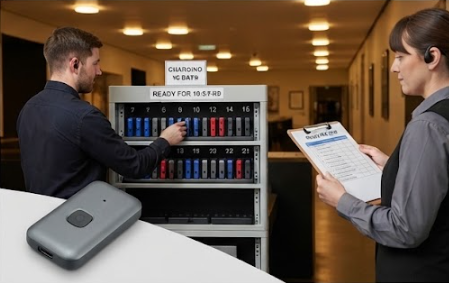
The RC2501 is the model that changes the schedule itself. Its receiver runs 40 h and its transmitter 25 h, against 20 h and 10 h on the other two, so a device can survive two tour days without visiting the rack. The transmitter weighs 61 g and the receiver 52 g; the body measures 86 × 50 × 19 mm, small enough to sit in a coat pocket. Pairing is one-click with no threshold to learn, the microphone is noise-cancelling, and the rated operating temperature is −10 °C to +45 °C, so an unheated corridor is not an exception. Charging is over Type-C.
richitek accessible tour vs tourtalk listen 3

Specification Comparison

SpecificationRC2408RC2401RC2501Tourtalk TT 300Listen LK-1
Frequency band2403-2483 MHz (2.4 GHz ISM)2403-2483 MHz (2.4 GHz ISM)2403-2483 MHz (2.4 GHz ISM)863-865 MHz1.9 GHz DECT
Channels or simultaneous groups80 channels50 channels50 channels42 channels30 groups
Working rangeUp to 200 mUp to 200 mUp to 200 mUp to 100 m150 m indoors, 300 m outdoors
Receiver battery20 h20 h40 hNot published8 h
Communication modeOne-way broadcastOne-way broadcastOne-way broadcastFull-duplex, up to 6 speakersTwo-way
Receiver weight50 g50 g52 gNot publishedNot published
Charging portDC trayDC, multi-deviceType-CNot publishedUSB

Read the table with the desk in mind rather than the datasheet. The three Richitek models share a band, a rated range and a three-year mainboard warranty, so the choice is not about coverage. It is about channels, endurance and weight: RC2408 buys the widest staging capacity at 80 channels, RC2401 adds an IPX4 housing and multi-device DC charging, and RC2501 doubles receiver endurance to 40 h while dropping pairing to a single click.

Three cells are left as "Not published" for the Tourtalk TT 300, whose public material lists no receiver battery, weight or charging interface. We have not inferred them; if receiver endurance decides your fleet, ask the supplier in writing before ordering. All three Richitek units ship CE and RoHS compliant, while the two imported systems do not state certification. The wider wireless tour guide system range follows the same pattern.

Where Tourtalk and Listen Pull Ahead

Two things here are genuinely better than what we offer, and both concern what a visitor can say rather than what they can hear. The Tourtalk TT 300 is a full-duplex system supporting up to six people speaking at once on 42 channels across 863-865 MHz, licence-free in Europe. Where a visitor needs to ask a question — a blind visitor describing something the guide cannot see, or a carer confirming a detail — that changes the format of the tour. The Listen LK-1 is a 1.9 GHz DECT unit with a two-way link, USB charging, up to 30 simultaneous groups, 150 m indoors and 300 m outdoors, and eight hours of battery. Neither is matched by one-way broadcast.

The Route Breaks the Group, Not the Signal

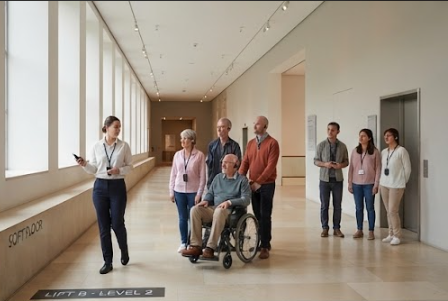
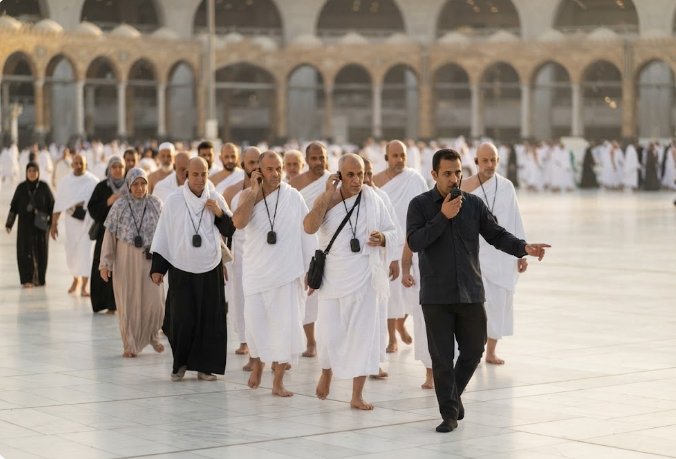
On an accessible route the group does not split because the transmitter ran out of reach. It splits at a lift lobby or a doorway wide enough for one wheelchair at a time, and re-forms on the far side in a different running order. A 200 m rating measured in open air says nothing about that. What helps is channel separation so two halves of the same party cannot bleed into each other, a transmitter light enough for a guide who is also pushing a chair, and a receiver a visitor can put on one-handed while holding a handrail. Plan the route as a series of break points, test at each one, and treat the open-air figure as a ceiling.

Plan the Next Accessible Season With Richitek

If your programme is built around one guide, one group and a long route, the RC2408, RC2401 and RC2501 are designed for that shape of day: sortable at the desk, light enough to wear all afternoon, and slow enough to discharge that the return table stops dictating tomorrow. If it depends on visitors talking back, be honest about it and consider a duplex system alongside ours. Our published cross-brand comparisons sit in the tour guide system comparison hub, and OEM/ODM customisation is available on the RC2401.
2026年09月16日 15:39
click: 31
Home > VS

Richitek RC2408, RC2401 and RC2501 vs Tourtalk TT 300 and Listen LK-1 for Accessible Museum and Heritage Tours

time: 2026年09月16日 click:31

Inclusion Is a Logistics Problem Before It Is an Audio Problem

Ask three venue managers what limits an accessible tour and none of them will mention loudspeakers. The first is the handover desk, where thirty people arrive at thirty different speeds and a queue is the one thing a wheelchair user cannot join comfortably. The second is the route, which breaks the moment a lift or a narrow doorway appears. The third is the return table at four o'clock, where tomorrow's schedule is decided by how many devices are back on charge. Everything else — including the audio guide itself — is downstream of those three moments, so we file our museum work under museum audio guide rather than under a speaker specification.

What an Inclusive Tour Day Asks of a Wireless System

Accessible tours are not quieter versions of ordinary tours. They run at a different tempo: device issue takes longer, groups re-form more often, and staff are usually volunteers rather than technicians. A system that needs a trained operator to pair it will fail here, no matter how good it sounds. For this comparison we put three Richitek models — RC2408, RC2401 and RC2501 — against two imported systems, the Tourtalk TT 300 from the United Kingdom and the Listen LK-1 from the United States, and judged all five against the desk, the route and the return table.

The Handover Desk Sets the Day's Tempo

A busy inclusive morning is a queuing problem disguised as an AV problem. Someone needs a receiver that clips to a lapel rather than a headband. Someone else needs to be shown twice how the volume wheel works, and will not be rushed the second time. The desk therefore needs three things that have nothing to do with signal strength: devices that are visually sortable at a glance, pairs already matched when they leave the tray, and a charging arrangement that lets staff top up one unit without dismantling the rack. Every minute saved here is returned to the group.

Colour as a Sorting Tool

The RC2408 is the model we would put behind a busy counter first. It carries 80 channels with an anti-interference design, which matters less for the visitor than for the desk: with that much separation you can stage several groups on one tray without anyone reasoning about which receiver belongs to which party. It ships in multiple colours, and colour is the cheapest sorting technology ever invented — a staff member hands out "the blue ones" without checking a list. The transmitter weighs 59 g and the receiver 50 g, they run 10 h and 20 h, and the charging system is DC based.

richitek accessible tour vs tourtalk listen 1

Built for the Visitor Who Cannot Queue

The RC2401 answers a different problem: it is a 2.4 GHz system built around one transmitter and unlimited receivers, with 50 PLL digital channels and a range of up to 200 m in open area. Its published protection level is IPX4, which matters when you issue devices on a wet doorstep or wipe a receiver down between groups. Charging is DC and, importantly, multi-device, so a full tray can be serviced at once rather than one socket at a time. Communication is one-way broadcast, the honest limitation of this series, and the warranty runs three years on the mainboard — headsets, microphones and batteries excluded.

richitek accessible tour vs tourtalk listen 2

Removing the Recharge Question

The RC2501 is the model that changes the schedule itself. Its receiver runs 40 h and its transmitter 25 h, against 20 h and 10 h on the other two, so a device can survive two tour days without visiting the rack. The transmitter weighs 61 g and the receiver 52 g; the body measures 86 × 50 × 19 mm, small enough to sit in a coat pocket. Pairing is one-click with no threshold to learn, the microphone is noise-cancelling, and the rated operating temperature is −10 °C to +45 °C, so an unheated corridor is not an exception. Charging is over Type-C.

richitek accessible tour vs tourtalk listen 3

Specification Comparison

SpecificationRC2408RC2401RC2501Tourtalk TT 300Listen LK-1
Frequency band2403-2483 MHz (2.4 GHz ISM)2403-2483 MHz (2.4 GHz ISM)2403-2483 MHz (2.4 GHz ISM)863-865 MHz1.9 GHz DECT
Channels or simultaneous groups80 channels50 channels50 channels42 channels30 groups
Working rangeUp to 200 mUp to 200 mUp to 200 mUp to 100 m150 m indoors, 300 m outdoors
Receiver battery20 h20 h40 hNot published8 h
Communication modeOne-way broadcastOne-way broadcastOne-way broadcastFull-duplex, up to 6 speakersTwo-way
Receiver weight50 g50 g52 gNot publishedNot published
Charging portDC trayDC, multi-deviceType-CNot publishedUSB

Read the table with the desk in mind rather than the datasheet. The three Richitek models share a band, a rated range and a three-year mainboard warranty, so the choice is not about coverage. It is about channels, endurance and weight: RC2408 buys the widest staging capacity at 80 channels, RC2401 adds an IPX4 housing and multi-device DC charging, and RC2501 doubles receiver endurance to 40 h while dropping pairing to a single click.

Three cells are left as "Not published" for the Tourtalk TT 300, whose public material lists no receiver battery, weight or charging interface. We have not inferred them; if receiver endurance decides your fleet, ask the supplier in writing before ordering. All three Richitek units ship CE and RoHS compliant, while the two imported systems do not state certification. The wider wireless tour guide system range follows the same pattern.

Where Tourtalk and Listen Pull Ahead

Two things here are genuinely better than what we offer, and both concern what a visitor can say rather than what they can hear. The Tourtalk TT 300 is a full-duplex system supporting up to six people speaking at once on 42 channels across 863-865 MHz, licence-free in Europe. Where a visitor needs to ask a question — a blind visitor describing something the guide cannot see, or a carer confirming a detail — that changes the format of the tour. The Listen LK-1 is a 1.9 GHz DECT unit with a two-way link, USB charging, up to 30 simultaneous groups, 150 m indoors and 300 m outdoors, and eight hours of battery. Neither is matched by one-way broadcast.

The Route Breaks the Group, Not the Signal

On an accessible route the group does not split because the transmitter ran out of reach. It splits at a lift lobby or a doorway wide enough for one wheelchair at a time, and re-forms on the far side in a different running order. A 200 m rating measured in open air says nothing about that. What helps is channel separation so two halves of the same party cannot bleed into each other, a transmitter light enough for a guide who is also pushing a chair, and a receiver a visitor can put on one-handed while holding a handrail. Plan the route as a series of break points, test at each one, and treat the open-air figure as a ceiling.

Plan the Next Accessible Season With Richitek

If your programme is built around one guide, one group and a long route, the RC2408, RC2401 and RC2501 are designed for that shape of day: sortable at the desk, light enough to wear all afternoon, and slow enough to discharge that the return table stops dictating tomorrow. If it depends on visitors talking back, be honest about it and consider a duplex system alongside ours. Our published cross-brand comparisons sit in the tour guide system comparison hub, and OEM/ODM customisation is available on the RC2401.

×

Contact us

email:
name:
subject:
content: