.webp)

Range Is Not the Bottleneck
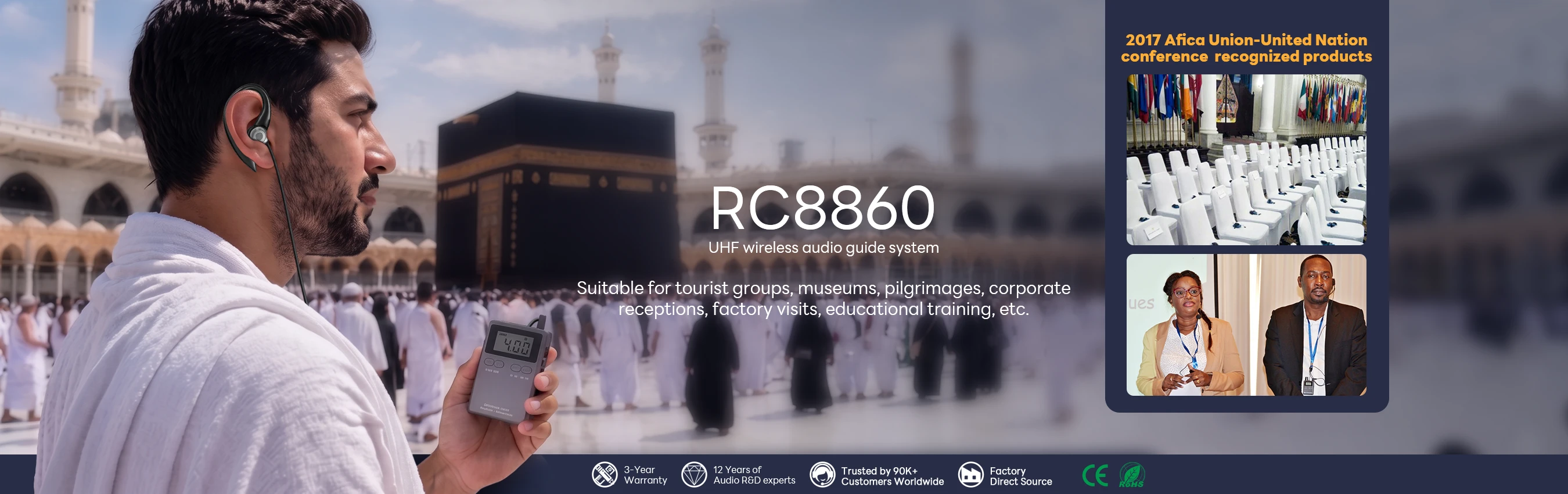
Every wireless tour guide datasheet leads with distance. In real pilgrimage work, distance is the number buyers stop worrying about first. What decides whether a guidance system survives a full day at Mina, Arafat or around the Haram sits elsewhere.
Richitek RC085, RC2468 and RC2402 vs AudioConexus HearMe and Sound Off GLO 3 for Hajj and Umrah Pilgrimage Guidance
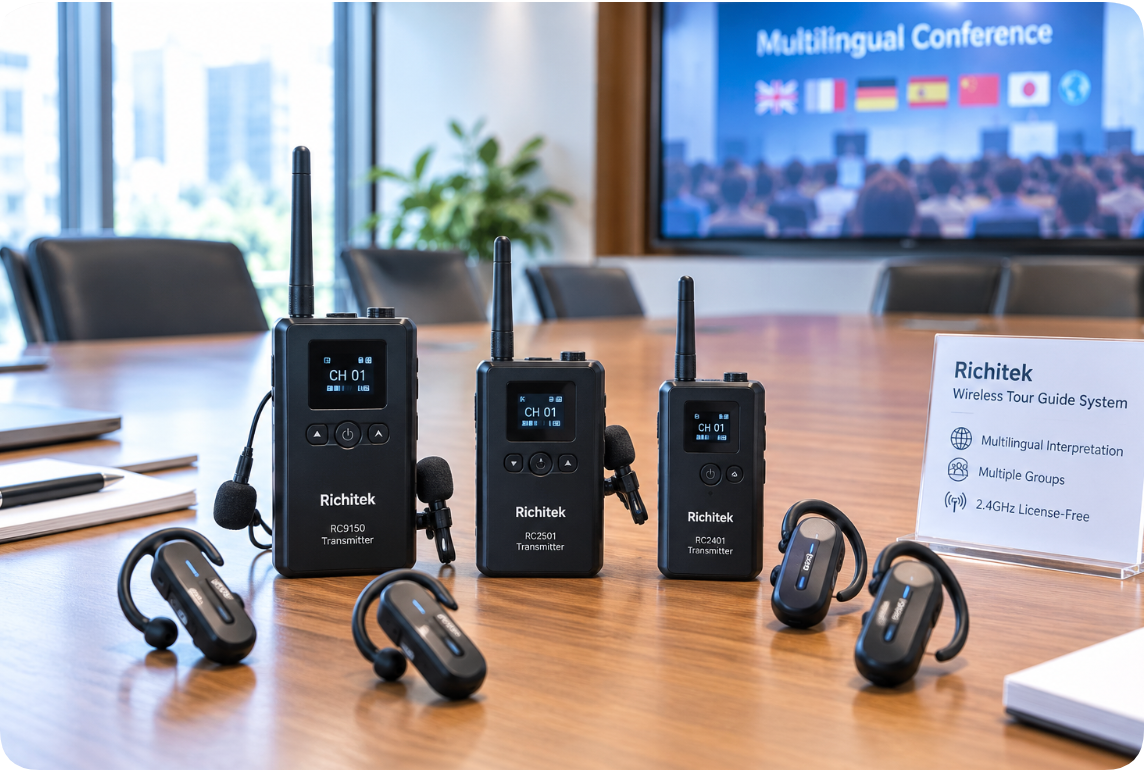
This comparison places three Richitek models against two deployed alternatives for pilgrimage fleets: the AudioConexus HearMe system from Canada and the Sound Off GLO 3 headphone system from the United States. All five are shipping products with published figures; where a manufacturer publishes none, this article says so.
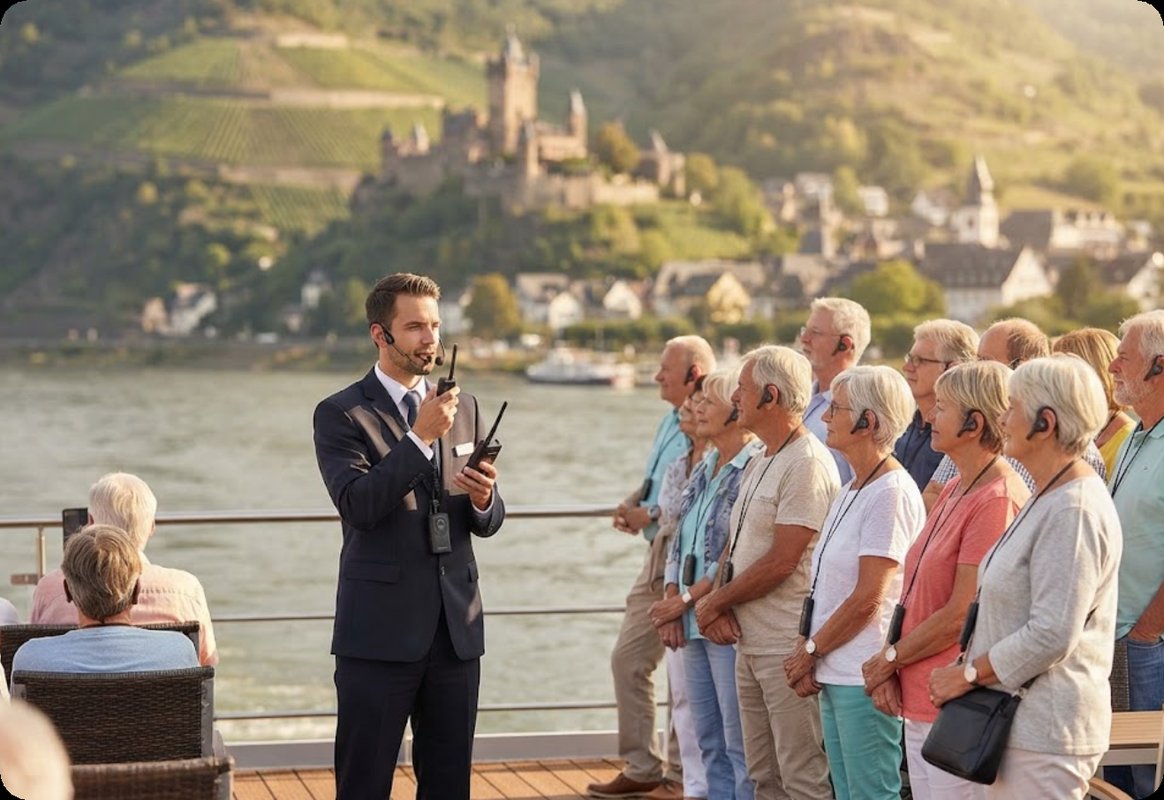
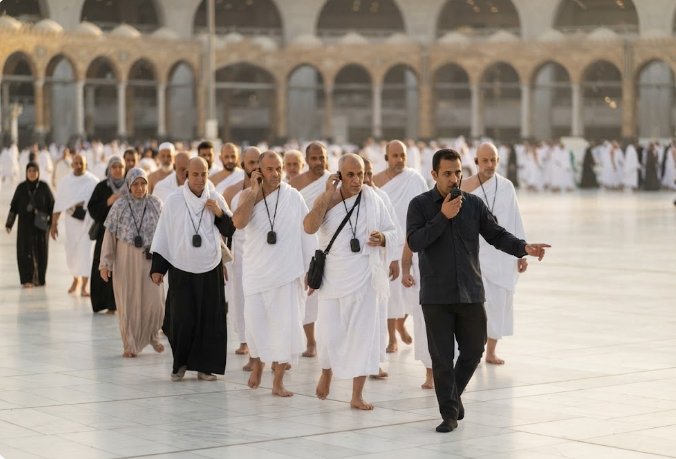
A guide needs gear that can be handed out at dawn, worn for six or seven hours, and collected in the evening without a technician chasing flat batteries across a tent city. The specific demands of group audio for Hajj and Umrah make that plain.
What a Pilgrimage Group Actually Asks of a Wireless System
Three figures matter more than range. The first is channel count, because a pilgrimage convoy is rarely one group. Six language groups may walk the same route in the same hour, and each needs its own channel so nobody hears a commentary they cannot follow. Ten groups on site means ten channels, plus spares.
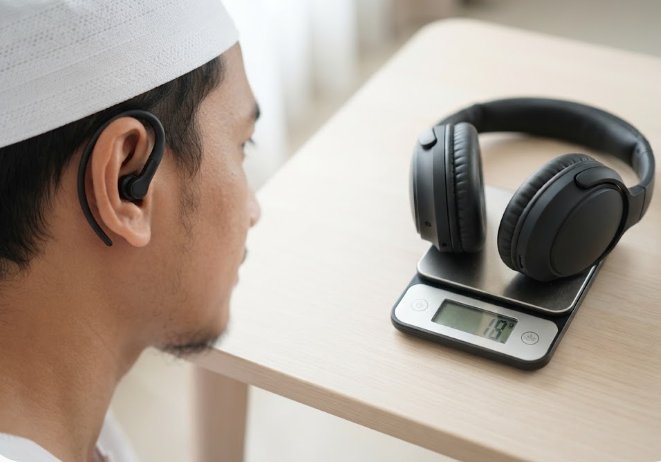
The second is mass. A receiver hanging on a lanyard for seven hours is felt by the end of the day, which is why elderly pilgrims often hand the device back early. An eighteen-gram ear-hook and a two-hundred-gram over-ear headphone are not the same experience after hour four.
The third is receiver endurance. A group leaves before sunrise and returns after dusk, so a receiver rated for eight hours needs a mid-afternoon battery change, and swapping batteries across a hundred units in a crowded street is nobody's preferred workflow.
Range, by contrast, is largely settled: a group stays within thirty to fifty metres of its guide, so a three-hundred-metre claim describes a radio link, not a usable tour.
Three Richitek Choices for Crowded Circuits
RC2402: Fifty Channels and a Twenty-Hour Receiver
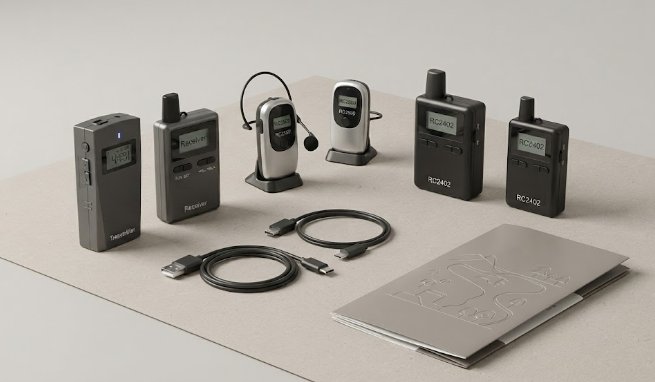
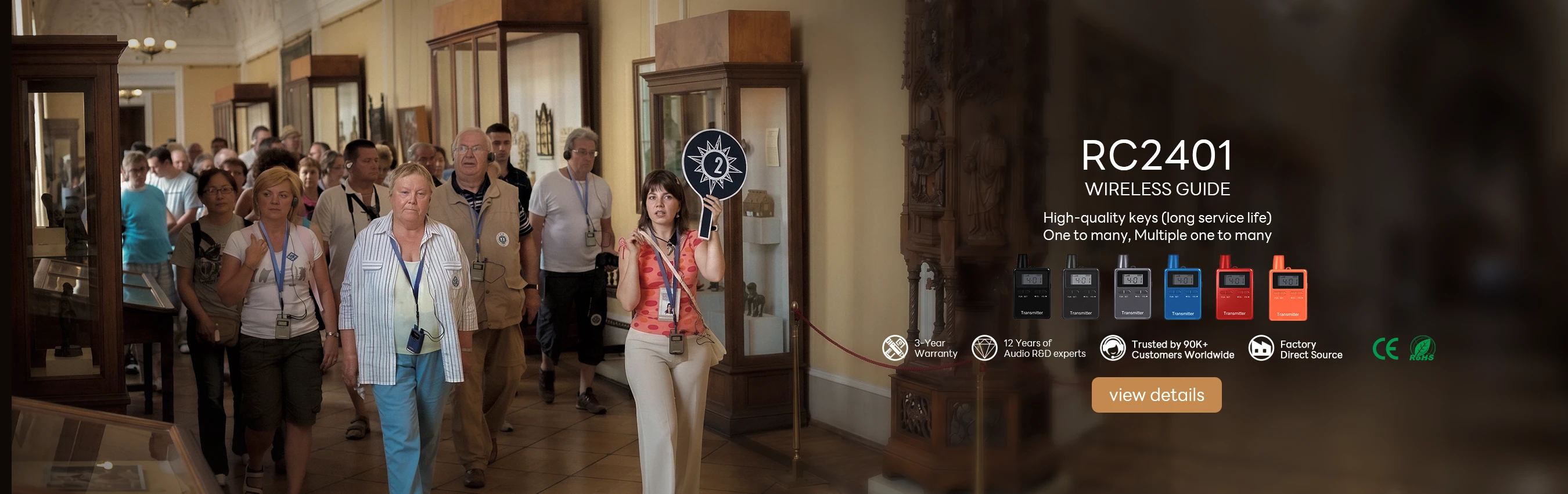
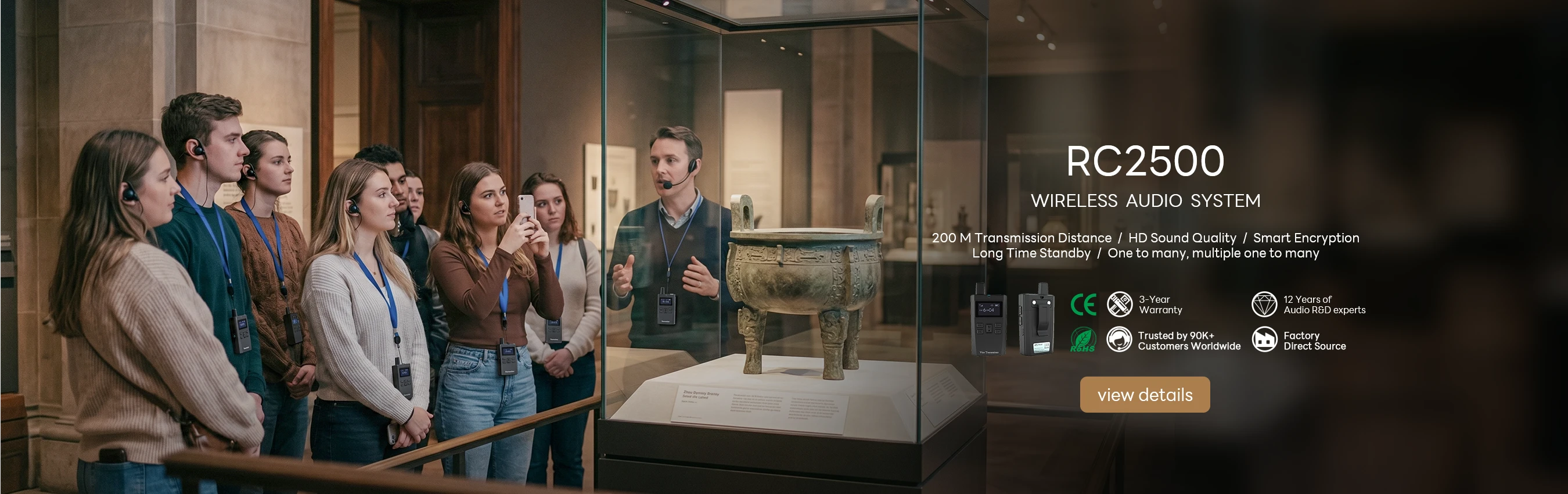
The RC2402 is the standard 2.4 GHz workhorse here, carrying fifty channels on the 2403-2483 MHz band at 10 mW with a published distance of one to two hundred metres. Its value for pilgrimage work is the asymmetry between the two ends of the link: the transmitter runs about ten hours while the receiver runs about twenty, so receivers can go out charged and still finish the day with capacity left. Each receiver weighs fifty grams. Details on the RC2402 page.
RC2468: Eighteen Grams, and an Honest Limit
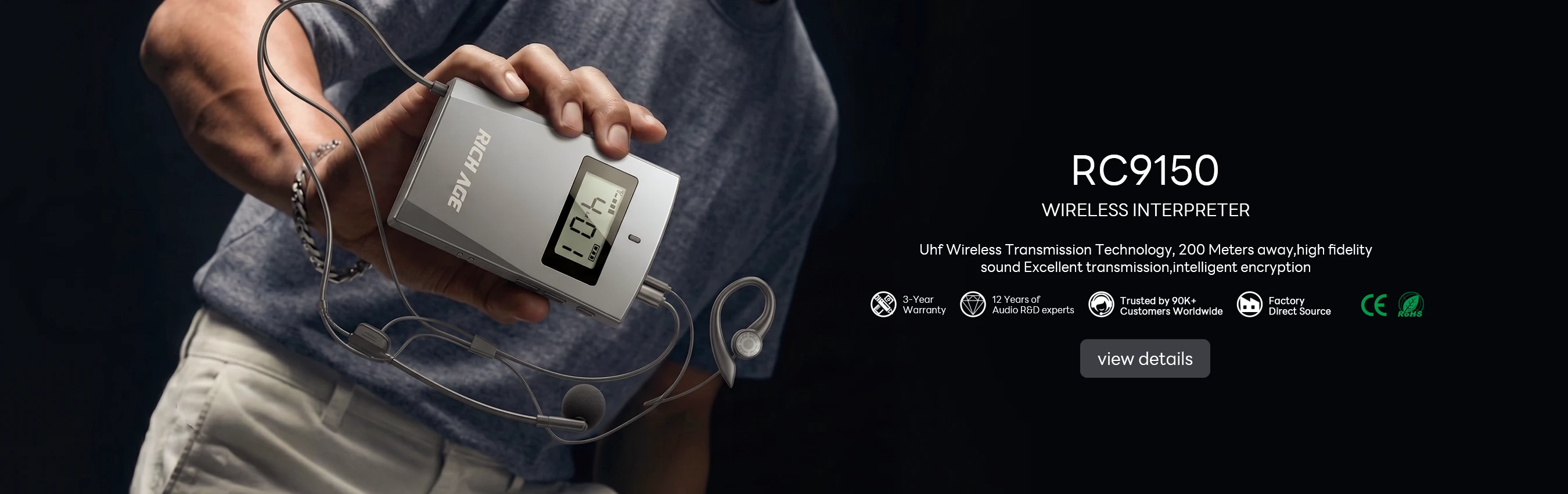
The RC2468 attacks the weight problem directly. Its receiver is an eighteen-gram ear-hook with a 300 mAh battery, roughly a third of the weight of a standard body-worn unit. For a group walking for hours in heat that is not cosmetic; it is why the device stays on the ear instead of ending up in a pocket. The honest limit is endurance: the receiver is published at approximately eight hours, the shortest of the three, so it suits morning circuits or a fleet with an easy swap point. Details are on the RC2468 product page.
RC085: UHF, One Hundred Channels, a Sensitive Microphone
The RC085 leaves the 2.4 GHz band for UHF between 470 and 510 MHz, offering one hundred channels, the largest count in the range. Its other distinguishing figure is microphone sensitivity of approximately -102 dBm, the most sensitive Richitek publishes, which helps when a guide speaks quietly inside a noisy crowd. It shares the twenty-hour receiver endurance of the RC2402. The trade-off is regulatory: UHF allocations differ by country, so a fleet crossing borders on 470-510 MHz needs local frequency coordination, while the 2.4 GHz models travel more easily. More on the RC085 page.
How AudioConexus and Sound Off Handle a Walking Group
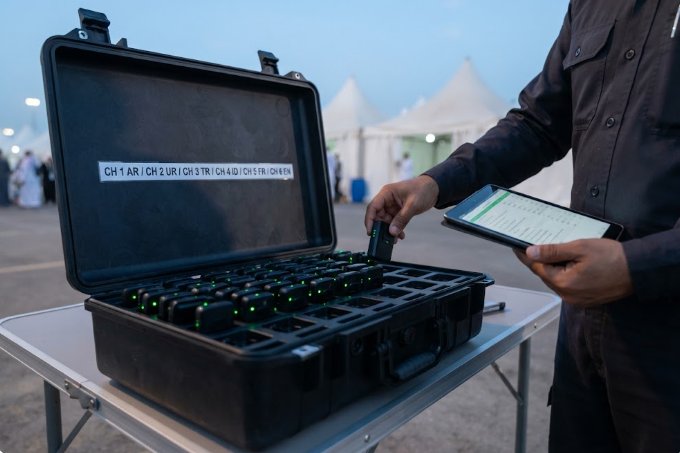
AudioConexus approaches this from the operator side. Its HearMe system uses a body-worn transmitter with no microphone to carry and receivers worn on a belt or around the neck on a lanyard. The company publishes a working distance of up to eighty metres in an open area and up to eight channels used simultaneously for multilingual interpretation, with charger cases holding thirty-six or twelve units. Receiver battery life and receiver weight are not published. Its coachsound system is hardwired and GPS-triggered, and its handheld guide is a pre-recorded player, so neither is a live-voice kit for a walking group.
Sound Off comes from event audio. Its GLO 3 headphone system publishes figures that look strong on paper: an operational distance under three hundred metres, up to sixteen hours of battery life, and 0.22 kilograms for the over-ear headphone. The channel count is three, with a ten-channel variant sold as the GLO 3XC, and the exact RF band is not published. The company states its radio can share audio with two to more than two thousand participants, which is true for a single stream; a route running ten languages needs ten streams, and there a three-channel system stops.
Specification Comparison
| Specification | RC2402 | RC2468 | RC085 | AudioConexus HearMe | Sound Off GLO 3 |
| Frequency band | 2403-2483 MHz | 2403-2483 MHz | 470-510 MHz UHF | Not published | Not published |
| Channels | 50 | 50 | 100 | Up to 8 simultaneous | 3 (GLO 3XC: 10) |
| Published working distance | 1-200 m | 1-200 m | 1-200 m | 80 m open area | Under 300 m |
| Transmitter battery life | 10 h | 12 h | 12 h | Not published | Not published |
| Receiver battery life | 20 h | Approx. 8 h | 20 h | Not published | Up to 16 h |
| Receiver weight | 50 g | 18 g ear-hook | Not published | Not published | 0.22 kg over-ear |
| Worn as | Body-worn receiver | Ear-hook receiver | Body-worn receiver | Belt or lanyard receiver | Over-ear headphone |
| Microphone sensitivity | Not published | Not published | Approx. -102 dBm | Not published | Not published |
Where Richitek Falls Short
Two honest weaknesses belong here. First, the model built for comfort has the shortest endurance: the eighteen-gram RC2468 runs roughly eight hours while the GLO 3 is published at up to sixteen. Second, Richitek does not lead on raw range, publishing one to two hundred metres against under three hundred for the GLO 3.
A third limitation is architectural: the RC series is a live-voice system with no GPS-triggered or pre-recorded commentary, so automatic narration at fixed points requires a second product.
How to Choose for a Pilgrimage Fleet
Match the model to the circuit, not the datasheet headline. Morning-only groups suit the RC2468, where eighteen grams buys real comfort. Full-day convoys suit the RC2402, whose twenty-hour receiver covers the route on one charge. Groups running a dozen languages, or guiding through heavy noise, are the case for the RC085 and its hundred channels. The wider tour guide system range covers the remaining combinations of channel count, weight and band.
Plan the Next Pilgrimage Season With Richitek
A pilgrimage fleet is bought once and reused every season, so the decision deserves a side-by-side read. The head-to-head comparison library collects these breakdowns across venues and brands, and Richitek can quote mixed fleets that pair light ear-hook receivers for walking groups with higher-channel transmitters for the interpreter tent.