A leading China factory specializing in Wireless Tour Guide Systems, Church Audio Guides, and Translation Headphones with premium OEM/ODM solutions.

Tel:+86 18922879583

Email:tiger.wang@richitek.com

Richitek RC2406, RC2500 and RC2501 vs Linkx TG-300 and ME2 for School Field Trips

The Trip Ends, the Fleet Does Not

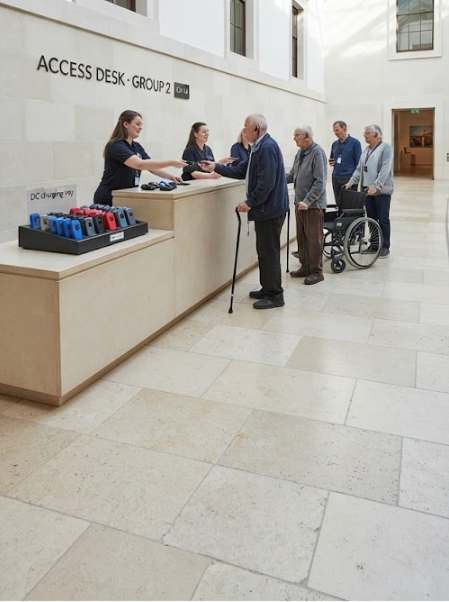
A school buys a tour guide system the way it buys a set of lab coats. It is ordered once, entered into a budget line, and then handed out to classes that never meet each other. The outing lasts a morning. The kit outlives every student who wears it, and usually the teacher who signed the order as well.

That gap between one morning and one decade is where school purchases go wrong. A set gets chosen on the strength of a range figure quoted at a trade fair, or on the unit price of a receiver, and then it goes into a cupboard and comes out forty times a year. The questions that decide whether it survives are duller than range: how many groups can run at the same time, how long a receiver lasts on a single charge, what a student carries on a lanyard for four hours, and what the charging ports look like in the third year. School group audio systems deserve to be judged on that basis.

⚖️ Richitek RC2406, RC2500 and RC2501 vs Linkx TG-300 and ME2 for School Field Trips

This comparison sets three Richitek models against two systems that schools consider in the same bracket: the Linkx TG-300, a mid-range transmitter, and the ME2, an ear-hook transmitter and receiver set. All three Richitek units run on the 2.4 GHz ISM band and are licence-free worldwide, which matters the moment a coach crosses a border. What separates the three from one another is not the band they use. It is what each one assumes about the people handling it.

🎓 What a School Fleet Has to Survive

Three things wear out a school audio fleet, and none of them is the radio. The first is the sign-out: whether one set can be split across several classes that leave at the same time. The second is the fortnightly routine: what goes into a bag, what hangs on a student, and how long a receiver survives a school day without a charger nearby. The third is the long tail: whether the ports still grip, whether batteries still hold their charge, and what the warranty actually covers in year three. Each of the three Richitek models below answers one of those questions more directly than the others.

Eighty Channels Is a Timetable Tool

The RC2406 is the model built for the sign-out desk. It carries 80 channels on PLL frequency synthesis, which in a school context is not a radio specification so much as a scheduling one: four classes can leave through the same gate at the same time on four separate channels, and a fifth group can be added without reissuing anything. Its transmitter runs 10 hours and its receiver 20 hours on a 3.7 V 1000 mAh cell, so a full teaching day sits inside one charge. At 59 g for the transmitter and 50 g for the receiver, it is light enough for younger students to wear on a lanyard. The RC2406 is also the only model here rated IPX4 splash resistant, and it charges over a DC port.
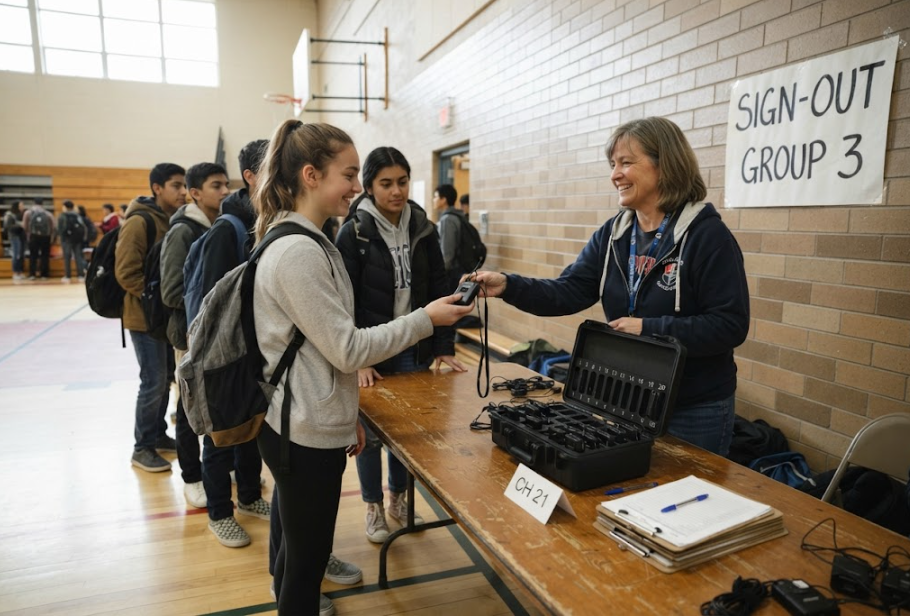
richitek school_field_trip vs linkx me2 1

The Handover That Takes One Button

The RC2500 answers the routine. It is the heavy one in this group at 104 g for both transmitter and receiver, and that weight buys two things: a 3.7 V 1800 mAh cell in each unit, giving 15 hours on the transmitter and 35+ hours on the receiver, and a set of one-click controls. One button synchronises the frequency, one powers the units down, one mutes the microphone. In a school that is the difference between a teacher spending ten minutes pairing receivers before a bus leaves and a teacher pressing a button while the class files past. The RC2500 also runs a one-to-many broadcast mode for assemblies, works between −15 °C and +50 °C, and charges over Type-C.
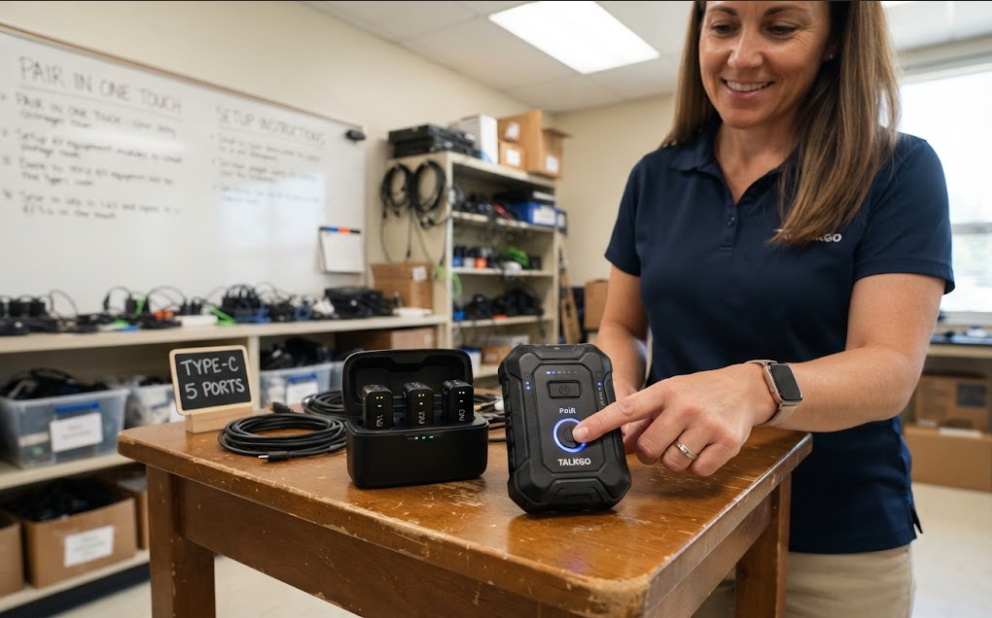
richitek school_field_trip vs linkx me2 2

🎓 Forty-Seven Grams in a Student's Hand

The RC2501 is the one a student forgets they are wearing. Transmitter and receiver both weigh 47 g, and the whole unit measures 86 × 50 × 19 mm, so it sits in a pocket when it is not in use. It pairs that weight with the same 35+ hour receiver life as the RC2500 on a 3.7 V 1000 mAh cell, and it is the only model here that publishes 13 mW output rather than 10 mW. It also takes an optional headset or lavalier microphone, with MIC sensitivity quoted at approximately −38 dBm, and runs between −10 °C and +45 °C. For a school that sends students out in pairs rather than as one block, multi-group independent transmission keeps the groups apart without crosstalk.

richitek school_field_trip vs linkx me2 3

Three Models, One Sheet

DimensionRC2406RC2500RC2501
Frequency band2403–2483 MHz2403–2483 MHz2403–2483 MHz
Channels805050
Transmission distance1–200 m1–200 m1–200 m
Output power10 mW10 mW13 mW
Transmitter battery life10 h15 h15 h
Receiver battery life20 h35+ h35+ h
Transmitter weight59 g104 g47 g
Receiver weight50 g104 g47 g
Charging portDC PortType-CType-C
CertificationRoHSCE, EMC, LVD, RED, RoHSCE, RoHS
Warranty3 years3 years3 years

All three carry a three-year warranty that covers the mainboard, with the headset, microphone and battery excluded, and all three are available with OEM/ODM customisation. The sheet above is the part of a school purchase that gets filed; the rest of the wireless tour guide system range is where the differences between these models were decided.

Where Linkx and ME2 Pull Ahead

Two competitor strengths deserve a straight account. The ME2 publishes a receiver weight of 20 g, which is lighter than anything Richitek lists in this article — the lightest unit here is the RC2501 at 47 g. ME2 also quotes a two-hour fast charge, and Richitek publishes no equivalent charging-time figure for these three models, so the two cannot be compared on that point at all. On the transmitter side, the Linkx TG-300 is lighter than two of the three Richitek models at 49 g, and it charges over USB, which is the cable a school is most likely to already have in a drawer. In contrast, the RC2406 uses a DC port, and only the RC2500 and RC2501 move to Type-C. Range runs the other way: the Richitek units are rated to 200 m against the 150 m published for the TG-300, and the RC2406 offers 80 channels against the 39 listed for the ME2.

🎓 What a School Should Ask Before It Buys

Ask how many groups must run simultaneously before choosing a model, because that number decides whether 50 channels is generous or tight. Ask how long a receiver lasts, because 20 hours and 35+ hours describe two different school days. Ask what the heaviest unit weighs, because a 104 g transmitter and a 47 g one feel like different objects after four hours. Then ask what happens in year three. A fleet is bought once and judged for years, and the model that suits a school is the one whose weakest number the school can live with.

If a single class is the normal unit, the RC2501 covers it at the lowest weight and the longest receiver life. If several groups leave together, the RC2406 and its 80 channels are the practical answer. If one teacher has to hand out and recover the whole set alone, the one-click controls on the RC2500 are worth the extra grams. You can also work through the head-to-head comparisons to see how these three sit against other systems.

2026年09月17日 15:56
click: 41
no data
Home > VS

Richitek RC2406, RC2500 and RC2501 vs Linkx TG-300 and ME2 for School Field Trips

time: 2026年09月17日 click:41

The Trip Ends, the Fleet Does Not

A school buys a tour guide system the way it buys a set of lab coats. It is ordered once, entered into a budget line, and then handed out to classes that never meet each other. The outing lasts a morning. The kit outlives every student who wears it, and usually the teacher who signed the order as well.

That gap between one morning and one decade is where school purchases go wrong. A set gets chosen on the strength of a range figure quoted at a trade fair, or on the unit price of a receiver, and then it goes into a cupboard and comes out forty times a year. The questions that decide whether it survives are duller than range: how many groups can run at the same time, how long a receiver lasts on a single charge, what a student carries on a lanyard for four hours, and what the charging ports look like in the third year. School group audio systems deserve to be judged on that basis.

⚖️ Richitek RC2406, RC2500 and RC2501 vs Linkx TG-300 and ME2 for School Field Trips

This comparison sets three Richitek models against two systems that schools consider in the same bracket: the Linkx TG-300, a mid-range transmitter, and the ME2, an ear-hook transmitter and receiver set. All three Richitek units run on the 2.4 GHz ISM band and are licence-free worldwide, which matters the moment a coach crosses a border. What separates the three from one another is not the band they use. It is what each one assumes about the people handling it.

🎓 What a School Fleet Has to Survive

Three things wear out a school audio fleet, and none of them is the radio. The first is the sign-out: whether one set can be split across several classes that leave at the same time. The second is the fortnightly routine: what goes into a bag, what hangs on a student, and how long a receiver survives a school day without a charger nearby. The third is the long tail: whether the ports still grip, whether batteries still hold their charge, and what the warranty actually covers in year three. Each of the three Richitek models below answers one of those questions more directly than the others.

Eighty Channels Is a Timetable Tool

The RC2406 is the model built for the sign-out desk. It carries 80 channels on PLL frequency synthesis, which in a school context is not a radio specification so much as a scheduling one: four classes can leave through the same gate at the same time on four separate channels, and a fifth group can be added without reissuing anything. Its transmitter runs 10 hours and its receiver 20 hours on a 3.7 V 1000 mAh cell, so a full teaching day sits inside one charge. At 59 g for the transmitter and 50 g for the receiver, it is light enough for younger students to wear on a lanyard. The RC2406 is also the only model here rated IPX4 splash resistant, and it charges over a DC port.

richitek school_field_trip vs linkx me2 1

The Handover That Takes One Button

The RC2500 answers the routine. It is the heavy one in this group at 104 g for both transmitter and receiver, and that weight buys two things: a 3.7 V 1800 mAh cell in each unit, giving 15 hours on the transmitter and 35+ hours on the receiver, and a set of one-click controls. One button synchronises the frequency, one powers the units down, one mutes the microphone. In a school that is the difference between a teacher spending ten minutes pairing receivers before a bus leaves and a teacher pressing a button while the class files past. The RC2500 also runs a one-to-many broadcast mode for assemblies, works between −15 °C and +50 °C, and charges over Type-C.

richitek school_field_trip vs linkx me2 2

🎓 Forty-Seven Grams in a Student's Hand

The RC2501 is the one a student forgets they are wearing. Transmitter and receiver both weigh 47 g, and the whole unit measures 86 × 50 × 19 mm, so it sits in a pocket when it is not in use. It pairs that weight with the same 35+ hour receiver life as the RC2500 on a 3.7 V 1000 mAh cell, and it is the only model here that publishes 13 mW output rather than 10 mW. It also takes an optional headset or lavalier microphone, with MIC sensitivity quoted at approximately −38 dBm, and runs between −10 °C and +45 °C. For a school that sends students out in pairs rather than as one block, multi-group independent transmission keeps the groups apart without crosstalk.

richitek school_field_trip vs linkx me2 3

Three Models, One Sheet

DimensionRC2406RC2500RC2501
Frequency band2403–2483 MHz2403–2483 MHz2403–2483 MHz
Channels805050
Transmission distance1–200 m1–200 m1–200 m
Output power10 mW10 mW13 mW
Transmitter battery life10 h15 h15 h
Receiver battery life20 h35+ h35+ h
Transmitter weight59 g104 g47 g
Receiver weight50 g104 g47 g
Charging portDC PortType-CType-C
CertificationRoHSCE, EMC, LVD, RED, RoHSCE, RoHS
Warranty3 years3 years3 years

All three carry a three-year warranty that covers the mainboard, with the headset, microphone and battery excluded, and all three are available with OEM/ODM customisation. The sheet above is the part of a school purchase that gets filed; the rest of the wireless tour guide system range is where the differences between these models were decided.

Where Linkx and ME2 Pull Ahead

Two competitor strengths deserve a straight account. The ME2 publishes a receiver weight of 20 g, which is lighter than anything Richitek lists in this article — the lightest unit here is the RC2501 at 47 g. ME2 also quotes a two-hour fast charge, and Richitek publishes no equivalent charging-time figure for these three models, so the two cannot be compared on that point at all. On the transmitter side, the Linkx TG-300 is lighter than two of the three Richitek models at 49 g, and it charges over USB, which is the cable a school is most likely to already have in a drawer. In contrast, the RC2406 uses a DC port, and only the RC2500 and RC2501 move to Type-C. Range runs the other way: the Richitek units are rated to 200 m against the 150 m published for the TG-300, and the RC2406 offers 80 channels against the 39 listed for the ME2.

🎓 What a School Should Ask Before It Buys

Ask how many groups must run simultaneously before choosing a model, because that number decides whether 50 channels is generous or tight. Ask how long a receiver lasts, because 20 hours and 35+ hours describe two different school days. Ask what the heaviest unit weighs, because a 104 g transmitter and a 47 g one feel like different objects after four hours. Then ask what happens in year three. A fleet is bought once and judged for years, and the model that suits a school is the one whose weakest number the school can live with.

If a single class is the normal unit, the RC2501 covers it at the lowest weight and the longest receiver life. If several groups leave together, the RC2406 and its 80 channels are the practical answer. If one teacher has to hand out and recover the whole set alone, the one-click controls on the RC2500 are worth the extra grams. You can also work through the head-to-head comparisons to see how these three sit against other systems.

no data
×

Contact us

email:
name:
subject:
content: