.webp)

Regroup at Every Crossing
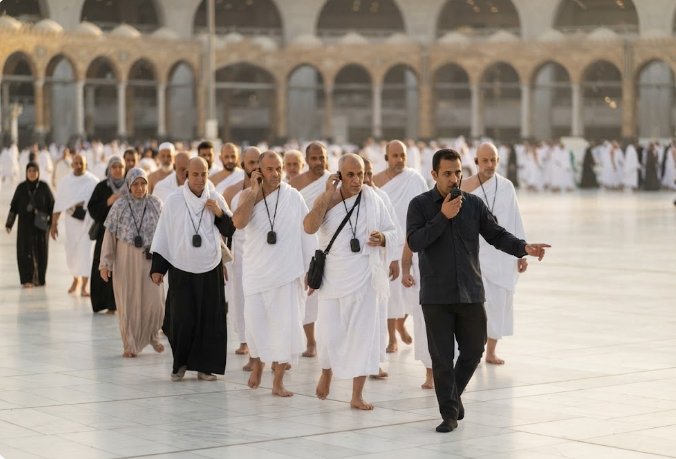
A city walking tour is not one continuous walk. It is a sequence of regroups: the guide waits at a traffic light while half the group is still on the far pavement, counts heads in a market lane, and starts talking again only when the last visitor has cleared the metro gate. Every crossing is a small stress test for the audio system. Pavement reflects sound differently from a museum wall, traffic bursts between sentences, and a group that holds together in a gallery falls apart within one block of a busy intersection. The guide who runs city walking tour solutions for a living needs range that reaches across a street, receivers that guests forget they are wearing, and channels that survive a crowded plaza. Get those three right and the tour flows; get one of them wrong and every red light becomes an interruption.
⚖️ Richitek RC9150, RC2468 and RC085 vs EXMAX ATG-100T and Televic Unite for City Walking Tours
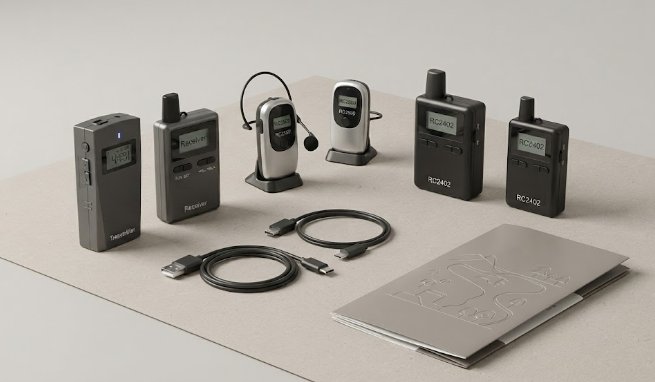
This comparison puts three Richitek systems against two well-known alternatives. The EXMAX ATG-100T is a budget VHF transmitter set popular with school and scout groups, publishing 99 frequency channels and up to 40 groups working at once. The Televic Unite UHF938 sits at the other end of the market: a Belgian bidirectional digital system with encrypted transmission and Dante connectivity, priced around USD 500 per set. The three Richitek models cover the ground between them, and each earns its place on a street route for a different reason: one buys channel headroom, one buys comfort, and one buys UHF behaviour in noise. The sections below take each model through the same city day, then put all five systems side by side.
RC9150: One Hundred Channels Above the Plaza Noise
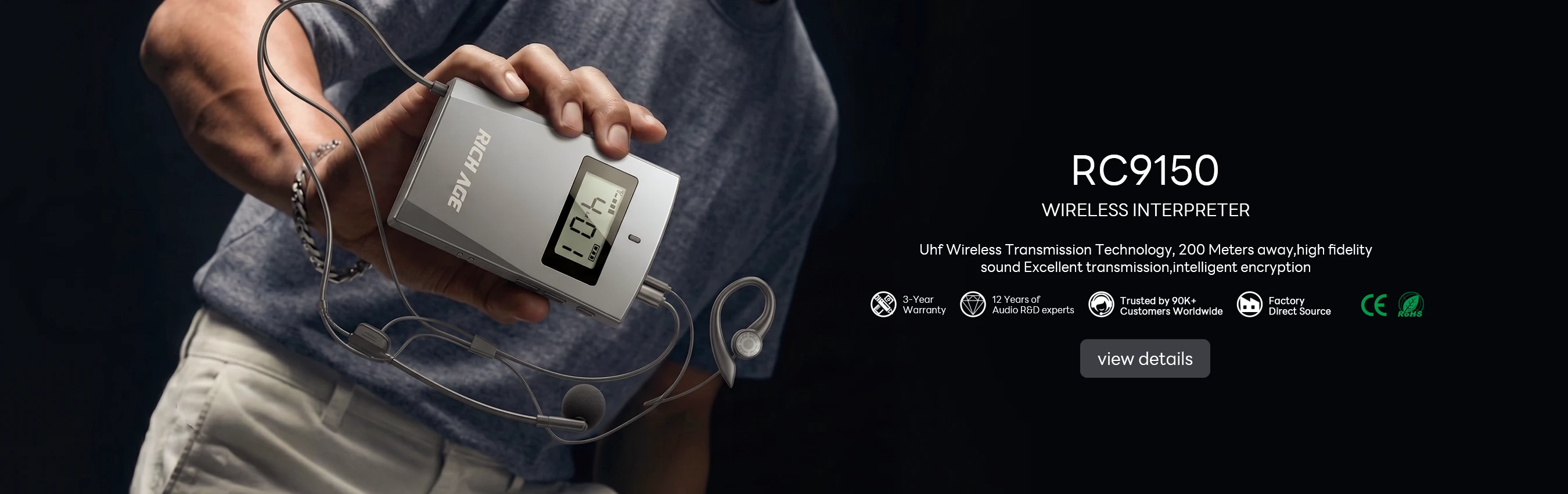
The RC9150 is the flagship, built for the moments when a square is full of other groups. It runs on the 2403-2483 MHz ISM band with 100 independent channels and PLL synthesis, so two, three or four tours can share a plaza without crosstalk. That headroom matters most in high season, when the guide cannot choose who else is working the same square. The published working range of 1-200 m easily spans a wide crossing, which means the guide keeps talking while the group is still converging from the far side. The transmitter runs 15 hours from an 1800 mAh cell and recharges over Type-C, and the receiver holds more than 35 hours of standby, enough to cover a weekend of back-to-back departures without a charge. Operators who need a reference for the full RC9150 specification will find the channel plan and battery details on the product page.
RC2468: Eighteen Grams from Square to Metro Gate
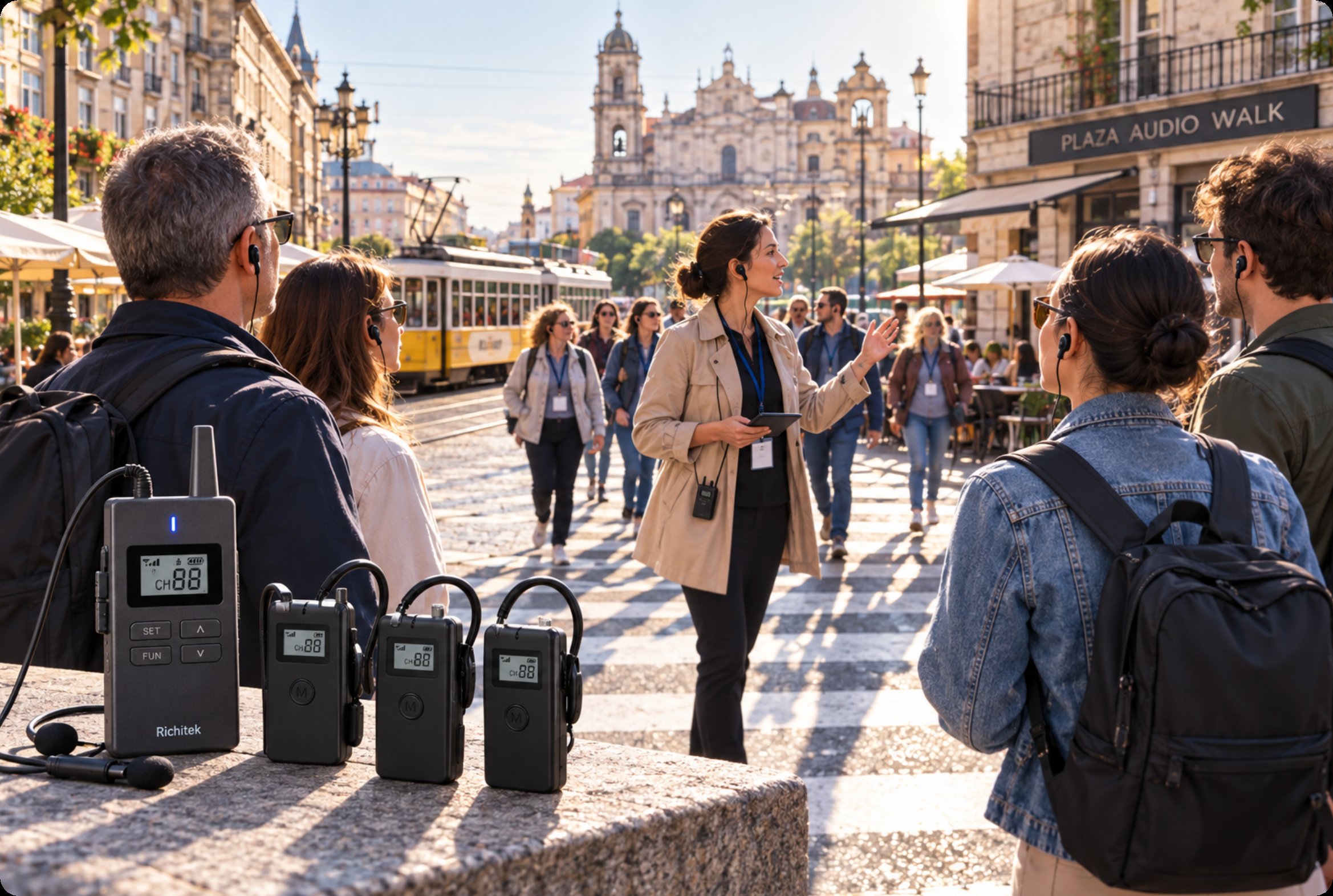
The RC2468 answers a different city problem: what a guest is willing to wear for eight hours. Its receiver is an 18 g ear-hook, light enough that a visitor stepping off a curb or ducking into a metro entrance stops noticing it is there. Weight is not a luxury on a street route; it is the difference between guests who keep the earpiece on and guests who quietly pocket it at the first stop. The transmitter is 59 g and runs about 10 hours on a 1500 mAh battery, comfortably more than most walking itineraries ask of it. Fifty PLL-locked channels hold group separation in the old town, and the same 1-200 m range applies in open areas. For operators who hand equipment to the public every day, the RC2468 is the model that disappears into the tour, which is exactly what a street route wants from a receiver.

RC085: The UHF Workhorse for the Loudest Arterials
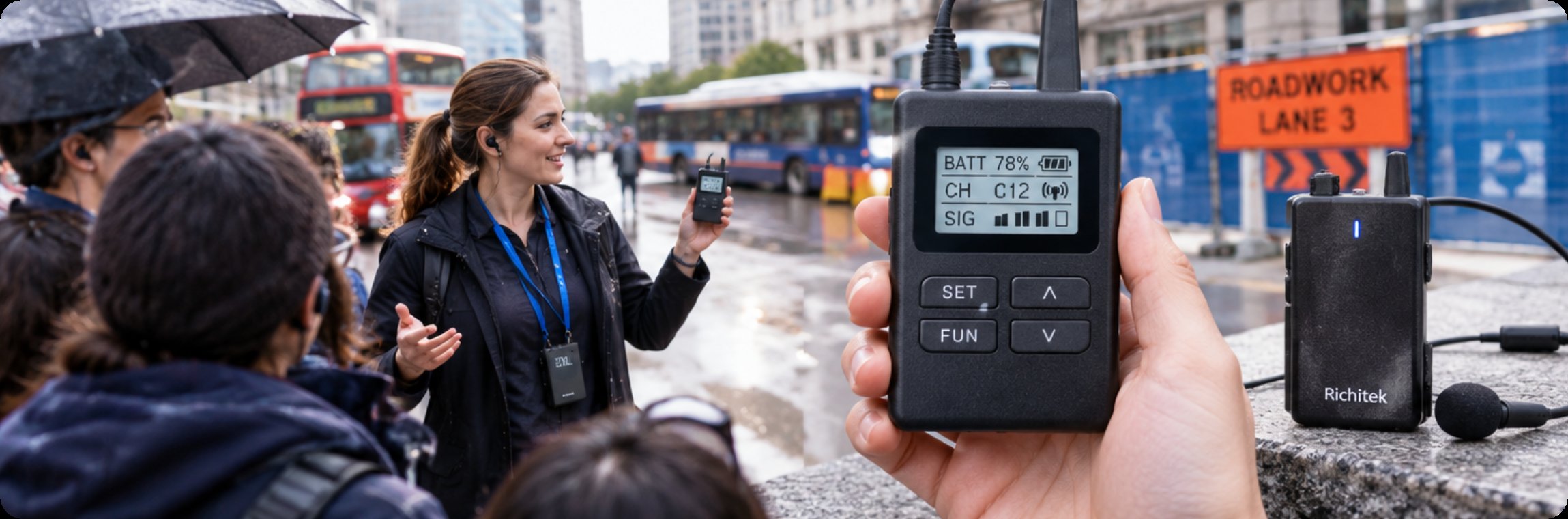
The RC085 moves to UHF, operating at 470-510 MHz with GFSK modulation and 100 channels. Lower frequencies penetrate street canyons and building edges differently from 2.4 GHz, and some operators simply prefer UHF behaviour on loud arterials with buses and roadworks. The receiver carries an LCD smart screen showing battery, channel and signal at a glance, which a guide can read across a huddle without opening an app — a small convenience that becomes valuable when the group is standing in the rain under an awning. It also supports F1 one-way and F2 two-way modes, optional headset or lavalier microphones, and automatic sleep and wake-up between departures, so a kit that waits in the office between Monday and Saturday does not arrive flat on Sunday. The RC085 is the working option for routes that never leave the noise.
How EXMAX and Televic Cover the Same Streets
The EXMAX ATG-100T works in the 195-230 MHz VHF band and publishes a range of 50-60 m. On a city route that figure matters at exactly the wrong moment: a crossing of a four-lane avenue can consume the entire budget, and the guide must shorten the leash, wait, or repeat the story twice. Its 99 channels are genuine, and roughly 18 hours of transmitter battery is honest endurance for the price class, which is why the set remains common with school outings that stay inside a single campus. The Televic Unite UHF938 approaches the street from the professional end: UHF, 30 channels, around 150 m of range, bidirectional encrypted digital audio, and multi-presenter support that suits broadcast-style productions more than walking groups. The premium price reflects that positioning. Between the two, the 200 m class of all three Richitek models is what keeps a tour narrated through a regroup rather than paused by one, and it is the single specification a city operator should read first.
One Table, Five Systems
| Comparison | RC9150 | RC2468 | RC085 | EXMAX ATG-100T | Televic Unite |
|---|---|---|---|---|---|
| Core band | 2403-2483 MHz | 2403-2483 MHz | 470-510 MHz | 195-230 MHz | UHF |
| Channels | 100 | 50 | 100 | 99 | 30 |
| Working range | 200 m | 200 m | 200 m | 50-60 m | approx. 150 m |
| Receiver weight | 97.5 g | 18 g ear-hook | 60 g | ear-hook (light) | Not published |
| Transmitter battery | 15 h | approx. 10 h | 12 h | approx. 18 h | Not published |
Where the Richitek Trio Falls Short
An honest comparison has to name the trade-offs. The RC2468 receiver runs on a 300 mAh cell for roughly 8 hours, the shortest figure of the three, and it charges over Micro USB, the oldest port in the line-up; on a full-day route it wants a midday top-up. The RC9150 pays for its 100 channels and 35+ hour standby in weight, with 97.5 g receivers that cost five times the RC2468 ear-hook across a whole day on a visitor's ear. The RC085 lives on 470-510 MHz, which is not licence-free everywhere: in the United States that spectrum carries television allocations, and in Europe the licence-free UHF window sits at 863-865 MHz, so an operator must confirm regional rules before shipping kits abroad. And none of the three advertises encrypted audio, where the Televic Unite line does. These are the numbers a buyer should weigh against the route, not against a brochure.
Matching the System to the Route
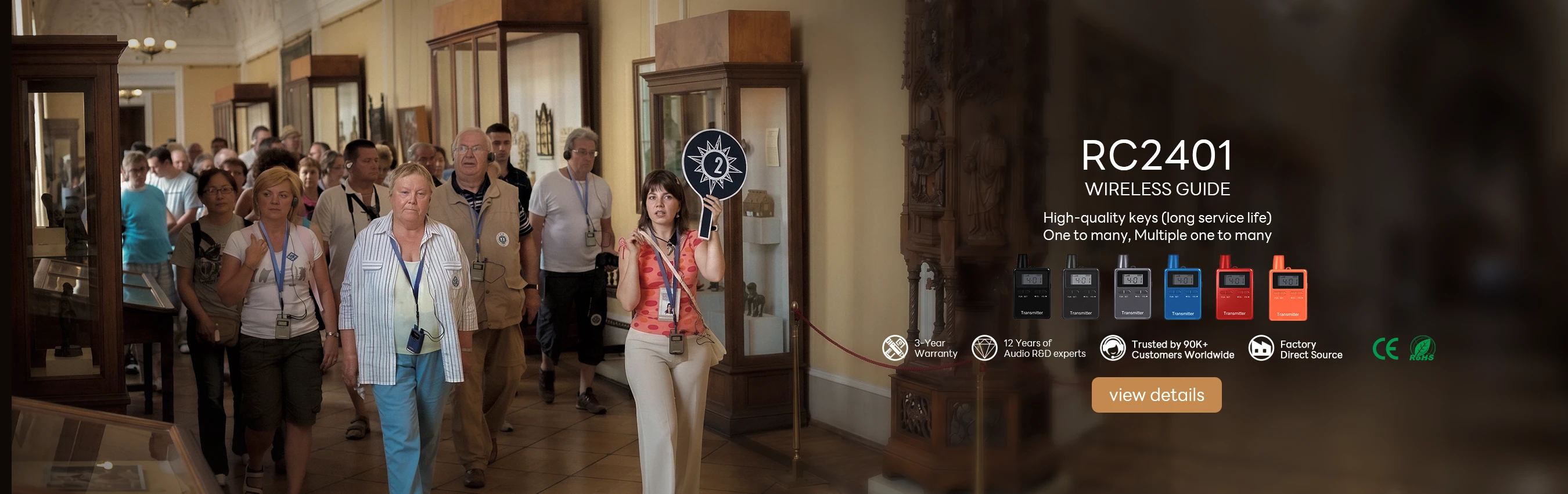
Match the model to the shape of the day. If the route runs through packed squares and the operator needs every channel it can get, the RC9150 brings 100 channels and the longest receiver standby. If guests range in age from children to cruise passengers and comfort decides the reviews, the 18 g RC2468 ear-hook is the honest pick. If the streets are loud, the LCD status screen and two-way F2 mode of the RC085 keep the guide in command. The full wireless tour guide system range lists all ten models with channel plans and charging options, and the head-to-head comparisons show how these systems fare against other brands scene by scene. A city tour is judged at every crossing, and the right system is the one that lets the guide count heads without ever raising a voice.