A leading China factory specializing in Wireless Tour Guide Systems, Church Audio Guides, and Translation Headphones with premium OEM/ODM solutions.

Tel:+86 18922879583

Email:tiger.wang@richitek.com

Richitek RC9150, RC2500 and RC2402 vs Orpheo Mikro LX and MuseumMate for Heritage Sightseeing Tours

Two Ways to Tell One Old Town

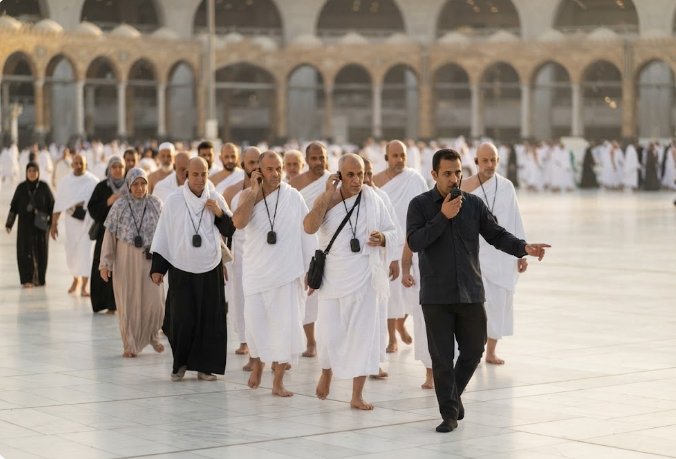
Every heritage sightseeing operation makes the same decision at the gate, season after season: do visitors borrow the story, or does a guide carry it to them? The player rack hands each guest a device that narrates stop forty-two on cue; the guide-led group walks behind one voice that answers back. Both models sell the same cobbles, and both are honest ways to run a route — which is why the comparison deserves better than a slogan. A team that runs city walking tour solutions across an old town needs to know where a live system earns its keep, where the rack is genuinely the smarter purchase, and what the hardware difference looks like line by line.

⚖️ Richitek RC9150, RC2500 and RC2402 vs Orpheo Mikro LX and MuseumMate for Heritage Sightseeing Tours

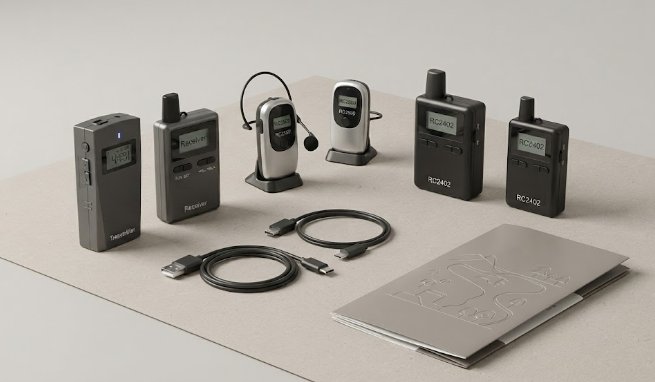
This comparison puts three Richitek live-guided systems against two established European suppliers of the self-guided model. Orpheo Group, founded in Paris with studios in New York, built its name on the Mikro LX audio player — trigger points, synchronised video, an anti-theft frame, and housings rated for wet and dry rooms — alongside the Orpheo Tour Guide, a digital group system with an OLED colour screen. MuseumMate, headquartered in Madrid since 1996 under OnCulture Capital, supplies multimedia guide hardware and the content platform behind it to museums, galleries and heritage sites across Spain, Italy, Portugal and the UK. Neither competitor publishes channel counts or radio band data for its hardware, so the table below compares what each side actually documents: device class, power, battery, weight and the working model around the visitor.
richitek heritage_sightseeing_tour vs orpheo museummate 1

RC9150: One Hundred Channels in the Grand Square

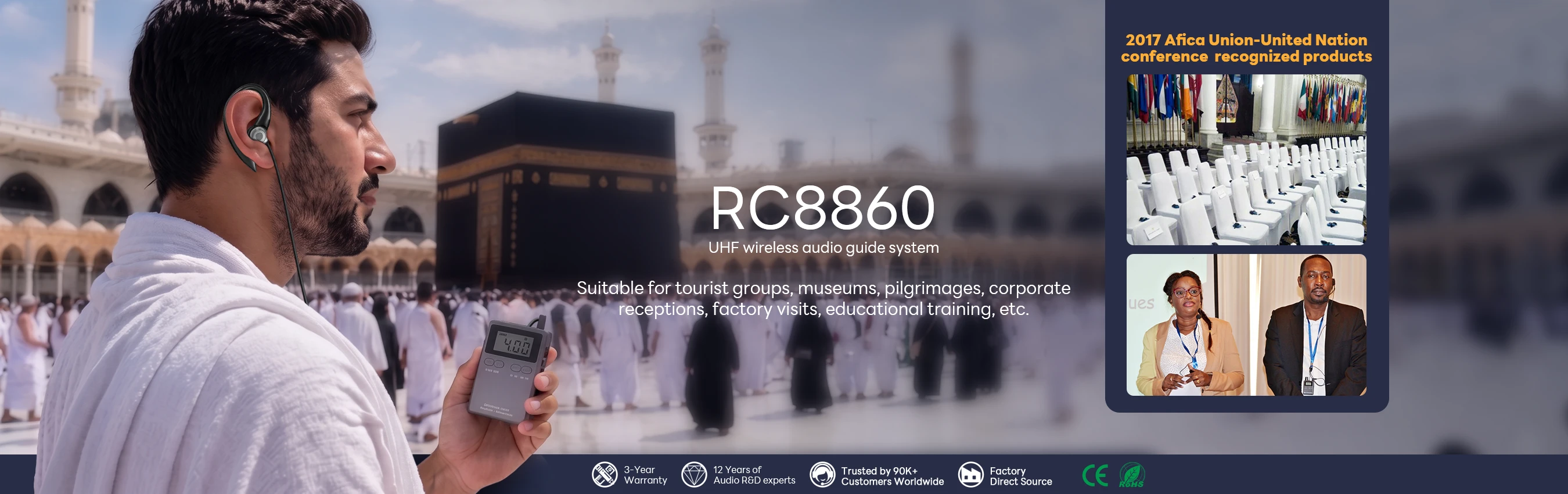
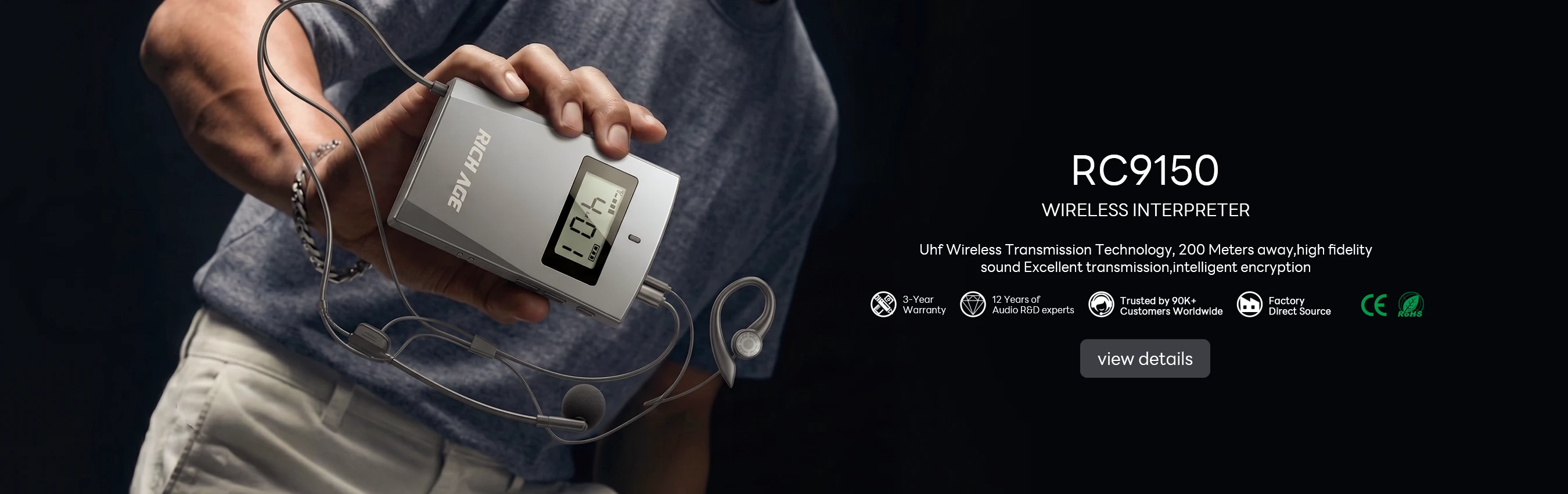
The oldest quarters of a city concentrate crowds the way a cathedral concentrates echoes, and the RC9150 is built for exactly that density. One hundred selectable channels mean three operators can run overlapping loops around the same square without a group ever drifting onto a neighbour's frequency, and the 20 mW output holds a clean signal at the full 200-metre class range across open ground. The 2.4 GHz band is licence-free across borders, so a seasonal route that crosses from one country's old quarter into another needs no frequency paperwork. Receivers run roughly forty hours per charge on a 3.7 V 1800 mAh cell — a full week of morning departures before the charging case comes out — and the full 20 Hz to 20 kHz response keeps music stops, not just speech, honest.

The RC9150's full specification is here, and its role in a fleet is simple: it is the system you assign to the loudest, most crowded heritage route on the map.

RC2500: The Flagship That Syncs Itself

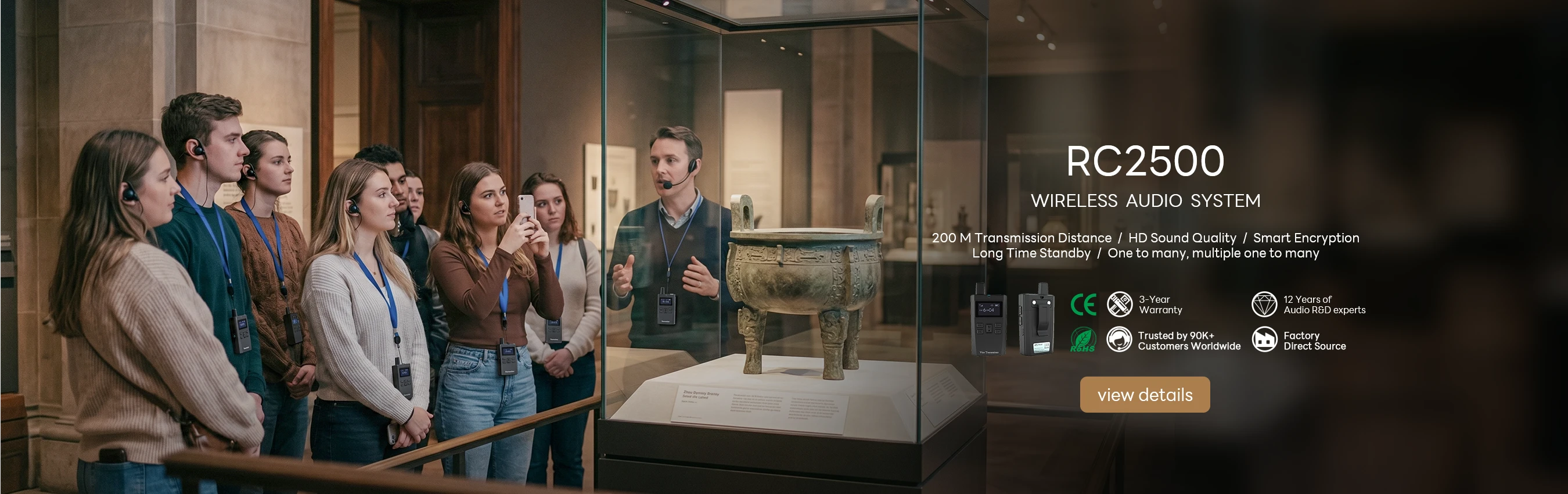
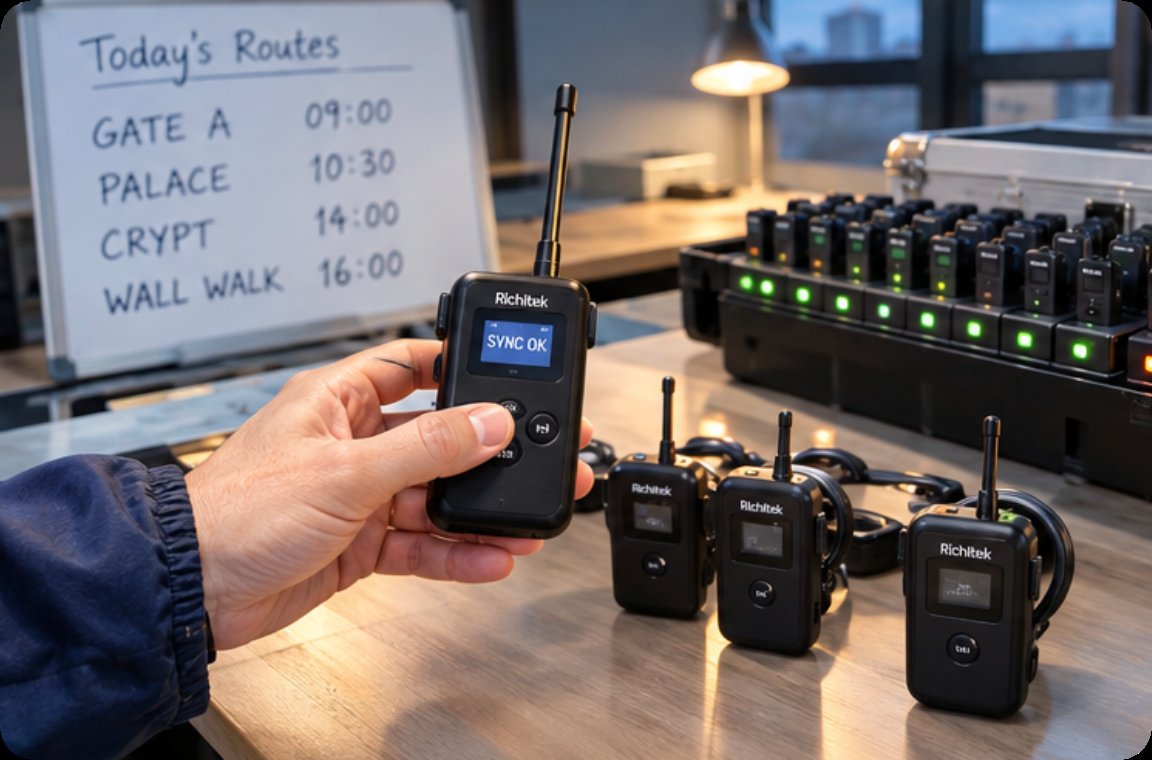
Multi-group heritage operations lose their mornings to pairing. The RC2500 attacks that directly with one-key frequency synchronisation: press once and the receiver fleet follows the transmitter, no menu diving, no per-unit channel hunting before the first departure. It shares the RC9150's licence-free 2.4 GHz band and 200-metre-class range, carries the same 97.5 g receiver weight, and adds a fifteen-hour transmitter battery with more than forty hours of receiver runtime, plus forty-plus hours of standby. Charging is USB Type-C on both ends, which means a sites team can top a case from the same bricks they already carry for phones and cameras.
richitek heritage_sightseeing_tour vs orpheo museummate 2

The RC2500's product page documents the sync workflow, and for an operator running four guides from one equipment room it is the difference between a calm dispatch and a scramble.

RC2402: The Light Receiver for a Long Queue

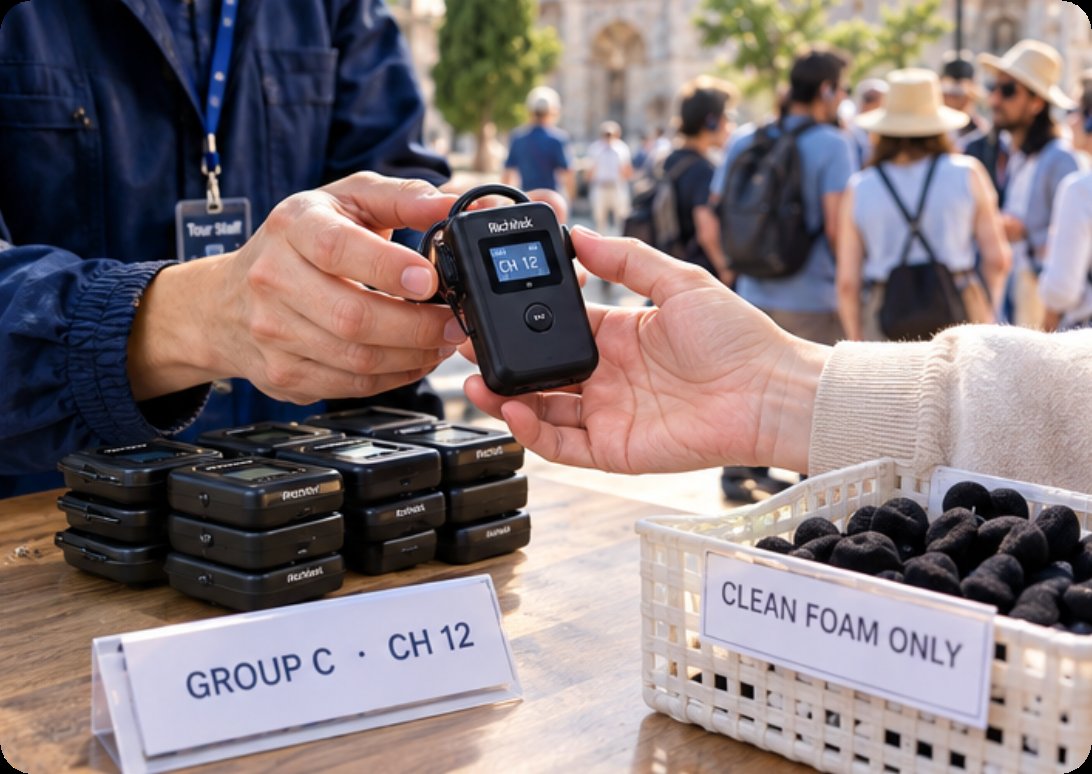
Heritage groups skew towards visitors who have walked six kilometres already, and every gram at the ear counts by the third hour. The RC2402 receiver weighs fifty grams — roughly the weight of two euro coins and a ticket stub — and its transmitter comes in at fifty-nine grams, the lightest in this trio. It keeps fifty channels on the same licence-free 2.4 GHz band with a ten-hour transmitter and twenty-hour receiver battery, which comfortably covers a double-shift day of two three-hour circuits. Output power is a modest 10 mW with a 200-metre class range, well matched to routes that stay inside a walled quarter rather than sprawling across a waterfront. As the entry unit of the range it is the model a fleet buys in volume, pairing fifty-channel receivers behind either flagship transmitter without changing band or workflow.
richitek heritage_sightseeing_tour vs orpheo museummate 3

The RC2402's specification sheet is here for teams pricing a large receiver pool against a fixed budget.

How Orpheo and MuseumMate Fill the Same Route

The self-guided model deserves its reputation, and both suppliers execute it well. Orpheo's Mikro LX plays numbered stops on demand or fires them automatically at trigger points, synchronises video on screen-equipped units, and ships in a housing that survives both a rainy cloister and a humid crypt; the anti-theft frame answers the honest worry about devices walking away from a busy gate. MuseumMate's strength sits a layer above the hardware: nearly three decades of multimedia content production and a management platform that lets a heritage team update languages, add an audio-described track and track usage without touching a soldering iron. For a site where most visitors arrive without a guide — a palace open until late, a basilica with mass schedules to respect — these systems deliver depth no live tour can match, and they do it without putting a single staff member on the route.

The Spec Table, Side by Side

DimensionRC9150RC2500RC2402Orpheo Mikro LXMuseumMate
Working modelLive guide, one to manyLive guide, one to manyLive guide, one to manySelf-guided playbackSelf-guided multimedia
Radio band2.4 GHz, licence-free2.4 GHz, licence-free2.4 GHz, licence-freeNot publishedNot published
Channels1005050Stop-triggeredStop-triggered
Range1-200 m class1-200 m class1-200 m classFixed stopsFixed stops
Battery, receiverAbout 40 h40 h and above20 hFull-day duty ratedFull-day duty rated
Weight, receiver97.5 g97.5 g50 gHandheld player classHandheld player class
ChargingType-CType-CDCCabinet / rack returnCabinet / rack return
Visitor questionsAnswered liveAnswered liveAnswered liveNot supportedNot supported
Content updatesGuide is the contentGuide is the contentGuide is the contentStudio revision cyclePlatform revision cycle

Where the Player Model Wins

An honest comparison says this plainly. A rack of players needs no guide on the payroll for the afternoon shift, no scheduling software, and no overtime on a strike day; a visitor who prefers wandering alone gets a better experience from a Mikro LX than from trailing a group they cannot hear properly. Content revisions cost studio time, but they amortise across tens of thousands of visitors, and a language added once serves every subsequent guest. For small staff teams at high-traffic sites, the economics are real, and neither Paris nor Madrid would have built a business on them otherwise.

Choosing by Group Size and Route

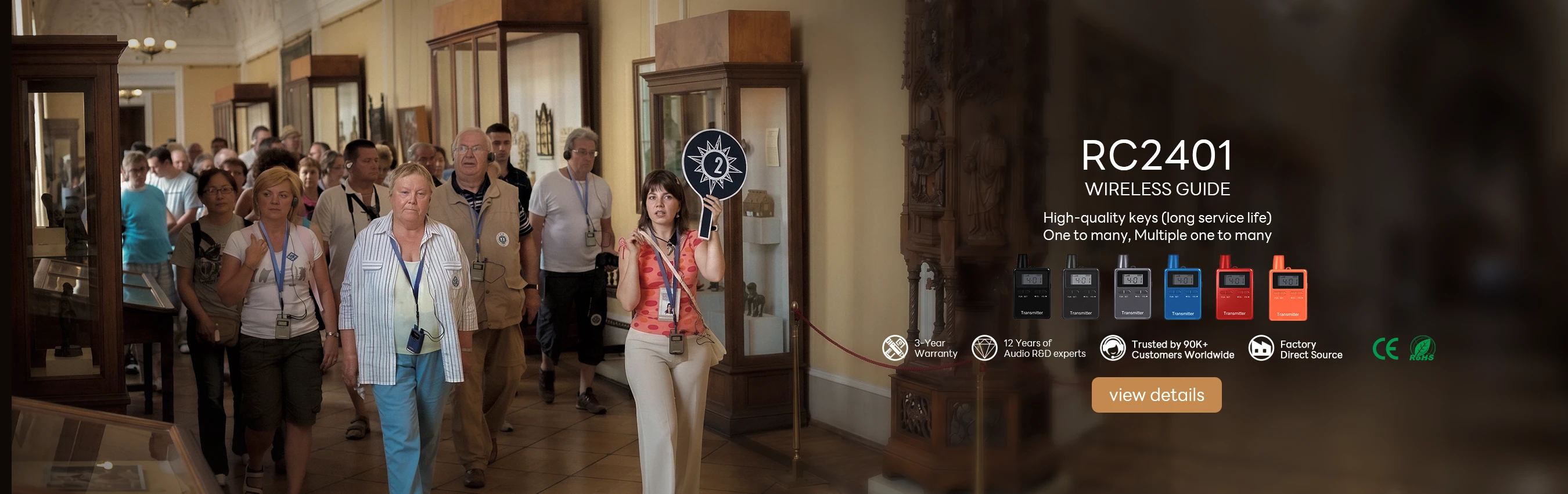
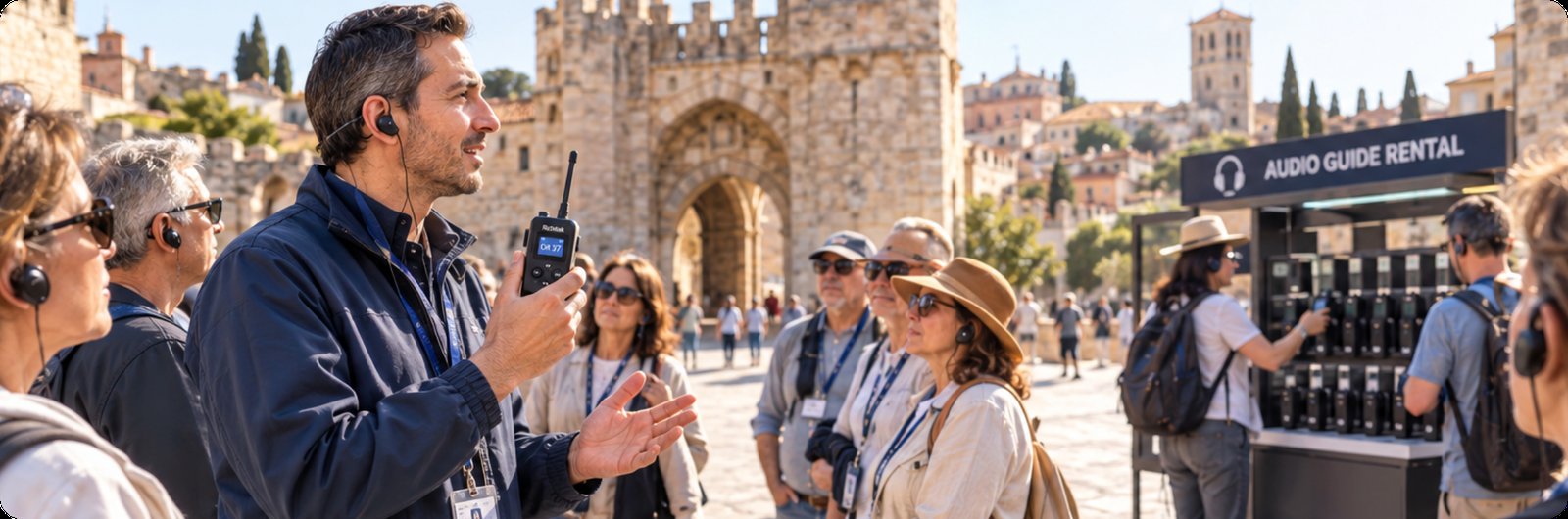
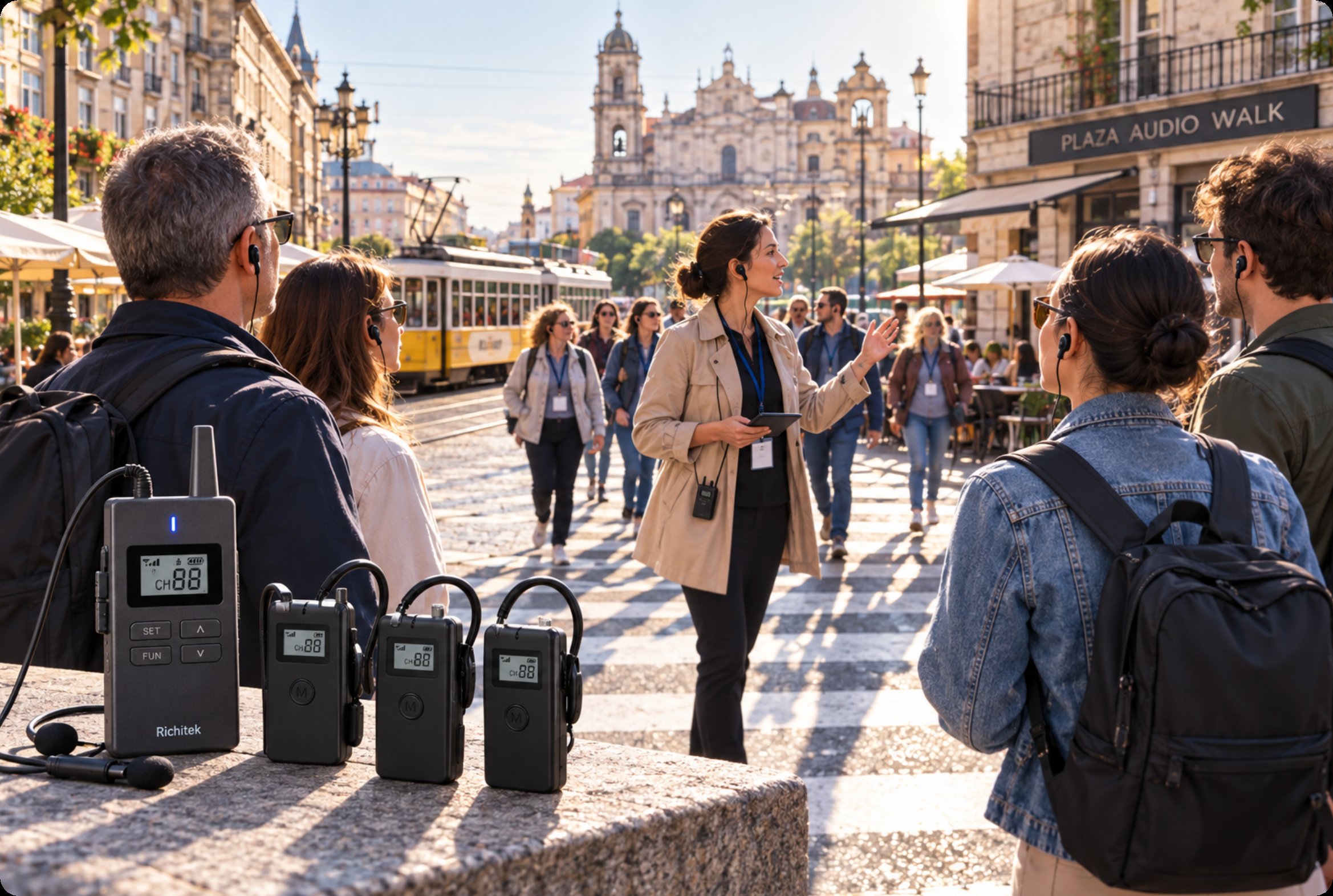
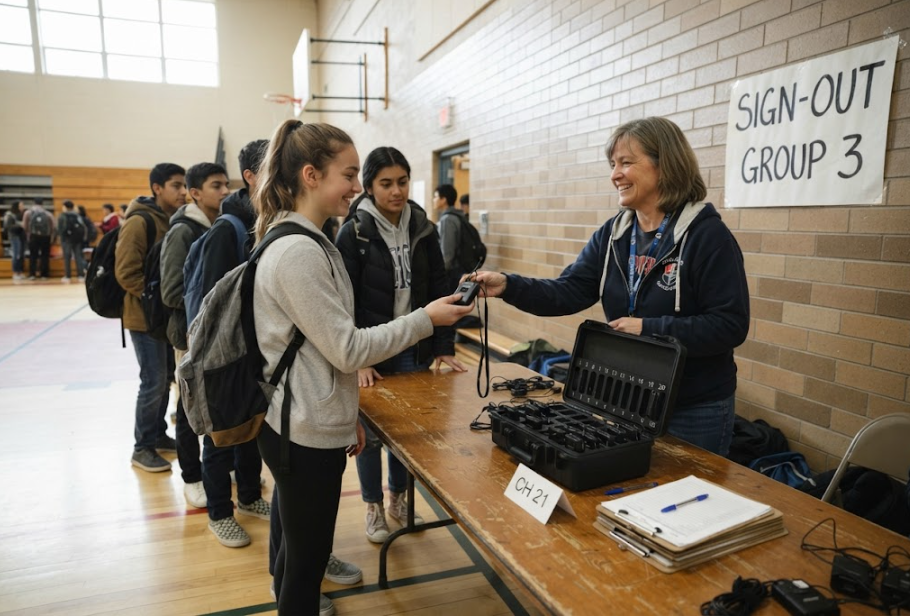
The decision rarely needs a spreadsheet. When the route is fixed and visitors flow continuously, the player rack fits; when a guide must hold a named group together through crowds, answer questions and adapt on the move, a live system wins. The Richitek trio covers that second case end to end: the wireless tour guide range pairs a hundred-channel coverage or a self-syncing flagship with light fifty-gram receivers, on one licence-free band and one charging workflow. The honest version of this choice runs on our full comparison guide, where the same five systems are tested against the routes they actually serve.
2026年09月19日 12:13
click: 13
no data
Home > VS

Richitek RC9150, RC2500 and RC2402 vs Orpheo Mikro LX and MuseumMate for Heritage Sightseeing Tours

time: 2026年09月19日 click:13

Two Ways to Tell One Old Town

Every heritage sightseeing operation makes the same decision at the gate, season after season: do visitors borrow the story, or does a guide carry it to them? The player rack hands each guest a device that narrates stop forty-two on cue; the guide-led group walks behind one voice that answers back. Both models sell the same cobbles, and both are honest ways to run a route — which is why the comparison deserves better than a slogan. A team that runs city walking tour solutions across an old town needs to know where a live system earns its keep, where the rack is genuinely the smarter purchase, and what the hardware difference looks like line by line.

⚖️ Richitek RC9150, RC2500 and RC2402 vs Orpheo Mikro LX and MuseumMate for Heritage Sightseeing Tours

This comparison puts three Richitek live-guided systems against two established European suppliers of the self-guided model. Orpheo Group, founded in Paris with studios in New York, built its name on the Mikro LX audio player — trigger points, synchronised video, an anti-theft frame, and housings rated for wet and dry rooms — alongside the Orpheo Tour Guide, a digital group system with an OLED colour screen. MuseumMate, headquartered in Madrid since 1996 under OnCulture Capital, supplies multimedia guide hardware and the content platform behind it to museums, galleries and heritage sites across Spain, Italy, Portugal and the UK. Neither competitor publishes channel counts or radio band data for its hardware, so the table below compares what each side actually documents: device class, power, battery, weight and the working model around the visitor.

richitek heritage_sightseeing_tour vs orpheo museummate 1

RC9150: One Hundred Channels in the Grand Square

The oldest quarters of a city concentrate crowds the way a cathedral concentrates echoes, and the RC9150 is built for exactly that density. One hundred selectable channels mean three operators can run overlapping loops around the same square without a group ever drifting onto a neighbour's frequency, and the 20 mW output holds a clean signal at the full 200-metre class range across open ground. The 2.4 GHz band is licence-free across borders, so a seasonal route that crosses from one country's old quarter into another needs no frequency paperwork. Receivers run roughly forty hours per charge on a 3.7 V 1800 mAh cell — a full week of morning departures before the charging case comes out — and the full 20 Hz to 20 kHz response keeps music stops, not just speech, honest.

The RC9150's full specification is here, and its role in a fleet is simple: it is the system you assign to the loudest, most crowded heritage route on the map.

RC2500: The Flagship That Syncs Itself

Multi-group heritage operations lose their mornings to pairing. The RC2500 attacks that directly with one-key frequency synchronisation: press once and the receiver fleet follows the transmitter, no menu diving, no per-unit channel hunting before the first departure. It shares the RC9150's licence-free 2.4 GHz band and 200-metre-class range, carries the same 97.5 g receiver weight, and adds a fifteen-hour transmitter battery with more than forty hours of receiver runtime, plus forty-plus hours of standby. Charging is USB Type-C on both ends, which means a sites team can top a case from the same bricks they already carry for phones and cameras.

richitek heritage_sightseeing_tour vs orpheo museummate 2

The RC2500's product page documents the sync workflow, and for an operator running four guides from one equipment room it is the difference between a calm dispatch and a scramble.

RC2402: The Light Receiver for a Long Queue

Heritage groups skew towards visitors who have walked six kilometres already, and every gram at the ear counts by the third hour. The RC2402 receiver weighs fifty grams — roughly the weight of two euro coins and a ticket stub — and its transmitter comes in at fifty-nine grams, the lightest in this trio. It keeps fifty channels on the same licence-free 2.4 GHz band with a ten-hour transmitter and twenty-hour receiver battery, which comfortably covers a double-shift day of two three-hour circuits. Output power is a modest 10 mW with a 200-metre class range, well matched to routes that stay inside a walled quarter rather than sprawling across a waterfront. As the entry unit of the range it is the model a fleet buys in volume, pairing fifty-channel receivers behind either flagship transmitter without changing band or workflow.

richitek heritage_sightseeing_tour vs orpheo museummate 3

The RC2402's specification sheet is here for teams pricing a large receiver pool against a fixed budget.

How Orpheo and MuseumMate Fill the Same Route

The self-guided model deserves its reputation, and both suppliers execute it well. Orpheo's Mikro LX plays numbered stops on demand or fires them automatically at trigger points, synchronises video on screen-equipped units, and ships in a housing that survives both a rainy cloister and a humid crypt; the anti-theft frame answers the honest worry about devices walking away from a busy gate. MuseumMate's strength sits a layer above the hardware: nearly three decades of multimedia content production and a management platform that lets a heritage team update languages, add an audio-described track and track usage without touching a soldering iron. For a site where most visitors arrive without a guide — a palace open until late, a basilica with mass schedules to respect — these systems deliver depth no live tour can match, and they do it without putting a single staff member on the route.

The Spec Table, Side by Side

DimensionRC9150RC2500RC2402Orpheo Mikro LXMuseumMate
Working modelLive guide, one to manyLive guide, one to manyLive guide, one to manySelf-guided playbackSelf-guided multimedia
Radio band2.4 GHz, licence-free2.4 GHz, licence-free2.4 GHz, licence-freeNot publishedNot published
Channels1005050Stop-triggeredStop-triggered
Range1-200 m class1-200 m class1-200 m classFixed stopsFixed stops
Battery, receiverAbout 40 h40 h and above20 hFull-day duty ratedFull-day duty rated
Weight, receiver97.5 g97.5 g50 gHandheld player classHandheld player class
ChargingType-CType-CDCCabinet / rack returnCabinet / rack return
Visitor questionsAnswered liveAnswered liveAnswered liveNot supportedNot supported
Content updatesGuide is the contentGuide is the contentGuide is the contentStudio revision cyclePlatform revision cycle

Where the Player Model Wins

An honest comparison says this plainly. A rack of players needs no guide on the payroll for the afternoon shift, no scheduling software, and no overtime on a strike day; a visitor who prefers wandering alone gets a better experience from a Mikro LX than from trailing a group they cannot hear properly. Content revisions cost studio time, but they amortise across tens of thousands of visitors, and a language added once serves every subsequent guest. For small staff teams at high-traffic sites, the economics are real, and neither Paris nor Madrid would have built a business on them otherwise.

Choosing by Group Size and Route

The decision rarely needs a spreadsheet. When the route is fixed and visitors flow continuously, the player rack fits; when a guide must hold a named group together through crowds, answer questions and adapt on the move, a live system wins. The Richitek trio covers that second case end to end: the wireless tour guide range pairs a hundred-channel coverage or a self-syncing flagship with light fifty-gram receivers, on one licence-free band and one charging workflow. The honest version of this choice runs on our full comparison guide, where the same five systems are tested against the routes they actually serve.
no data
×

Contact us

email:
name:
subject:
content: