.webp)
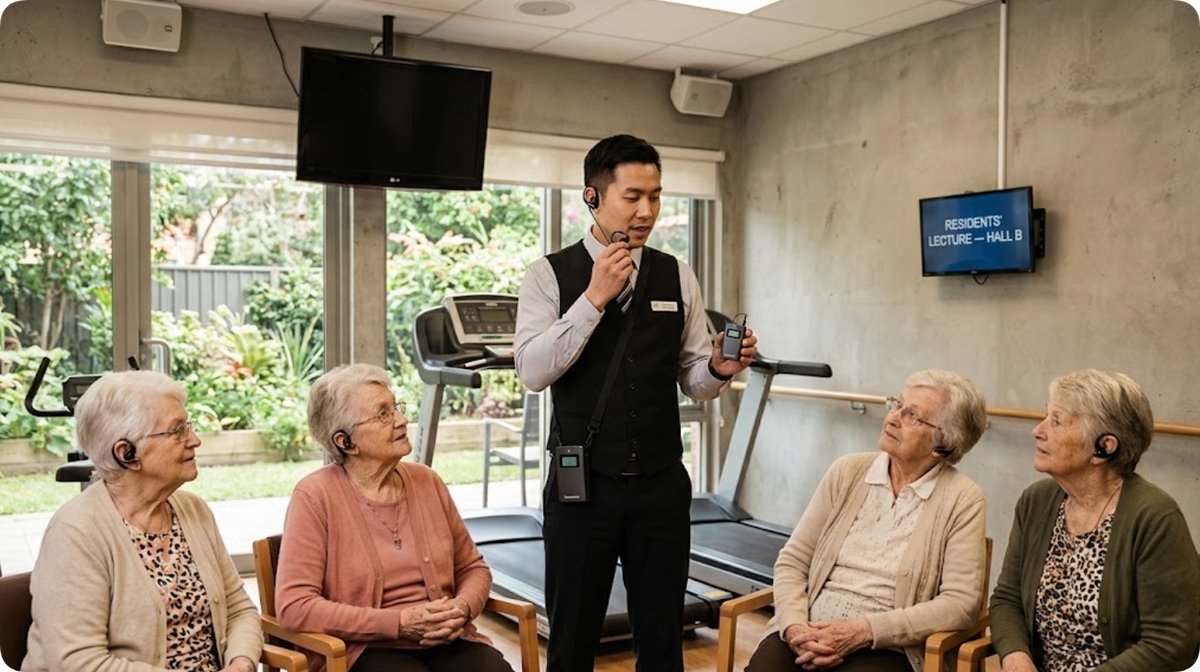
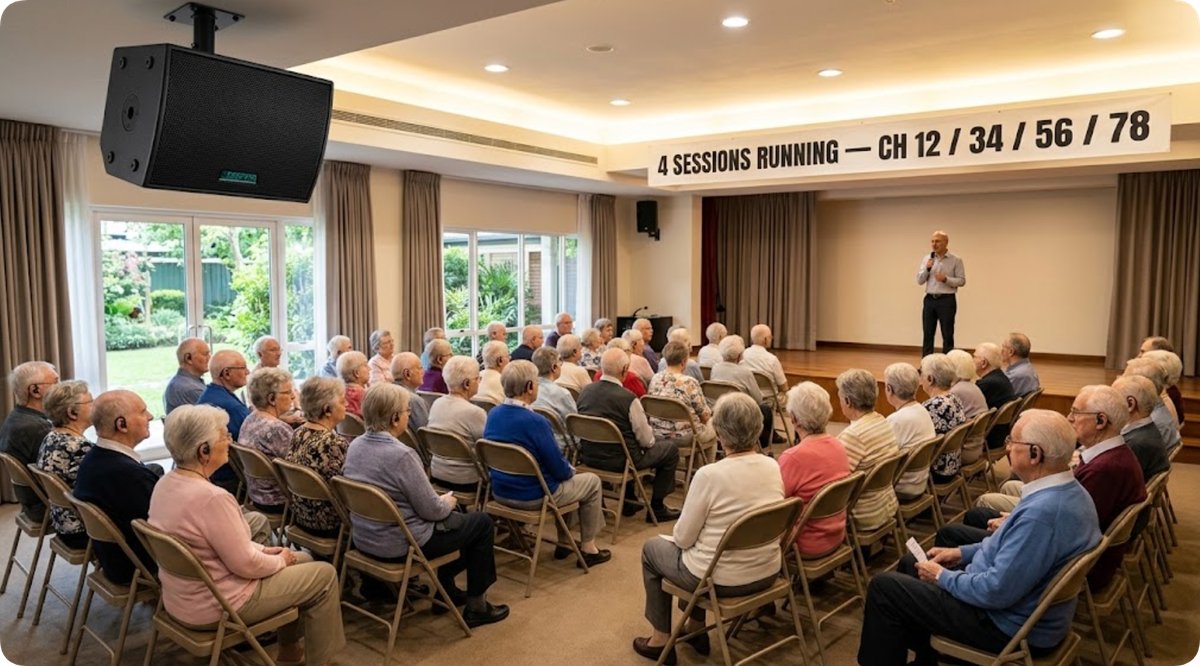
A retirement community runs four guided programmes a week, and only one of them is a guided tour. Tuesday morning is a physiotherapy session where the instructor must be heard over a treadmill motor. Thursday is the weekly residents' lecture, where forty people in a hall with hard walls and a shared television system need to follow a speaker at the front. Saturday is the family visiting day, when forty visitors are given a route across the campus. Sunday afternoon is the multilingual welcome session for new overseas residents and the volunteers who support them. These four jobs share a budget line but nothing else. The incumbent answers in the Chinese market are usually hardware built for a different buyer: Guangzhou DSPPA integrates the explanation system with the building's fixed public-address network, so it inherits the emergency call system that a care home is legally required to have; Shanghai Ling'er removes hardware from the equation entirely, using QR and NFC triggers with cloud management and attendance analytics. Both are reasonable answers to a different question. This comparison sets three Richitek units against them on the axis that actually decides a care-home purchase — whether the words reach a hard-of-hearing ear through a reinforced concrete wall, over shared Wi-Fi, for a full morning without a recharge.
📻 Two Vendors Solving Different Problems Well
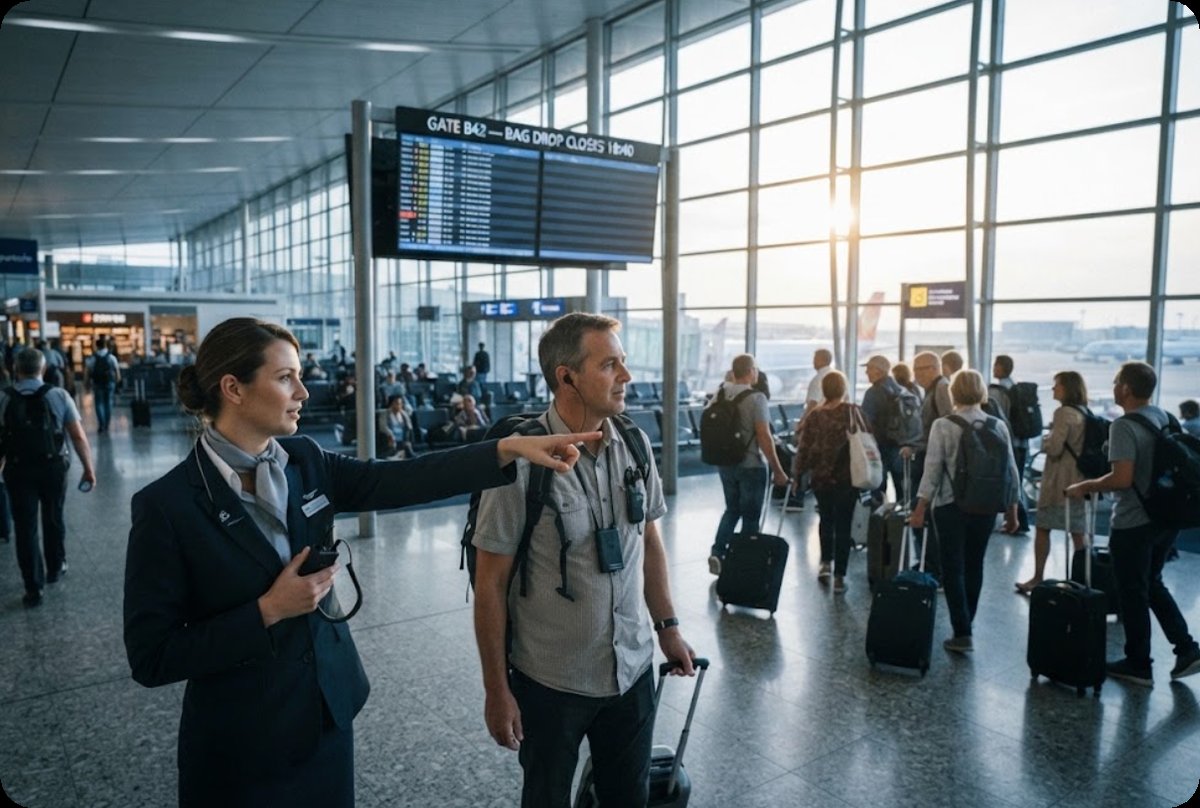
DSPPA's explanation series is a mid-range PA integration product: acoustic processing, tie-in to the venue's existing fixed broadcast, and speakers that are already in the ceiling. For a care home, that integration is genuinely valuable rather than merely cheap, because the mandatory call system, the background music in the dining hall and the corridor announcements all live on the same network, and adding a second parallel infrastructure is the thing a facilities manager is usually told to avoid. What a PA-linked explanation system cannot do is deliver a private 40-metre channel to one group while another group runs in the same building — public address is public by design, which is the same structural limitation an airport terminal runs into.
Ling'er's IoT approach goes the other direction. Trigger tags on walls and wayfinding points, position-aware automatic playback, cloud management, and behavioural data on who attended what — no receiver is issued to anyone, which is exactly what a residential community with a fluctuating visitor population wants, and the analytics layer is something hardware vendors do not produce. Its weakness is the one that matters in a care setting: a visitor who does not have a phone, or a resident whose phone is the property of the front desk, hears nothing at all. Neither product is weak. Both answer questions about infrastructure and data rather than about ears.
| Item | RC085 | RC9150 | RC2500 | DSPPA explanation series | Ling'er IoT guide |
|---|---|---|---|---|---|
| Band | 470–510 MHz UHF | 2403–2483 MHz | 2403–2483 MHz | wired / fixed PA | Wi-Fi, QR / NFC tags |
| Channels | multi-group UHF | 100 independent | 50 independent | per-zone, not per-group | per-device cloud session |
| Two-way | F1 / F2 modes | push, encrypted | one-to-many push | one-to-all | phone playback |
| Range | 200 m, wall penetration | 200 m open area | 200 m open area | installed coverage | tag proximity |
| Battery | not stated on spec sheet | 15 h TX / 30+ h RX | 12 h TX / 40 h RX | mains | visitor's own phone |
| Hardware issued | receiver per person | receiver per person | receiver per person | none, ceiling speakers | none, tags only |
| Certification | CE, RED, RoHS | CE, EMC, LVD, RED, RoHS | CE, EMC, LVD, RED, RoHS | facilities integration | platform operated |
🧱 Concrete Walls, Shared Wi-Fi, Long Mornings
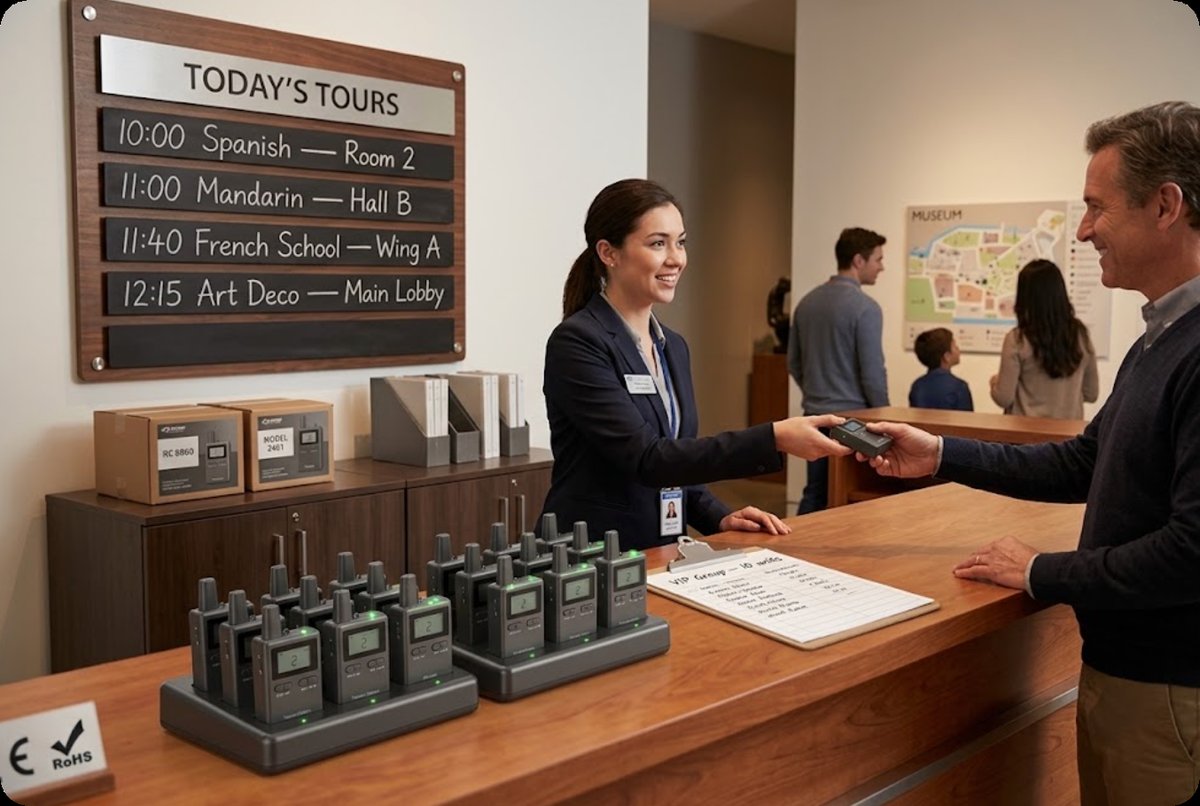
A care home is one of the hardest acoustic environments in the industry: reinforced concrete and brick, hard floors in activity rooms, Wi-Fi and Bluetooth from the medical monitoring equipment, and residents whose hearing loss means the signal has to arrive with margin rather than merely arrive. The RC085 is built for exactly that interference picture — 470–510 MHz UHF digital transmission, chosen for its penetration through walls and steel and its immunity to dense 2.4 GHz environments, running up to 200 metres with both one-way broadcast and a two-way F2 mode so a volunteer can actually answer a resident's question. It also carries an LCD smart screen and automatic sleep and wake-up, which matters when a receiver sits unused between sessions for six hours.
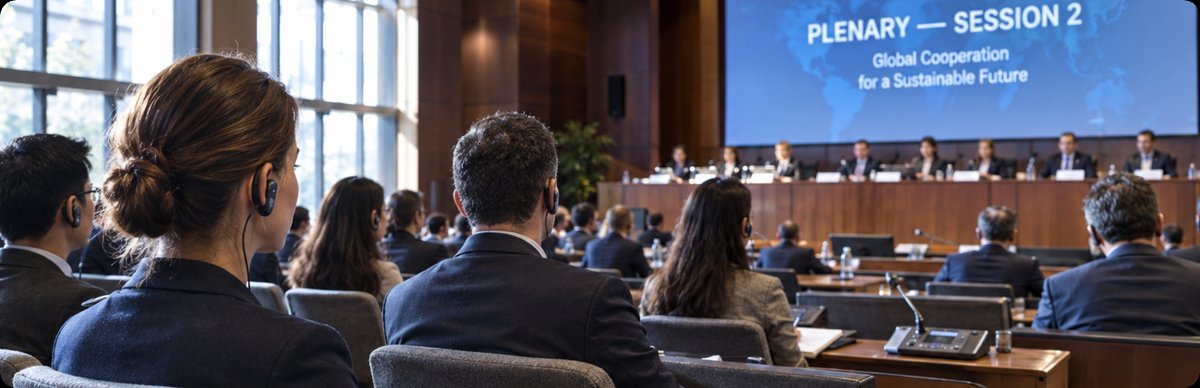
The RC9150 answers the density question. With one hundred independent channels and intelligent encryption on the licence-free 2403–2483 MHz band, a campus can run the physiotherapy group, the lecture, the visiting-day route and the multilingual welcome session simultaneously without crosstalk, and a conversation about a resident's medical or financial situation is not broadcast on an open frequency — the same requirement an international school meets, and the reason this unit pairs naturally with the interpretation line when new overseas residents, family members and volunteer helpers do not share one language.
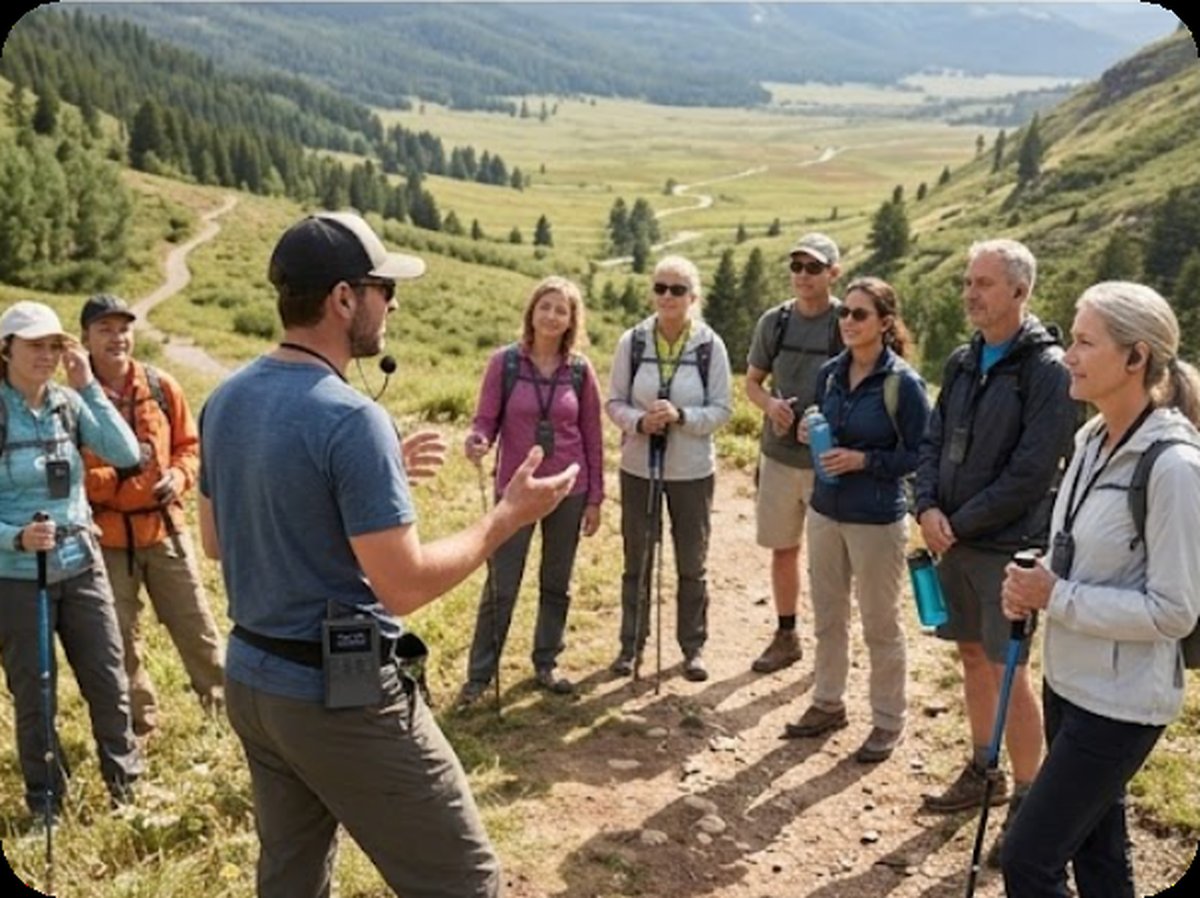
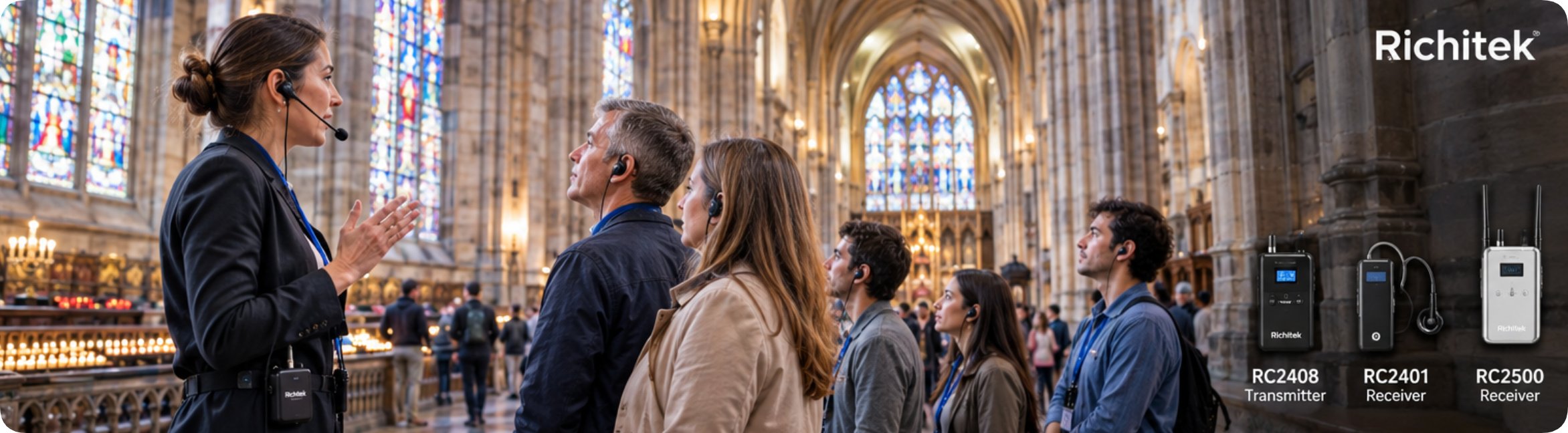
The RC2500 covers the part of the day that leaves the building. Twenty milliwatts on 2.4 GHz across fifty PLL channels, a receiver rated for forty hours and a transmitter for twelve, a 20 Hz–20 kHz response that carries a lecture's low voice as well as music playback between groups, and an operating range of −15 °C to 50 °C for a winter garden walk or a summer courtyard programme — five working days of listening without a charging trolley being wheeled between activities.
🤝 What Each Side Is Actually Better At
Two admissions keep this comparison honest. First, the facilities argument for DSPPA is stronger than anything on the Richitek side of this table: a care home already owns a certified public-address and call network, it is inspected as part of the building, and integrating the explanation system into it avoids a second cable run and a second set of approvals. A wireless tour guide is not a substitute for an emergency call system and should never be specified as one. Second, Ling'er's zero-hardware model wins on cost and on data whenever the audience is a stream of one-off visitors rather than a cohort that returns every week — no receivers to sanitise, no lost units, no charging, and attendance data that a director actually wants.
Against that, the three things a wearable channel does better are physical. An elderly ear with presbycusis needs margin: RF that survives a concrete wall, a 20 Hz–20 kHz response rather than a speech-band-only chain, and enough transmit power to reach a resident who is sitting twenty metres from the guide rather than the three metres a ceiling speaker serves. Then there is the cohort question — a physiotherapy group that must hear its instructor and a family tour that must hear a guide, in the same building, on the same afternoon, without either overhearing the other. Hardware vendors cannot manufacture a quieter network, and neither can a cloud platform manufacture twenty minutes of battery.
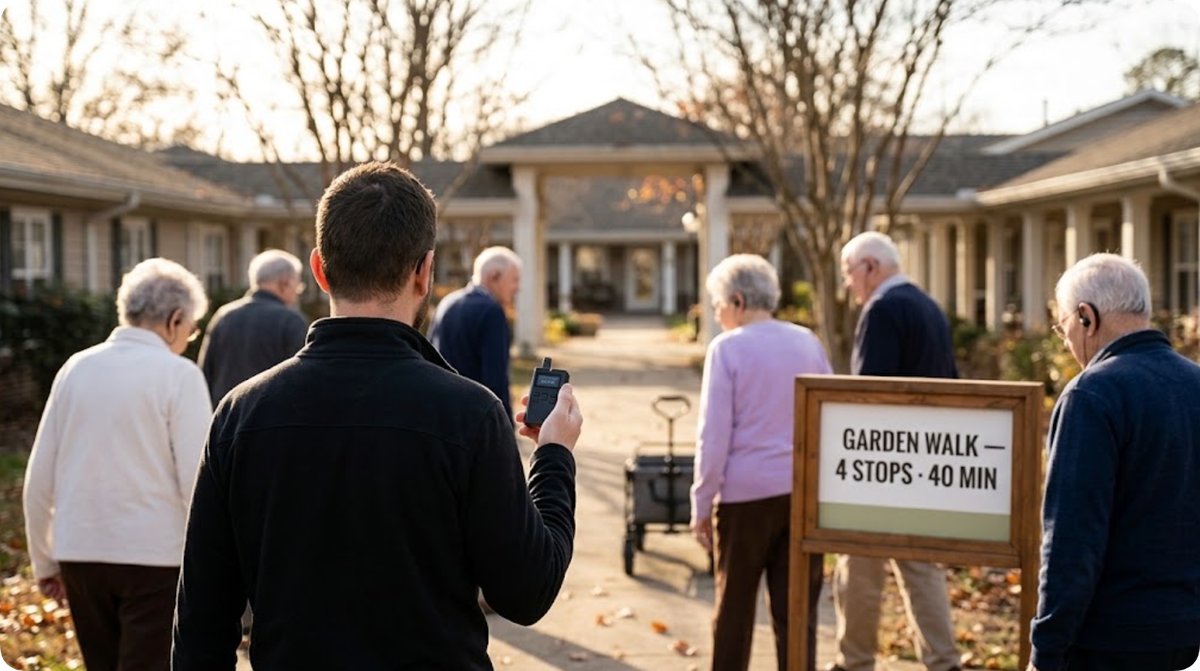
The recommendation follows that split. Keep DSPPA for what a care home must have — the broadcast, the calls and the announcements — and treat its explanation module as a public-audio layer, not a guided-tour layer. Keep a tag-based IoT walk for casual self-guided visitors who bring a phone and can be counted. Then buy the three Richitek units for the programmes where a person speaks and a specific group must understand: the physiotherapy instructor, the weekly lecture, the visiting-day route and the multilingual welcome, where one hundred channels, a UHF option for the hard rooms, forty-hour receivers and encryption are not features but the reason the session works. The education audio system overview covers that class of deployment in detail, and the full system range lists every configuration discussed here.