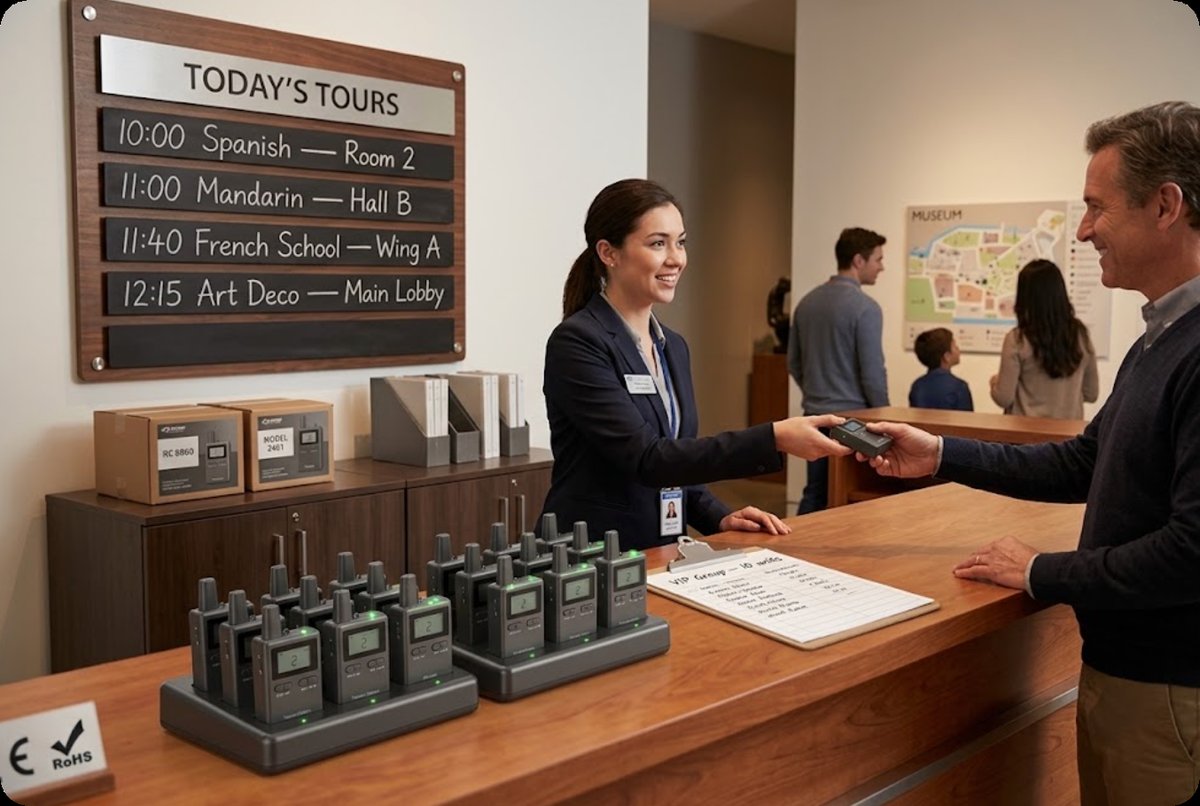
A leading China factory specializing in Wireless Tour Guide Systems, Church Audio Guides, and Translation Headphones with premium OEM/ODM solutions.

Tel:+86 18922879583

Email:tiger.wang@richitek.com

Richitek RC9150, RC2406 and RC2501 vs Deep Layer Interconnected and Dongfang Shengxun for Zoo and Aquarium Guide Systems

An aquarium gallery and a zoo exhibit do not behave like a museum hall. The humidity in a tropical house sits above eighty percent for most of the day, and the visitor path is a loop that brings the same group back past the same four enclosures. More importantly, the schedule is not yours. A sea turtle decides when it surfaces, an otter decides whether it comes out, and a keeper decides whether the feed happens at all this morning. A guide system for these venues is therefore judged on one question that never appears in a museum specification: when the animal interrupts the narration, who decides that the audio should start again? Two routes to that answer are compared below. Shenzhen ShenCeng Interconnected builds automatic-sensing units that trigger playback and pause from sub-metre body-position detection and directional audio output, so the visitor's own arrival controls the timeline. Beijing Dongfang Shengxun sells an encrypted audio codec with anti-eavesdropping positioning for national-level museums and summit venues, where what is being discussed matters as much as what is being heard. Richitek's three units sit on the other side of that divide: a transmitter in the guide's hand and a button pressed deliberately. That difference is the honest core of this comparison.

Richitek RC9150: One Hundred Channels for a Venue That Doubles Its Audience

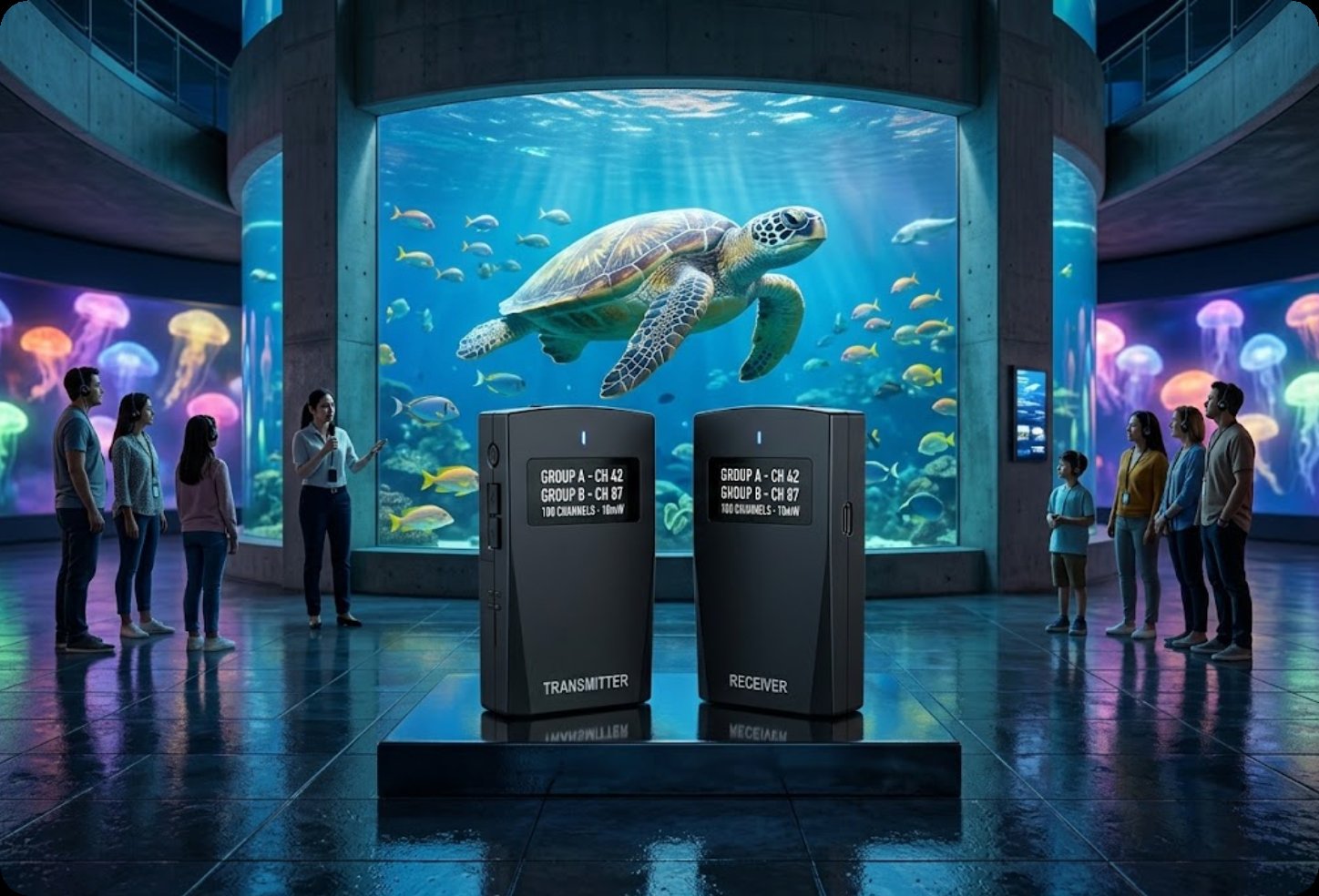
The RC9150 High-end 2.4G Wireless Audio/Radio Guide System is the unit a large aquarium picks when the school groups arrive in the same week as the coach tours. It runs 100 channels on the 2403-2483MHz band at 10mW, and both the transmitter and the receiver carry a 15-hour and 35-hour-plus standby figure respectively, with a 3.7V 1800mAh cell on each side and a Type-C charging port. The 97.5g figure applies to both halves. Frequency response is listed as 20Hz-8kHz.

Channel count is the working argument. An aquarium on a wet-weather Saturday may have a primary school group in the sea turtle hall and a walking tour in the river exhibit simultaneously, and a hundred channels means the two do not have to share. The 10mW figure on a 2.4GHz band is also licence-exempt in most markets. What 20Hz-8kHz does not cover is the low end an exhibit's pump noise sits in, and that is a real limit rather than a rounding error.
richitek zoo_aquarium vs shenceng dongfang 1

Richitek RC2406: Eighty Channels Where Interference Comes from Water and Metal

The RC2406 Wireless Tour Guide System drops to 80 channels from the RC9150's hundred and carries 10mW on the same band, with 10 hours of transmitter life and 20 hours on the receiver, both on 3.7V 1500mAh cells and a DC charging port. The transmitter is quoted at 59g and the receiver at 50g, with a frequency response listed as 50Hz-200kHz on transmit and 50Hz-12kHz on receive. Its documented advantage in the specification table is eighty-channel interference resistance.

Eighty channels is still more than most venues will ever need, and the reason to choose this unit over the hundred-channel one is the physical environment. Aquarium galleries put steel walkways, glass and water features between the guide and the last listener, and a high-humidity room behaves differently from a dry hall. Cutting twenty channels is a modest sacrifice for a cheaper unit that still clears every realistic group size in the building.

Richitek RC2501: Forty-Seven Grams for a Keeper Who Already Carries a Bucket

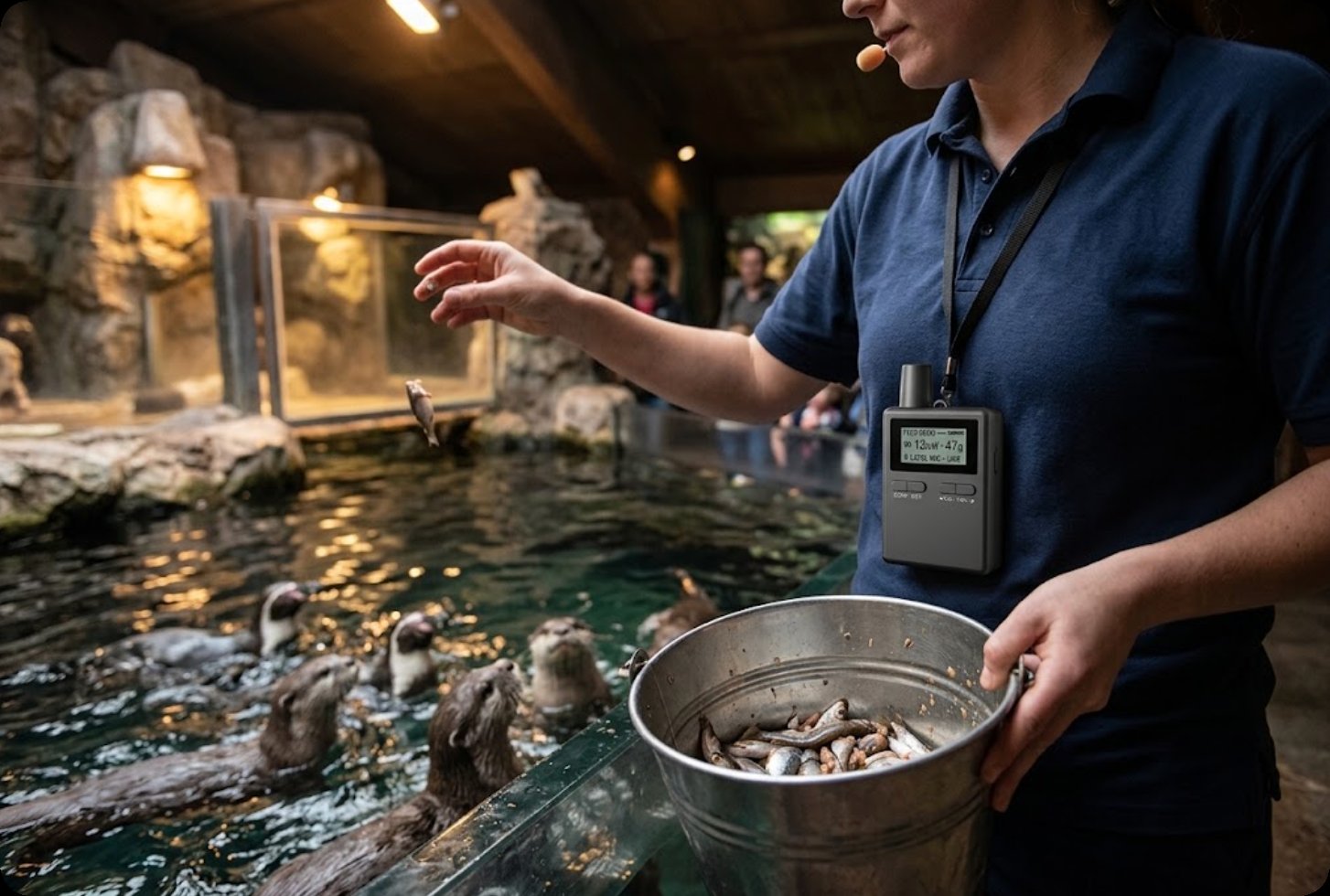
The RC2501 Wireless Tour Guide System is the lightest of the three at 47g for both transmitter and receiver, on 50 channels with 13mW output — the highest transmit power in this group — and the same 15-hour transmitter and 35-hour-plus receiver standby as the RC9150, on a 3.7V 1500mAh transmitter cell and 3.7V 1000mAh receiver cell, both Type-C. Frequency response is listed as 20Hz-200kHz. The documented special design notes an optional head-worn or lapel microphone and a sensitivity figure of approximately -38dBm.

The keeper is the person this unit is actually for. A feed demonstration involves a bucket, a hose and two gloved hands, so a transmitter that must be held, aimed at the mouth and pressed at the right moment is a liability. Forty-seven grams is light enough to hang from a lanyard and still be there when the feed ends. The trade is honest: 13mW reaches further than the other two, but fifty channels will not support four simultaneous groups, and the -38dBm sensitivity figure sits fifty-odd decibels away from the -102dBm quoted for a different model in the same family, which the specification table carries without further comment.
richitek zoo_aquarium vs shenceng dongfang 2

Shenzhen ShenCeng: Sub-Metre Sensing and Audio That Starts by Itself

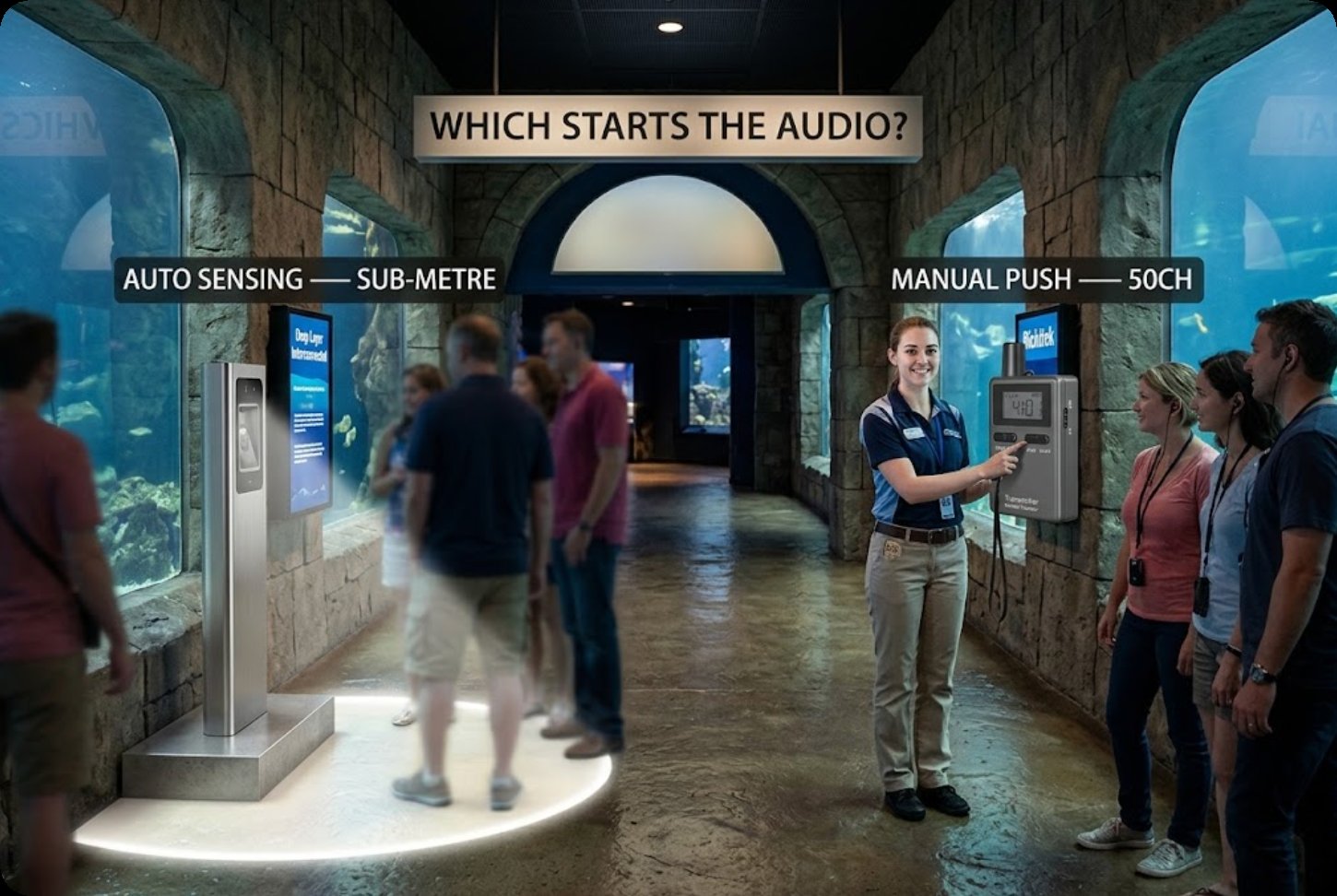
Shenzhen ShenCeng Interconnected is the Shenzhen Deep Layer Interconnected entry in the competitive database, positioned at the premium end and sold into art museums, cultural exhibition halls and high-end corporate showrooms. The documented capability is sub-metre body-position sensing with directional audio output and automatic playback and pause. The unit decides when audio starts; the visitor does not press anything.

This is genuinely the better answer to the interrupted-narration question, and it deserves to be said plainly. A visitor who walks up to a tank and stops gets the track; a visitor who walks past does not. In a venue where the group drifts in and out of range for eight hours, that removes the largest single staffing cost in the operation — a person whose job is mostly pressing a button at approximately the right moment. Directional output also reduces the overlap that makes a shared gallery noisy when two groups stand near each other.

The cost is that the system has to be planned. Sub-metre detection implies installed reference points, and content must be authored and loaded against those points in advance. A venue whose enclosures move, or whose animal schedule shifts the stopping places week to week, is paying for a plan that has to be revisited. Neither the sensing range nor the battery figures for this unit are published in the source database, which is a real gap against a published specification sheet.

Beijing Dongfang Shengxun: When the Content Is the Sensitive Part

Beijing Dongfang Shengxun is a different proposition, at the premium end and aimed at national-level museums, international summits, senior government functions and any setting where sensitive information is discussed in a public room. The documented capability is audio codec encryption on transmission with anti-eavesdropping positioning, backed by stated experience serving national museums, with custom development available.

That gap only opens where a venue has something to protect. A zoo conservation talk about a breeding programme, or an aquarium debrief about a rescue operation, sits somewhere between those cases. The honest position is that encryption is not a feature an aquarium needs for a public dolphin talk and is not optional for a venue discussing conservation logistics during a closed staff session. Dongfang Shengxun sells the second case, and its credentials in the first are not the point.

The counter-argument is equally concrete. Encryption on transmission, positioning and custom development are the cost drivers, and none appear in the database with figures attached. A buyer comparing this against a hundred-channel unlicensed unit is comparing a specification that solves a risk most venues do not have.
richitek zoo_aquarium vs shenceng dongfang 3

Specification Comparison: Three Richitek Units Against Two Venue-Specific Alternatives

Richitek RC91502403-2483MHz, 100 channels, 10mW15h transmitter, 35+h receiver97.5g both halvesType-C20Hz-8kHzNot listed in the source database
Richitek RC24062403-2483MHz, 80 channels, 10mW10h transmitter, 20h receiver59g transmitter, 50g receiverDC port50Hz-200kHz transmit, 50Hz-12kHz receiveNot listed in the source database
Richitek RC25012403-2483MHz, 50 channels, 13mW15h transmitter, 35+h receiver47g both halvesType-C20Hz-200kHzNot listed in the source database
Shenzhen Deep Layer InterconnectedNot published in the source databaseNot published in the source databaseNot published in the source databaseNot published in the source databaseNot published in the source databasePremium positioning, price not listed
Beijing Dongfang ShengxunEncrypted band, channel count not publishedNot published in the source databaseNot published in the source databaseNot published in the source databaseNot published in the source databasePremium positioning, price not listed

Choosing by Venue Constraint Rather Than Feature Count

Two or more groups running in parallel halls at onceRC9150100 channels keep simultaneous groups off each other's audio, with a 15h and 35+h standby pair covering a full operating day
One or two groups in a humid gallery with steel walkwaysRC240680 channels clear any realistic group size in a single-venue building at a lower unit cost
Keepers who handle animals, buckets and hoses during the talkRC250147g on both halves with 13mW output, so the transmitter can stay worn rather than be held
Stopping places that are known and rarely change, and a shortage of staffShenzhen Deep Layer InterconnectedSub-metre sensing removes the button-press duty from the operation entirely
Closed staff briefings or conservation discussions in a public roomBeijing Dongfang ShengxunEncrypted audio codec and anti-eavesdropping positioning address a risk the other units do not attempt

A Closing Note on What These Specifications Do Not Say

Two of the five units here publish almost nothing beyond positioning and capability language, and the honest response is to say so rather than estimate. An aquarium buying on a tight capital cycle will find published figures on the Richitek side and can compute battery logistics against a real opening schedule. For the automatic-sensing route, the first question worth asking a supplier is how a detection point behaves when a visitor stands still in front of the wrong tank, and the second is what happens to the content plan when an exhibit closes for a season.

For venues weighing general guidance hardware for exhibit floors and outdoor areas, the museum audio guide equipment overview sets out how the ranges divide by venue type, and plant and industrial sites with the same multi-stop structure can look at the industrial tour headset page for the same reason. Readers who want the full model range side by side will find the complete tour guide system comparison index, which also covers whether an outdoor enclosure sits on a 2.4GHz or a UHF plan.

2026年10月14日 12:21
ꄘ click: 31
Home > VS

Richitek RC9150, RC2406 and RC2501 vs Deep Layer Interconnected and Dongfang Shengxun for Zoo and Aquarium Guide Systems

time: 2026年10月14日 click:31

An aquarium gallery and a zoo exhibit do not behave like a museum hall. The humidity in a tropical house sits above eighty percent for most of the day, and the visitor path is a loop that brings the same group back past the same four enclosures. More importantly, the schedule is not yours. A sea turtle decides when it surfaces, an otter decides whether it comes out, and a keeper decides whether the feed happens at all this morning. A guide system for these venues is therefore judged on one question that never appears in a museum specification: when the animal interrupts the narration, who decides that the audio should start again? Two routes to that answer are compared below. Shenzhen ShenCeng Interconnected builds automatic-sensing units that trigger playback and pause from sub-metre body-position detection and directional audio output, so the visitor's own arrival controls the timeline. Beijing Dongfang Shengxun sells an encrypted audio codec with anti-eavesdropping positioning for national-level museums and summit venues, where what is being discussed matters as much as what is being heard. Richitek's three units sit on the other side of that divide: a transmitter in the guide's hand and a button pressed deliberately. That difference is the honest core of this comparison.

Richitek RC9150: One Hundred Channels for a Venue That Doubles Its Audience

The RC9150 High-end 2.4G Wireless Audio/Radio Guide System is the unit a large aquarium picks when the school groups arrive in the same week as the coach tours. It runs 100 channels on the 2403-2483MHz band at 10mW, and both the transmitter and the receiver carry a 15-hour and 35-hour-plus standby figure respectively, with a 3.7V 1800mAh cell on each side and a Type-C charging port. The 97.5g figure applies to both halves. Frequency response is listed as 20Hz-8kHz.

Channel count is the working argument. An aquarium on a wet-weather Saturday may have a primary school group in the sea turtle hall and a walking tour in the river exhibit simultaneously, and a hundred channels means the two do not have to share. The 10mW figure on a 2.4GHz band is also licence-exempt in most markets. What 20Hz-8kHz does not cover is the low end an exhibit's pump noise sits in, and that is a real limit rather than a rounding error.

richitek zoo_aquarium vs shenceng dongfang 1

Richitek RC2406: Eighty Channels Where Interference Comes from Water and Metal

The RC2406 Wireless Tour Guide System drops to 80 channels from the RC9150's hundred and carries 10mW on the same band, with 10 hours of transmitter life and 20 hours on the receiver, both on 3.7V 1500mAh cells and a DC charging port. The transmitter is quoted at 59g and the receiver at 50g, with a frequency response listed as 50Hz-200kHz on transmit and 50Hz-12kHz on receive. Its documented advantage in the specification table is eighty-channel interference resistance.

Eighty channels is still more than most venues will ever need, and the reason to choose this unit over the hundred-channel one is the physical environment. Aquarium galleries put steel walkways, glass and water features between the guide and the last listener, and a high-humidity room behaves differently from a dry hall. Cutting twenty channels is a modest sacrifice for a cheaper unit that still clears every realistic group size in the building.

Richitek RC2501: Forty-Seven Grams for a Keeper Who Already Carries a Bucket

The RC2501 Wireless Tour Guide System is the lightest of the three at 47g for both transmitter and receiver, on 50 channels with 13mW output — the highest transmit power in this group — and the same 15-hour transmitter and 35-hour-plus receiver standby as the RC9150, on a 3.7V 1500mAh transmitter cell and 3.7V 1000mAh receiver cell, both Type-C. Frequency response is listed as 20Hz-200kHz. The documented special design notes an optional head-worn or lapel microphone and a sensitivity figure of approximately -38dBm.

The keeper is the person this unit is actually for. A feed demonstration involves a bucket, a hose and two gloved hands, so a transmitter that must be held, aimed at the mouth and pressed at the right moment is a liability. Forty-seven grams is light enough to hang from a lanyard and still be there when the feed ends. The trade is honest: 13mW reaches further than the other two, but fifty channels will not support four simultaneous groups, and the -38dBm sensitivity figure sits fifty-odd decibels away from the -102dBm quoted for a different model in the same family, which the specification table carries without further comment.

richitek zoo_aquarium vs shenceng dongfang 2

Shenzhen ShenCeng: Sub-Metre Sensing and Audio That Starts by Itself

Shenzhen ShenCeng Interconnected is the Shenzhen Deep Layer Interconnected entry in the competitive database, positioned at the premium end and sold into art museums, cultural exhibition halls and high-end corporate showrooms. The documented capability is sub-metre body-position sensing with directional audio output and automatic playback and pause. The unit decides when audio starts; the visitor does not press anything.

This is genuinely the better answer to the interrupted-narration question, and it deserves to be said plainly. A visitor who walks up to a tank and stops gets the track; a visitor who walks past does not. In a venue where the group drifts in and out of range for eight hours, that removes the largest single staffing cost in the operation — a person whose job is mostly pressing a button at approximately the right moment. Directional output also reduces the overlap that makes a shared gallery noisy when two groups stand near each other.

The cost is that the system has to be planned. Sub-metre detection implies installed reference points, and content must be authored and loaded against those points in advance. A venue whose enclosures move, or whose animal schedule shifts the stopping places week to week, is paying for a plan that has to be revisited. Neither the sensing range nor the battery figures for this unit are published in the source database, which is a real gap against a published specification sheet.

Beijing Dongfang Shengxun: When the Content Is the Sensitive Part

Beijing Dongfang Shengxun is a different proposition, at the premium end and aimed at national-level museums, international summits, senior government functions and any setting where sensitive information is discussed in a public room. The documented capability is audio codec encryption on transmission with anti-eavesdropping positioning, backed by stated experience serving national museums, with custom development available.

That gap only opens where a venue has something to protect. A zoo conservation talk about a breeding programme, or an aquarium debrief about a rescue operation, sits somewhere between those cases. The honest position is that encryption is not a feature an aquarium needs for a public dolphin talk and is not optional for a venue discussing conservation logistics during a closed staff session. Dongfang Shengxun sells the second case, and its credentials in the first are not the point.

The counter-argument is equally concrete. Encryption on transmission, positioning and custom development are the cost drivers, and none appear in the database with figures attached. A buyer comparing this against a hundred-channel unlicensed unit is comparing a specification that solves a risk most venues do not have.

richitek zoo_aquarium vs shenceng dongfang 3

Specification Comparison: Three Richitek Units Against Two Venue-Specific Alternatives

Richitek RC91502403-2483MHz, 100 channels, 10mW15h transmitter, 35+h receiver97.5g both halvesType-C20Hz-8kHzNot listed in the source database
Richitek RC24062403-2483MHz, 80 channels, 10mW10h transmitter, 20h receiver59g transmitter, 50g receiverDC port50Hz-200kHz transmit, 50Hz-12kHz receiveNot listed in the source database
Richitek RC25012403-2483MHz, 50 channels, 13mW15h transmitter, 35+h receiver47g both halvesType-C20Hz-200kHzNot listed in the source database
Shenzhen Deep Layer InterconnectedNot published in the source databaseNot published in the source databaseNot published in the source databaseNot published in the source databaseNot published in the source databasePremium positioning, price not listed
Beijing Dongfang ShengxunEncrypted band, channel count not publishedNot published in the source databaseNot published in the source databaseNot published in the source databaseNot published in the source databasePremium positioning, price not listed

Choosing by Venue Constraint Rather Than Feature Count

Two or more groups running in parallel halls at onceRC9150100 channels keep simultaneous groups off each other's audio, with a 15h and 35+h standby pair covering a full operating day
One or two groups in a humid gallery with steel walkwaysRC240680 channels clear any realistic group size in a single-venue building at a lower unit cost
Keepers who handle animals, buckets and hoses during the talkRC250147g on both halves with 13mW output, so the transmitter can stay worn rather than be held
Stopping places that are known and rarely change, and a shortage of staffShenzhen Deep Layer InterconnectedSub-metre sensing removes the button-press duty from the operation entirely
Closed staff briefings or conservation discussions in a public roomBeijing Dongfang ShengxunEncrypted audio codec and anti-eavesdropping positioning address a risk the other units do not attempt

A Closing Note on What These Specifications Do Not Say

Two of the five units here publish almost nothing beyond positioning and capability language, and the honest response is to say so rather than estimate. An aquarium buying on a tight capital cycle will find published figures on the Richitek side and can compute battery logistics against a real opening schedule. For the automatic-sensing route, the first question worth asking a supplier is how a detection point behaves when a visitor stands still in front of the wrong tank, and the second is what happens to the content plan when an exhibit closes for a season.

For venues weighing general guidance hardware for exhibit floors and outdoor areas, the museum audio guide equipment overview sets out how the ranges divide by venue type, and plant and industrial sites with the same multi-stop structure can look at the industrial tour headset page for the same reason. Readers who want the full model range side by side will find the complete tour guide system comparison index, which also covers whether an outdoor enclosure sits on a 2.4GHz or a UHF plan.

×

Contact us

email:
name:
subject:
content: