.webp)
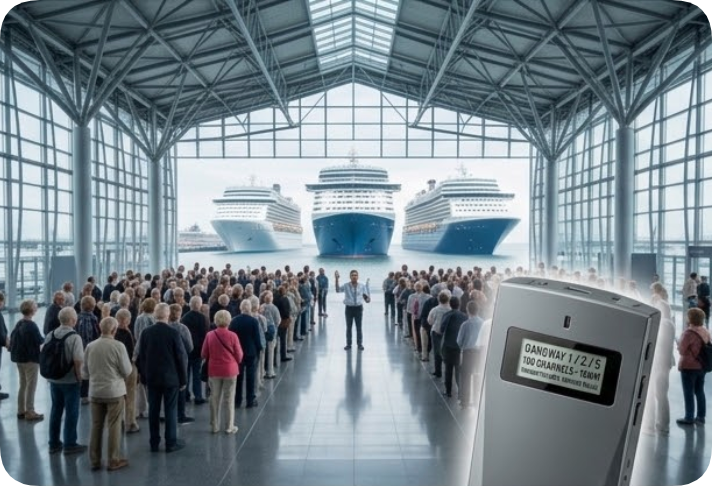
A cruise terminal guide system is asked to work in two rooms that share a building and nothing else. The first is the terminal hall: an open concourse of steel structure, glass frontage and salt air off the water, where a group guide needs to reach a hundred listeners spread across a hundred metres, and where a cheap unit in someone's pocket has to be found again before the boarding queue forms. The second is inside the ship: a narrow cabin corridor, a dining room, a theatre and a deck, all closer together than the seats in the hall, and all built from steel and glass that reflect rather than absorb. A guide team that specifies one kit for both rooms usually discovers the mismatch on embarkation day. This comparison sets three Richitek units against two systems aimed at the same two-room problem, and the constraint that decides the purchase is not transmission range at all. It is what happens when eighty people carrying thirty-nine channels enter a steel box.
🪧 Richitek RC9150: One Hundred Channels for a Terminal Running Two Sailings at Once
The RC9150 High-end 2.4G Wireless Audio/Radio Guide System is the unit a port with a busy embarkation schedule specifies, because the hundred-channel figure is the whole argument. A large cruise terminal on a Saturday morning may be loading three ships across three gangways, and a terminal operator who wants to run two guided groups without them bleeding into each other needs more separation than thirty-nine channels gives. The RC9150 runs 100 channels on the 2403-2483MHz band at 10mW, with a 1-200m quoted transmission range, PLL frequency synthesis control, and a grey transmitter with a black receiver.
The battery figures suit a long working day in a way the mid-range units cannot match: 15 hours on the transmitter and 35 hours-plus on the receiver, with a 3.7V 1800mAh cell on each side and Type-C charging on both. The 97.5 gram weight applies to each half, which is the number that decides whether a guest keeps it in a pocket or stops carrying it. The documented advantages in the specification table are high power with long standby, a hundred channels, and suitability for large venues. What that last line quietly concedes is the audio band: this unit's response is specified at 20Hz to 8kHz, and a terminal playing recorded music between announcements would be working outside it.
Richitek RC2408: Eighty Channels Where Interference Comes from Glass and Steel
The RC2408 Wireless Tour Guide System sits one step below the hundred-channel unit and is, on the published figures, the more sensible buy for a single gangway. It carries 80 channels on the same 2403-2483MHz band at 10mW over a quoted 1-200m range, and the specification table records eighty-channel interference resistance as its distinguishing trait — a claim worth taking seriously in a building full of metal. Unlike the hundred-channel model, this unit's transmit response reaches 200kHz, with the receive side specified to 12kHz.
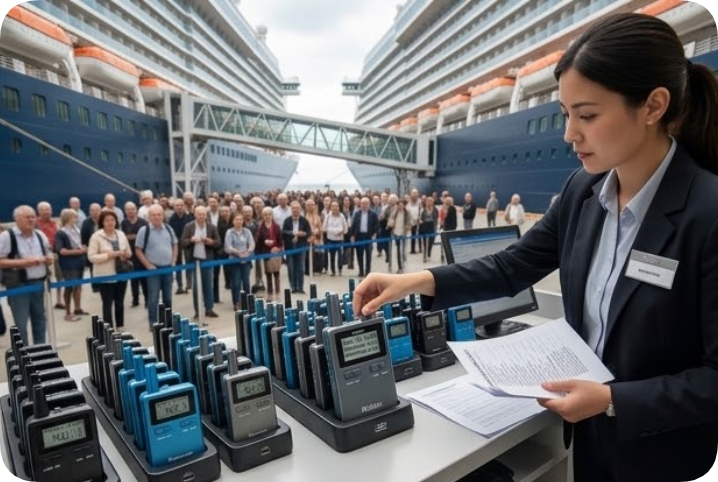
The battery difference is the part to plan around. The RC2408 quotes 10 hours on the transmitter and 20 hours on the receiver, from a 3.7V 1500mAh transmitter cell and a 3.7V 1000mAh receiver cell, charged over a DC port rather than Type-C. In a terminal that runs a six-hour check-in followed by a boarding call, a twenty-hour receiver still clears the day comfortably; in a shore-excursion operation where the same unit follows a coach for nine hours and then returns to the ship, the ten-hour transmitter figure becomes the number that decides how many spare units are carried.
Weight is 59 grams on the transmitter and 50 on the receiver, with multiple colour options available for bulk orders. For a terminal handing units to guests at a gate, the colour choice is a minor operational convenience rather than a technical advantage: it makes it obvious at a glance which unit belongs to which group.
✅ Richitek RC2402: The Basic Standard Model That Ships in Volume
The RC2402 Wireless Tour Guide System is the entry point of the three, and the specification table describes it in exactly those terms: a basic 2.4GHz standard version, fifty channels, suitable for conventional scenarios. It shares the 2403-2483MHz band at 10mW and a 1-200m quoted range with the larger units, with PLL control and multiple colour options available for bulk orders. Audio bandwidth is given as 50Hz to 200kHz on transmit and 50Hz to 12kHz on receive, the same pair the RC2408 publishes.
Weight and battery sit between the extremes: 59 grams on the transmitter and 50 on the receiver, with 10 hours of transmitter life and 20 on the receiver from a 3.7V 1500mAh transmitter cell and a 3.7V 1000mAh receiver cell, charged over a DC port.
For a terminal buying several hundred units, this is the model where the price sheet does the work, and the specification table's own description — conventional scenarios — is the honest boundary of that claim. Fifty channels and a twenty-hour receiver are comfortable for a single guided group touring one gangway with one coach attached. They stop being comfortable the moment two deployments share a hall, and no amount of buying in volume changes that arithmetic.
🏭 Guangzhou Tianzhong: A Multi-Language 2.4G Production Supplier
Guangzhou Tianzhong Wireless Guide is listed in the competitive database as a mid-range Chinese brand whose documented characteristics are scaled production, fast market response, and coverage across wireless guide, wireless teaching and wireless guide-system subdivisions, with a multi-band entry in the frequency column. Its stated market position is volume supply rather than a specific technical differentiator, and that is the honest characterisation: the record names breadth of product lines, not a measured specification.
For a cruise terminal buyer, that distinction matters in one specific way. A supplier describing itself by production scale is usually quoting a price per unit at volume and a delivery window, not a channel count, a sensitivity figure or a certification. If the terminal's requirement is simply that several hundred units work on the licence-exempt 2.4GHz band without interference from adjacent halls, that is a defensible answer. If the requirement is that a specific number of parallel groups stay isolated inside a steel ship, the buyer has to ask for the channel figure in writing, because the database does not publish one.
ME2: Light Earpieces, Thirty-Nine Channels
ME2 is listed at the mid tier with ear-hook form factor, and its published parameters are unusually concrete for a small brand: 10 hours of battery life, 2-hour fast charging, 39 channels, and a 50-gram transmitter with a 20-gram receiver. That 20-gram receiver is the lightest figure anywhere in this comparison, and it is a genuine advantage in a cabin corridor where units are handed out and returned by the hundred.
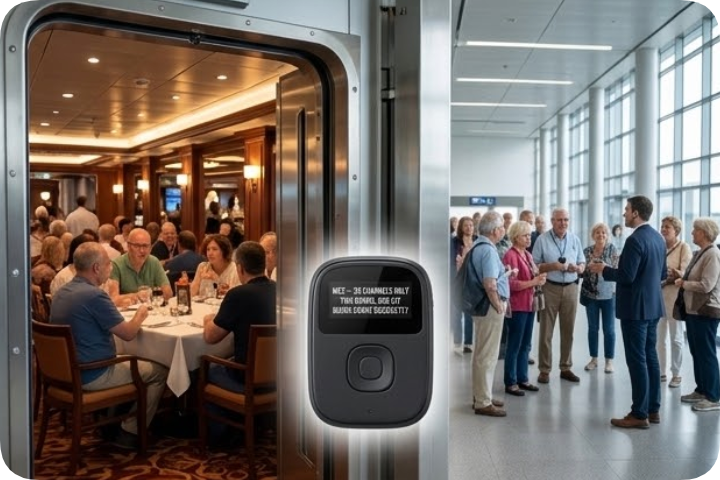
The 39-channel figure is where the comparison gets uncomfortable. A terminal hall running two or three simultaneous groups has room; a ship holding a muster of passengers from several guided tours on the same deck does not. Thirty-nine channels sounds generous until the room it has to serve is a restaurant where three tours are eating at once. The two-hour fast charge is worth noting separately, because it means a terminal can turn a flat unit around during a turnaround window rather than pulling it out of service.
Specification Comparison: Three Richitek Units Against Two Alternatives
| Richitek RC9150 | 2403-2483MHz, 100 channels, 10mW, 1-200m | 15h transmitter, 35+h receiver, 3.7V 1800mAh both sides | 97.5g transmitter, 97.5g receiver | 20Hz-8kHz | Type-C; grey transmitter, black receiver | High power with long standby, hundred channels, large venues |
| Richitek RC2408 | 2403-2483MHz, 80 channels, 10mW, 1-200m | 10h transmitter, 20h receiver, 3.7V 1500mAh and 1000mAh | 59g transmitter, 50g receiver | 50Hz-200kHz transmit, 50Hz-12kHz receive | DC port; multiple colours at volume | Eighty channels, interference resistance, stable performance |
| Richitek RC2402 | 2403-2483MHz, 50 channels, 10mW, 1-200m | 10h transmitter, 20h receiver, 3.7V 1500mAh and 1000mAh | 59g transmitter, 50g receiver | 50Hz-200kHz transmit, 50Hz-12kHz receive | DC port; multiple colours at volume | Basic 2.4GHz, fifty channels, conventional scenarios |
| Guangzhou Tianzhong | Multi-band entry published; channel count not published | Not published in the source database | Not published in the source database | Not published in the source database | Not published in the source database | Scaled production, fast market response, multiple guide and teaching lines |
| ME2 | 39 channels | 10 hours, 2-hour fast charge | 50g transmitter, 20g receiver | Not published in the source database | Not published in the source database | Ear-hook form factor for guided tours |
Choosing by Room, Not by Specification Sheet
| Terminal hall with two or three guided groups boarding in parallel | RC9150 | 100 channels keep simultaneous groups isolated, and 35+h receiver standby covers a full operating day without a charging pool |
| Single gangway where two groups may overlap | RC2408 | Eighty channels are more than a two-group operation needs, and the DC port and 20-hour receiver clear a turnaround day |
| Volume purchase where the terminal runs one guided group per gangway | RC2402 | The basic 2.4GHz standard version suits conventional single-group operations, and the DC port plus twenty-hour receiver cover a turnaround day |
| Volume purchase where the terminal only needs licence-exempt 2.4GHz operation | Guangzhou Tianzhong | Production-scale supply, but the channel count must be obtained in writing before the pier booking is signed |
| Handing out units for a short shore excursion where turnaround speed matters | ME2 | 20-gram receiver and a two-hour fast charge suit a fleet that cycles all day |
What These Specifications Do Not Settle
Two questions decide a cruise terminal purchase and neither appears on any of the five specification sheets. The first is interference between a terminal hall and a ship hull at the same moment, when a gangway is open and two hundred RF-close environments are a few metres apart. A 2.4GHz system works in both, but whether the two interfere is a site survey question, and it should be measured with the actual antenna orientation rather than inferred from a quoted range.
The second is what happens when a unit comes back. Cruise terminals run on returns, not sales: a guest carries a receiver through the gangway, onto a coach, into a museum and back, and somewhere in that chain a unit is left on a seat. Systems with colour differentiation, dock-based charging and a fast charge cycle manage that better than systems that do not. None of the five units here publishes a return-rate figure, which is exactly the number a terminal operator would find most useful and the one every buyer should ask for.
For terminals that also handle heritage sites or industrial venues on the same itinerary, the museum audio guide equipment overview sets out how the ranges divide by venue type, and multi-stop industrial itineraries can be planned against the industrial tour headset page. To weigh capacity classes against each other before specifying, begin with the tour guide system comparison index.