A leading China factory specializing in Wireless Tour Guide Systems, Church Audio Guides, and Translation Headphones with premium OEM/ODM solutions.

Tel:+86 18922879583

Email:tiger.wang@richitek.com

Richitek RC085, RC2401 and RC2468 vs Yiyouyou E519 and Koyinda for Theme Park Guide Systems

Theme Park Guide Systems: Licence, Weight and the 18-Gram Question

A theme park guide system is judged on two questions that have nothing to do with each other, and most purchasing mistakes come from asking only one of them. The first is regulatory: which frequency band is the equipment operating in, and does that band require a licence in the country the park is built in? The second is physical: how many grams is a guest willing to wear for six hours while walking fifteen thousand steps a day? This comparison sets three Richitek units against two systems sold into Chinese scenic sites, and the honest finding is that these two questions have different answers inside the same product range. The RC085 is a 470 to 510MHz UHF unit with a hundred channels and a receiver sensitivity quoted at approximately -102dBm. The RC2401 and RC2468 are both 2.4GHz units on the licence-exempt band. The RC2468 puts an 18-gram receiver on a guest's ear and nothing else. None of the three is the wrong answer; they answer different halves of the same brief, and a park that buys one unit for both halves is the source of most of the complaints in this article.

Richitek RC085: The UHF Unit with a Hundred Channels

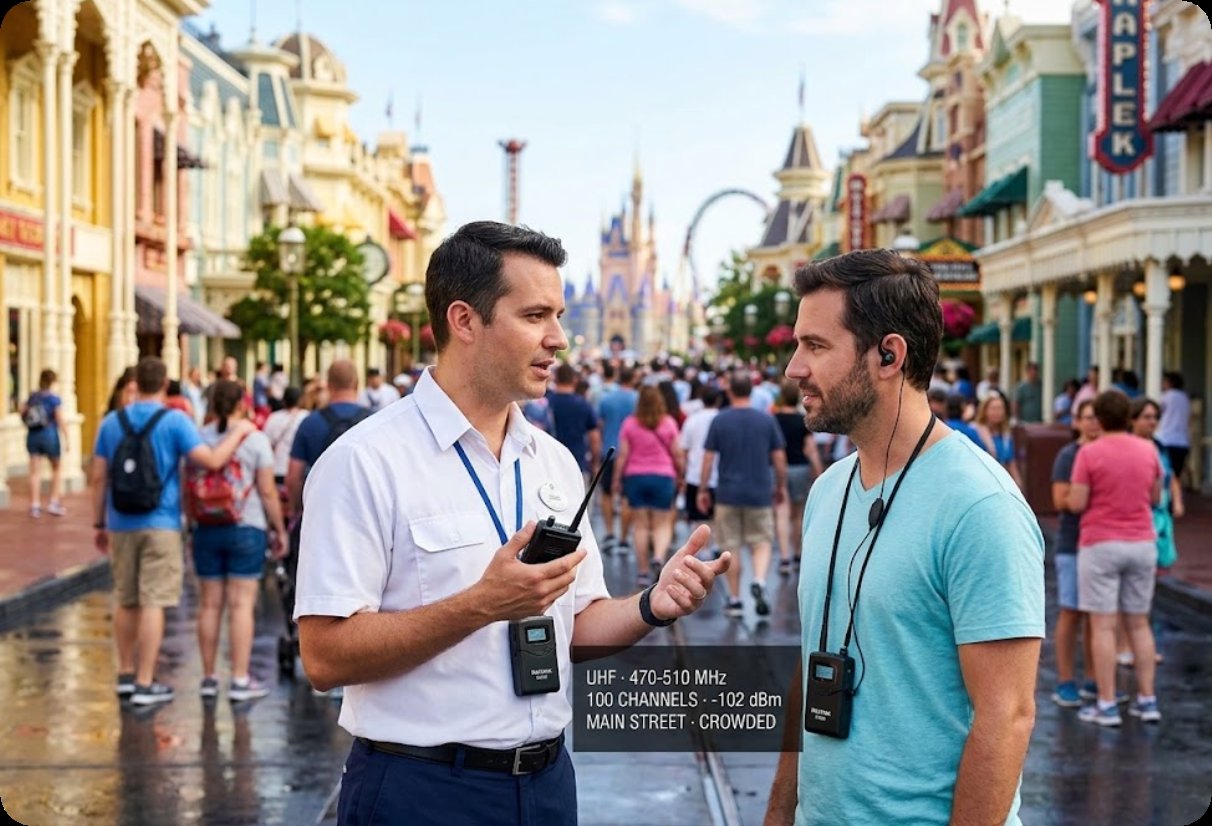
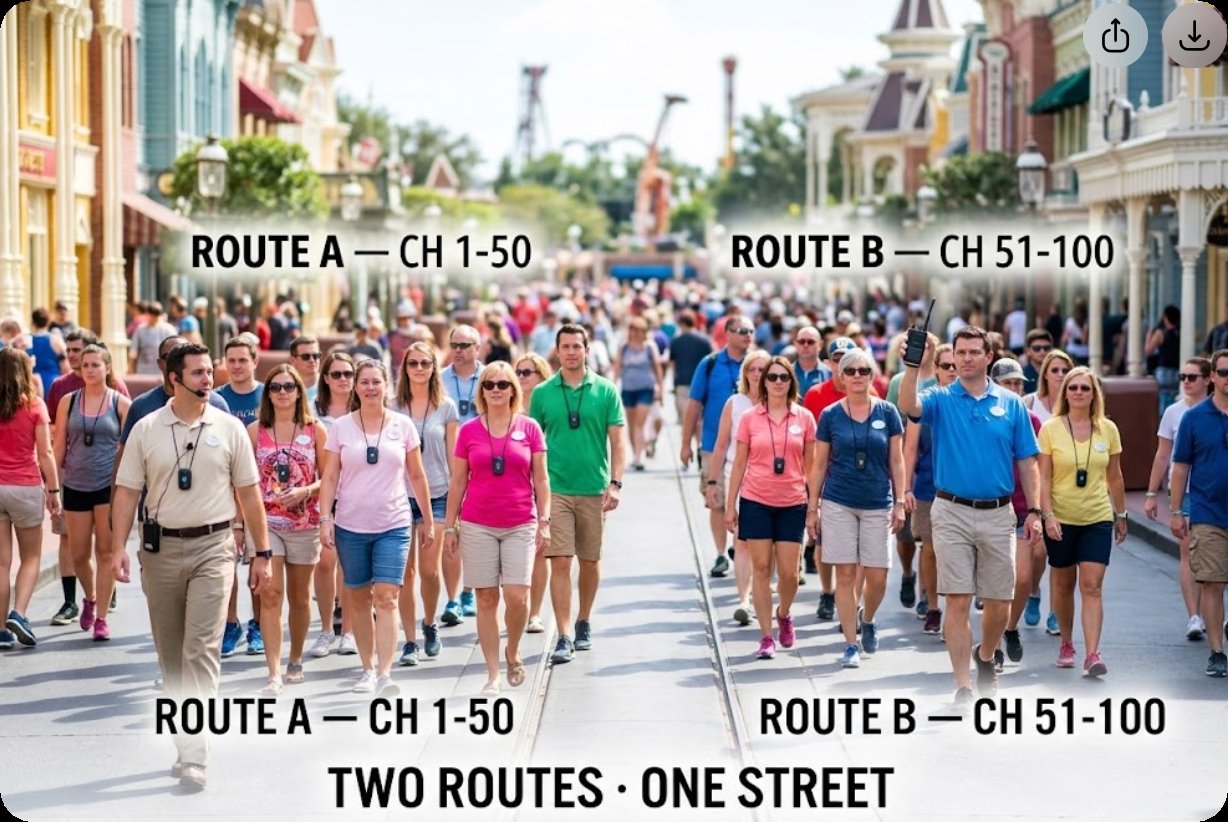
The RC085 Digital Tour Guide System is the odd one out in this comparison, and the oddness is the reason to buy it. It runs on 470 to 510MHz rather than the 2.4GHz band the other two use, with 100 channels, 1-200m quoted range, and output power given as a range of 8 to 10mW rather than a single figure. The documented design notes are an optional head-worn or lapel microphone and a receiver sensitivity of approximately -102dBm — the most sensitive figure published anywhere in this comparison, and the reason a park with a crowded main street uses it.

The rest of the specification is a professional configuration. A 3.7V 1200mAh cell powers twelve hours of transmitter use and a 3.7V 1000mAh cell twenty hours on the receiver, both charging over USB. The two halves weigh 65 and 60 grams, with black, iron grey and blue available at volume. Audio bandwidth runs 50Hz to 12kHz. Control is PLL, and the documented advantages in the specification table are a hundred channels, a professional microphone option, UHF and suitability for special scenarios.

The regulatory point is the one to settle before anything else. A 470 to 510MHz UHF allocation is a licensed band in most markets, which means a park deploying several hundred units may need a spectrum licence and may be restricted to specific frequencies. The published 8 to 10mW output sits at the low end of what is normally permitted precisely because that is how the band is allocated. A park that wants to avoid licence administration entirely will find this unit the wrong choice, and should look at the two 2.4GHz units instead.
richitek themed_park vs yiyouyou koyinda 1

Richitek RC2401: The Fifty-Channel Baseline

The RC2401 Wireless Audio Guide System is the middle of the three, and its specification table describes it plainly: a basic 2.4GHz standard version, easy to use and high in value. Fifty channels on 2403-2483MHz at 10mW over a quoted 1-200m range, PLL control, and multiple colours available for volume orders. Power comes from a 3.7V 1500mAh transmitter cell and a 3.7V 1000mAh receiver cell — ten hours and twenty respectively — over a DC port, while the two halves weigh 59 and 50 grams. On the transmit side it reaches 50Hz to 200kHz, and the receive side 50Hz to 12kHz.

For a park running a single guided route at a time, that is a complete specification. Fifty channels is generous for one route, the 2.4GHz band needs no licence administration in most markets, and a twenty-hour receiver covers an operating day. The trade is against the hundred-channel unit, which matters the moment the park runs two routes close enough to interfere.

🏨 Richitek RC2468: Eighteen Grams on the Guest's Ear

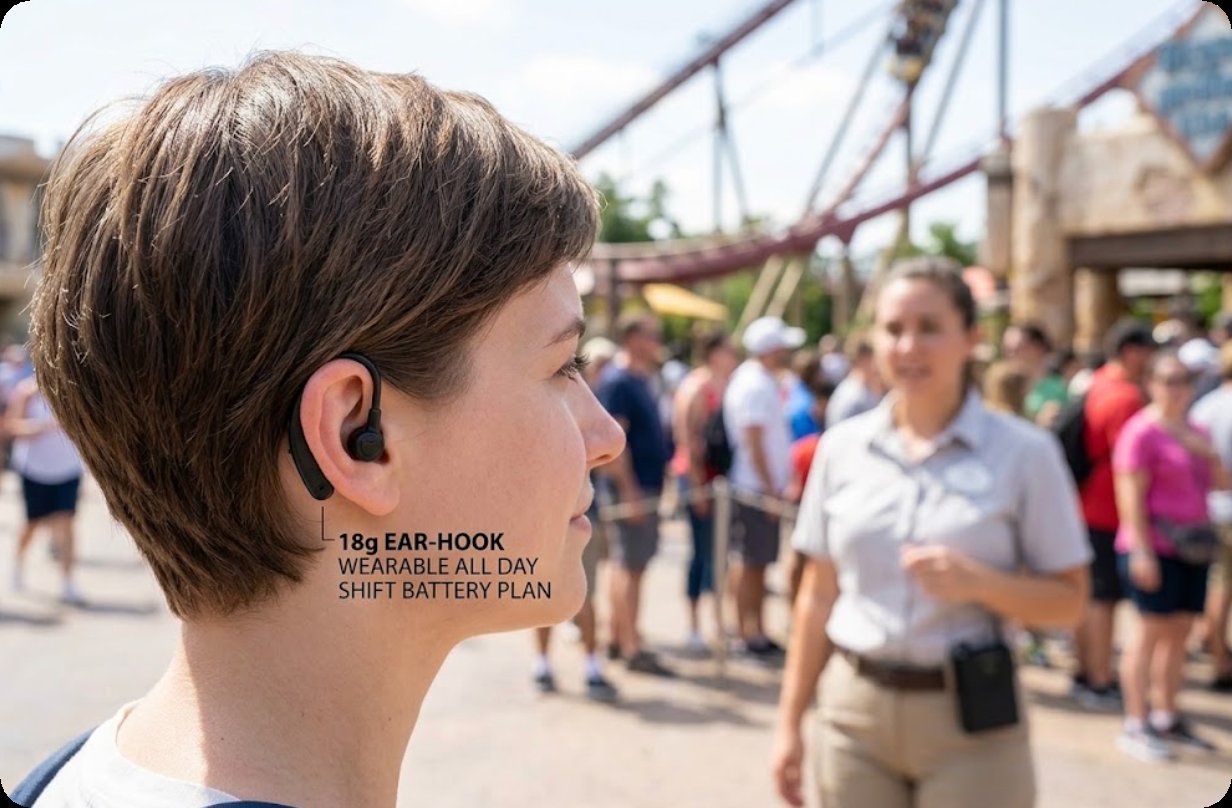
The RC2468 Ultra-Light 2.4G Wireless Tour Guide System is the answer to the second question, and it is not close. The receiver is quoted at 18 grams on an ear-hook form factor, less than a third of what the RC2401 receiver weighs, and the transmitter is 59 grams. Band and range are the same as the RC2401 — 2403-2483MHz at 10mW over 1-200m with 50 channels — with the same 50Hz to 200kHz transmit bandwidth and 50Hz to 12kHz receive figure.

Two published figures make this unit a different proposition rather than a smaller RC2401. The receiver cell drops to 3.7V 300mAh against the RC2401's 1000mAh, and receiver standby falls to about eight hours against twenty. Charging is Micro USB at 5V and 1A rather than a DC port. Bandwidth figures stay where they were — 50Hz to 200kHz on transmit, 50Hz to 12kHz on receive. The documented design notes give the 18-gram ear-hook as the special design and Micro USB charging as the support detail; the transmitter takes multiple colours while the receiver stays black.

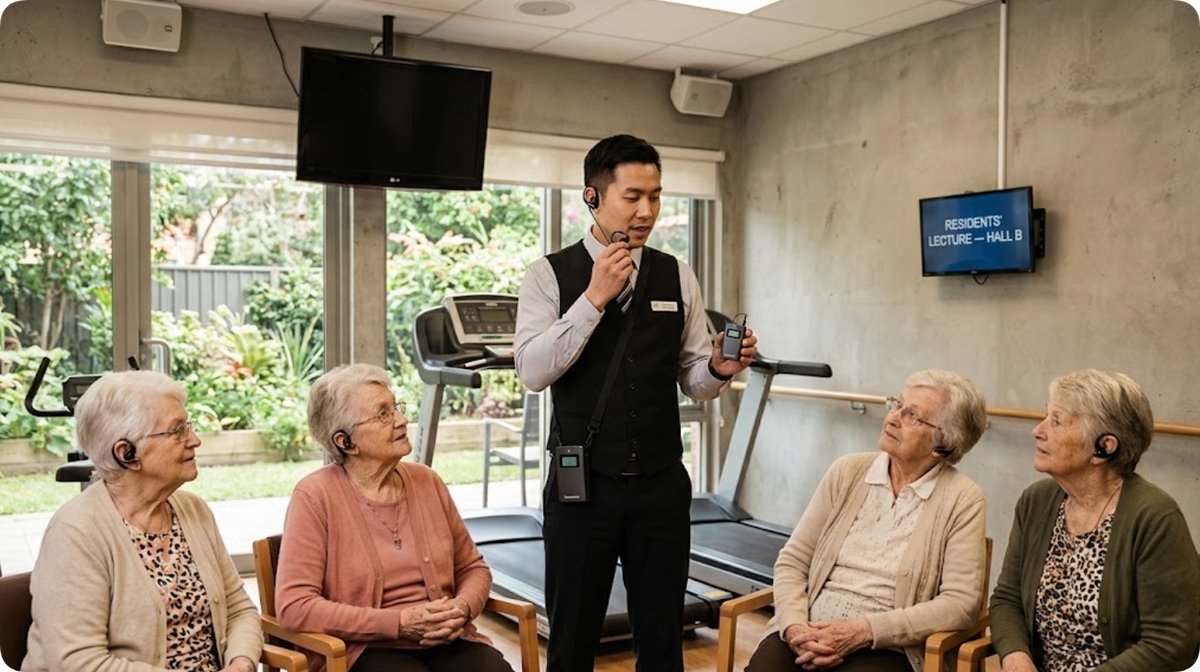
The honest reading is that 18 grams buys eight hours. A guest who wears the receiver from the gate to the exit gets through the day; a guide who hands units out at the entrance and collects them at the exit can run a full double cycle on one charge. What the unit does not offer is the twenty-hour figure or the hundred channels, and a park running multiple routes simultaneously should read the eight-hour number as the limit of one shift.
richitek themed_park vs yiyouyou koyinda 2

💰 Yiyouyou E519: A Digital Encrypted Unit Deployed at Named Sites

Yiyouyou's E519 2026 classic model is listed at the mid-to-high tier with digital encrypted channels, stepless volume adjustment and an orange-and-black colour scheme, and the record names specific deployments: the Terracotta Army, the Potala Palace, Gulangyu and Mount Emei. That is a stronger piece of evidence than any datasheet line, because it means four operators with very different site conditions chose this unit.

What the record does not publish is a channel count, a transmission distance, a battery figure or a weight. Those omissions matter for a park buyer, because a unit named after four landmark sites does not tell you how many parallel routes it supports or whether a guest wears it for a full day. Digital encryption is also a genuine feature rather than a specification line, and for a park running paid experiences where the narration is part of the ticket, it is a reasonable thing to ask about. It should be asked about in writing.

Koyinda: A UHF Neck-Worn Entry Unit With IP54

The Koyinda entry neck-worn unit is listed with UHF wireless voice transmission, IP54 water resistance, one-to-thirty or fifty coverage and a mid-tier price band, aimed at scenic sites and outdoor use. Its strength is immediately legible: it is a UHF unit, so it shares the band question with the RC085, and it is built neck-worn for operators who want a hands-free rental fleet.

The published gap is scale. One-to-thirty or fifty is a smaller ceiling than a hundred channels, and IP54 is a lower ingress rating than the IP figures the Richitek units carry. For a park running three or four routes that never overlap, that is adequate. For a park running eight routes across a site that a thousand people are walking through at once, the ceiling is the binding constraint, not the water rating.
richitek themed_park vs yiyouyou koyinda 3

Specification Comparison: Three Richitek Units Against Two Scenic-Site Systems

Richitek RC085470-510MHz, 100 channels, 8-10mW, 1-200m12h transmitter, 20h receiver, 3.7V 1200mAh and 1000mAh65g transmitter, 60g receiver50Hz-12kHzUSB; black, iron grey, blue at volumeNot published in the source database
Richitek RC24012403-2483MHz, 50 channels, 10mW, 1-200m10h transmitter, 20h receiver, 3.7V 1500mAh and 1000mAh59g transmitter, 50g receiver50Hz-200kHz transmit, 50Hz-12kHz receiveDC port; multiple colours at volumeNot published in the source database
Richitek RC24682403-2483MHz, 50 channels, 10mW, 1-200m10h transmitter, about 8h receiver, 3.7V 1500mAh and 300mAh59g transmitter, 18g ear-hook receiver50Hz-200kHz transmit, 50Hz-12kHz receiveMicro USB 5V/1A; multi-colour transmitter, black receiverNot published in the source database
Yiyouyou E519Digital encrypted channels; channel count not publishedNot published in the source databaseNot published in the source databaseNot published in the source databaseOrange-and-black colourwayMid-to-high tier, price not listed
Koyinda entry neck-wornUHF, one-to-30 or 50 coverageNot published in the source databaseNeck-worn form factor; weight not publishedNot published in the source databaseIP54 water resistanceMid tier, price not listed

🏨 Choosing by Licence Route and Guest Comfort

Park cannot or will not administer a spectrum licenceRC24012.4GHz band with 50 channels and a 20-hour receiver covers one or two routes without licence paperwork
Many simultaneous routes on a crowded main street, and licence administration is possibleRC085100 channels on UHF with approximately -102dBm sensitivity; budget for the frequency licence before ordering
Guests wear the receiver for a full operating dayRC246818-gram ear-hook is the lightest figure in this comparison; plan around the 8-hour receiver figure and a shift-based charging pool
Narration is part of a paid experience and encryption is requiredYiyouyou E519Digital encrypted channels with named deployments at four major Chinese sites; obtain the channel count in writing
Small park running three or four non-overlapping routes on a budgetKoyinda entry neck-wornUHF entry unit with IP54 and a 30-to-50 ceiling, adequate where routes never overlap

What a Theme Park Specification Does Not Settle

Two things decide a theme park guide purchase that no datasheet covers. The first is queue density and how it changes between seasons. A park that runs one hundred guests through a single attraction queue at midday is a different acoustic problem from the same park on a quiet Tuesday, and the answer changes whether a hundred channels is worth paying for or whether fifty is enough. Any supplier who quotes a range figure without asking about peak density is quoting a catalogue number rather than a recommendation.

The second is the return rate. A park hands out hundreds of receivers at the gate, and somewhere in the day a good share of them end up in a pocket, a pram or a bin. Units that are light enough to be forgotten are cheap to replace, and units with an eight-hour receiver need a charging pool sized for that rather than for the park's operating hours. Neither figure appears in any of the five published records compared here.

Parks running heritage or museum content alongside the rides can review the museum audio guide equipment overview for the heavier-duty chassis, and multi-stop industrial itineraries share the same multi-guide constraints covered in the industrial tour headset page. To weigh capacity classes across the whole range before specifying, begin with the tour guide system comparison index.
2026年10月15日 14:19
ꄘ click: 32
no data
Home > VS

Richitek RC085, RC2401 and RC2468 vs Yiyouyou E519 and Koyinda for Theme Park Guide Systems

time: 2026年10月15日 click:32

Theme Park Guide Systems: Licence, Weight and the 18-Gram Question

A theme park guide system is judged on two questions that have nothing to do with each other, and most purchasing mistakes come from asking only one of them. The first is regulatory: which frequency band is the equipment operating in, and does that band require a licence in the country the park is built in? The second is physical: how many grams is a guest willing to wear for six hours while walking fifteen thousand steps a day? This comparison sets three Richitek units against two systems sold into Chinese scenic sites, and the honest finding is that these two questions have different answers inside the same product range. The RC085 is a 470 to 510MHz UHF unit with a hundred channels and a receiver sensitivity quoted at approximately -102dBm. The RC2401 and RC2468 are both 2.4GHz units on the licence-exempt band. The RC2468 puts an 18-gram receiver on a guest's ear and nothing else. None of the three is the wrong answer; they answer different halves of the same brief, and a park that buys one unit for both halves is the source of most of the complaints in this article.

Richitek RC085: The UHF Unit with a Hundred Channels

The RC085 Digital Tour Guide System is the odd one out in this comparison, and the oddness is the reason to buy it. It runs on 470 to 510MHz rather than the 2.4GHz band the other two use, with 100 channels, 1-200m quoted range, and output power given as a range of 8 to 10mW rather than a single figure. The documented design notes are an optional head-worn or lapel microphone and a receiver sensitivity of approximately -102dBm — the most sensitive figure published anywhere in this comparison, and the reason a park with a crowded main street uses it.

The rest of the specification is a professional configuration. A 3.7V 1200mAh cell powers twelve hours of transmitter use and a 3.7V 1000mAh cell twenty hours on the receiver, both charging over USB. The two halves weigh 65 and 60 grams, with black, iron grey and blue available at volume. Audio bandwidth runs 50Hz to 12kHz. Control is PLL, and the documented advantages in the specification table are a hundred channels, a professional microphone option, UHF and suitability for special scenarios.

The regulatory point is the one to settle before anything else. A 470 to 510MHz UHF allocation is a licensed band in most markets, which means a park deploying several hundred units may need a spectrum licence and may be restricted to specific frequencies. The published 8 to 10mW output sits at the low end of what is normally permitted precisely because that is how the band is allocated. A park that wants to avoid licence administration entirely will find this unit the wrong choice, and should look at the two 2.4GHz units instead.

richitek themed_park vs yiyouyou koyinda 1

Richitek RC2401: The Fifty-Channel Baseline

The RC2401 Wireless Audio Guide System is the middle of the three, and its specification table describes it plainly: a basic 2.4GHz standard version, easy to use and high in value. Fifty channels on 2403-2483MHz at 10mW over a quoted 1-200m range, PLL control, and multiple colours available for volume orders. Power comes from a 3.7V 1500mAh transmitter cell and a 3.7V 1000mAh receiver cell — ten hours and twenty respectively — over a DC port, while the two halves weigh 59 and 50 grams. On the transmit side it reaches 50Hz to 200kHz, and the receive side 50Hz to 12kHz.

For a park running a single guided route at a time, that is a complete specification. Fifty channels is generous for one route, the 2.4GHz band needs no licence administration in most markets, and a twenty-hour receiver covers an operating day. The trade is against the hundred-channel unit, which matters the moment the park runs two routes close enough to interfere.

🏨 Richitek RC2468: Eighteen Grams on the Guest's Ear

The RC2468 Ultra-Light 2.4G Wireless Tour Guide System is the answer to the second question, and it is not close. The receiver is quoted at 18 grams on an ear-hook form factor, less than a third of what the RC2401 receiver weighs, and the transmitter is 59 grams. Band and range are the same as the RC2401 — 2403-2483MHz at 10mW over 1-200m with 50 channels — with the same 50Hz to 200kHz transmit bandwidth and 50Hz to 12kHz receive figure.

Two published figures make this unit a different proposition rather than a smaller RC2401. The receiver cell drops to 3.7V 300mAh against the RC2401's 1000mAh, and receiver standby falls to about eight hours against twenty. Charging is Micro USB at 5V and 1A rather than a DC port. Bandwidth figures stay where they were — 50Hz to 200kHz on transmit, 50Hz to 12kHz on receive. The documented design notes give the 18-gram ear-hook as the special design and Micro USB charging as the support detail; the transmitter takes multiple colours while the receiver stays black.

The honest reading is that 18 grams buys eight hours. A guest who wears the receiver from the gate to the exit gets through the day; a guide who hands units out at the entrance and collects them at the exit can run a full double cycle on one charge. What the unit does not offer is the twenty-hour figure or the hundred channels, and a park running multiple routes simultaneously should read the eight-hour number as the limit of one shift.

richitek themed_park vs yiyouyou koyinda 2

💰 Yiyouyou E519: A Digital Encrypted Unit Deployed at Named Sites

Yiyouyou's E519 2026 classic model is listed at the mid-to-high tier with digital encrypted channels, stepless volume adjustment and an orange-and-black colour scheme, and the record names specific deployments: the Terracotta Army, the Potala Palace, Gulangyu and Mount Emei. That is a stronger piece of evidence than any datasheet line, because it means four operators with very different site conditions chose this unit.

What the record does not publish is a channel count, a transmission distance, a battery figure or a weight. Those omissions matter for a park buyer, because a unit named after four landmark sites does not tell you how many parallel routes it supports or whether a guest wears it for a full day. Digital encryption is also a genuine feature rather than a specification line, and for a park running paid experiences where the narration is part of the ticket, it is a reasonable thing to ask about. It should be asked about in writing.

Koyinda: A UHF Neck-Worn Entry Unit With IP54

The Koyinda entry neck-worn unit is listed with UHF wireless voice transmission, IP54 water resistance, one-to-thirty or fifty coverage and a mid-tier price band, aimed at scenic sites and outdoor use. Its strength is immediately legible: it is a UHF unit, so it shares the band question with the RC085, and it is built neck-worn for operators who want a hands-free rental fleet.

The published gap is scale. One-to-thirty or fifty is a smaller ceiling than a hundred channels, and IP54 is a lower ingress rating than the IP figures the Richitek units carry. For a park running three or four routes that never overlap, that is adequate. For a park running eight routes across a site that a thousand people are walking through at once, the ceiling is the binding constraint, not the water rating.

richitek themed_park vs yiyouyou koyinda 3

Specification Comparison: Three Richitek Units Against Two Scenic-Site Systems

Richitek RC085470-510MHz, 100 channels, 8-10mW, 1-200m12h transmitter, 20h receiver, 3.7V 1200mAh and 1000mAh65g transmitter, 60g receiver50Hz-12kHzUSB; black, iron grey, blue at volumeNot published in the source database
Richitek RC24012403-2483MHz, 50 channels, 10mW, 1-200m10h transmitter, 20h receiver, 3.7V 1500mAh and 1000mAh59g transmitter, 50g receiver50Hz-200kHz transmit, 50Hz-12kHz receiveDC port; multiple colours at volumeNot published in the source database
Richitek RC24682403-2483MHz, 50 channels, 10mW, 1-200m10h transmitter, about 8h receiver, 3.7V 1500mAh and 300mAh59g transmitter, 18g ear-hook receiver50Hz-200kHz transmit, 50Hz-12kHz receiveMicro USB 5V/1A; multi-colour transmitter, black receiverNot published in the source database
Yiyouyou E519Digital encrypted channels; channel count not publishedNot published in the source databaseNot published in the source databaseNot published in the source databaseOrange-and-black colourwayMid-to-high tier, price not listed
Koyinda entry neck-wornUHF, one-to-30 or 50 coverageNot published in the source databaseNeck-worn form factor; weight not publishedNot published in the source databaseIP54 water resistanceMid tier, price not listed

🏨 Choosing by Licence Route and Guest Comfort

Park cannot or will not administer a spectrum licenceRC24012.4GHz band with 50 channels and a 20-hour receiver covers one or two routes without licence paperwork
Many simultaneous routes on a crowded main street, and licence administration is possibleRC085100 channels on UHF with approximately -102dBm sensitivity; budget for the frequency licence before ordering
Guests wear the receiver for a full operating dayRC246818-gram ear-hook is the lightest figure in this comparison; plan around the 8-hour receiver figure and a shift-based charging pool
Narration is part of a paid experience and encryption is requiredYiyouyou E519Digital encrypted channels with named deployments at four major Chinese sites; obtain the channel count in writing
Small park running three or four non-overlapping routes on a budgetKoyinda entry neck-wornUHF entry unit with IP54 and a 30-to-50 ceiling, adequate where routes never overlap

What a Theme Park Specification Does Not Settle

Two things decide a theme park guide purchase that no datasheet covers. The first is queue density and how it changes between seasons. A park that runs one hundred guests through a single attraction queue at midday is a different acoustic problem from the same park on a quiet Tuesday, and the answer changes whether a hundred channels is worth paying for or whether fifty is enough. Any supplier who quotes a range figure without asking about peak density is quoting a catalogue number rather than a recommendation.

The second is the return rate. A park hands out hundreds of receivers at the gate, and somewhere in the day a good share of them end up in a pocket, a pram or a bin. Units that are light enough to be forgotten are cheap to replace, and units with an eight-hour receiver need a charging pool sized for that rather than for the park's operating hours. Neither figure appears in any of the five published records compared here.

Parks running heritage or museum content alongside the rides can review the museum audio guide equipment overview for the heavier-duty chassis, and multi-stop industrial itineraries share the same multi-guide constraints covered in the industrial tour headset page. To weigh capacity classes across the whole range before specifying, begin with the tour guide system comparison index.
no data
×

Contact us

email:
name:
subject:
content: