.webp)
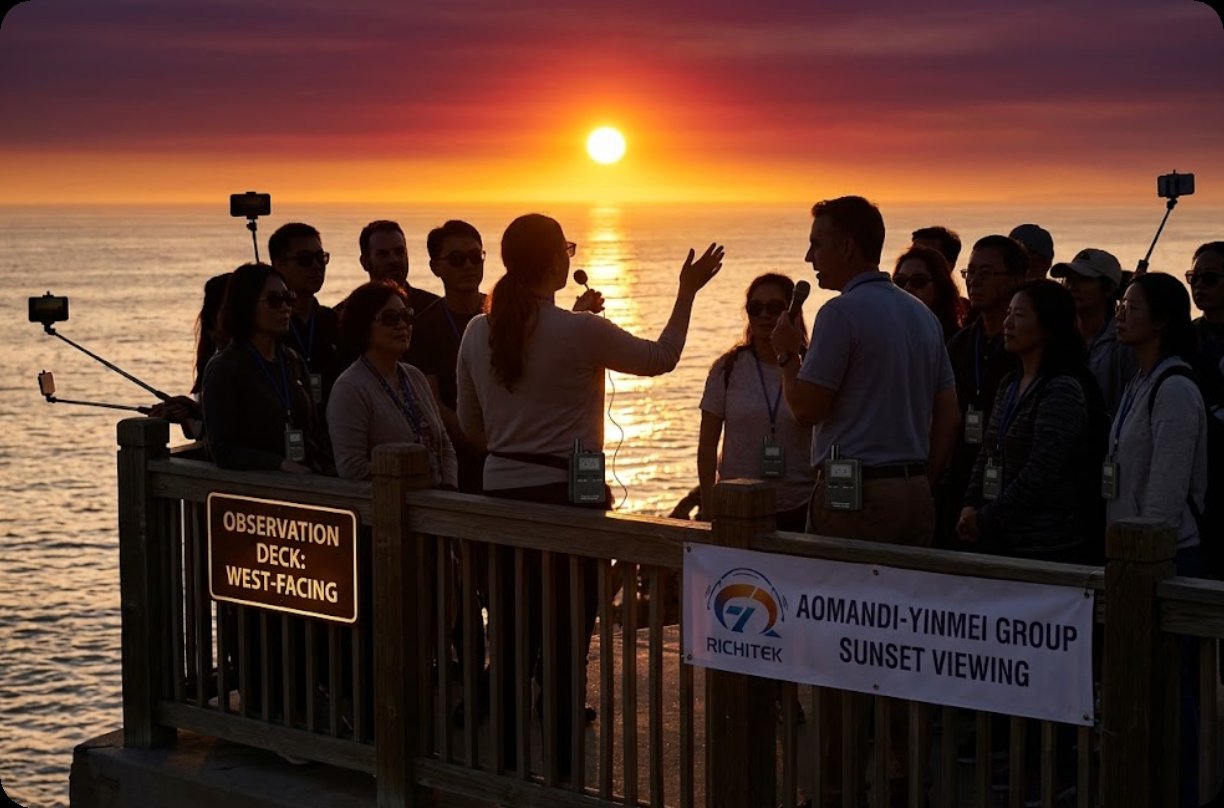
Picture the last twenty minutes of a busy afternoon at a clifftop viewpoint. One group is at the western railing because that is where the sunset is. A second group has just arrived and is at the eastern railing. A third is somewhere in between, and a fourth is late, walking up from the car park. Every one of them paid for the same commentary, every one of them can hear everyone else, and no amount of transmit power fixes what happens when four conversations occupy one platform at the same time.
Two questions decide an observation deck purchase, and they are not the two a buyer expects. The first is whether visitors who converge on the same railing at the same minute can be kept apart — which is arithmetic about channel ceilings, not about distance. The second is whether the hardware survives being handed to two hundred people a day. Range, wind handling and noise cancellation all get attention on a datasheet. Neither of those two does.
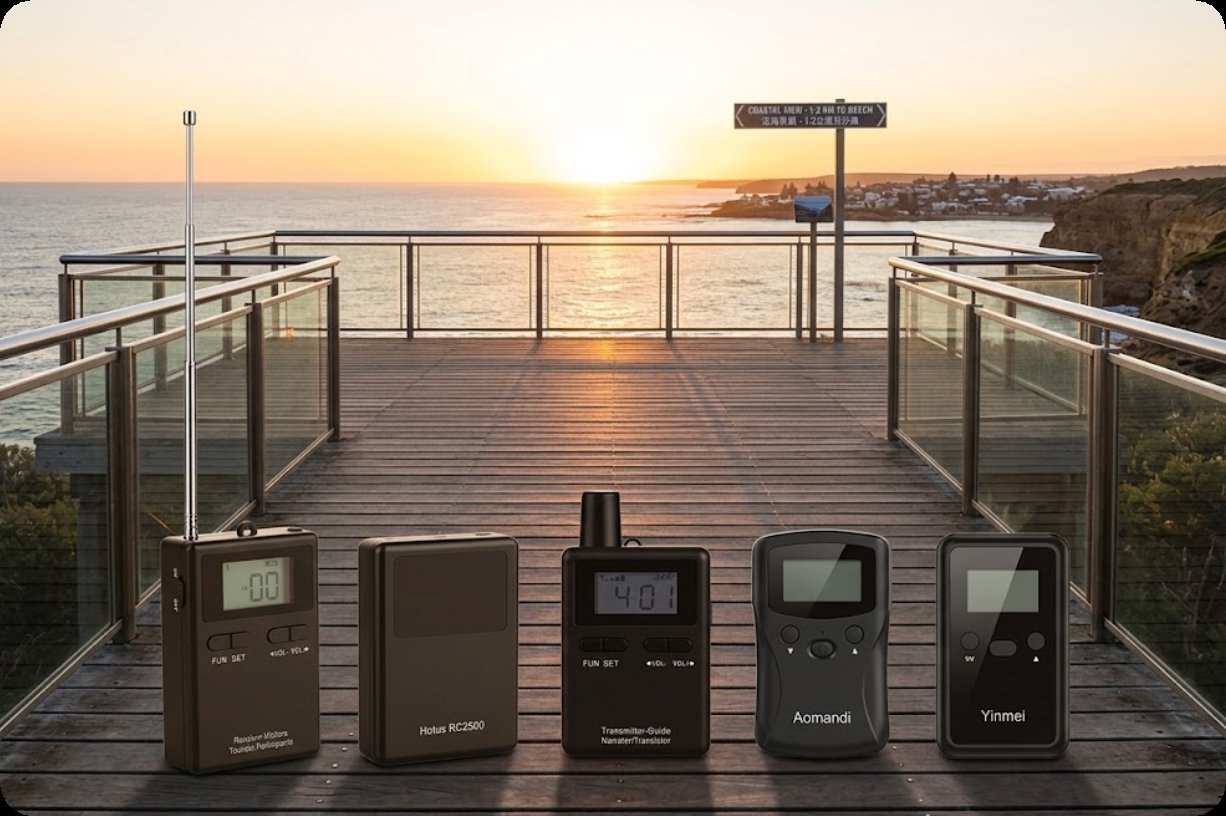
Three Richitek units are compared here against two systems that address a deck differently. The RC8860 is the only UHF unit in the group at 860 to 870MHz, and it does so with twenty channels — the smallest ceiling here. The RC2500 and RC2406 both sit on the licence-exempt 2.4GHz band and separate from it on standby and channel count rather than on band: fifty channels and 35 hours-plus against eighty channels and 20 hours. Facing them are Aomandi, whose documented approach is UHF voice transmission with multi-channel zone-based commentary, and Yinmei, whose long-range digital noise cancellation claims the open air as its problem to solve.
Richitek RC8860: Twenty Channels on the Band That Tolerates an Open Sky
The Richitek RC8860 is the odd unit out, and the specification table is blunt about why: 860 to 870MHz UHF, single band, documented advantages of strong interference resistance and stable signal. Twenty channels at 10mW over a quoted 1 to 200m. On an open deck surrounded by nothing but weather, UHF behaves predictably in a way 2.4GHz does not, because there is no dense multipath to fight and the band is not shared with a hundred consumer devices.
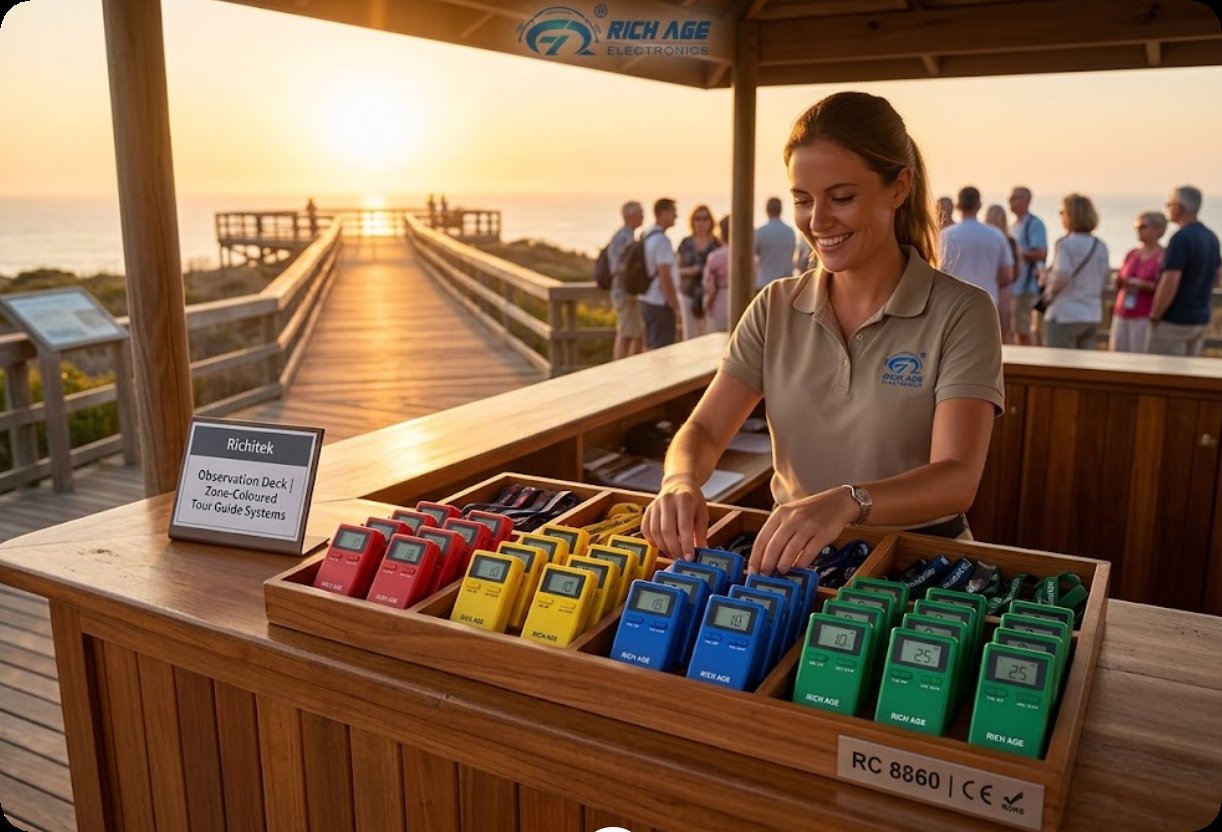
On the bench it is a 59-gram transmitter and a 50-gram receiver, charging over a DC port rather than Type-C, with PLL control and audio bandwidth of 50Hz to 12kHz. In the field it is a ten-hour transmitter and a twenty-hour receiver, from 1500mAh and 1000mAh cells respectively. Six colour options are listed for volume orders — black, iron grey, silver grey, red, orange and blue — which for a rental operation means a colour can be assigned to a zone.
Twenty channels is the honest limit for an open clifftop platform. Two well-separated decks can run two routes on this unit; a single deck running three simultaneous groups cannot, and no amount of transmit power changes that arithmetic. A site that wants three zones on one deck is looking at the two 2.4GHz units instead.
Richitek RC2500: The Flagship That Trades Weight for Standby
The RC2500 Wireless Tour Guide System is the heaviest unit in this comparison at 104 grams on both halves, and it buys the longest standby figure here with them: 35 hours-plus on the receiver, from a 3.7V 1800mAh cell that is the larger of the two packs fitted to any of the three units. Transmitter life is fifteen hours, also the longest, and charging is Type-C.
What those figures solve at a clifftop deck exposed to weather is turnover. A deck that hands out fifty receivers at the entrance and collects them at the exit runs on charging docks, and a unit with a thirty-five-hour receiver can sit through a full day and still be charged once overnight. The specification table also records a design detail that matters more than its size suggests: one-touch synchronisation, power-off and mute. On a rental counter, one-touch pairing and a single press to mute are the difference between a two-minute handoff and a two-minute handoff plus an argument.
Two costs matter most at an exposed clifftop deck. At 104 grams it is the only unit here that a guest notices carrying after an hour. And the audio bandwidth is listed as 50Hz to 8kHz, the narrowest in this comparison — fine for speech, and not a specification to deploy on a site that also plays recorded content through the same channel.
Richitek RC2406: Eighty Channels, and the Documented Interference Claim
The Richitek RC2406 Wireless Tour Guide System has the highest channel count in this comparison at eighty, and the specification table records the reason as eighty-channel interference resistance — a claim worth examining rather than repeating, because a deck is exactly the place where a claim about interference either proves itself or does not.
Weighing 59 and 50 grams, drawing on 1500mAh and 1000mAh cells for ten and twenty hours respectively, and charging over a DC port, the RC2406 is otherwise an ordinary 2.4GHz unit: 10mW across 2403 to 2483MHz over a quoted 1 to 200m, PLL control, 200kHz of transmit bandwidth and 12kHz on receive. Nothing about it is remarkable in isolation, which is rather the point for hardware that will spend its life clamped to a clifftop rail through salt air. The one item that is not ordinary is the colour: multiple finishes are available at volume, so a site running three zones can hand out three visibly different sets of hardware.
Two trade-offs come with the eighty-channel ceiling, and both are sharper at a clifftop deck than they would be indoors. The quoted transmitter life of ten hours is the shortest of the three 2.4GHz batteries here, which matters if the guide also hands out receivers and is expected to work a full day. And the 20-hour receiver is half what the RC2500 carries, so the overnight charging pool has to be sized for a full shift rather than for a day and a half.
The colour flexibility is the quiet advantage at a clifftop deck, where a visitor two hundred metres downwind still needs to know which tour is theirs. On a deck divided into viewing zones, giving each zone its own colour removes an entire category of mistake at the counter, and the specification table lists multiple colours at volume rather than a single finish.
Aomandi: UHF With Multi-Channel Zone Commentary
Aomandi and Yinmei both sell the open air as the problem to be solved, and both answer it without publishing the number that decides the purchase. Aomandi's UHF receiver is listed at the mid tier with multi-channel zone commentary for planning exhibitions, factory tours and large conferences; the mechanism suits a deck divided into viewing areas, but "multi-channel" is a description of intent rather than a figure, and a planner cannot size a twenty-channel estate against an adjective. Yinmei goes at the noise instead, claiming long-range digital cancellation aimed squarely at wind at a railing, which is the right target — broadband, low-frequency, and exactly the sort of sound that a notch in the frequency response will not touch.
Specification Comparison: Three Richitek Units Against Two Alternatives
| Richitek RC8860 | 860-870MHz UHF, 20 channels, 10mW, 1-200m | 10h transmitter, 20h receiver, 3.7V 1500mAh and 1000mAh | 59g transmitter, 50g receiver | 50Hz-12kHz | DC port; six colours at volume | Not published in the source database |
| Richitek RC2500 | 2403-2483MHz, 50 channels, 10mW, 1-200m | 15h transmitter, 35+h receiver, 3.7V 1800mAh on both sides | 104g transmitter, 104g receiver | 50Hz-8kHz | Type-C; black only at volume | Not published in the source database |
| Richitek RC2406 | 2403-2483MHz, 80 channels, 10mW, 1-200m | 10h transmitter, 20h receiver, 3.7V 1500mAh and 1000mAh | 59g transmitter, 50g receiver | 50Hz-200kHz transmit, 50Hz-12kHz receive | DC port; multiple colours at volume | Not published in the source database |
| Aomandi UHF receiver | UHF with multi-channel zone commentary; channel count not published | Not published in the source database | Not published in the source database | Not published in the source database | Not published in the source database | Mid tier, price not listed |
| Yinmei long-range digital noise cancellation | Digital audio noise reduction; range not published | Not published in the source database | Not published in the source database | Digital noise reduction, bandwidth not published | Multilingual simultaneous interpretation | Mid-to-high tier, price not listed |
Choosing by How Many Groups Share the Railing
| Two zones on one deck, and UHF interference behaviour matters more than channel count | RC8860 | UHF for the open air, six colour options for zone assignment; twenty channels covers two separated zones |
| Thirty-five-hour receiver standby is what makes the overnight charging pool work | RC2500 | 35+h receiver from a 1800mAh cell, plus one-touch sync, power-off and mute for a fast counter handoff |
| Deck running three or more groups at once, and zone-coded colour matters at the counter | RC2406 | Eighty channels is the highest ceiling here, with multiple colours available at volume so each viewing zone can be issued visually distinct hardware |
| A deck physically divided into viewing zones with separate commentary | Aomandi | UHF voice with documented multi-channel zone commentary; obtain the channel count in writing before ordering |
| Deck where wind noise at the railing is the limiting problem | Yinmei | Digital noise reduction is aimed at exactly the broadband wind noise an open railing produces, with multilingual commentary from one guide position; obtain the range figure in writing |
What an Observation Deck Specification Does Not Settle
Two questions decide a deck purchase that no datasheet covers. The first is the weather between the last transmitter position and the farthest listener, because a deck at 200 metres is outdoors in wind, rain and salt air, and the quoted 1 to 200m figure is a line-of-sight number that a crowd of visitors standing between the guide and the railing will shorten. Testing on an empty deck tells you very little.
The second is the sunset problem, and on a west-facing clifftop it is the one that changes the channel decision. If every group on the deck converges on the western railing at the same minute, then the number that matters is not how many channels the equipment has but how many groups arrive at the railing at once. A deck that schedules its groups fifteen minutes apart needs far fewer channels than the same deck running a continuous stream, and a site that has not decided which of those two it is running has not finished specifying the system.
Sites combining an observation deck with heritage interiors can review the museum audio guide equipment overview for the indoor chassis, and multi-stop industrial itineraries share the same group-management constraints covered in the industrial tour headset page. Where a weighing of one unit against another is the question, the tour guide system comparison index holds the rest of this series.