
A leading China factory specializing in Wireless Tour Guide Systems, Church Audio Guides, and Translation Headphones with premium OEM/ODM solutions.

Tel:+86 18922879583

Email:tiger.wang@richitek.com

Richitek RC2402, RC2501 and RC9150 vs Kaimile KML-980-2HT-30 and Allite for Trade Mission Guide Systems

A trade mission is not a tour with foreign guests in it. It is a negotiation, a factory audit, a signing ceremony and a lunch, and in all four the equipment is the least important thing on the table except in one respect: the guest is wearing it. A visitor who keeps touching an earpiece has stopped listening, and a visitor who is still listening has not noticed the device at all. That is why the number that decides this purchase is not channel count or transmission range. It is grams.

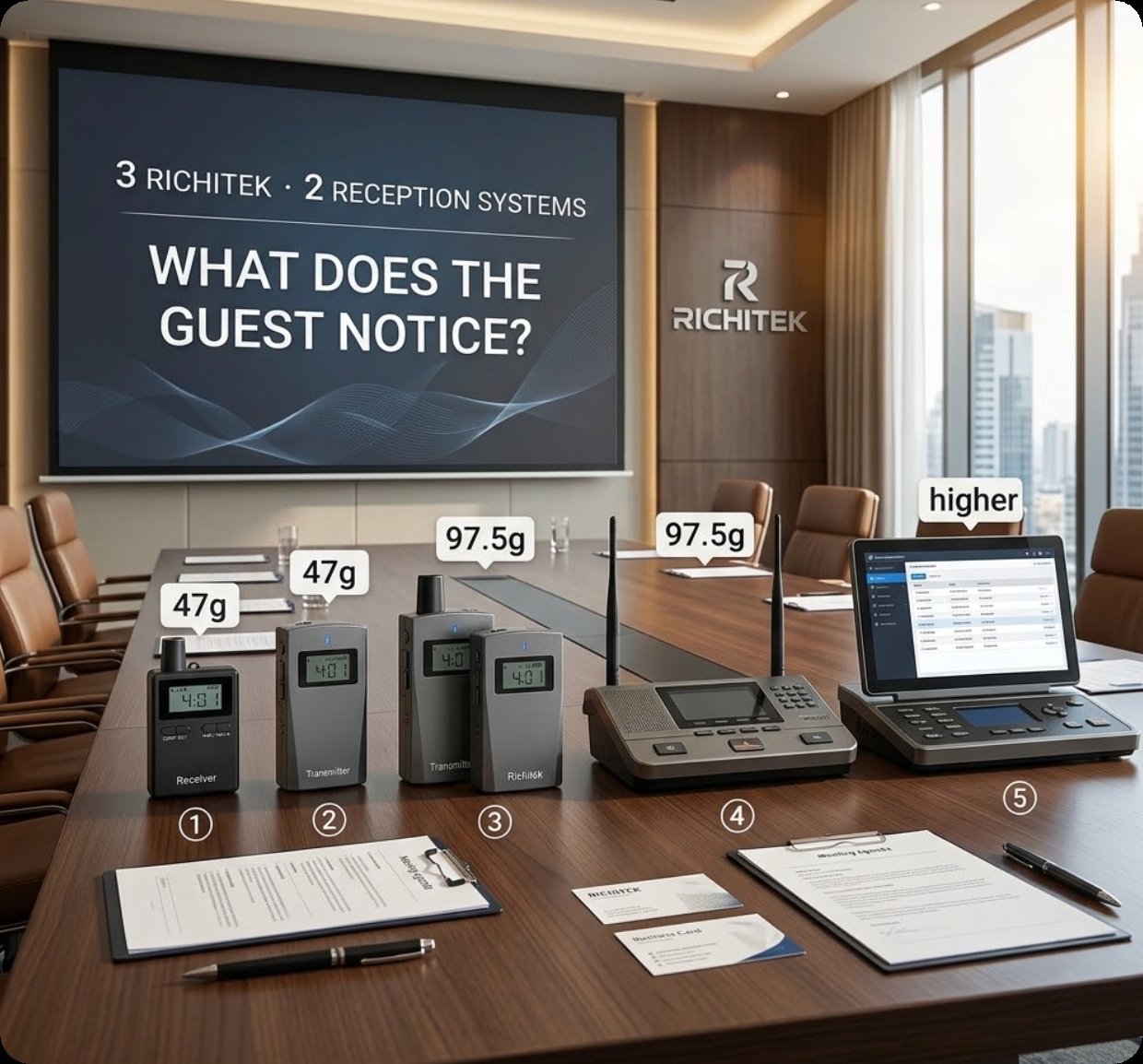
The useful way to divide the three Richitek units on offer is not by specification but by the part of the day they suit. The morning briefing puts a guest in a chair for ninety minutes with no walking and no need to keep the device on. The factory walk is two hours on a production floor. The evening dinner is three hours, indoors, loud, and the one slot where a light receiver genuinely matters. Each of those three slots rewards a different figure, and the specification table settles each one differently.

Two boundaries should be drawn before any comparison is attempted. On the two competitor systems, the published material is a feature list and a price; parallel arithmetic on channels, range or battery life would be invention rather than comparison. On the Richitek side, the three units described here carry a guide and a microphone, not a second language channel — where a delegation needs simultaneous interpretation, that is a different kind of system, and the one competitor record that names it is the expensive one.
richitek trade_mission vs kaimile allite 1

The Morning Briefing: RC2402 on a Chair for Ninety Minutes

The RC2402 Wireless Tour Guide System is the light option, and it takes a different route to lightness than the ear-hook units in this category. Fifty channels on 2403 to 2483MHz over a quoted 1 to 200m at 10mW, a 47-gram transmitter and a 50-gram receiver, and a 3.7V 1500mAh transmitter cell with a 3.7V 1000mAh receiver cell.

Endurance is 15 hours on the transmitter and more than thirty-five on the receiver — the same receiver figure the two larger units publish, which is unusual at this weight. Audio bandwidth reaches 20Hz to 200kHz, the widest range in this comparison, and charging runs over a DC port. Documented extras are an optional head-worn or lapel microphone and a receiver sensitivity of approximately -38dBm; that last figure sits fifty-odd decibels away from the -102dBm quoted for a different model in the same family and the table carries it without comment, so treat it as recorded data and test it in the room where the meeting happens.

A bandwidth figure of twenty hertz to two hundred kilohertz is worth pausing on, because it covers far more than speech. A morning session that ends with a product film, or a factory tour that pauses in front of a demonstration screen, benefits from an audio path that was not designed only for a voice. No specification sheet promises anything about that in practice, and a demonstration in the actual room remains the only way to know whether the wide figure changes anything a listener would notice.

A guest notices weight; an organiser notices battery. This unit answers both: light over a morning, and long enough that nothing has to be recalled at midday. Single-colour availability at volume.

Ninety minutes in a chair is the easiest part of any trade mission to equip, and it is the part most specifications over-engineer for. The room is climate-controlled, the client is seated, the guide is standing at the head of the table with a microphone in hand, and the only real risk is feedback from a body microphone held too close to a lapel. A wired lapel clipped at mid-chest solves it for almost every delegate, and a receiver set to a comfortable volume stays comfortable for the full session because the listener is not walking and not concentrating on staying upright.

What actually goes wrong in the morning is administrative rather than acoustic. Devices arrive in a case, get counted onto a table, and every one has to be matched to a delegate before the session starts. That is a hundred small operations performed in the fifteen minutes before anyone sits down, and it is the reason a unit with thirty-five hours of standby is easier to run than one with eight — the morning unit can be handed straight back into the same case at midday and still be full at the afternoon session.

The microphone option matters more here than anywhere else in the day. A guide who is also translating, or who is holding a printed agenda and pointing at a screen, cannot also hold a transmitter up to their mouth. A head-worn or lapel option releases both hands, and on a ninety-minute briefing that is the difference between a composed delivery and a hand occasionally crossing in front of the delegate's line of sight.

🏭 The Factory Walk: RC2501 and the Thirteen-Milliwatt Question

The RC2501 Wireless Tour Guide System is the middle answer, and it moves in both directions at once. Both halves weigh 47 grams against the RC9150's 97.5, and transmit power rises to 13mW, the highest figure in this comparison. Fifty channels, 1 to 200m, and a 3.7V 1500mAh transmitter cell with a 3.7V 1000mAh receiver cell.

Wireless and audio are where this unit differs from the one below it. Output is 13mW — the highest figure here — against a bandwidth of 20Hz to 200kHz, and the table records an optional head-worn or lapel microphone alongside a receiver sensitivity of approximately -38dBm. That sensitivity sits fifty-odd decibels away from the -102dBm quoted for a different model in the same family and is carried without comment; treat it as recorded data and test it in the room where the meeting actually happens. Cells of 1500mAh and 1000mAh back fifteen hours of transmitter use and thirty-five-plus on the receiver, both over Type-C.

For a business day that includes walking a production line, this is the balanced choice: forty-seven grams disappears, and a receiver that lasts the day turns recharging into something that happens overnight rather than at one o'clock in the client's lobby. Single-colour availability is arguably an advantage on a client-facing day rather than a limitation.

A factory floor changes the acoustic problem completely, and in a way that favours the unit with more transmit power. A briefing room is a controlled space with soft furnishings and a door; a production line is a hard-surfaced space with hard-surfaced reflections, machinery running, and a guide who may be thirty metres from the last person in the line. The published output on this unit is 13mW, the highest of the three here, which does not make it immune to a noisy floor but does give it the best starting position.

Weight becomes a different question on a walkaround. Anything above about a hundred grams starts to be noticed at the end of the second hour, and a delegate who has been told to wear a device for a factory audit will put it in a pocket if it is uncomfortable — which turns the commentary channel off exactly when the client is looking at the line. Forty-seven grams on each half is below the threshold where that tends to happen.

The thirteen milliwatts also matter for a reason that has nothing to do with distance. On a floor with a lot of steel — machine guards, frames, ducting, fencing — a stronger signal reduces the retries that turn into dropouts, and a dropout in front of a client reads as a fault in the demonstration rather than in the room. Whether 13mW is sufficient for a particular floor is a question that has to be answered by walking that floor, which is why the figure belongs in a trial rather than a spec sheet.

The Evening Dinner: RC9150 and Whether Weight Shows

The RC9150 High-end 2.4G Wireless Audio/Radio Guide System is the heaviest unit here at 97.5 grams on both halves, and it buys two things the lighter pair cannot offer. The first is a hundred channels, the highest ceiling in this comparison, at 10mW on the same 2.4GHz band over a quoted 1 to 200m. The second is endurance: 3.7V 1800mAh cells on both sides, giving 15 hours on the transmitter and more than thirty-five on the receiver, with PLL lock-loop frequency synthesis and Type-C charging.

Audio bandwidth is given as 20Hz to 8kHz, the narrowest of the three, which is entirely adequate for a voice briefing and not the specification to choose if the same channel will carry recorded video or a presentation with music. What the table offers instead is endurance, a hundred channels and a stated suitability for large venues. Grey on the transmitter and black on the receiver, both customisable at volume.

The honest case for it is a large site walked in groups. A hundred channels means a delegation can be split across four separate routes without the operator thinking about it, and a thirty-five-hour receiver means nothing is collected at midday. The cost is that a guest carries ninety-seven grams, and on a factory floor that is a weight some visitors will comment on.

An evening dinner is where weight stops being a technical specification and becomes a social one. A delegate at a table for three hours is not walking, but they are also sitting across from people they are trying to impress, and a device that is visibly present gets commented on. That is the strongest argument in this comparison for the lighter units, and the reason a hundred-gram receiver belongs in a production-line walkaround rather than at a dinner table.
richitek trade_mission vs kaimile allite 3

Dinner also inverts the acoustic requirement. A briefing room rewards directionality, because everyone faces the same way; a dinner table scatters listeners around a circle with the guide standing in the middle of it, at roughly equal distance from nobody. More transmit power does not fix that geometry. What fixes it is getting the device light enough that a delegate forgets it is there and stops adjusting it halfway through the second course.

The hundred channels on this unit solve a problem the other two do not have, and it is worth being honest that it is not the problem this particular day has. Four simultaneous routes matter at a site with multiple production halls and a delegation large enough to split. One group walking one route through one building needs none of it, and paying for a hundred-channel ceiling in order to run two channels is a real and common over-specification.

There is a version of the trade mission day where the ninety-seven grams is worth carrying anyway, and it is the one where the delegation is large. A twelve-person group split across three halls with a guide in each needs three simultaneous channels before anyone thinks about route count, and a fifth group arriving late needs a fourth. On that day the hundred-channel unit is not the heavy option that also works. It is the only option in this comparison that does not run out of channels.

Kaimile KML-980-2HT-30: The Interpretation-Grade Reference

The Kaimile KML-980-2HT-30 is listed at high tier with a published price of 14,136 yuan per unit, and its documented characteristics are one-to-many team commentary, meeting simultaneous interpretation, and use in guided tours, scenic visits and corporate reception. The interpretation claim is the part that matters here: it is not a headset tour system with an interpreter standing next to it, it is a system built to run an interpreter channel into the same audio path.

A trade mission where a client needs two languages simultaneously therefore has a different answer available, at roughly thirty times the price of a lightweight receiver. Whether that is worth it depends entirely on whether simultaneous interpretation is a requirement or a convenience — and on a mission where the guide and the guest speak the same language, it is neither.

The price gap deserves a second look before it frightens anyone. A hundred-and-forty thousand yuan is roughly what a full delegation kit costs, and it buys one channel that an interpreter occupies. The three lighter units combined cost less than a single interpreter charges for a day, and they serve the far more common case where the guide speaks the client's language and the commentary is simply a volume problem rather than a language problem.

Where an interpretation requirement is real, though, no amount of channel count substitutes for it. A delegate following a conversation in a language they do not read cannot be helped by a clearer signal in a language they already understand, and that is the one failure mode in this comparison that no specification figure would have caught.

Allite: Digital Band, Fast Charging and a Management App

Allite's wireless commentary series is listed at the mid-to-high tier with strong RF technology, high audio fidelity, an intelligent management mini-programme, Type-C fast charging and Bluetooth assistance, sold into museum interpretation, international conference simultaneous interpretation and smart scenic sites.

Two features are directly relevant to a business day. Type-C fast charging means the charging cradle is less of a bottleneck between sessions, and a management mini-programme is what a corporate organiser uses to allocate devices and retrieve them at the end — the administrative side of a delegation day, which is where most of the cost and nearly all of the embarrassment lives. The published record is thin on the figures a buyer would use for a rental fleet comparison.

Against that, the documented application list includes simultaneous interpretation, which again places it in a category the three Richitek units do not claim to occupy.

For a corporate organiser, the software half is often the deciding factor rather than the hardware half. A delegation of twenty people across a three-day visit involves roughly sixty handovers, and doing that on a clipboard in a hotel lobby is how devices end up in the wrong suitcase. A management tool that issues a device against a name and records the return removes a category of mistake that has nothing to do with audio and everything to do with the client watching.

richitek trade_mission vs kaimile allite 2

Specification Comparison: Three Richitek Units Against Two Reception Systems

Richitek RC24022403-2483MHz, 50 channels, 10mW, 1-200m15h transmitter, 35+h receiver, 3.7V 1500mAh and 1000mAh47g transmitter, 50g receiver20Hz-200kHzDC port; grey only at volumeNot published in the source database
Richitek RC25012403-2483MHz, 50 channels, 13mW, 1-200m15h transmitter, 35+h receiver, 3.7V 1500mAh and 1000mAh47g transmitter, 47g receiver20Hz-200kHzType-C; grey only at volumeNot published in the source database
Richitek RC91502403-2483MHz, 100 channels, 10mW, 1-200m15h transmitter, 35+h receiver, 3.7V 1800mAh on both sides97.5g transmitter, 97.5g receiver20Hz-8kHzType-C; grey transmitter, black receiverNot published in the source database
Kaimile KML-980-2HT-30Not published in the source databaseNot published in the source databaseNot published in the source databaseNot published in the source databaseSupports meeting simultaneous interpretation14,136 CNY per unit
Allite commentary seriesDigital band; channel count not publishedNot published in the source databaseNot published in the source databaseHigh audio fidelity, bandwidth not publishedType-C fast charging, Bluetooth, management mini-programmeMid-to-high tier, price not listed

One practical note belongs with any of these units. A factory audit involves walking past equipment that is running, and a receiver set to its maximum volume in order to hear over a production line is a receiver that will be set down and picked up again several times during the visit. Whatever the specification says about sensitivity, the setting a delegate actually uses is the one that decides whether they keep the device on, and that setting is established in the first five minutes.

The table below maps each device to the part of the day it fits rather than to a specification tier, because the same receiver can be the wrong choice at nine in the morning and the right one at nine in the evening.

🏨 Choosing by How Long the Guest Wears It

Single-site visit where the guest is expected to keep it on all dayRC240247 to 50 grams with 35-plus hours of receiver standby and the widest audio bandwidth of the three, so nothing is collected at midday
Full business day across two sites with an evening returnRC250147 grams on both halves with 35-plus hours of receiver standby, 13mW output and the widest bandwidth of the three
Delegation split across four separate routes on a large siteRC9150A hundred channels is the highest ceiling here, and thirty-five hours of receiver standby means nothing is collected at midday
Two languages must run simultaneously through an interpreterKaimile KML-980-2HT-30Simultaneous meeting interpretation is documented; budget for 14,136 yuan per unit, roughly thirty times a lightweight receiver
Corporate organiser needs device allocation and collection handled in softwareAlliteIntelligent management mini-programme plus Type-C fast charging; confirm channel count and battery figures in writing

What a Trade Mission Specification Does Not Settle

Two questions decide a trade mission purchase that no datasheet answers. The first is language, and it needs a straight answer before any hardware is chosen: if the guide and the guests share a working language, a commentary system is sufficient and interpretation capability is dead weight. If they do not, the purchase is not a guide system at all — it is an interpretation system, and at a price difference of roughly thirty to one the two categories should not share a quotation. Both competitors name interpretation; none of the three Richitek units claims it.

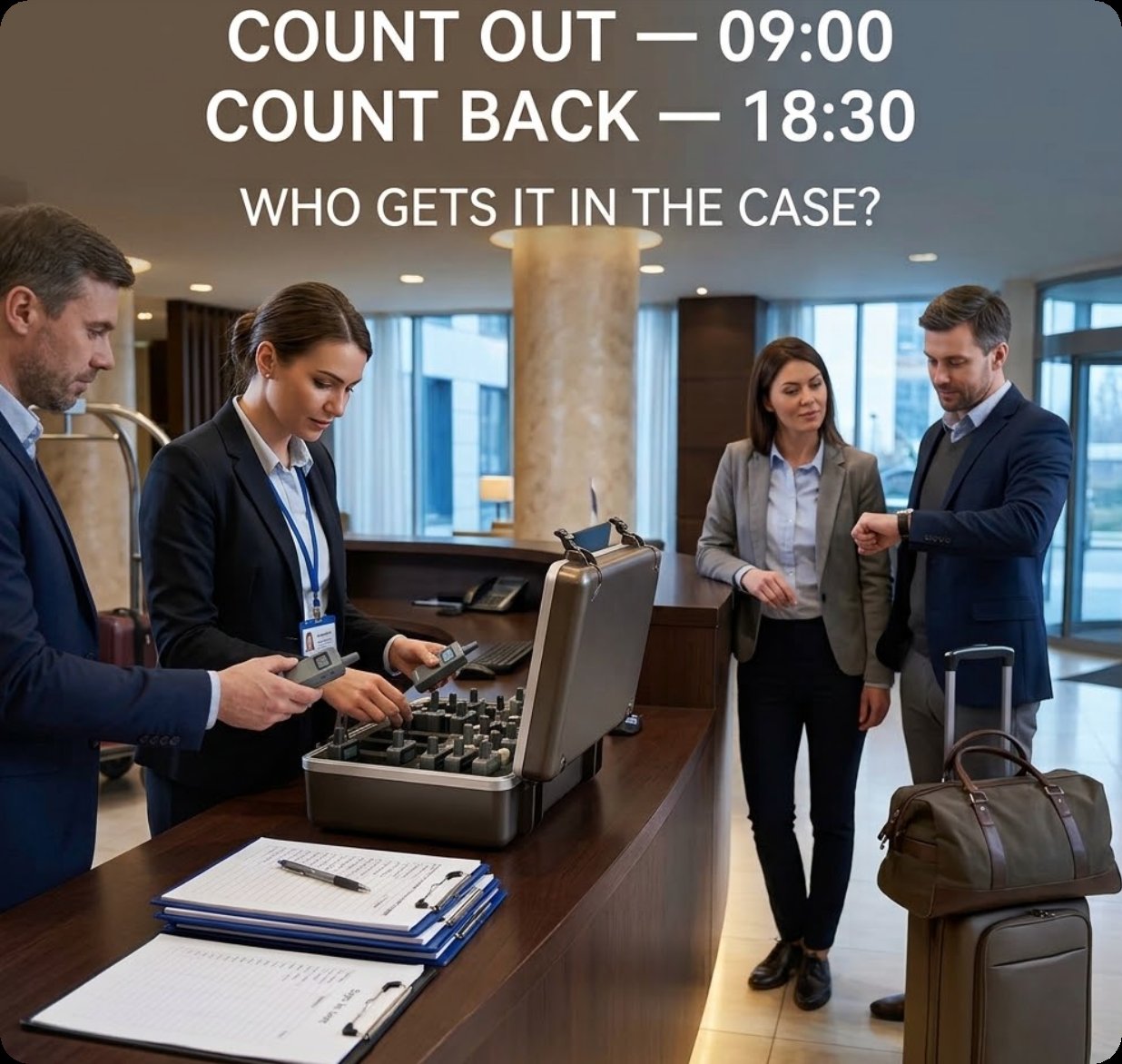
The second is the handover, and on a business day it sits inside a schedule the client is watching. Receivers are counted out at the entrance and counted back at the exit, and any unit that needs a cradle at midday interrupts that count. Thirty-five hours of receiver standby removes the interruption entirely, which is why that figure rather than the channel count decides whether an organiser's day runs to time.

A third question surfaces at the end rather than the beginning, which is why it gets asked last. Most delegations travel home the same evening, and a rental fleet has to be counted back into its case before anyone leaves the venue. A unit that is still on its last few percent at that point is a unit somebody has to find a charger for in a car park, and a unit that ended the day at half charge is a unit that goes back into the case and is full again the next morning. The thirty-five-hour figures on two of the three units here are what remove that end-of-day scramble; the eight-hour figure on a lighter unit is what causes it.

Sites running heritage or museum content alongside a business visit can review the museum audio guide equipment overview, and multi-stop industrial itineraries share the same group-management constraints covered in the industrial tour headset page. Where a weighing of one unit against another is the question, the tour guide system comparison index holds the rest of this series.
2026年10月17日 16:46
ꄘ click: 24
Home > VS

Richitek RC2402, RC2501 and RC9150 vs Kaimile KML-980-2HT-30 and Allite for Trade Mission Guide Systems

time: 2026年10月17日 click:24

A trade mission is not a tour with foreign guests in it. It is a negotiation, a factory audit, a signing ceremony and a lunch, and in all four the equipment is the least important thing on the table except in one respect: the guest is wearing it. A visitor who keeps touching an earpiece has stopped listening, and a visitor who is still listening has not noticed the device at all. That is why the number that decides this purchase is not channel count or transmission range. It is grams.

The useful way to divide the three Richitek units on offer is not by specification but by the part of the day they suit. The morning briefing puts a guest in a chair for ninety minutes with no walking and no need to keep the device on. The factory walk is two hours on a production floor. The evening dinner is three hours, indoors, loud, and the one slot where a light receiver genuinely matters. Each of those three slots rewards a different figure, and the specification table settles each one differently.

Two boundaries should be drawn before any comparison is attempted. On the two competitor systems, the published material is a feature list and a price; parallel arithmetic on channels, range or battery life would be invention rather than comparison. On the Richitek side, the three units described here carry a guide and a microphone, not a second language channel — where a delegation needs simultaneous interpretation, that is a different kind of system, and the one competitor record that names it is the expensive one.

richitek trade_mission vs kaimile allite 1

The Morning Briefing: RC2402 on a Chair for Ninety Minutes

The RC2402 Wireless Tour Guide System is the light option, and it takes a different route to lightness than the ear-hook units in this category. Fifty channels on 2403 to 2483MHz over a quoted 1 to 200m at 10mW, a 47-gram transmitter and a 50-gram receiver, and a 3.7V 1500mAh transmitter cell with a 3.7V 1000mAh receiver cell.

Endurance is 15 hours on the transmitter and more than thirty-five on the receiver — the same receiver figure the two larger units publish, which is unusual at this weight. Audio bandwidth reaches 20Hz to 200kHz, the widest range in this comparison, and charging runs over a DC port. Documented extras are an optional head-worn or lapel microphone and a receiver sensitivity of approximately -38dBm; that last figure sits fifty-odd decibels away from the -102dBm quoted for a different model in the same family and the table carries it without comment, so treat it as recorded data and test it in the room where the meeting happens.

A bandwidth figure of twenty hertz to two hundred kilohertz is worth pausing on, because it covers far more than speech. A morning session that ends with a product film, or a factory tour that pauses in front of a demonstration screen, benefits from an audio path that was not designed only for a voice. No specification sheet promises anything about that in practice, and a demonstration in the actual room remains the only way to know whether the wide figure changes anything a listener would notice.

A guest notices weight; an organiser notices battery. This unit answers both: light over a morning, and long enough that nothing has to be recalled at midday. Single-colour availability at volume.

Ninety minutes in a chair is the easiest part of any trade mission to equip, and it is the part most specifications over-engineer for. The room is climate-controlled, the client is seated, the guide is standing at the head of the table with a microphone in hand, and the only real risk is feedback from a body microphone held too close to a lapel. A wired lapel clipped at mid-chest solves it for almost every delegate, and a receiver set to a comfortable volume stays comfortable for the full session because the listener is not walking and not concentrating on staying upright.

What actually goes wrong in the morning is administrative rather than acoustic. Devices arrive in a case, get counted onto a table, and every one has to be matched to a delegate before the session starts. That is a hundred small operations performed in the fifteen minutes before anyone sits down, and it is the reason a unit with thirty-five hours of standby is easier to run than one with eight — the morning unit can be handed straight back into the same case at midday and still be full at the afternoon session.

The microphone option matters more here than anywhere else in the day. A guide who is also translating, or who is holding a printed agenda and pointing at a screen, cannot also hold a transmitter up to their mouth. A head-worn or lapel option releases both hands, and on a ninety-minute briefing that is the difference between a composed delivery and a hand occasionally crossing in front of the delegate's line of sight.

🏭 The Factory Walk: RC2501 and the Thirteen-Milliwatt Question

The RC2501 Wireless Tour Guide System is the middle answer, and it moves in both directions at once. Both halves weigh 47 grams against the RC9150's 97.5, and transmit power rises to 13mW, the highest figure in this comparison. Fifty channels, 1 to 200m, and a 3.7V 1500mAh transmitter cell with a 3.7V 1000mAh receiver cell.

Wireless and audio are where this unit differs from the one below it. Output is 13mW — the highest figure here — against a bandwidth of 20Hz to 200kHz, and the table records an optional head-worn or lapel microphone alongside a receiver sensitivity of approximately -38dBm. That sensitivity sits fifty-odd decibels away from the -102dBm quoted for a different model in the same family and is carried without comment; treat it as recorded data and test it in the room where the meeting actually happens. Cells of 1500mAh and 1000mAh back fifteen hours of transmitter use and thirty-five-plus on the receiver, both over Type-C.

For a business day that includes walking a production line, this is the balanced choice: forty-seven grams disappears, and a receiver that lasts the day turns recharging into something that happens overnight rather than at one o'clock in the client's lobby. Single-colour availability is arguably an advantage on a client-facing day rather than a limitation.

A factory floor changes the acoustic problem completely, and in a way that favours the unit with more transmit power. A briefing room is a controlled space with soft furnishings and a door; a production line is a hard-surfaced space with hard-surfaced reflections, machinery running, and a guide who may be thirty metres from the last person in the line. The published output on this unit is 13mW, the highest of the three here, which does not make it immune to a noisy floor but does give it the best starting position.

Weight becomes a different question on a walkaround. Anything above about a hundred grams starts to be noticed at the end of the second hour, and a delegate who has been told to wear a device for a factory audit will put it in a pocket if it is uncomfortable — which turns the commentary channel off exactly when the client is looking at the line. Forty-seven grams on each half is below the threshold where that tends to happen.

The thirteen milliwatts also matter for a reason that has nothing to do with distance. On a floor with a lot of steel — machine guards, frames, ducting, fencing — a stronger signal reduces the retries that turn into dropouts, and a dropout in front of a client reads as a fault in the demonstration rather than in the room. Whether 13mW is sufficient for a particular floor is a question that has to be answered by walking that floor, which is why the figure belongs in a trial rather than a spec sheet.

The Evening Dinner: RC9150 and Whether Weight Shows

The RC9150 High-end 2.4G Wireless Audio/Radio Guide System is the heaviest unit here at 97.5 grams on both halves, and it buys two things the lighter pair cannot offer. The first is a hundred channels, the highest ceiling in this comparison, at 10mW on the same 2.4GHz band over a quoted 1 to 200m. The second is endurance: 3.7V 1800mAh cells on both sides, giving 15 hours on the transmitter and more than thirty-five on the receiver, with PLL lock-loop frequency synthesis and Type-C charging.

Audio bandwidth is given as 20Hz to 8kHz, the narrowest of the three, which is entirely adequate for a voice briefing and not the specification to choose if the same channel will carry recorded video or a presentation with music. What the table offers instead is endurance, a hundred channels and a stated suitability for large venues. Grey on the transmitter and black on the receiver, both customisable at volume.

The honest case for it is a large site walked in groups. A hundred channels means a delegation can be split across four separate routes without the operator thinking about it, and a thirty-five-hour receiver means nothing is collected at midday. The cost is that a guest carries ninety-seven grams, and on a factory floor that is a weight some visitors will comment on.

An evening dinner is where weight stops being a technical specification and becomes a social one. A delegate at a table for three hours is not walking, but they are also sitting across from people they are trying to impress, and a device that is visibly present gets commented on. That is the strongest argument in this comparison for the lighter units, and the reason a hundred-gram receiver belongs in a production-line walkaround rather than at a dinner table.

richitek trade_mission vs kaimile allite 3

Dinner also inverts the acoustic requirement. A briefing room rewards directionality, because everyone faces the same way; a dinner table scatters listeners around a circle with the guide standing in the middle of it, at roughly equal distance from nobody. More transmit power does not fix that geometry. What fixes it is getting the device light enough that a delegate forgets it is there and stops adjusting it halfway through the second course.

The hundred channels on this unit solve a problem the other two do not have, and it is worth being honest that it is not the problem this particular day has. Four simultaneous routes matter at a site with multiple production halls and a delegation large enough to split. One group walking one route through one building needs none of it, and paying for a hundred-channel ceiling in order to run two channels is a real and common over-specification.

There is a version of the trade mission day where the ninety-seven grams is worth carrying anyway, and it is the one where the delegation is large. A twelve-person group split across three halls with a guide in each needs three simultaneous channels before anyone thinks about route count, and a fifth group arriving late needs a fourth. On that day the hundred-channel unit is not the heavy option that also works. It is the only option in this comparison that does not run out of channels.

Kaimile KML-980-2HT-30: The Interpretation-Grade Reference

The Kaimile KML-980-2HT-30 is listed at high tier with a published price of 14,136 yuan per unit, and its documented characteristics are one-to-many team commentary, meeting simultaneous interpretation, and use in guided tours, scenic visits and corporate reception. The interpretation claim is the part that matters here: it is not a headset tour system with an interpreter standing next to it, it is a system built to run an interpreter channel into the same audio path.

A trade mission where a client needs two languages simultaneously therefore has a different answer available, at roughly thirty times the price of a lightweight receiver. Whether that is worth it depends entirely on whether simultaneous interpretation is a requirement or a convenience — and on a mission where the guide and the guest speak the same language, it is neither.

The price gap deserves a second look before it frightens anyone. A hundred-and-forty thousand yuan is roughly what a full delegation kit costs, and it buys one channel that an interpreter occupies. The three lighter units combined cost less than a single interpreter charges for a day, and they serve the far more common case where the guide speaks the client's language and the commentary is simply a volume problem rather than a language problem.

Where an interpretation requirement is real, though, no amount of channel count substitutes for it. A delegate following a conversation in a language they do not read cannot be helped by a clearer signal in a language they already understand, and that is the one failure mode in this comparison that no specification figure would have caught.

Allite: Digital Band, Fast Charging and a Management App

Allite's wireless commentary series is listed at the mid-to-high tier with strong RF technology, high audio fidelity, an intelligent management mini-programme, Type-C fast charging and Bluetooth assistance, sold into museum interpretation, international conference simultaneous interpretation and smart scenic sites.

Two features are directly relevant to a business day. Type-C fast charging means the charging cradle is less of a bottleneck between sessions, and a management mini-programme is what a corporate organiser uses to allocate devices and retrieve them at the end — the administrative side of a delegation day, which is where most of the cost and nearly all of the embarrassment lives. The published record is thin on the figures a buyer would use for a rental fleet comparison.

Against that, the documented application list includes simultaneous interpretation, which again places it in a category the three Richitek units do not claim to occupy.

For a corporate organiser, the software half is often the deciding factor rather than the hardware half. A delegation of twenty people across a three-day visit involves roughly sixty handovers, and doing that on a clipboard in a hotel lobby is how devices end up in the wrong suitcase. A management tool that issues a device against a name and records the return removes a category of mistake that has nothing to do with audio and everything to do with the client watching.

richitek trade_mission vs kaimile allite 2

Specification Comparison: Three Richitek Units Against Two Reception Systems

Richitek RC24022403-2483MHz, 50 channels, 10mW, 1-200m15h transmitter, 35+h receiver, 3.7V 1500mAh and 1000mAh47g transmitter, 50g receiver20Hz-200kHzDC port; grey only at volumeNot published in the source database
Richitek RC25012403-2483MHz, 50 channels, 13mW, 1-200m15h transmitter, 35+h receiver, 3.7V 1500mAh and 1000mAh47g transmitter, 47g receiver20Hz-200kHzType-C; grey only at volumeNot published in the source database
Richitek RC91502403-2483MHz, 100 channels, 10mW, 1-200m15h transmitter, 35+h receiver, 3.7V 1800mAh on both sides97.5g transmitter, 97.5g receiver20Hz-8kHzType-C; grey transmitter, black receiverNot published in the source database
Kaimile KML-980-2HT-30Not published in the source databaseNot published in the source databaseNot published in the source databaseNot published in the source databaseSupports meeting simultaneous interpretation14,136 CNY per unit
Allite commentary seriesDigital band; channel count not publishedNot published in the source databaseNot published in the source databaseHigh audio fidelity, bandwidth not publishedType-C fast charging, Bluetooth, management mini-programmeMid-to-high tier, price not listed

One practical note belongs with any of these units. A factory audit involves walking past equipment that is running, and a receiver set to its maximum volume in order to hear over a production line is a receiver that will be set down and picked up again several times during the visit. Whatever the specification says about sensitivity, the setting a delegate actually uses is the one that decides whether they keep the device on, and that setting is established in the first five minutes.

The table below maps each device to the part of the day it fits rather than to a specification tier, because the same receiver can be the wrong choice at nine in the morning and the right one at nine in the evening.

🏨 Choosing by How Long the Guest Wears It

Single-site visit where the guest is expected to keep it on all dayRC240247 to 50 grams with 35-plus hours of receiver standby and the widest audio bandwidth of the three, so nothing is collected at midday
Full business day across two sites with an evening returnRC250147 grams on both halves with 35-plus hours of receiver standby, 13mW output and the widest bandwidth of the three
Delegation split across four separate routes on a large siteRC9150A hundred channels is the highest ceiling here, and thirty-five hours of receiver standby means nothing is collected at midday
Two languages must run simultaneously through an interpreterKaimile KML-980-2HT-30Simultaneous meeting interpretation is documented; budget for 14,136 yuan per unit, roughly thirty times a lightweight receiver
Corporate organiser needs device allocation and collection handled in softwareAlliteIntelligent management mini-programme plus Type-C fast charging; confirm channel count and battery figures in writing

What a Trade Mission Specification Does Not Settle

Two questions decide a trade mission purchase that no datasheet answers. The first is language, and it needs a straight answer before any hardware is chosen: if the guide and the guests share a working language, a commentary system is sufficient and interpretation capability is dead weight. If they do not, the purchase is not a guide system at all — it is an interpretation system, and at a price difference of roughly thirty to one the two categories should not share a quotation. Both competitors name interpretation; none of the three Richitek units claims it.

The second is the handover, and on a business day it sits inside a schedule the client is watching. Receivers are counted out at the entrance and counted back at the exit, and any unit that needs a cradle at midday interrupts that count. Thirty-five hours of receiver standby removes the interruption entirely, which is why that figure rather than the channel count decides whether an organiser's day runs to time.

A third question surfaces at the end rather than the beginning, which is why it gets asked last. Most delegations travel home the same evening, and a rental fleet has to be counted back into its case before anyone leaves the venue. A unit that is still on its last few percent at that point is a unit somebody has to find a charger for in a car park, and a unit that ended the day at half charge is a unit that goes back into the case and is full again the next morning. The thirty-five-hour figures on two of the three units here are what remove that end-of-day scramble; the eight-hour figure on a lighter unit is what causes it.

Sites running heritage or museum content alongside a business visit can review the museum audio guide equipment overview, and multi-stop industrial itineraries share the same group-management constraints covered in the industrial tour headset page. Where a weighing of one unit against another is the question, the tour guide system comparison index holds the rest of this series.
×

Contact us

email:
name:
subject:
content: