.webp)
Marketing copy tells you a tour guide system is reliable. Customers who have used one for six years tell you something different, and what they say is more useful. Over the past decade the same brand has been used by operators in Italy, Angola, Indonesia, Singapore, France, Belgium, Saudi Arabia, the Netherlands, Spain and several other countries, and the strongest evidence is not a brochure but a stream of messages from operators who came back years later to say their original order is still working. The selection below is drawn from real customer correspondence and the on-site photographs they shared, and the case is for choosing a brand that operators stay with rather than one they replace. Before reading through the deployment examples, a useful starting point is the church wireless audio solutions page, because much of the longest-tenure evidence comes from houses of worship and pilgrimage routes.
Fourteen Five-Star Verdicts in a Row
The most compressed way to summarise the record is to count the public five-star ratings. Across Alibaba listings and direct follow-ups, fourteen unprompted five-star verdicts have been logged for the current generation of receivers, transmitters and carry cases, written in Italian, Portuguese, Dutch, English, Spanish and Indonesian. The operators who wrote them include tour companies, interpretation providers, conference organisers and pilgrimage group leaders. The relevant comparison is not with other products in the category but with what those operators say six, twelve or twenty-four months later when the system is still in service.
Six Years Later, the Old Order Is Still Working
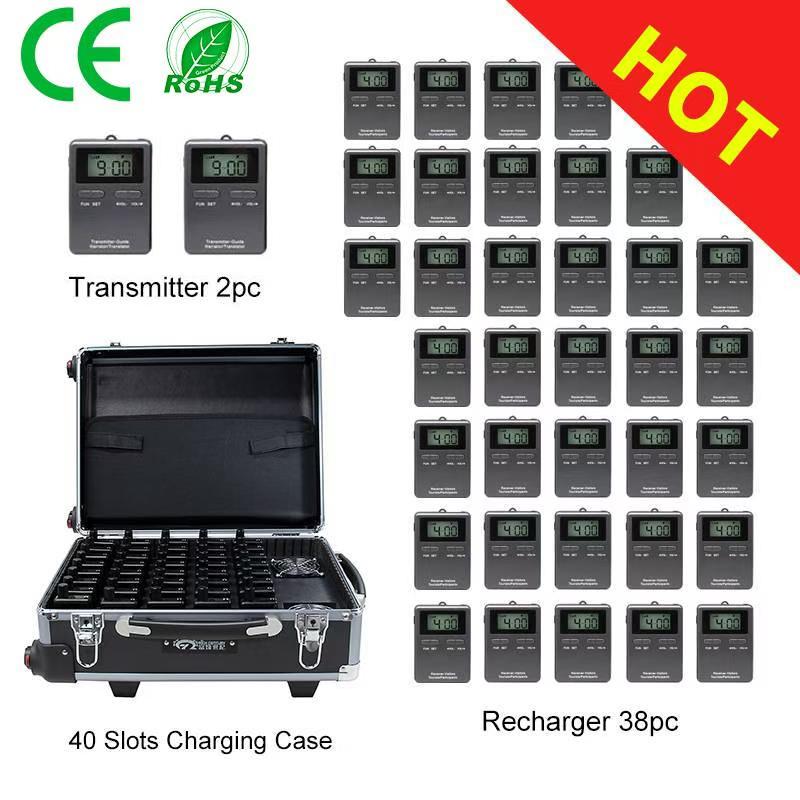
The earliest return customer in the file is an Italian operator who placed an order in 2018, and a follow-up exchange in 2024 makes the long-term picture unusually clear. The message is plain: the units are still in the charging case, still in service, and still being used by the same group of regular clients. The accompanying photograph shows the receivers in their original charging case, much as they looked on the day they were delivered, with the only visible change being wear on the case handle. That is useful evidence for any operator planning a multi-year fleet: what it shows is not that the equipment was particularly clever in 2018, but that it kept being unremarkable in 2024, the only test that matters in real venues. The RC2402 line is the one most of these long-tenure customers first bought, and the consistent report is that the receivers, the charging case, and the microphones keep working without intervention.
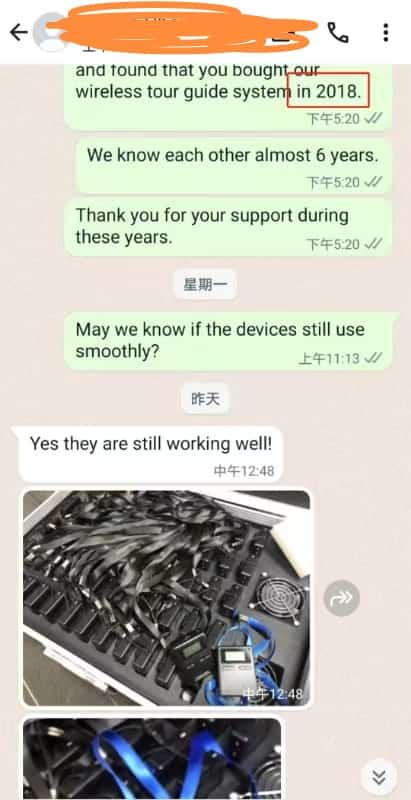
The original 2018 charging case photographed in 2024, with the receivers still inside and the system still on the regular duty roster of the operator who first bought it.
What a New Buyer Notices in the First Week
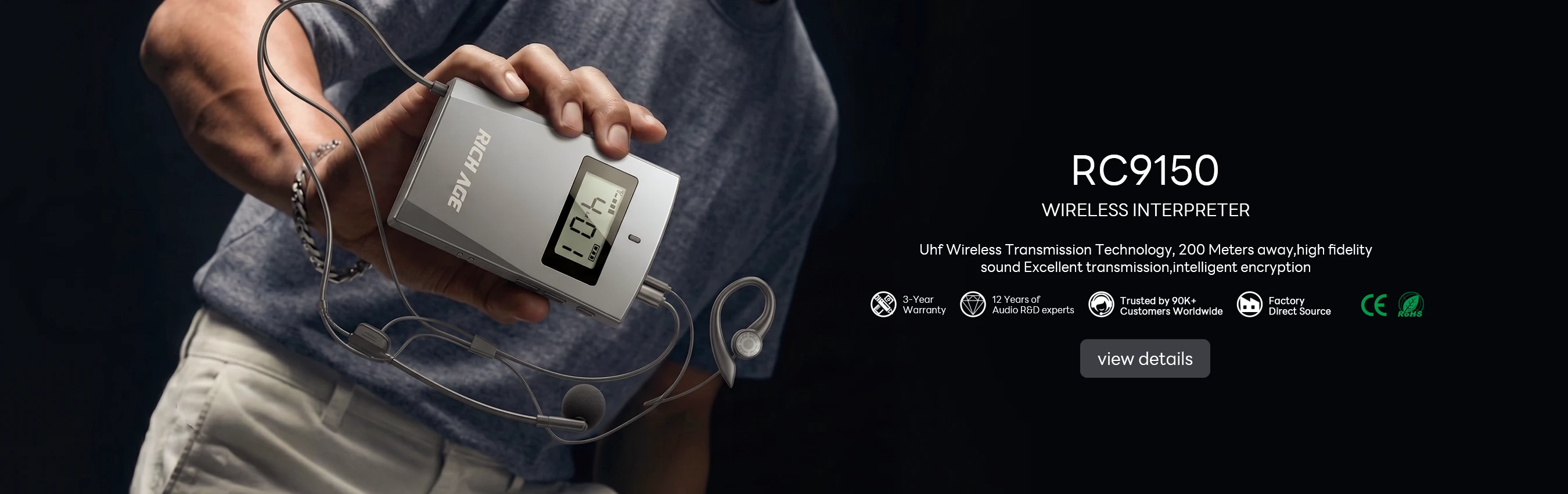
Recent buyers describe a different but compatible experience: across languages and venue types, the first thing a new operator comments on is the speed the equipment goes from the shipping box into service. A Singapore-based tour group manager sent a thank-you message within hours of delivery; an Italian team reported that two large jobs had been completed without any technical issue by the end of the first week; an Angolan client confirmed in Portuguese that the products had arrived and that the build quality was good; an Indonesian client, ordering replacement earphones for an existing system, wrote that the devices were very good and very recommended. A buyer called Goga sent a brief follow-up: devices are good, working good, thank you. None of these comments are about specifications, and that is the point. New buyers want a system that does not make them think, and the message that comes back is that this one behaves as it is supposed to. The RC9150 is the model that first-time high-end buyers most often land on, because the form factor and the carry case make it the easiest to put straight into a working venue without trial runs.
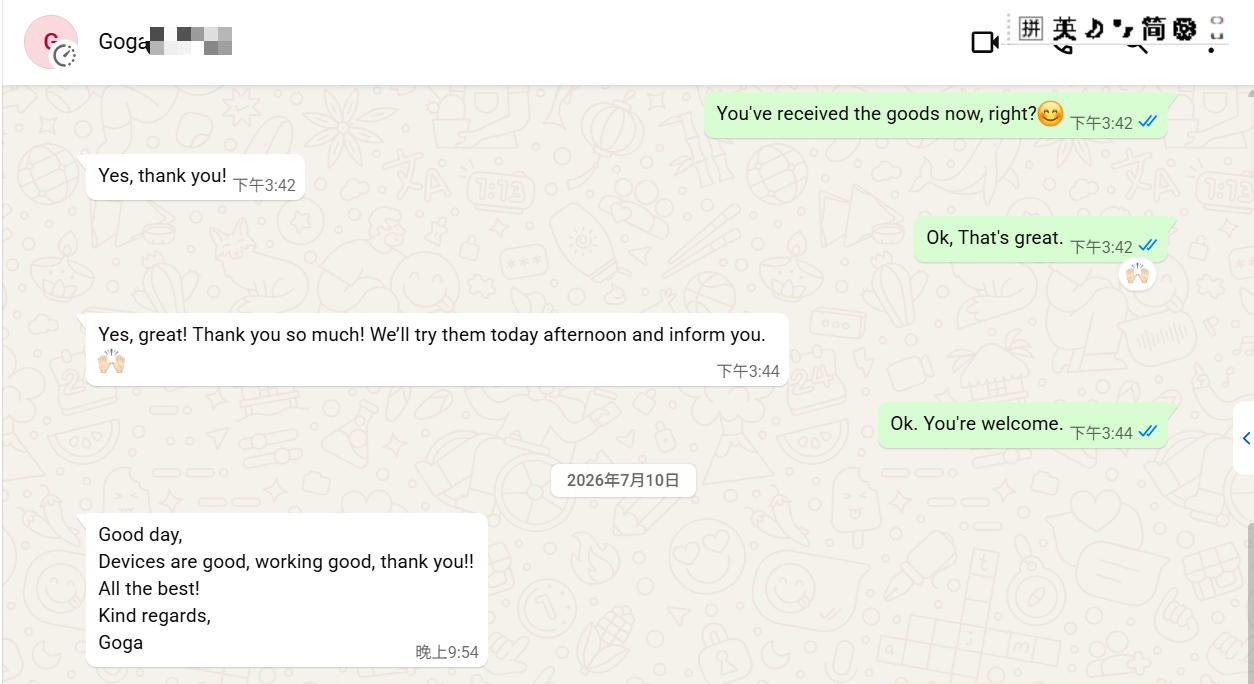
A new buyer's first-week follow-up message: the system went into service without trial runs and the operator's response was to mark it as very recommended.
When Localisation Matches the Brand Promise
Wireless tour guide equipment is sold across borders but used in local languages, and localisation quality is part of what the brand is being judged on. A buyer in Angola in Portuguese, in Italy in Italian, in Indonesia in Indonesian, in France in French, and in the Netherlands in Dutch expects more than a translated spec sheet. The response is not a translated script but a person who works in the relevant language and understands the local logistics: which shipping documents to prepare, which customs codes to use, and how to pack a charging case so it survives a long-haul courier without the management adding a budget line. The RC2500 in particular is bought by operators who run tours in three or more languages, and the first-week comments from those operators tend to focus less on the hardware and more on the supplier's ability to support that language and that delivery combination in a single transaction.
Inside a Conference Room With the System
Conference and event deployments produce some of the most direct visual evidence. The shared photographs show the equipment in a working venue: receivers in individual bagged sleeves lined up on long tables, charging hubs in the corner of the room, the lead operator walking the floor with a transmitter, and the audience wearing the receivers with the brand lanyard. The image that recurs is the one in which the table is fully set before the session starts, every receiver accounted for, the lanyards arranged in a row, the translation consoles already in place. That is the picture of a system chosen because the operator trusts it to be in working order at the moment the session begins, and the absence of on-site troubleshooting is itself part of the case.
Alongside the Pilgrimage Route With the System
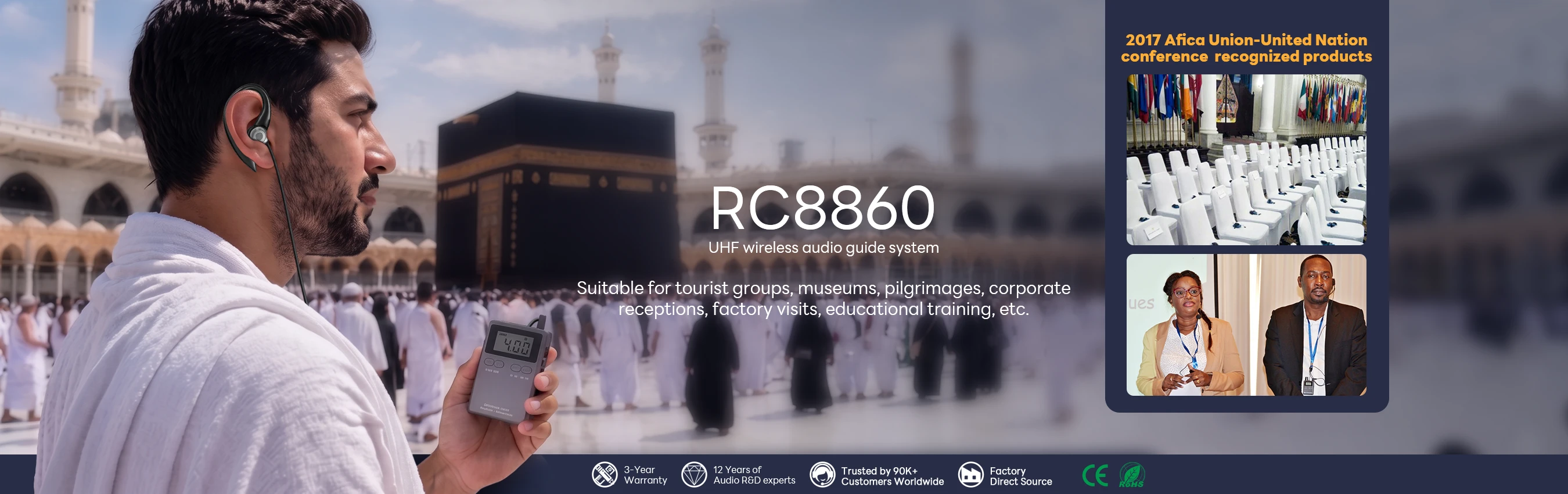
The most striking deployment in the record is a Hajj pilgrimage at the Grand Mosque in Mecca, where a large group of pilgrims wears the receivers with the brand lanyard over ihram garments, the Kaaba visible behind them. Pilgrimage groups have a particular set of requirements: the equipment has to work in extreme heat, in dense crowds, in continuous sun, over a long day that may start before dawn and end well after midnight. The fact that the receivers are still being worn and still functional in the most physically demanding tour environment in the industry is, for a buyer weighing the cost of a system that fails halfway through a long day, more persuasive than any brochure. Smaller but consistent evidence comes from street-level groups in Brussels and Paris, where the receivers are visible in dense mixed-language groups moving between landmarks in a way that requires reliable coverage at distance.

A Hajj group at the Grand Mosque, photographed in ihram, with the receivers still on and still functional after a long day in dense crowds and high heat.
The Repeat-Order Pattern and What It Predicts
Read across the customer files, the repeat-order pattern is more informative than any single review. The strongest signal is not the immediate re-purchase but the long gap, because a customer who comes back after eighteen months or two years is not buying spare parts out of anxiety; they are buying because the original system has earned its place. The second purchase is usually an accessory order, often earphones, neck loops or additional carry cases, sent to an existing fleet rather than added as a new system. That distinction tells the next buyer something the operator has already worked out: the system is not the part that needs replacing.
| Customer origin | First order year | Follow-up action | Indicates |
|---|---|---|---|
| Italy | 2018 | 2024 confirmation system still in service | Six-year fleet life |
| Italy | 2024 | 2026 follow-up re-order of earphones | Units retained, accessories added |
| Angola | 2026 | First-week build-quality confirmation | New market |
| Indonesia | 2024 | 2026 re-order with packing feedback | Repeat order with notes |
| Singapore | 2026 | Same-day long-term cooperation interest | First impression |
| Alibaba platform | 2018-2026 | Five-star ratings, third-purchase confirmed | Third-time public buyer |
💡 Why Operators Stay With the Same Vendor
Operators stay with the same vendor not because any single piece of evidence proves the system superior, but because the same quiet pattern shows up across languages and venue types: equipment that arrived in working order, kept working without intervention, was easy to operate in the field, was supported by a supplier who spoke the local language and understood the local logistics, and was still in service years later. Buyers who came back for earphones or a second fleet did so because the first fleet had already earned its place. That is the kind of decision a buyer only makes when the equipment has stopped being a topic of conversation. Our wireless tour guide system range is built around that same logic, and the pattern is documented in a factory floor case where the same team repeated the order after the first year. The honest summary is that operators who choose a brand and stay with it are not making an exciting decision; they are making a settled one, and that is the only kind of decision worth trusting in a category where the wrong equipment fails in the middle of a real event.