
RC2402, RC085 and RC8860: Matching a City Walking Tour to the Radio Environment
The brief behind this rollout was not about price. A city operator running three paid walking lines wanted one question answered: why did the audio hold together on two routes and fall apart on the third? All three left from the same square, used the same headsets, and were led by guides with identical training. The variable turned out to be the radio environment each route walked through, and that is what ended up deciding which system went on which line. Nothing about the deployment was exotic, which is exactly why it is worth writing down.
Three Lines, Three Radio Environments
Line one hugs an open waterfront and crosses two broad squares. Line two threads a medieval core where the walls are a metre thick and includes a stretch that runs below grade. Line three cuts through the financial district, where every cafe, bank branch and bus shelter is broadcasting on 2.4GHz. Two of those routes tolerate a licence-free 2.4GHz system. One does not. Treating the three as interchangeable is the most common and most expensive mistake in city tour audio, and it usually surfaces as a complaint about the guide rather than about the equipment.
Line One: An Open Waterfront Loop
For the waterfront the operator settled on the RC2402, a 2.4GHz system working the 2403 to 2483MHz ISM band. That band is licence-free in most countries, which matters for a company that hires seasonal guides from abroad and does not want frequency registration attached to every contract. Quoted range is 200 metres in open area, far beyond the 40 to 60 metres a walking party actually spans, and that headroom is what keeps the signal clean when a group strings out along a pier. The transmitter runs ten hours and the receiver twenty, so a guide taking three consecutive departures never has to think about batteries mid-route. One-click frequency synchronisation lets a relief guide join a channel without a technician, and the built-in encryption keeps a neighbouring operator out when two companies share the same square on a Saturday.

Line Two: Old Stone and a Below-Grade Passage
The medieval line failed on 2.4GHz for a reason that has nothing to do with distance. The band is absorbed and reflected by wet stone and by the reinforced floors of the below-grade stretch, so the signal arriving at the back of the party was never the signal leaving the guide. The fix was the RC085, a UHF digital system on the 470 to 510MHz band with GFSK modulation. Lower frequencies bend around heavy masonry instead of scattering off it, and the same physics that makes the band useful in industrial halls makes it useful in a walled old town. The unit carries an LCD screen for channel and status, and power management puts it to sleep between stops and wakes it on the next transmission, which is how a guide gets through a four-hour shift with a single charge. Its two working modes matter more than they first appear: F1 is a plain one-way broadcast, and F2 opens a return path so a guest can ask a question without the guide walking back down the line. The manufacturer does not publish a runtime figure for this model, so the operator keeps one spare pack per guide rather than trusting one number.
Line Three: A Downtown Saturated With Wi-Fi
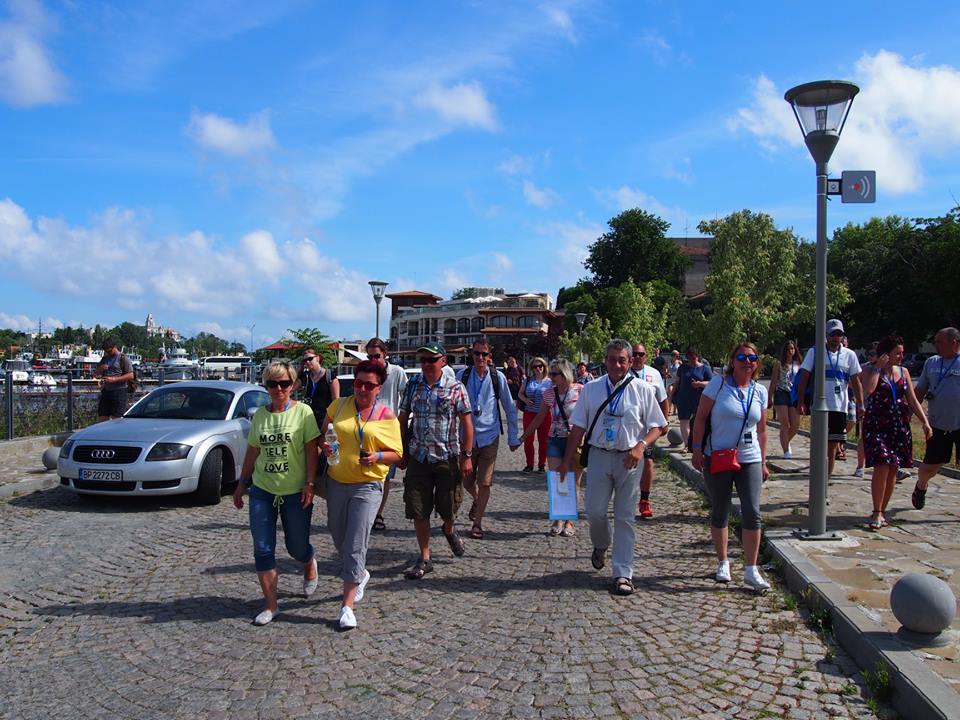
The financial district was the harder case, because nothing there is closed to signal. It is simply crowded. Coffee shops, card terminals, transit signage and every visitor's phone sit on 2.4GHz, and a tour walks straight through the middle of it. The operator moved that route onto the RC8860, which transmits in the 860 to 870MHz UHF band and therefore does not compete for the same air. It carries 20 PLL channels, enough for the three departures plus the temporary groups that form during peak weeks, and its quoted reach is 200 metres in open ground with usable penetration through walls and street furniture. The receiver weighs 50 grams and the transmitter 59, and both are rated IPX4 for light rain, which a walking product needs more often than the catalogue suggests. Receiver output is 10mW with a 50Hz to 12kHz response, tuned for voice rather than for music.
Where the Three Systems Overlap
Once the routes were separated by environment, the overlapping parts of the range stopped being a problem. All three cover the same walking distance and the same headset sockets, so spares and chargers are interchangeable across the fleet. What differs is the band, the channel plan and the interaction model, and those are the three columns a buyer should actually compare.
| Model | Frequency band | Channels | Open-area range | Interaction mode | Certification |
|---|---|---|---|---|---|
| RC2402 | 2.4GHz ISM, 2403 to 2483MHz | One-click synchronisation | 200 m | One-way broadcast | CE, EMC, LVD, RED, RoHS |
| RC085 | UHF, 470 to 510MHz | Multi-channel group operation | 200 m | F1 one-way / F2 two-way | CE, RED, RoHS |
| RC8860 | UHF, 860 to 870MHz | 20 with PLL synthesis | 200 m | One-to-many broadcast | CE, RoHS, IPX4 |
Battery, Spares and the Handover Window
Two of the three lines run a ten-hour transmitter against a twenty-hour receiver, which produces an asymmetry that is easy to misread as a fault. The guide's unit drains fastest; the guest units are rarely below half. The operator's countermeasure is boring and effective. Charging happens per guide, not per kit, so a transmitter is never handed over at eighty per cent, and each line carries two spare receivers rather than one, because a dead receiver mid-route costs a guest and a dead transmitter costs the whole departure. Ten minutes of the guide briefing is now spent on pairing, and the rest of the day runs without a technician on site.
Buying by Environment, Not by Shelf Price
The lesson the operator passes on is to sort candidate routes by radio environment before comparing units on a spec sheet. A waterfront loop with nothing overhead will run happily on a licence-free 2.4GHz product, and paying for more band than the route needs buys nothing. A walled core with a below-grade stretch will punish that same purchase every single departure. A downtown crossing will punish anything that shares spectrum with the street. The map below is the one the operator now draws before any purchase conversation.
| Route | Radio environment | System fitted | Reason |
|---|---|---|---|
| Waterfront loop | Open, no obstructions, low interference | RC2402 | Licence-free band is sufficient and needs no registration |
| Medieval core | Thick wet stone, one below-grade stretch | RC085 | Lower UHF band penetrates masonry instead of scattering |
| Financial district | Congested 2.4GHz from street infrastructure | RC8860 | 860MHz UHF avoids the crowded band entirely |
What Changed After the First Season
The measurable change was not in audio quality, which had always been acceptable on the good days. It was in the complaints that stopped arriving. The operator had been attributing dropouts to guide technique, and had run coaching sessions on microphone handling that changed nothing, because the cause was the band and the walls. Once the three systems were fitted to their environments, the season produced no route-level audio failures, the relief-guide pool could cover any line with a ten-minute briefing, and the spare-part list collapsed from three incompatible sets to one. For a business that sells a two-hour experience at a fixed price, that is the whole return. Operators weighing the same decision across other walks of their portfolio, from harbour promenades to walled towns, can compare formats in the deployment cases before they commit, and check unit availability across the wireless tour guide system range for the band their own route will tolerate. Teams that already publish interpretive walks in several languages may also want the city tour audio solutions overview, which covers the guide-side workflow rather than the hardware.