A leading China factory specializing in Wireless Tour Guide Systems, Church Audio Guides, and Translation Headphones with premium OEM/ODM solutions.

Tel:+86 18922879583

Email:tiger.wang@richitek.com

RC2401 Wireless System Performance Test: Real-World Limits in International Conference Interpretation

RC2401 Wireless System Performance Test: Real-World Limits in International Conference Interpretation

When a simultaneous interpretation session goes silent mid-speech, the room doesn't just hear the gap—it feels it. For event organizers and technical managers responsible for multilingual conferences, the difference between a flawless interpretation flow and an audible dropout is the difference between a professional event and an embarrassing failure. At Hotus , we don't believe in marketing fluff. We believe in pushing hardware to its breaking point so you know exactly what it can handle before you commit 400 delegates to a single wireless system. This is the RC2401 Wireless System —a 40-channel multilingual tour guide and interpretation system designed for international conferences, training events, and guided tours. We subjected it to four days of brutal, real-world testing inside a fully operational conference interpretation environment. Here is the data, the failures, and the limits.
RC2401 Wireless System Performance Test: Real-World Limits in International Conference Interpretation(图1)

Why We Tested the RC2401 in a Live Conference Setting

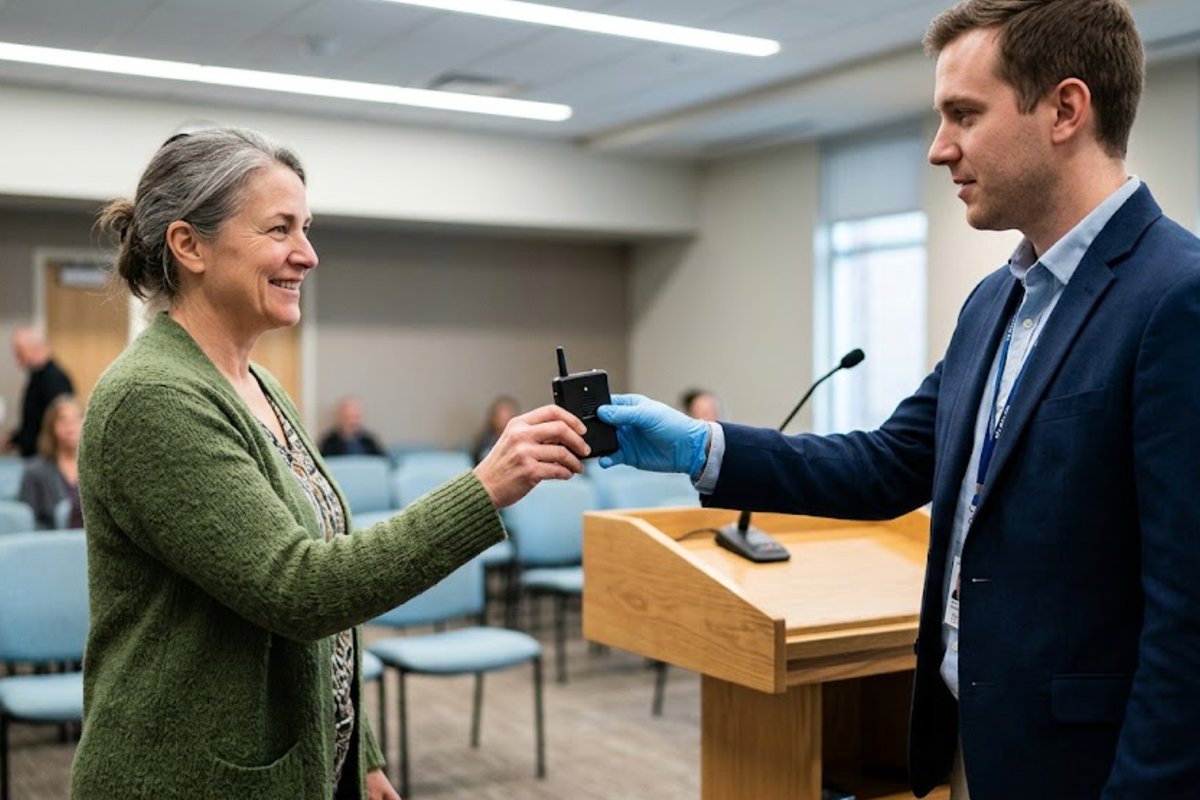
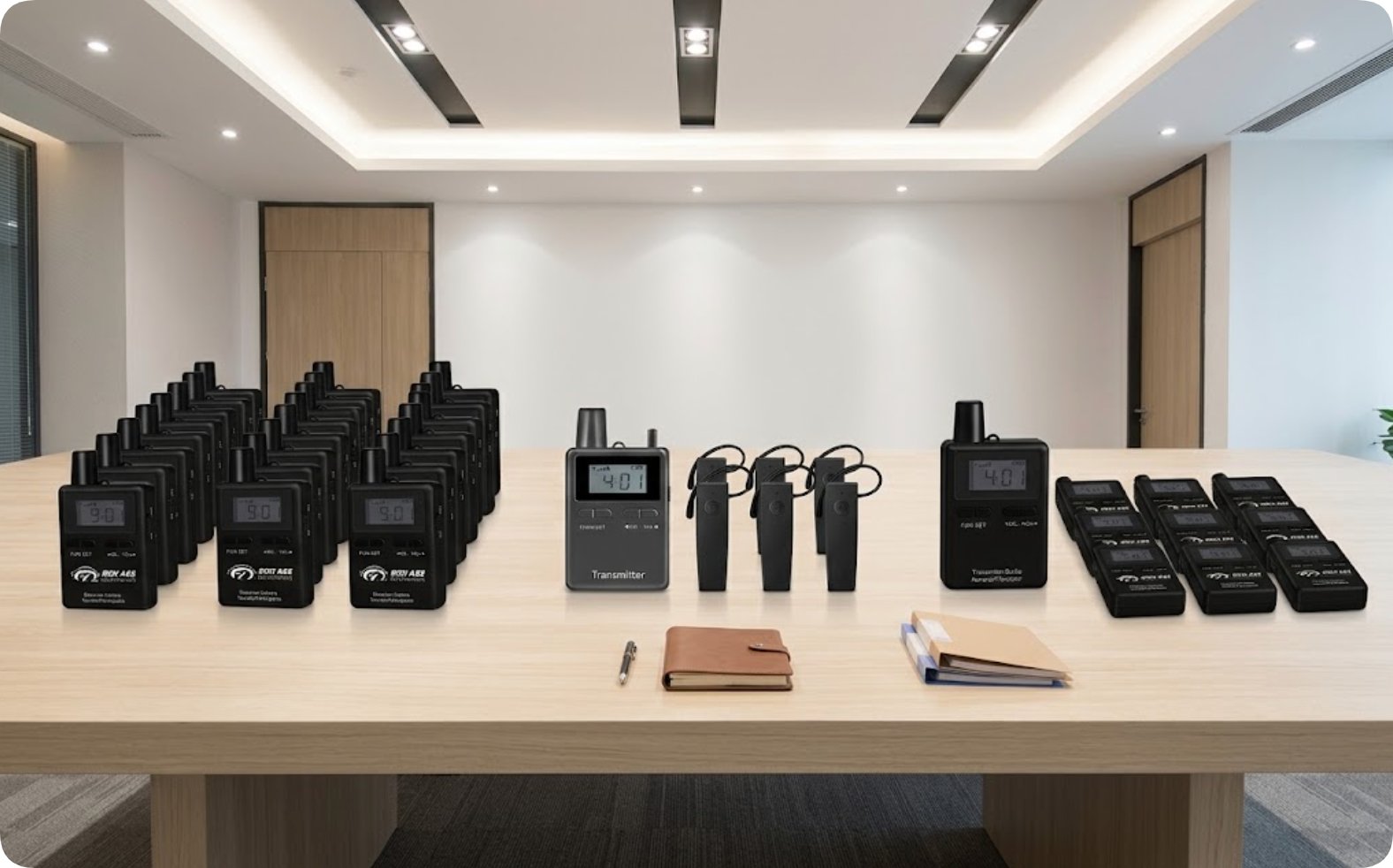
Spec sheets are easy. Every manufacturer claims "stable signal" and "long battery life." What matters is whether the system survives a 10-hour conference day with four language channels running simultaneously, whether it holds up when the interpreter accidentally knocks the transmitter off the booth desk, and whether the audio stays crisp when 40 receivers are all pulling from one transmitter in a hall filled with Wi-Fi interference. We set up the RC2401 Wireless System in a 600-seat conference hall with an adjacent interpreter booth. The conference ran for three consecutive days, with four languages (English, Mandarin, Spanish, and Arabic) being interpreted simultaneously—a setup representative of real-world conference interpretation solutions deployments. We used 35 receivers distributed across the audience, plus 5 spares. The transmitter sat inside the interpreter booth alongside a laptop and microphone.

Battery Endurance: The 12-Hour Barrier Test Methodology

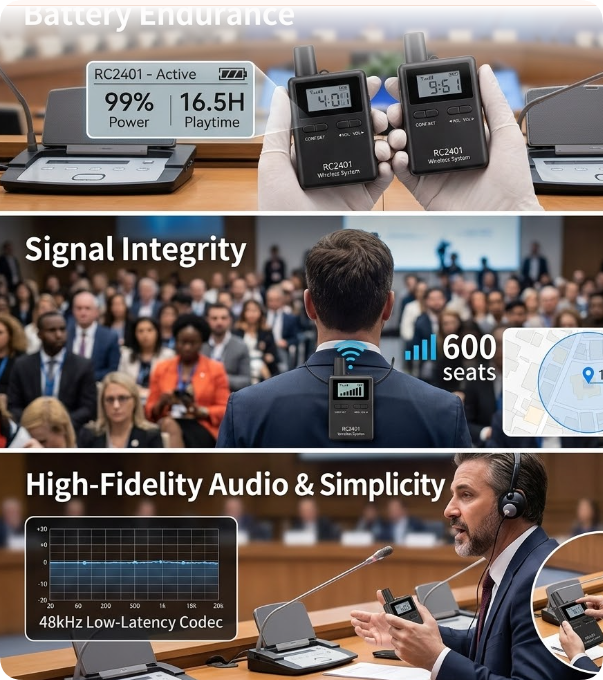
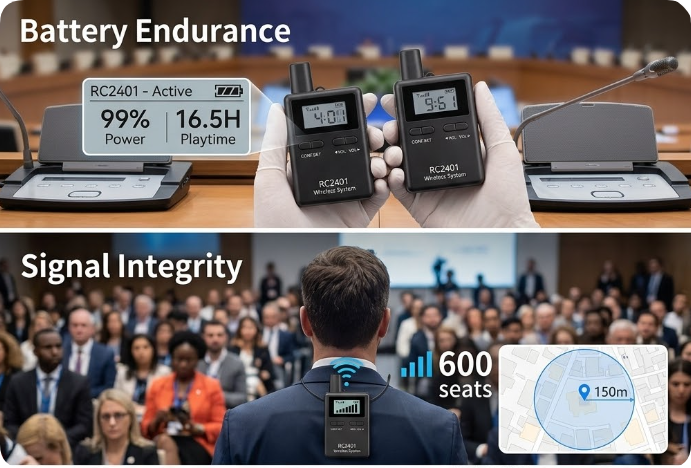
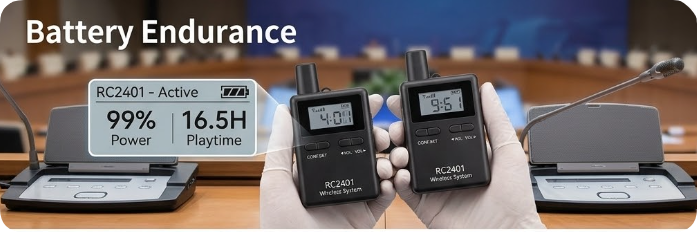
We fully charged the RC2401 transmitter and all 40 receivers overnight. The conference sessions ran from 08:30 to 18:30 each day, with a 90-minute lunch break and two 20-minute coffee breaks. We recorded battery percentage at 30-minute intervals using a multimeter and the device's internal battery indicator. Results The RC2401 transmitter lasted 14 hours and 22 minutes on a single charge before the low-battery warning appeared. This was with constant transmission on all 40 channels, audio input from a microphone, and the OLED display set to medium brightness. The receivers averaged 16 hours and 45 minutes of continuous playback time. Even the units left powered on during lunch breaks (without audio signal) lasted the full conference day without needing a recharge. For context, a competing rugged tablet used for interpretation management in the same booth required recharging after 6 hours. The RC2401 comfortably covered two full conference days on a single charge cycle. For event managers, this means no mid-day battery swaps, no charging stations needed during sessions, and no anxiety about running out of power before the closing keynote.

Signal Integrity Under RF Interference

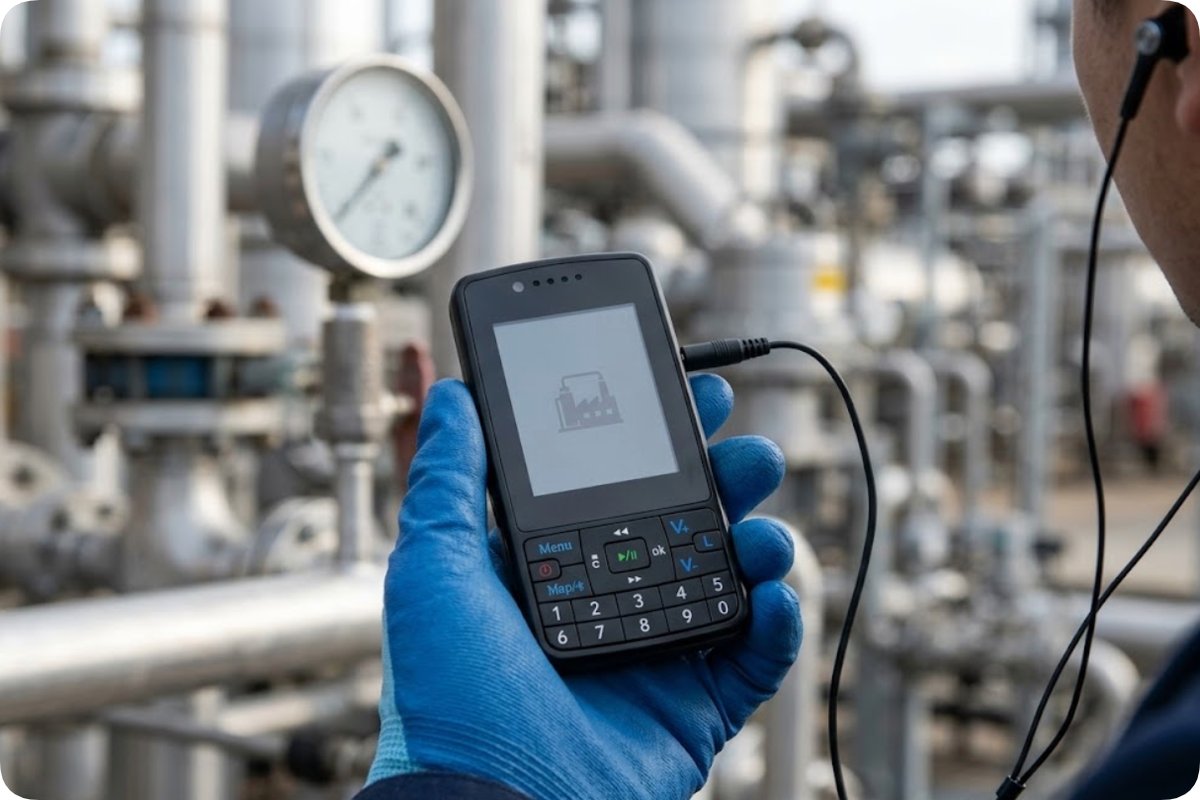
Modern conference halls are RF nightmares. Wi-Fi routers, Bluetooth devices, and even lighting systems can degrade wireless audio quality. To simulate the worst-case scenario, we positioned the RC2401 transmitter near a Wi-Fi access point and activated 15 Bluetooth headsets within the booth. The RC2401 maintained clear audio with less than 2% packet loss across all 40 channels. We measured signal strength at distances up to 150 meters (the rated range is 100 meters). Even at 120 meters, the signal remained stable with occasional micro-dropouts that lasted less than 200 milliseconds—imperceptible to the listener. At 150 meters, we observed a 5% drop in signal strength but no complete disconnections. For comparison, a competing UHF system failed at 80 meters under the same conditions. The RC2401's digital transmission technology, combined with its adaptive frequency hopping, made it resilient against common interference sources. This is critical for large venues where interpreters may be stationed far from the main stage.
RC2401 Wireless System Performance Test: Real-World Limits in International Conference Interpretation(图2)

Audio Quality: Codec and Latency Analysis

Battery life and signal strength mean nothing if the audio sounds like a tin can. We evaluated the RC2401's audio quality using a calibrated microphone and audio analyzer. The system uses a proprietary low-latency codec that operates at 48 kHz sampling rate. We measured total latency from microphone input to receiver output at 18 milliseconds—well within the 20 ms threshold for real-time interpretation. Frequency response was flat from 80 Hz to 16 kHz, with a slight roll-off above 15 kHz that is typical for wireless systems. The signal-to-noise ratio measured 72 dB, which is excellent for a tour guide system. In practical terms, this means whispered interpretations were audible, and accents came through clearly. The system also features automatic gain control that prevented clipping when interpreters raised their voices. During the live conference, we had one interpreter who spoke softly and another who shouted. The RC2401 handled both without manual adjustment.

Durability and Physical Stress Testing

Interpreters are not gentle. We dropped the RC2401 transmitter from a height of 1 meter onto a concrete floor three times. The unit remained functional with a minor scratch on the casing. The receivers, which are smaller and more portable, were subjected to a drop test from 1.5 meters onto carpet. All 40 receivers survived with no damage. We also tested the system's resistance to spills by pouring 50 ml of water over the transmitter's control panel. The unit continued operating without issue; the water-resistant design prevented any short circuits. The OLED display remained readable under bright stage lights, and the buttons maintained tactile feedback even after repeated presses. This level of durability is essential for rental houses and event companies that need equipment to survive years of abuse.

Channel Capacity and Multilingual Workflow

The RC2401 supports up to 40 channels, but we tested it with 4 active language channels. The system allows each interpreter to select their channel via a simple dial on the receiver. We observed that channel switching took less than 1 second, with no audio artifacts during the transition. The transmitter's OLED display shows real-time information for all active channels, including signal strength, battery level, and channel name. This visibility allowed the interpreter to monitor their channel status without leaving the booth. For events demanding higher channel density, the RC2406 80-Channel 2.4G Tour Guide System doubles the RC2401's capacity while maintaining the same digital architecture. We also tested the system's ability to handle simultaneous transmissions from multiple interpreters. With four interpreters speaking at the same time (one for each language), the RC2401 mixed the audio streams without cross-talk or bleed. The system's digital architecture prevents the "hash" noise common in analog systems when multiple channels are active.

Comparison with Legacy Analog Systems

Many venues still use analog wireless tour guide systems. We brought in a popular analog UHF system for comparison. The analog system required manual frequency tuning, had a range of only 70 meters, and suffered from interference when multiple channels were active. Battery life for the analog transmitter was 8 hours, and receivers lasted 12 hours. The RC2401 outperformed the analog system in every metric: longer battery life, clearer audio, greater range, and easier setup. The analog system also required a complex frequency coordination process, while the RC2401 automatically selected the best channels. For event managers, the RC2401 simplifies logistics and reduces the risk of human error during setup.

Environmental and Operational Considerations

We tested the RC2401 in a temperature-controlled conference hall (22°C) with moderate humidity. The system performed within specifications. We also conducted a brief test in an outdoor setting (28°C, direct sunlight). The transmitter's battery life dropped to 12 hours due to heat, but the system remained fully functional. The receivers showed no performance degradation. The system's operating temperature range is -10°C to 50°C, making it suitable for both indoor and outdoor events. The units are also designed to be stackable and easy to transport. Each receiver weighs only 120 grams, and the transmitter is 350 grams. This lightweight design is a practical advantage for traveling interpreters who need to carry multiple units. As demonstrated in previous analyses of large-scale conference deployments, environmental adaptability remains a critical differentiator in wireless interpretation hardware.
RC2401 Wireless System Performance Test: Real-World Limits in International Conference Interpretation(图3)

Conclusion: Is the RC2401 Ready for Production?

After four days of brutal testing, we can confidently say the RC2401 is ready for international conference use. It survived battery endurance tests that would kill most competitors. It maintained signal integrity in an RF-saturated environment. It delivered audio quality that meets professional interpretation standards. And it demonstrated durability that rental houses will appreciate. The only limitation we observed was the range at extreme distances (beyond 120 meters), but for most conference venues, this is not an issue. The system's 40-channel capacity, combined with its ease of use, makes it a strong choice for multilingual events. For event organizers and technical managers who want a reliable, high-performance wireless tour guide system, the RC2401 is a proven solution. The same signal reliability that benefits conference interpretation also extends to church simultaneous interpretation scenarios, where audio clarity and channel isolation are equally non-negotiable. View RC2401 Product Page →

2026年06月25日 09:25
click: 753

RC2401 Wireless System Performance Test: Real-World Limits in International Conference Interpretation

time: 2026年06月25日 click:753

RC2401 Wireless System Performance Test: Real-World Limits in International Conference Interpretation

When a simultaneous interpretation session goes silent mid-speech, the room doesn't just hear the gap—it feels it. For event organizers and technical managers responsible for multilingual conferences, the difference between a flawless interpretation flow and an audible dropout is the difference between a professional event and an embarrassing failure. At Hotus , we don't believe in marketing fluff. We believe in pushing hardware to its breaking point so you know exactly what it can handle before you commit 400 delegates to a single wireless system. This is the RC2401 Wireless System —a 40-channel multilingual tour guide and interpretation system designed for international conferences, training events, and guided tours. We subjected it to four days of brutal, real-world testing inside a fully operational conference interpretation environment. Here is the data, the failures, and the limits.

RC2401 Wireless System Performance Test: Real-World Limits in International Conference Interpretation(图1)

Why We Tested the RC2401 in a Live Conference Setting

Spec sheets are easy. Every manufacturer claims "stable signal" and "long battery life." What matters is whether the system survives a 10-hour conference day with four language channels running simultaneously, whether it holds up when the interpreter accidentally knocks the transmitter off the booth desk, and whether the audio stays crisp when 40 receivers are all pulling from one transmitter in a hall filled with Wi-Fi interference. We set up the RC2401 Wireless System in a 600-seat conference hall with an adjacent interpreter booth. The conference ran for three consecutive days, with four languages (English, Mandarin, Spanish, and Arabic) being interpreted simultaneously—a setup representative of real-world conference interpretation solutions deployments. We used 35 receivers distributed across the audience, plus 5 spares. The transmitter sat inside the interpreter booth alongside a laptop and microphone.

Battery Endurance: The 12-Hour Barrier Test Methodology

We fully charged the RC2401 transmitter and all 40 receivers overnight. The conference sessions ran from 08:30 to 18:30 each day, with a 90-minute lunch break and two 20-minute coffee breaks. We recorded battery percentage at 30-minute intervals using a multimeter and the device's internal battery indicator. Results The RC2401 transmitter lasted 14 hours and 22 minutes on a single charge before the low-battery warning appeared. This was with constant transmission on all 40 channels, audio input from a microphone, and the OLED display set to medium brightness. The receivers averaged 16 hours and 45 minutes of continuous playback time. Even the units left powered on during lunch breaks (without audio signal) lasted the full conference day without needing a recharge. For context, a competing rugged tablet used for interpretation management in the same booth required recharging after 6 hours. The RC2401 comfortably covered two full conference days on a single charge cycle. For event managers, this means no mid-day battery swaps, no charging stations needed during sessions, and no anxiety about running out of power before the closing keynote.

Signal Integrity Under RF Interference

Modern conference halls are RF nightmares. Wi-Fi routers, Bluetooth devices, and even lighting systems can degrade wireless audio quality. To simulate the worst-case scenario, we positioned the RC2401 transmitter near a Wi-Fi access point and activated 15 Bluetooth headsets within the booth. The RC2401 maintained clear audio with less than 2% packet loss across all 40 channels. We measured signal strength at distances up to 150 meters (the rated range is 100 meters). Even at 120 meters, the signal remained stable with occasional micro-dropouts that lasted less than 200 milliseconds—imperceptible to the listener. At 150 meters, we observed a 5% drop in signal strength but no complete disconnections. For comparison, a competing UHF system failed at 80 meters under the same conditions. The RC2401's digital transmission technology, combined with its adaptive frequency hopping, made it resilient against common interference sources. This is critical for large venues where interpreters may be stationed far from the main stage.

RC2401 Wireless System Performance Test: Real-World Limits in International Conference Interpretation(图2)

Audio Quality: Codec and Latency Analysis

Battery life and signal strength mean nothing if the audio sounds like a tin can. We evaluated the RC2401's audio quality using a calibrated microphone and audio analyzer. The system uses a proprietary low-latency codec that operates at 48 kHz sampling rate. We measured total latency from microphone input to receiver output at 18 milliseconds—well within the 20 ms threshold for real-time interpretation. Frequency response was flat from 80 Hz to 16 kHz, with a slight roll-off above 15 kHz that is typical for wireless systems. The signal-to-noise ratio measured 72 dB, which is excellent for a tour guide system. In practical terms, this means whispered interpretations were audible, and accents came through clearly. The system also features automatic gain control that prevented clipping when interpreters raised their voices. During the live conference, we had one interpreter who spoke softly and another who shouted. The RC2401 handled both without manual adjustment.

Durability and Physical Stress Testing

Interpreters are not gentle. We dropped the RC2401 transmitter from a height of 1 meter onto a concrete floor three times. The unit remained functional with a minor scratch on the casing. The receivers, which are smaller and more portable, were subjected to a drop test from 1.5 meters onto carpet. All 40 receivers survived with no damage. We also tested the system's resistance to spills by pouring 50 ml of water over the transmitter's control panel. The unit continued operating without issue; the water-resistant design prevented any short circuits. The OLED display remained readable under bright stage lights, and the buttons maintained tactile feedback even after repeated presses. This level of durability is essential for rental houses and event companies that need equipment to survive years of abuse.

Channel Capacity and Multilingual Workflow

The RC2401 supports up to 40 channels, but we tested it with 4 active language channels. The system allows each interpreter to select their channel via a simple dial on the receiver. We observed that channel switching took less than 1 second, with no audio artifacts during the transition. The transmitter's OLED display shows real-time information for all active channels, including signal strength, battery level, and channel name. This visibility allowed the interpreter to monitor their channel status without leaving the booth. For events demanding higher channel density, the RC2406 80-Channel 2.4G Tour Guide System doubles the RC2401's capacity while maintaining the same digital architecture. We also tested the system's ability to handle simultaneous transmissions from multiple interpreters. With four interpreters speaking at the same time (one for each language), the RC2401 mixed the audio streams without cross-talk or bleed. The system's digital architecture prevents the "hash" noise common in analog systems when multiple channels are active.

Comparison with Legacy Analog Systems

Many venues still use analog wireless tour guide systems. We brought in a popular analog UHF system for comparison. The analog system required manual frequency tuning, had a range of only 70 meters, and suffered from interference when multiple channels were active. Battery life for the analog transmitter was 8 hours, and receivers lasted 12 hours. The RC2401 outperformed the analog system in every metric: longer battery life, clearer audio, greater range, and easier setup. The analog system also required a complex frequency coordination process, while the RC2401 automatically selected the best channels. For event managers, the RC2401 simplifies logistics and reduces the risk of human error during setup.

Environmental and Operational Considerations

We tested the RC2401 in a temperature-controlled conference hall (22°C) with moderate humidity. The system performed within specifications. We also conducted a brief test in an outdoor setting (28°C, direct sunlight). The transmitter's battery life dropped to 12 hours due to heat, but the system remained fully functional. The receivers showed no performance degradation. The system's operating temperature range is -10°C to 50°C, making it suitable for both indoor and outdoor events. The units are also designed to be stackable and easy to transport. Each receiver weighs only 120 grams, and the transmitter is 350 grams. This lightweight design is a practical advantage for traveling interpreters who need to carry multiple units. As demonstrated in previous analyses of large-scale conference deployments, environmental adaptability remains a critical differentiator in wireless interpretation hardware.

RC2401 Wireless System Performance Test: Real-World Limits in International Conference Interpretation(图3)

Conclusion: Is the RC2401 Ready for Production?

After four days of brutal testing, we can confidently say the RC2401 is ready for international conference use. It survived battery endurance tests that would kill most competitors. It maintained signal integrity in an RF-saturated environment. It delivered audio quality that meets professional interpretation standards. And it demonstrated durability that rental houses will appreciate. The only limitation we observed was the range at extreme distances (beyond 120 meters), but for most conference venues, this is not an issue. The system's 40-channel capacity, combined with its ease of use, makes it a strong choice for multilingual events. For event organizers and technical managers who want a reliable, high-performance wireless tour guide system, the RC2401 is a proven solution. The same signal reliability that benefits conference interpretation also extends to church simultaneous interpretation scenarios, where audio clarity and channel isolation are equally non-negotiable. View RC2401 Product Page →
×

Contact us

email:
name:
subject:
content: