
.webp)
The first double-decker of the morning eases away from the kerb on a hop-on hop-off loop, and from the open-top upper deck the whole city skyline unrolls past the panoramic windows. Up front, the guide clips a transmitter to a lanyard and starts the guided commentary in two languages at once, while below on the lower deck a mixed row of multilingual passengers settles in with earpieces already tuned to their channel. A moving bus looks like an easy job for wireless audio until you account for engine hum, road noise, and the wind across an open top at speed. For any operator building a city sightseeing tour solutions program, the transmitter and receiver choice is what keeps the narration audible instead of lost in the rumble.

Why a sightseeing bus is its own audio problem
A tourist loop is neither a guided walk nor a conference hall. The same vehicle runs three or four hours straight, repeating the itinerary every cycle, with English, Japanese, and Mandarin visitors often sharing a single seat row. The guide moves between the lower deck and the upper deck and sometimes leads a short walk from the bus to a landmark, so the audio link has to follow the group off the vehicle without dropping. Seat-back or ear-hook receivers must stay comfortable for the full tourist route, and the battery has to survive a full day of repeated loops rather than a single morning session. Tour companies also rotate stock between vehicles, so gear that charges fast and survives being dropped on a step matters as much as the spec sheet, and none of this is solved by hardware built for a quiet museum gallery.
RC2402: 2.4 GHz multi-channel for mixed-language groups
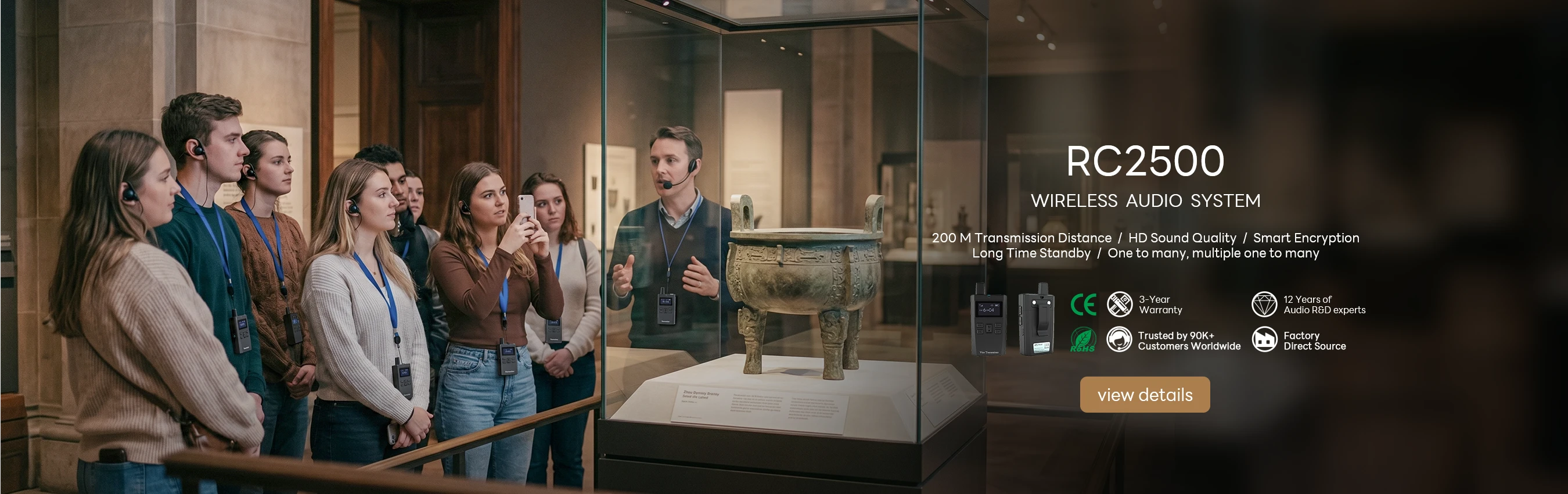
The RC2402 2.4G multi-channel system is the obvious anchor when one bus carries several language groups on the same departure. Its fifty channels let the operator assign English to one group, Mandarin to another, and Japanese to a third, so a single guide serves a multilingual cabin without the feeds crossing. The 2.4 GHz band is license-free in virtually every market, which matters for tour companies that cross borders on international routes and do not want to relicense hardware city by city. With roughly 180 metres of open range, the RC2402 keeps the audio alive when the guide steps off at a monument and walks the group a short distance from the bus. A charging dock between loops keeps a mixed fleet ready, and the transmitter accepts an external audio feed if the operator wants pre-recorded stops mixed into the live commentary.
RC085: UHF portable for the noisy lower deck
Down on the enclosed lower deck the engine hum and road noise never stop, and that is exactly where the RC085 UHF tour guide transmitter does its work. UHF handles the metal-and-glass cabin better than higher bands, pushing the commentary through the background hiss that buries weaker signals. The portable build suits a guide who clips the unit on at the start of the shift and forgets it, and the long battery carries the transmitter through multiple loops in a single day, the realistic duty cycle of a sightseeing operation rather than a meeting that ends at noon. The unit is light enough to wear on a belt clip through a full shift, and the simple controls mean a relief guide can take over mid-route without training.

RC9150: high-fidelity audio for clear commentary
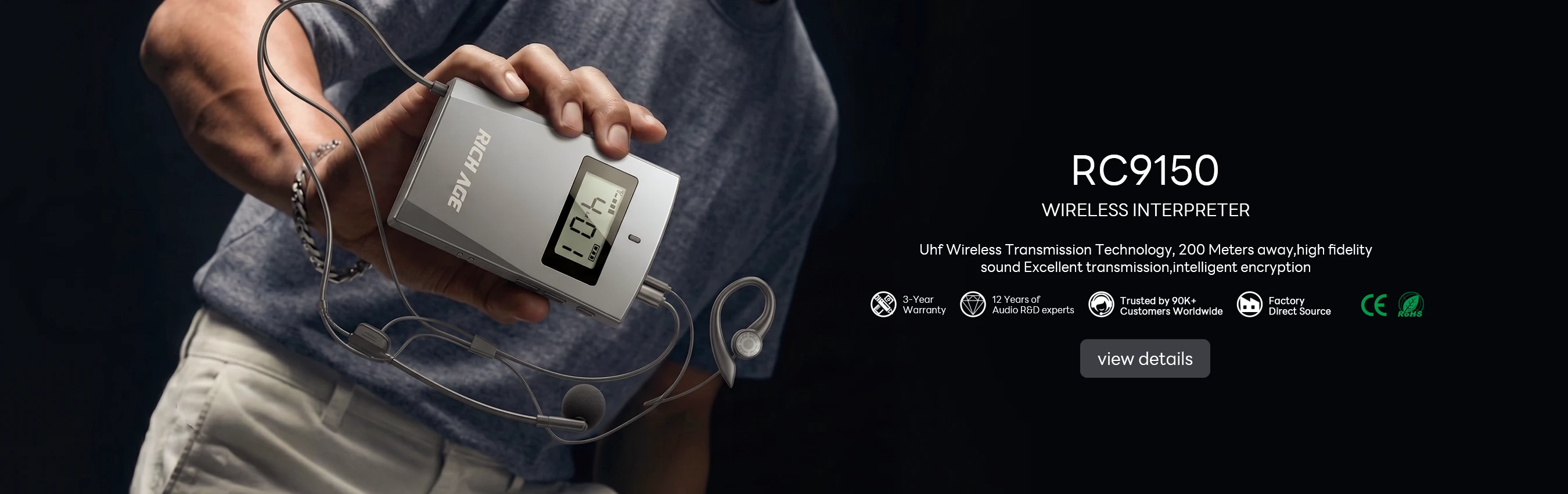
Premium sightseeing lives or dies on narration quality, and the RC9150 high-fidelity audio guide is built for that exact job. Where budget kits flatten a guide's voice into a tinny monotone, the RC9150 preserves the warmth and pacing that make a city story worth hearing, so passengers on the upper deck actually follow the commentary over the wind. For operators selling an upscale experience, clearer audio translates directly into better reviews and repeat bookings, not just fewer complaints. It also pairs well with the RC2402 on the same bus, giving the premium cabin a cleaner signal while the standard groups stay on the multi-channel system.

| Model | Band | Channels | Open range | Role on a bus route |
|---|---|---|---|---|
| RC2402 | 2.4 GHz | 50 | ~180 m | Multi-language groups, on- and off-bus walks |
| RC085 | UHF | Portable | Cabin-grade | Noisy lower deck, all-day duty cycle |
| RC9150 | High-fidelity | Premium | Tour-grade | Clear narration for upscale departures |
How AXIWI and Anleon compare
Two names turn up often in procurement shortlists, and neither is a bad product, but both are shaped for different jobs. AXIWI, a Dutch brand, sells the AT-350 as a 2.4 GHz full-duplex system where up to six people can talk at once. That two-way design is excellent for training and referee communication, yet a sightseeing bus is a one-to-many broadcast: the guide speaks and everyone listens. Full-duplex hardware adds cost and complexity the use case never uses. Anleon, a Chinese manufacturer, offers a 902-927 MHz UHF tour guide with six channels and a genuinely strong 24-hour battery, a respectable visitor-tour spec, but the six-channel ceiling caps how many language groups a single bus can run next to the RC2402's fifty.
| Brand | Band | Channels | Strength | Limit for bus tours |
|---|---|---|---|---|
| AXIWI AT-350 | 2.4 GHz | 6 (full-duplex) | Two-way talk | Built for dialogue, not broadcast |
| Anleon 902-927 | UHF | 6 | 24 h battery | Few channels for multilingual groups |
Putting together a kit for your route
Most sightseeing operators do not run one device for the whole fleet. A practical setup pairs the RC2402 for multilingual groups, the RC085 where the cabin noise is worst, and the RC9150 on premium departures where audio quality is the pitch. The full full wireless tour guide lineup covers single-language shuttles through to complex multilingual charters, and the side-by-side tour guide comparisons page lays out how each model stacks up before you commit to a purchase.