
.webp)
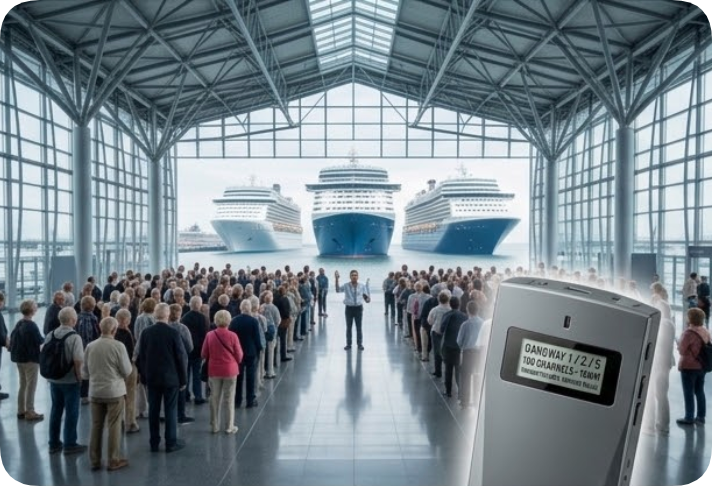
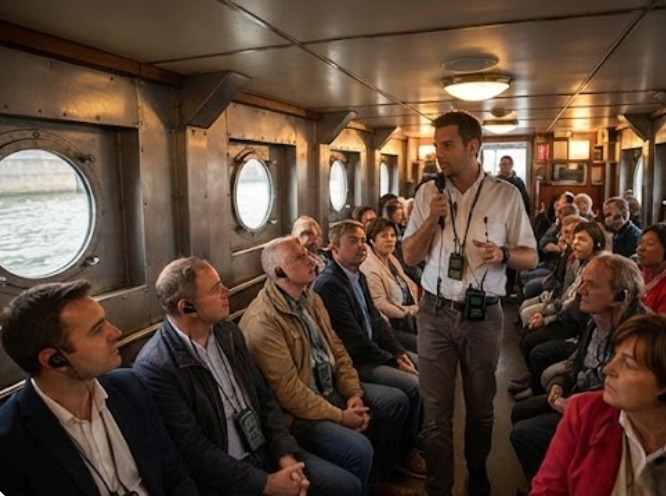
Passengers gather at the pier long before the gangway drops, and the guide reads the manifest aloud once, then again, while a French family and a Mandarin-speaking couple both lean in to catch the same welcome. A sightseeing boat runs a fixed loop route along the riverbank, so the group is never more than ninety minutes from the wharf, yet it is also never still: the deck rocks with the wake, the helm engine hums through the enclosed lower cabin, and the open-air upper deck trades that hum for wind, sun, and the occasional salt spray off the bow. Keeping every passenger, in two languages, on the same narration for the whole cruise is exactly the problem a city sightseeing boat tour solutions kit is built to solve — provided the transmitter and receivers are matched to where each listener actually stands.

RC2402 puts a multilingual group on one upper-deck channel plan
The upper deck is where a river cruise sells itself: skyline, bridge, shoreline, and the guide's voice carrying over open water. Mixed-language passengers are the norm on a harbor tour, and the RC2402 multi-channel tour guide answers that with 50 channels across 50 group IDs on 2.4 GHz, so a French channel and an English channel can run on the same departure without crossing over. A guide on the bow talks once; receivers tuned to the right ID hear clean narration while the rest of the deck goes about its photos. Range holds across the open-air span of a mid-size vessel, and because the system is digital, the cabin-to-deck handoff at the stairwell does not drop the signal the way an analog link often does. For the segment of the loop where everyone is outside and moving, this is the anchor unit.
RC085 reaches the people sealed behind cabin bulkheads
Step below and the physics change. The enclosed lower cabin wraps passengers in metal bulkheads and a constant ambient engine noise that chews through 2.4 GHz, and a guide standing at the stern can lose the bow seats entirely. The RC085 UHF portable transmitter works on UHF, which penetrates cabin structure far better than the higher band, so a single transmitter at the helm reaches listeners through the bulkhead instead of around it. It is a belt-pack and lavalier setup meant to be handed between guides per rotation, light enough for a full cruise, and the audio stays intelligible where the view is worst. On a vessel that splits its audience between an open top and a sealed bottom, the UHF link is the quiet workhorse that the postcard deck never sees.
RC8860 shrugs off what the deck throws at it
A guide who spends the sunset cruise on the open stern gets hit with three things the indoor kits were never rated for: salt spray off the wake, UV exposure for the full loop, and the constant small shocks of a boat that never stops moving. The RC8860 rugged IP54 transmitter carries the ingress and drop tolerance for exactly that environment, at 59 grams so it rides a lanyard without pulling the collar. Where RC2402 owns the multilingual open deck and RC085 owns the sealed cabin, RC8860 owns the exposed rail where the spray lands — the unit a marina would actually trust to a rotating crew across a season of tours. It is not the multi-language answer, but it is the one that still works after a wave finds the speaker.

How the three richitek units split the boat
| Model | Band | Best deck zone | Language handling | Ruggedness |
|---|---|---|---|---|
| RC2402 | 2.4 GHz digital | Open-air upper deck | 50 channels / 50 group IDs (multilingual) | Indoor-grade |
| RC085 | UHF | Enclosed lower cabin | Single channel per guide | Portable, hand-off ready |
| RC8860 | 2.4 GHz | Exposed stern rail | Single channel | IP54, 59 g, drop-tolerant |
Read that table as a floor plan, not a ranking. A practical harbor tour pairs RC2402 on the upper deck with RC085 below, and keeps RC8860 on the guide who works the open rail — three jobs, three units, no overlap in what each is asked to survive.
Where Enersound and MEDER sit on the same water
Two reference kits show the tradeoffs a cruise operator weighs against the richitek trio. Enersound builds UHF tour systems in the budget tier — strong through-metal reach for the lower cabin, but with fewer channels, so a mixed-language load is harder to run than on RC2402. MEDER CommTech, a German house, sells a high-end 2.4 GHz digital system with museum-grade clarity and a wide channel count, at a price and a fragility that suits a quiet gallery more than a spray-soaked stern. Neither is wrong; they simply optimize for one end of the boat.
| Reference kit | Band | Positioning | Strength on a cruise | Weak spot |
|---|---|---|---|---|
| Enersound (TGS-class UHF) | UHF ~672-697 MHz | Budget professional | Cabin bulkhead penetration | Limited channels for multilingual |
| MEDER CommTech | 2.4 GHz digital | Premium museum/enterprise | Clarity, wide channel count | Price and deck ruggedness |
Neither competitor link is added here on purpose — the comparison is about capability, not a referral — and both sit at the two extremes the richitek set fills in the middle: UHF-cabin on one side, premium-multilingual on the other, rugged-deck straddling the weather.
Picking the kit for a specific loop
A short wharf shuttle with one language and a calm lake needs less than a two-hour river cruise under a hot sun with four languages aboard. The complete wireless tour guide range lets an operator scale from a single RC085 cabin rig up to the full RC2402-plus-RC8860 deck plan as the route and the passenger mix demand. Battery on all three carries a full loop and then some, so the only thing a guide recharges between sailings is the welcome speech.
See the two transmitters side by side
For operators deciding between the UHF cabin unit and the rugged deck unit, the RC085 vs RC8860 detailed comparison lays the bands, weights, and ingress ratings against each other so the purchase matches the part of the boat that actually breaks gear.