
A leading China factory specializing in Wireless Tour Guide Systems, Church Audio Guides, and Translation Headphones with premium OEM/ODM solutions.

Tel:+86 13825295213

Email:tiger.wang@richitek.com

Ten Hours Is Not a Trail Day

Ten Hours Is Not a Trail Day

A walking tour has a power problem a museum floor does not: there is nowhere to plug in at the halfway point. Full-duplex intercoms solve a different problem — eight people talking over each other on a production set — and pay for it in weight and battery. For outdoor guiding and city tour operations, one person speaks and forty listen, and the arithmetic reverses.

Ten Hours Is Not a Trail Day(图1)

RC9150, RC2500 and RC2468 on Long-Distance Walking Tours

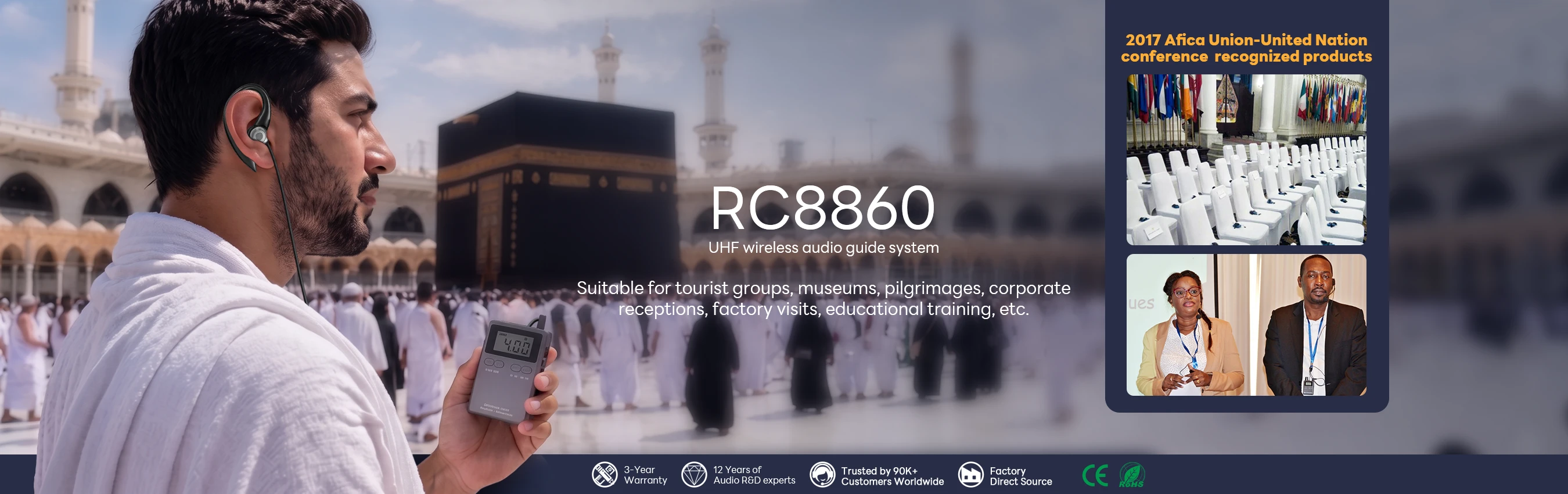
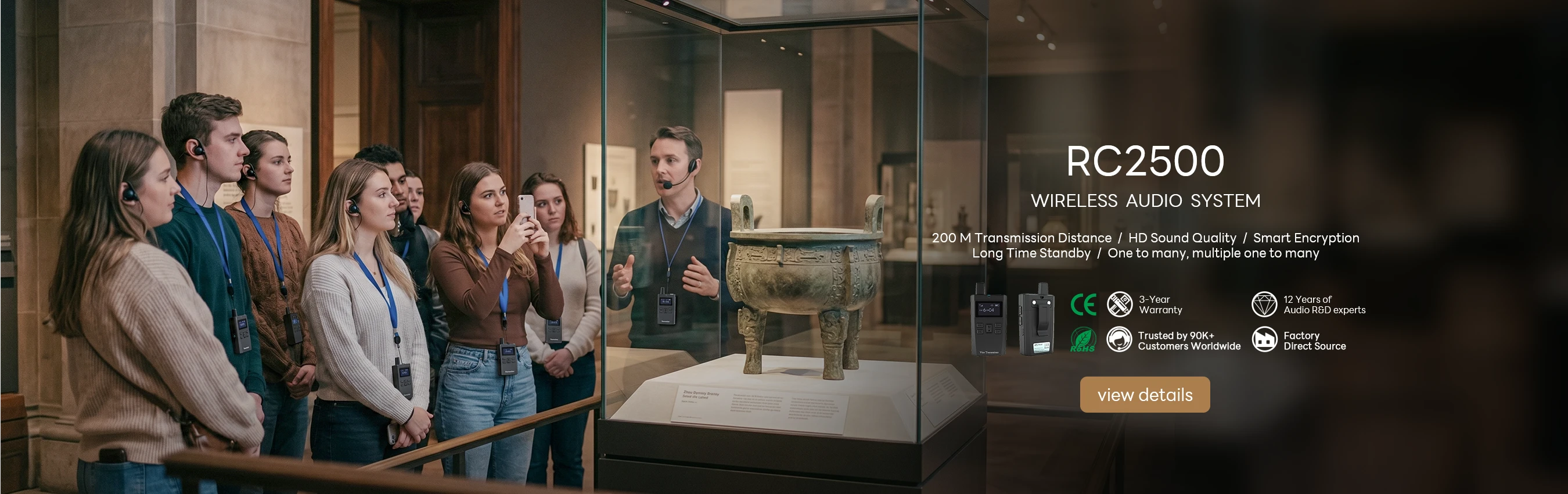
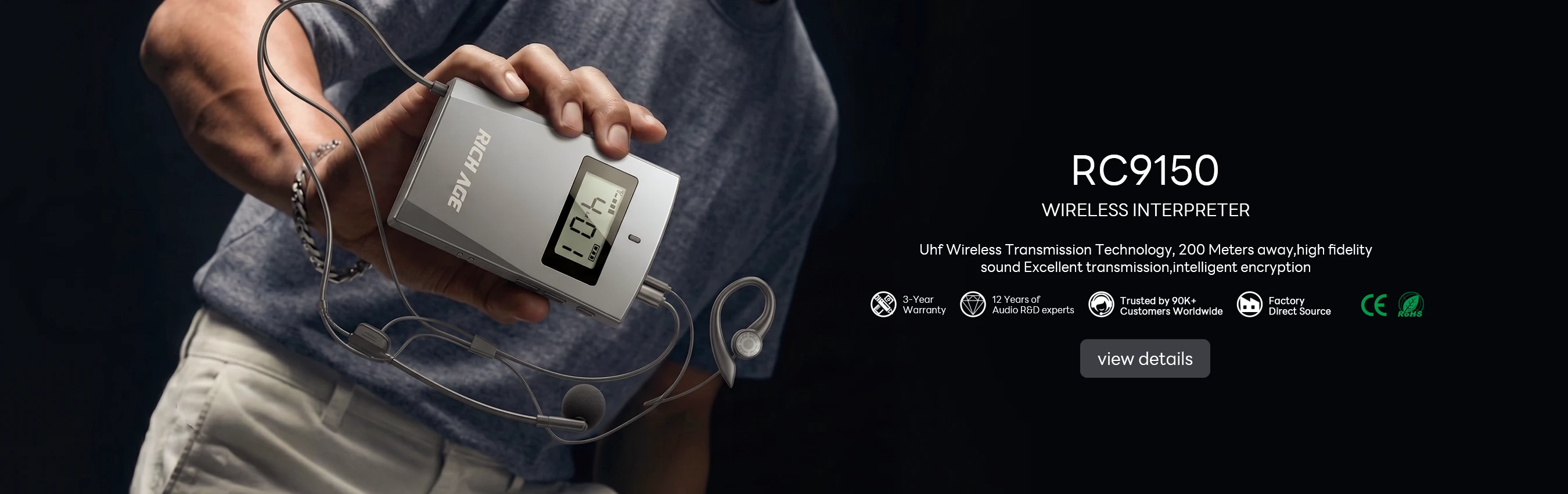
Three Richitek systems approach the trail differently. The RC9150 brings 100 channels for trailheads where several operators launch groups at once. The RC2500 is the endurance option, with a receiver rated at 40 hours and operation down to minus 15 degrees. The RC2468 is the weight option at 18 grams. All three transmit on 2403-2483 MHz, licence-free in every market.

What a Day on Foot Asks of the Kit

A day on foot adds four constraints. Weight accumulates across six to eight hours of wear. Temperature swings from a below-freezing start to an exposed afternoon. Group size flexes when two bookings merge. And there is no mains power, so whatever charge a receiver holds at the start is what it has at the finish.

The Weight Carried for Eight Hours

The SYNCO Xtalk XPro weighs 194 grams with its battery: a headset, not an earhook. The RC2468 receiver weighs 18 grams, roughly a tenth as much. Across a two-hour walk the gap is academic; across eight hours on a graded ascent it is the difference between kit a guest forgets and kit a guest takes off. Hollyland's Solidcom SE 2 sits between the two at 123 grams.

What Full-Duplex Costs in Battery

Full duplex means every unit transmits and receives continuously, so each one pays a transmitter's power bill. Hollyland rates the Solidcom SE 2 at 10 hours, and SE-series channel listings put that nearer five once five follower headsets are linked, because every added node is more traffic for the master to handle. Richitek receivers never transmit at all: 30-plus hours on the RC9150, 40 on the RC2500, and a hundredth listener costs the other ninety-nine nothing.

Ten Hours Is Not a Trail Day(图2)

The Temperature Floor Nobody Prints

SYNCO publishes a working range of 0 to 45 degrees Celsius for the Xtalk XPro. That floor is fine indoors and useless at an alpine start, on a winter coastal path or a high pass in shoulder season. The RC2500 is rated from minus 15 to 50 degrees. Operating limits for the RC9150 and RC2468 are not published on their product pages.

Thirteen Users Is a Ceiling

The Xtalk XPro supports two to thirteen users — the right number for a camera crew and the wrong number for an operator who merges two bookings on a busy morning. Richitek pairs one transmitter with an unlimited number of receivers, so group size is a purchasing decision, not a hardware limit. The trade is one-way: listeners hear the guide, but they cannot answer.

Frequency Paperwork on an International Trail

Hollyland's Solidcom line runs on DECT, and DECT allocations differ by region — the European band and the North American DECT 6.0 band are not the same slice of spectrum. An operator running trips on two continents has to confirm which hardware variant is being bought. All three Richitek models sit inside 2403-2483 MHz, the global ISM allocation, so the same units switch on anywhere.

The RC9150: Channel Headroom at the Trailhead

One hundred channels sounds excessive until four operators stand in the same car park. Each group locks an independent channel, so a geology talk does not bleed into the botany walk beside it. The receiver runs beyond 30 hours, the transmitter 15, and intelligent encryption covers corporate or research groups whose content is not public.

The RC2500: Five Days Without a Charger

Forty hours on the receiver is five working days between charges, which changes how a fleet is managed: units leave on Monday and come back on Friday. The transmitter runs 12 hours. The RC2500 also transmits at 20 mW, above standard tour-guide output, which is what holds a link together when a group strings out along a switchback or drops behind rock.

The RC2468: An 18-Gram Receiver

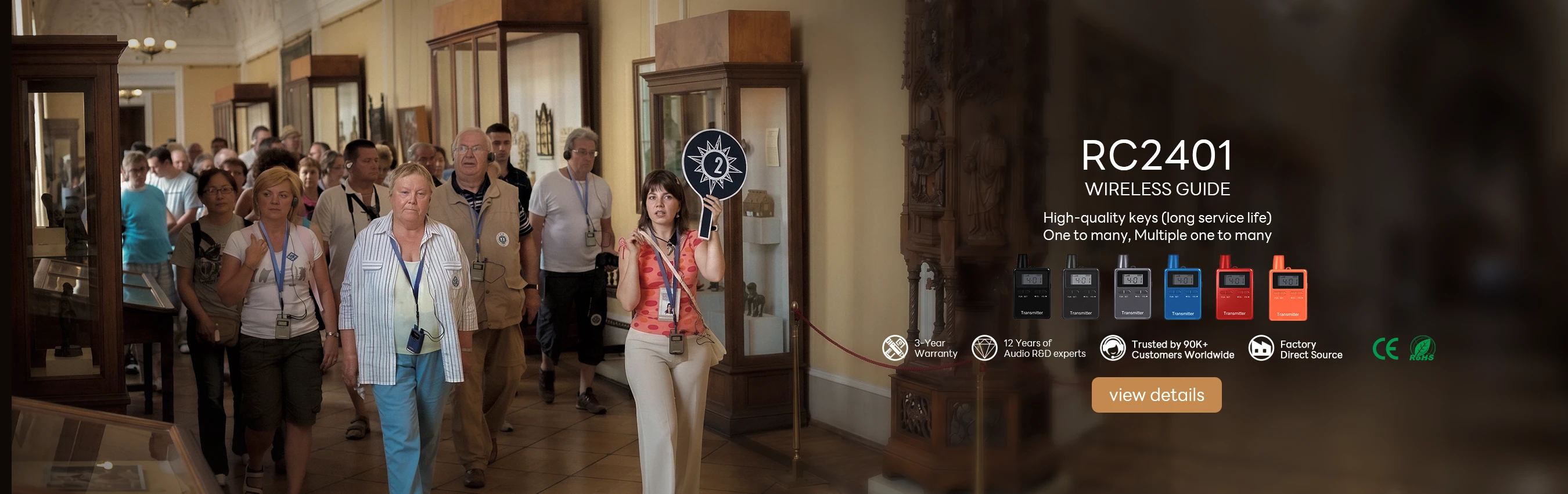
Eighteen grams is the figure that matters on a long day. The receiver runs 10 hours from a 300 mAh cell and the transmitter 12 hours from 1500 mAh, with Micro USB charging at 5V/1A — dated, but compatible with any power bank a guide carries. Six transmitter colour options help rental fleets track inventory.

Hollyland Solidcom SE 2: Built for a Crew

Hollyland launched the Solidcom SE 2 in August 2026. At 123 grams with dual-microphone environmental noise cancellation rated at 20 dB, it is a genuinely light intercom headset, and a 3.5 mm port lets a user monitor a camera feed while staying on the intercom channel. Battery is quoted at 10 hours. Channel count, certification and operating temperature are not published.

SYNCO Xtalk XPro: Long Reach, Hard Limits

SYNCO's Xtalk XPro is the stronger intercom on open ground: 500 metres line of sight with dual external antennas, 24 hours from a replaceable 1050 mAh cell with a two-slot charging station, and a low-latency mode quoted at 80 milliseconds. The costs are the 194-gram headset, the 13-user ceiling and a working floor of 0 degrees. List price is 99 US dollars.

Specification Comparison

ModelBandRangeBattery (TX / RX)WeightGroup limit
RC91502.4 GHz ISM200 m15 h / 30+ h75 gUnlimited receivers
RC25002.4 GHz ISM200 m12 h / 40 h55 gUnlimited receivers
RC24682.4 GHz ISM1-200 m12 h / 10 hTX 59 g / RX 18 gUnlimited receivers
Solidcom SE 2DECT 1.9 GHz350 m (LOS)10 h (about 5 h with 5 linked)123 gNot published
Xtalk XProDigital 2.4 GHz500 m (LOS)24 h194 g2-13 users

Choosing by Group Size and Terrain

OperationFirst constraintStart here
Groups above 13 on open groundIntercom user ceilingRC9150 or RC2500
Multi-day itineraries, no chargingReceiver enduranceRC2500
High routes, sub-zero startsIntercom 0 degrees floorRC2500
Receivers worn all dayHeadset weightRC2468
Crews that must talk backOne-way broadcastA full-duplex intercom

The last row is the honest one. A full-duplex intercom is the correct purchase when a team has to talk among itself; it is simply the wrong tool for one-to-many guiding. Across the wireless tour guide system range, every model is a one-transmitter, many-receiver design built for exactly that job.

Ten Hours Is Not a Trail Day(图3)

Final Word

Trail operators buy for the worst day of the season, not the average one: the oversized group, the sub-zero start, the ridge where sightlines vanish. A one-way broadcast system gives up a guest's ability to talk back, and returns receivers that weigh 18 grams, run for two days and switch on at minus 15. For how these systems compare across other scenarios, see the comparison library.
2026年09月11日 12:22
click: 12
no data
Home > VS

Ten Hours Is Not a Trail Day

time: 2026年09月11日 click:12

Ten Hours Is Not a Trail Day

A walking tour has a power problem a museum floor does not: there is nowhere to plug in at the halfway point. Full-duplex intercoms solve a different problem — eight people talking over each other on a production set — and pay for it in weight and battery. For outdoor guiding and city tour operations, one person speaks and forty listen, and the arithmetic reverses.

Ten Hours Is Not a Trail Day(图1)

RC9150, RC2500 and RC2468 on Long-Distance Walking Tours

Three Richitek systems approach the trail differently. The RC9150 brings 100 channels for trailheads where several operators launch groups at once. The RC2500 is the endurance option, with a receiver rated at 40 hours and operation down to minus 15 degrees. The RC2468 is the weight option at 18 grams. All three transmit on 2403-2483 MHz, licence-free in every market.

What a Day on Foot Asks of the Kit

A day on foot adds four constraints. Weight accumulates across six to eight hours of wear. Temperature swings from a below-freezing start to an exposed afternoon. Group size flexes when two bookings merge. And there is no mains power, so whatever charge a receiver holds at the start is what it has at the finish.

The Weight Carried for Eight Hours

The SYNCO Xtalk XPro weighs 194 grams with its battery: a headset, not an earhook. The RC2468 receiver weighs 18 grams, roughly a tenth as much. Across a two-hour walk the gap is academic; across eight hours on a graded ascent it is the difference between kit a guest forgets and kit a guest takes off. Hollyland's Solidcom SE 2 sits between the two at 123 grams.

What Full-Duplex Costs in Battery

Full duplex means every unit transmits and receives continuously, so each one pays a transmitter's power bill. Hollyland rates the Solidcom SE 2 at 10 hours, and SE-series channel listings put that nearer five once five follower headsets are linked, because every added node is more traffic for the master to handle. Richitek receivers never transmit at all: 30-plus hours on the RC9150, 40 on the RC2500, and a hundredth listener costs the other ninety-nine nothing.

Ten Hours Is Not a Trail Day(图2)

The Temperature Floor Nobody Prints

SYNCO publishes a working range of 0 to 45 degrees Celsius for the Xtalk XPro. That floor is fine indoors and useless at an alpine start, on a winter coastal path or a high pass in shoulder season. The RC2500 is rated from minus 15 to 50 degrees. Operating limits for the RC9150 and RC2468 are not published on their product pages.

Thirteen Users Is a Ceiling

The Xtalk XPro supports two to thirteen users — the right number for a camera crew and the wrong number for an operator who merges two bookings on a busy morning. Richitek pairs one transmitter with an unlimited number of receivers, so group size is a purchasing decision, not a hardware limit. The trade is one-way: listeners hear the guide, but they cannot answer.

Frequency Paperwork on an International Trail

Hollyland's Solidcom line runs on DECT, and DECT allocations differ by region — the European band and the North American DECT 6.0 band are not the same slice of spectrum. An operator running trips on two continents has to confirm which hardware variant is being bought. All three Richitek models sit inside 2403-2483 MHz, the global ISM allocation, so the same units switch on anywhere.

The RC9150: Channel Headroom at the Trailhead

One hundred channels sounds excessive until four operators stand in the same car park. Each group locks an independent channel, so a geology talk does not bleed into the botany walk beside it. The receiver runs beyond 30 hours, the transmitter 15, and intelligent encryption covers corporate or research groups whose content is not public.

The RC2500: Five Days Without a Charger

Forty hours on the receiver is five working days between charges, which changes how a fleet is managed: units leave on Monday and come back on Friday. The transmitter runs 12 hours. The RC2500 also transmits at 20 mW, above standard tour-guide output, which is what holds a link together when a group strings out along a switchback or drops behind rock.

The RC2468: An 18-Gram Receiver

Eighteen grams is the figure that matters on a long day. The receiver runs 10 hours from a 300 mAh cell and the transmitter 12 hours from 1500 mAh, with Micro USB charging at 5V/1A — dated, but compatible with any power bank a guide carries. Six transmitter colour options help rental fleets track inventory.

Hollyland Solidcom SE 2: Built for a Crew

Hollyland launched the Solidcom SE 2 in August 2026. At 123 grams with dual-microphone environmental noise cancellation rated at 20 dB, it is a genuinely light intercom headset, and a 3.5 mm port lets a user monitor a camera feed while staying on the intercom channel. Battery is quoted at 10 hours. Channel count, certification and operating temperature are not published.

SYNCO Xtalk XPro: Long Reach, Hard Limits

SYNCO's Xtalk XPro is the stronger intercom on open ground: 500 metres line of sight with dual external antennas, 24 hours from a replaceable 1050 mAh cell with a two-slot charging station, and a low-latency mode quoted at 80 milliseconds. The costs are the 194-gram headset, the 13-user ceiling and a working floor of 0 degrees. List price is 99 US dollars.

Specification Comparison

ModelBandRangeBattery (TX / RX)WeightGroup limit
RC91502.4 GHz ISM200 m15 h / 30+ h75 gUnlimited receivers
RC25002.4 GHz ISM200 m12 h / 40 h55 gUnlimited receivers
RC24682.4 GHz ISM1-200 m12 h / 10 hTX 59 g / RX 18 gUnlimited receivers
Solidcom SE 2DECT 1.9 GHz350 m (LOS)10 h (about 5 h with 5 linked)123 gNot published
Xtalk XProDigital 2.4 GHz500 m (LOS)24 h194 g2-13 users

Choosing by Group Size and Terrain

OperationFirst constraintStart here
Groups above 13 on open groundIntercom user ceilingRC9150 or RC2500
Multi-day itineraries, no chargingReceiver enduranceRC2500
High routes, sub-zero startsIntercom 0 degrees floorRC2500
Receivers worn all dayHeadset weightRC2468
Crews that must talk backOne-way broadcastA full-duplex intercom

The last row is the honest one. A full-duplex intercom is the correct purchase when a team has to talk among itself; it is simply the wrong tool for one-to-many guiding. Across the wireless tour guide system range, every model is a one-transmitter, many-receiver design built for exactly that job.

Ten Hours Is Not a Trail Day(图3)

Final Word

Trail operators buy for the worst day of the season, not the average one: the oversized group, the sub-zero start, the ridge where sightlines vanish. A one-way broadcast system gives up a guest's ability to talk back, and returns receivers that weigh 18 grams, run for two days and switch on at minus 15. For how these systems compare across other scenarios, see the comparison library.
no data
×

Contact us

email:
name:
subject:
content: