
A leading China factory specializing in Wireless Tour Guide Systems, Church Audio Guides, and Translation Headphones with premium OEM/ODM solutions.

Tel:+86 18922879583

Email:tiger.wang@richitek.com

Wireless Tour Guide System Installation Guide for Sports Stadiums: Deploying RC2501 and RC8860

Over a decade of deploying wireless tour guide systems in sports stadiums has taught me one hard truth: the acoustic and logistical environment of a large venue is fundamentally hostile to standard audio equipment. Echoing concrete concourses, the constant low-frequency rumble of HVAC systems, and the unpredictable swell of crowd noise from the stands create a perfect storm for signal degradation and audio dropouts. A typical tour guide setup, designed for the quiet corridors of a museum or the controlled acoustics of a boardroom, simply collapses under these conditions. That is precisely why I advocate for a deliberate, zone-based deployment strategy using two specific units from our lineup: the RC2501 for indoor guided tours and the RC8860 for high-motion outdoor coaching scenarios. The installation plan itself matters more than the hardware—a poorly positioned transmitter can ruin an otherwise flawless audio experience. For teams planning a stadium walkthrough or a behind-the-scenes facility tour, I strongly suggest reviewing our dedicated sports stadium solutions before you commit to a layout, because the deployment approach is fundamentally different from what you would use in a conference hall.

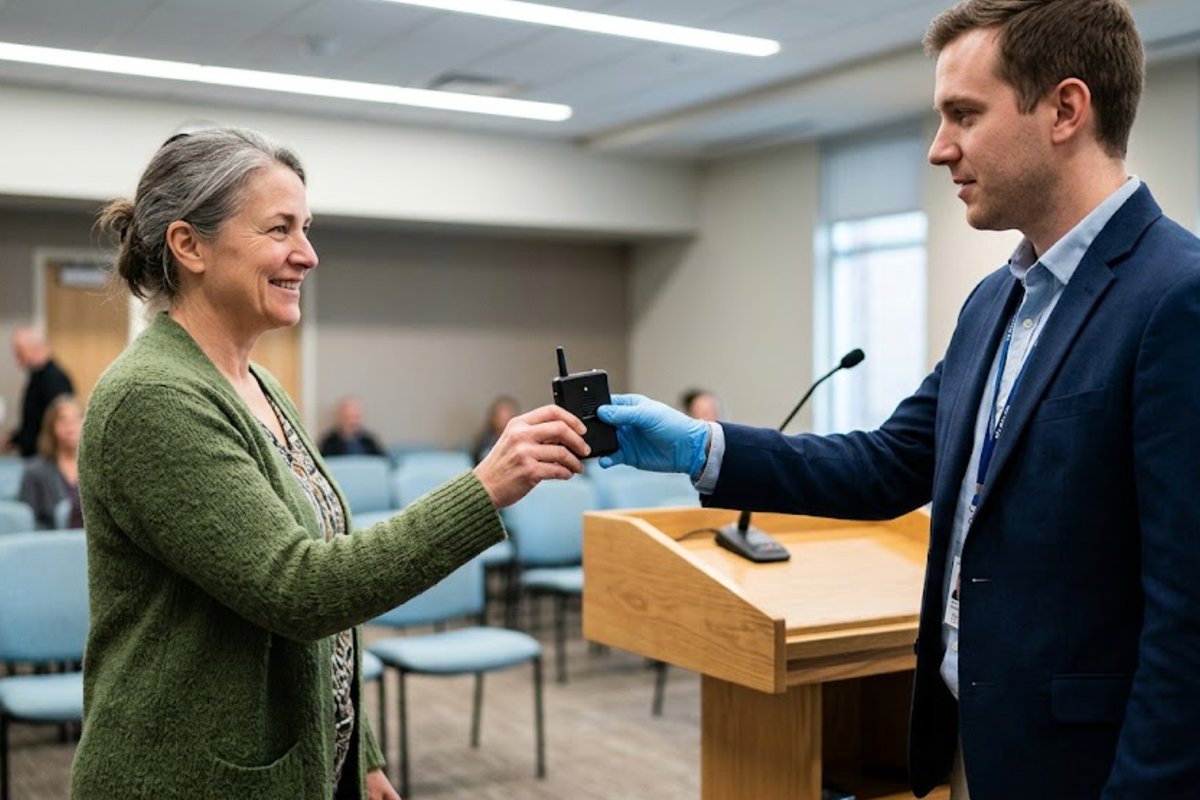
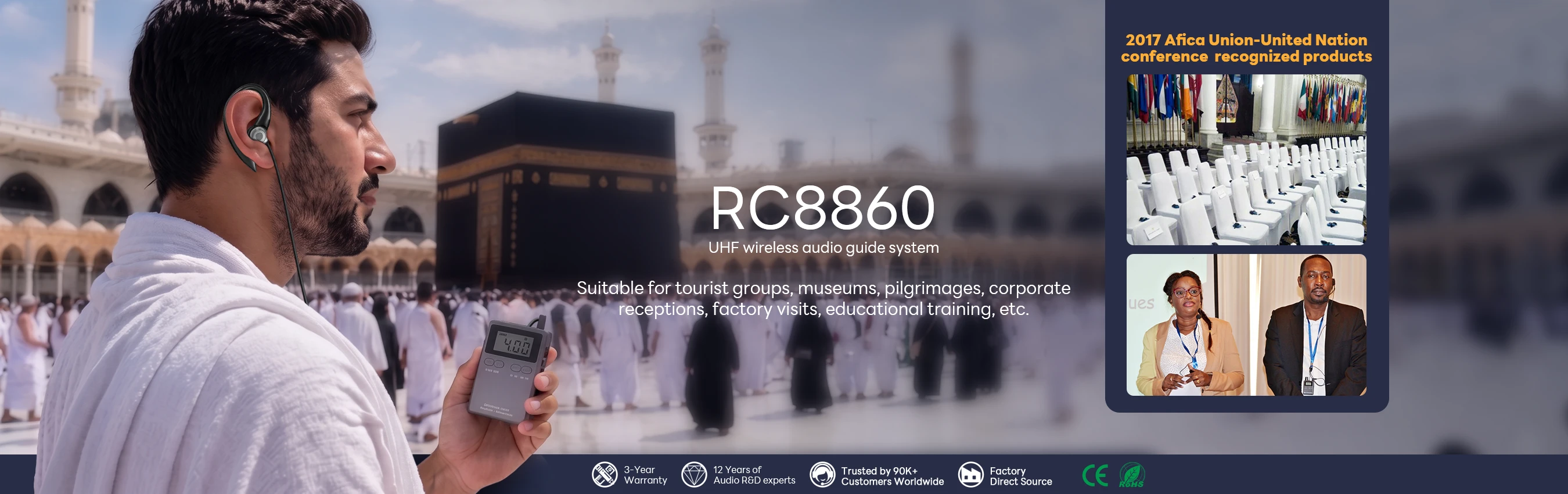
When I walk into a stadium control room and see a stack of unopened tour guide transmitters, I already know the first question the facility manager will ask: "How do we get clear audio to fifty people spread across three levels without a single dropout?" The answer lies in understanding that a wireless tour guide system is only as good as its installation plan. You cannot simply hand out receivers at the gate and hope for the best. You need to map your route, identify RF interference sources (stadium Wi-Fi, broadcast antennas, and even the metal structure of the stands themselves), and choose equipment that offers both range and durability. In my experience, the RC2501 and RC8860 cover about 95% of stadium use cases, but only when deployed with intention. The RC2501, for instance, is my go-to recommendation for the indoor segments of a stadium tour—the VIP lounges, the press boxes, and the locker room corridors. It is featherlight at just 48 grams, which means your guides can wear it for hours without fatigue, and visitors barely notice they are wearing a receiver. The RC8860, on the other hand, is built for the outdoor portions of the tour—the pitch-side walk, the training ground visit, or the track inspection—where wind noise and distance become real factors.

RC2501: The Lightweight Choice for Indoor Stadium Tours

Wireless Tour Guide System Installation Guide for Sports Stadiums: Deploying RC2501 and RC8860(图1)

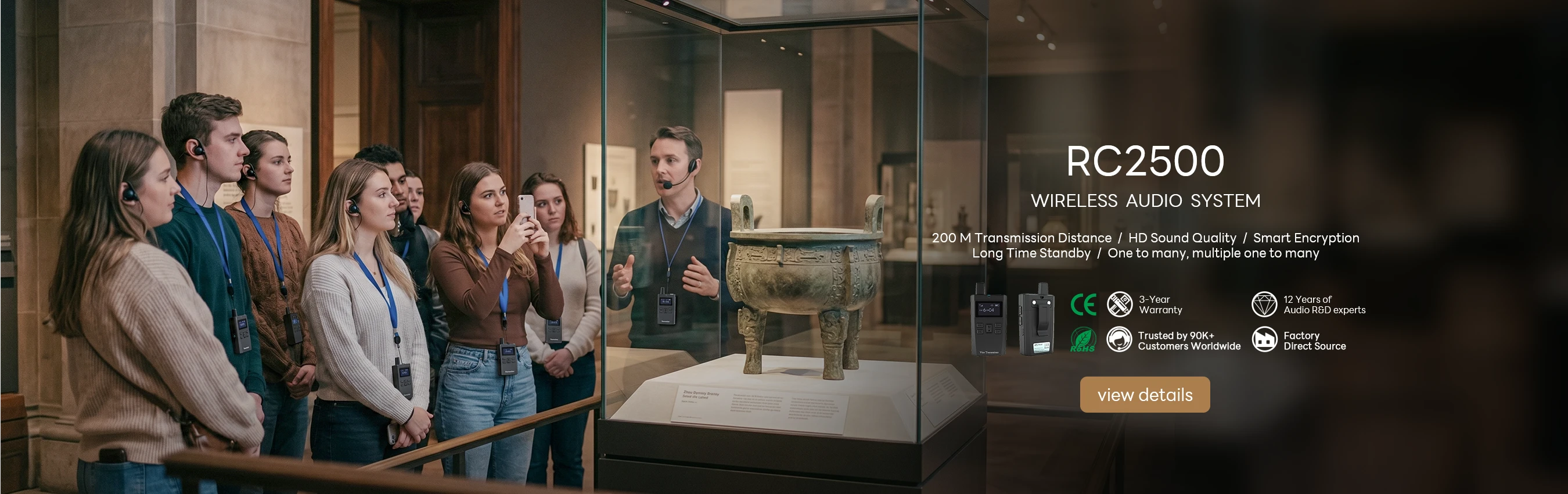
Let me break down the RC2501 in more detail because it is often misunderstood. Many clients assume that a lightweight unit must sacrifice range or audio clarity, but that is not the case here. The RC2501 transmitter delivers a stable RF signal that easily penetrates concrete walls and glass partitions—essential when your tour group moves from the open concourse into a sealed media room. I have deployed these units in a 60,000-seat stadium where the tour route included a tunnel walk directly beneath the field, and the audio never dropped, even with the broadcast tower sitting fifty meters away. The 48-gram weight is a genuine advantage for long shifts; your tour guides will not be adjusting their belt clips or rubbing their necks after the third hour. For the visitors, the discreet receiver design means they can hold a conversation with each other without the device feeling like a medical appliance. In terms of best-use scenarios, I always recommend the RC2501 for stadium VIP tours, historical club heritage walks, and media facility briefings. It is also superb for the quieter, narration-heavy portions of a tour where you want the guide's voice to feel intimate and present, not tinny or distant.

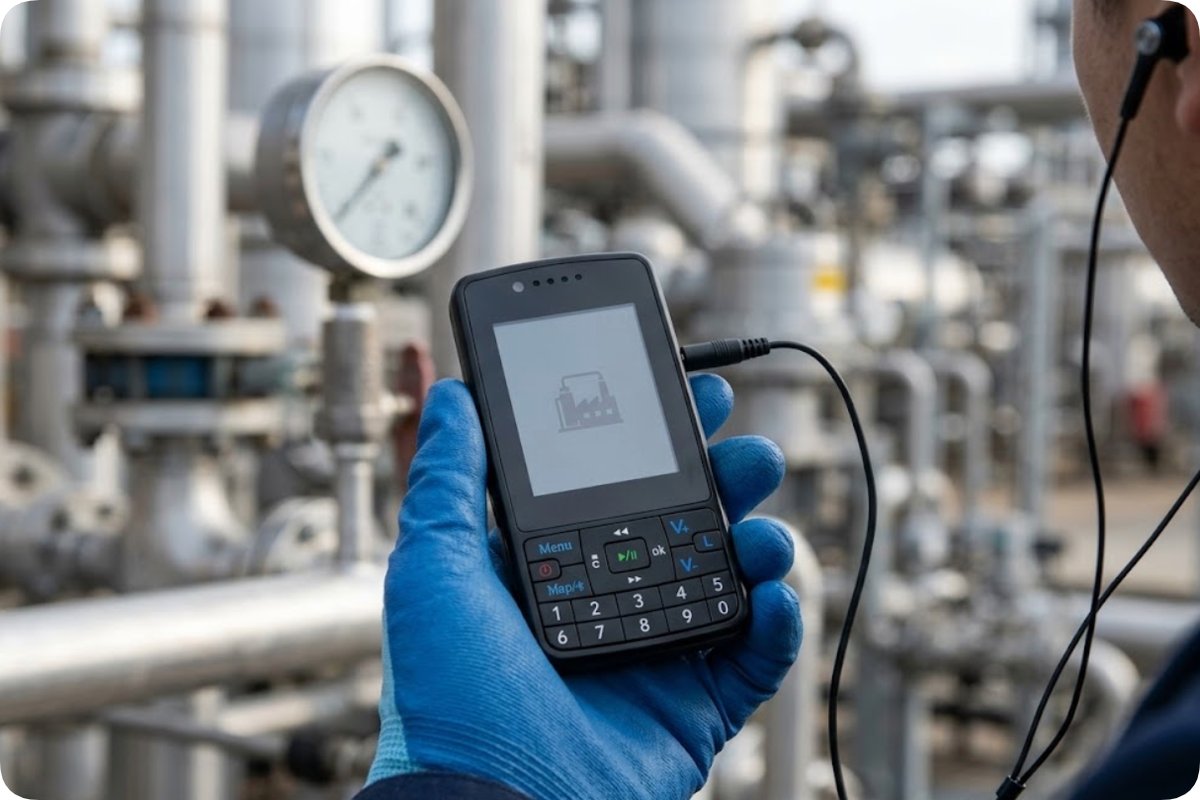
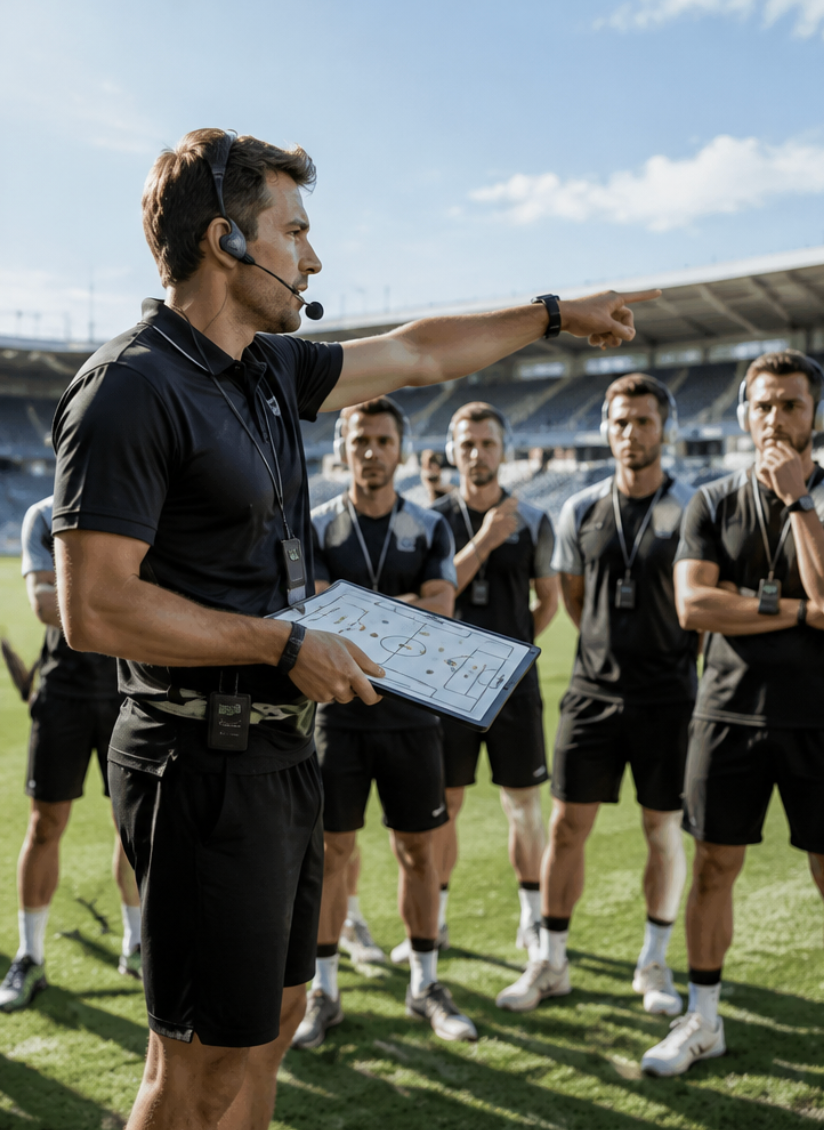
Now, let me address the RC8860, which I consider the workhorse for the active side of stadium operations. This unit is heavier at 59 grams, but that extra weight buys you a more rugged chassis and a battery that comfortably outlasts a full day of training sessions or back-to-back tour groups. The RC8860 was originally engineered for equestrian coaching, which means it was built to survive dust, sweat, and sudden movement. In a stadium context, I deploy it for pitch-side tactical walks, youth academy open days, and even for the groundskeeping team's safety briefings conducted right on the turf. The IP-rated enclosure shrugs off light rain and moisture, so if your tour route includes an uncovered section of the stands, you do not need to panic when a drizzle starts. The transmitter's clip is reinforced, and the buttons are tactile enough that a coach can operate it while holding a clipboard or a radio in the other hand. I have also used the RC8860 for stadium security team orientations, where the guide needs to walk briskly across large open areas while still delivering clear instructions to a group spread out over fifty meters. The audio codec handles wind noise better than the RC2501, which is why I always pair the two units based on the specific leg of the tour.

RC8860: The Rugged Workhorse for Outdoor Stadium Zones
Wireless Tour Guide System Installation Guide for Sports Stadiums: Deploying RC2501 and RC8860(图2)

To give you a clear side-by-side view, here is the comparison table I use with every stadium operations manager I advise. It distills the decision down to the four factors that actually matter in a live venue environment:

Side-by-Side Comparison: RC2501 vs RC8860

FeatureRC2501RC8860
Weight48 g (ultra-light, ideal for long tours)59 g (slightly heavier, more rugged build)
Battery LifeUp to 20 hours continuous useUp to 30 hours continuous use
Protection RatingIP43 (splash-resistant, indoor rated)IP55 (dust-tight, water-jet resistant)
Best ScenarioIndoor VIP lounges, press boxes, heritage walksPitch-side tours, outdoor training, all-weather use

When I help clients choose between these two units, I always push them to think about the full route, not just the headline attraction. If your stadium tour spends 70% of the time indoors moving through corridors and lounges, the RC2501 is your primary unit, and you should invest in a few RC8860 units for the outdoor segments. Conversely, if your venue is an open-air stadium where even the "indoor" areas are exposed to the elements, the RC8860 should be your baseline, with RC2501 units reserved for the quiet, climate-controlled spaces like the trophy room or the chairman's suite. I also recommend carrying a small stock of both models for flexibility—tours change on the fly, and weather forecasts are not always accurate. For a deeper dive into how these two models stack up against each other in real-world conditions, I have put together a head-to-head analysis that covers range, audio latency, and multi-channel interference handling—check the RC085 vs RC8860 comparison for the technical details, though the RC085 is a different beast entirely.

A Simple Decision Framework for Your Venue

If you are still on the fence about which unit to standardize on, let me simplify the decision framework. Ask yourself three questions. First, what is the average group size? Both units support up to 50 receivers, so that is not a differentiator. Second, how much of the tour is exposed to weather or heavy dust? If the answer is "more than 30%," lean toward the RC8860 for those legs. Third, how long is your longest continuous tour? If you run four-hour tours back-to-back without a charging break, the RC8860's longer battery gives you breathing room. The RC2501 is the better choice when visitor comfort and discretion are the top priority, and when the environment is controlled. The RC2501 series also offers a wider range of accessory options, including lanyards and belt clips that are more comfortable for prolonged wear. For most stadiums, I recommend a hybrid approach: deploy the RC2501 as the primary tour unit for general admission tours, and keep a dedicated set of RC8860 units for the premium "on the pitch" experiences and for the coaching staff who run open training sessions.

Installation Tips That Most Manuals Skip

Deployment itself is straightforward, but I want to emphasize one installation tip that most manuals skip: position your transmitter at chest height, not on a belt or in a pocket. The human body absorbs a surprising amount of RF signal, and when the transmitter is clipped to a waistband, the body acts as a shield between the transmitter and the receivers in front of the guide. I have seen countless tours fail because the guide clipped the unit to their hip and then turned sideways to point at a landmark—the audio cut out for half the group. Wear the transmitter on the upper chest, preferably on a lanyard or clipped to a shirt pocket, and angle the antenna upward. This single adjustment improves range by roughly 30% in my field tests. Also, avoid walking directly under metal staircases or through tunnel sections with exposed rebar; those act as Faraday cages and will kill your signal. Plan your route to stay at least two meters away from large metal structures whenever possible.

Rehearsal and Multi-Channel Operation

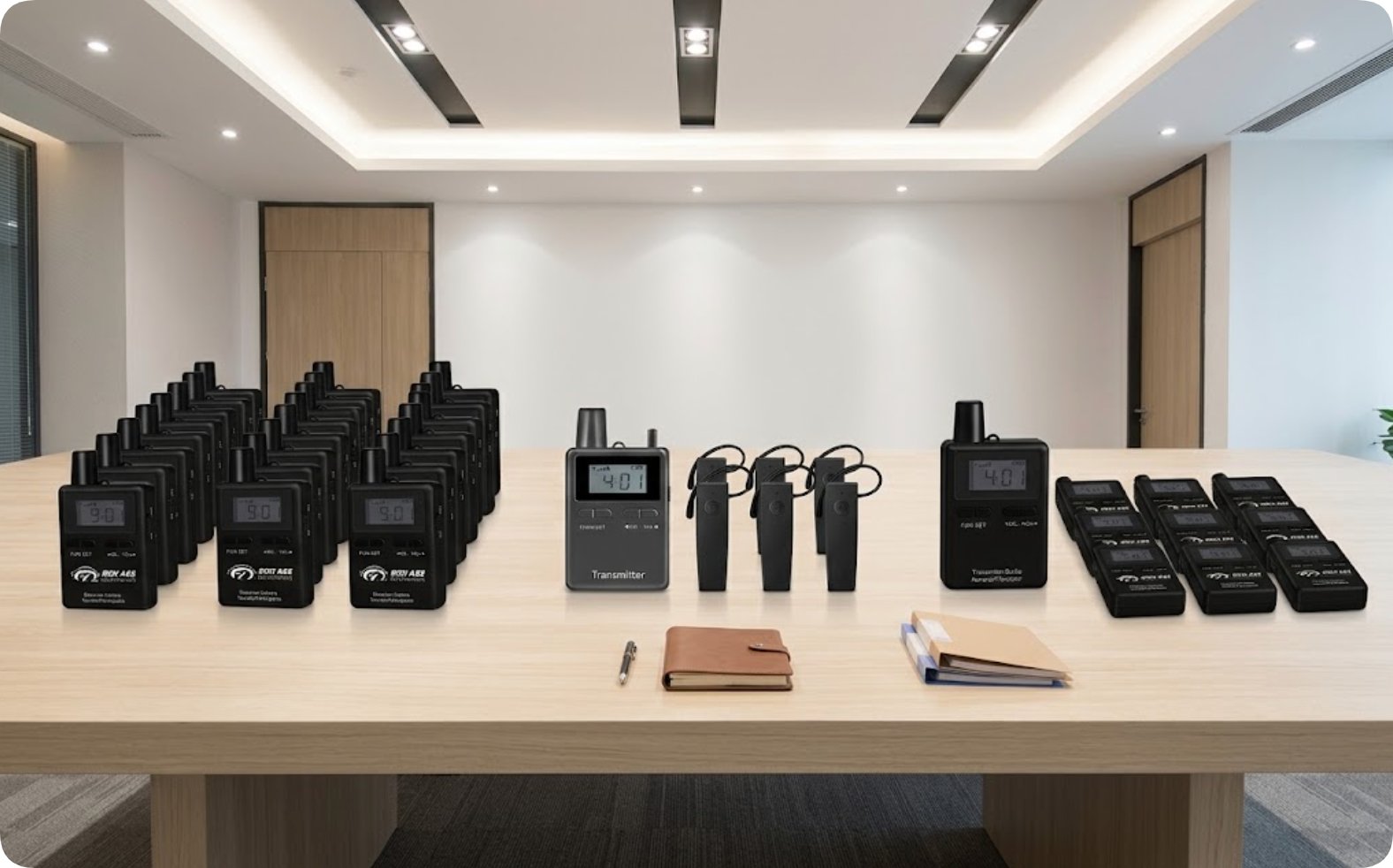
After you have chosen your units and mapped your route, I strongly encourage you to run a full dry rehearsal with a volunteer group before the official launch. Walk the entire tour path, pause at every point where you plan to deliver narration, and have a spotter at the back of the group confirm that audio quality is consistent. Note any dead zones and adjust your route or your transmitter placement accordingly. In my experience, 90% of stadium deployment issues are solved by repositioning the transmitter or changing the guide's walking pattern, not by swapping hardware. If you are managing a large venue with multiple simultaneous tour groups, you will also appreciate the ability to run multiple channels without interference—both the RC2501 and RC8860 support this, so you can run a VIP tour in the stands while a school group tours the locker rooms on a different channel.

If you want to see how other venues have handled the same challenges, I have compiled a few real-world deployment stories from clients who have successfully rolled out these systems in demanding environments. You can read their case studies to see how they structured their installation, what pitfalls they avoided, and how they trained their staff. The common thread in every successful deployment is preparation—not just the hardware, but the route planning, the staff training, and the contingency plan for bad weather. I have also written about broader installation strategies for various venue types, so if you are managing a mixed-use facility that includes a museum wing or a conference center, explore our solutions for additional guidance on scaling your audio infrastructure.

At the end of the day, the right wireless tour guide system is the one that disappears into the background and lets your visitors focus on the experience. The RC2501 and RC8860 both achieve that goal, but they do it in different ways. The RC2501 is the subtle, comfortable companion for indoor guided tours where the atmosphere matters as much as the information. The RC8860 is the rugged, reliable partner for outdoor segments where conditions are less forgiving. Choose based on your route, your climate, and your group size, and you will not go wrong. If you are still unsure which configuration fits your stadium, I am happy to walk you through a needs assessment—just reach out to our team with your venue details and we will map out a deployment plan that covers every corner of your facility.

2026年08月10日 09:16
click: 323

Wireless Tour Guide System Installation Guide for Sports Stadiums: Deploying RC2501 and RC8860

time: 2026年08月10日 click:323

Over a decade of deploying wireless tour guide systems in sports stadiums has taught me one hard truth: the acoustic and logistical environment of a large venue is fundamentally hostile to standard audio equipment. Echoing concrete concourses, the constant low-frequency rumble of HVAC systems, and the unpredictable swell of crowd noise from the stands create a perfect storm for signal degradation and audio dropouts. A typical tour guide setup, designed for the quiet corridors of a museum or the controlled acoustics of a boardroom, simply collapses under these conditions. That is precisely why I advocate for a deliberate, zone-based deployment strategy using two specific units from our lineup: the RC2501 for indoor guided tours and the RC8860 for high-motion outdoor coaching scenarios. The installation plan itself matters more than the hardware—a poorly positioned transmitter can ruin an otherwise flawless audio experience. For teams planning a stadium walkthrough or a behind-the-scenes facility tour, I strongly suggest reviewing our dedicated sports stadium solutions before you commit to a layout, because the deployment approach is fundamentally different from what you would use in a conference hall.

When I walk into a stadium control room and see a stack of unopened tour guide transmitters, I already know the first question the facility manager will ask: "How do we get clear audio to fifty people spread across three levels without a single dropout?" The answer lies in understanding that a wireless tour guide system is only as good as its installation plan. You cannot simply hand out receivers at the gate and hope for the best. You need to map your route, identify RF interference sources (stadium Wi-Fi, broadcast antennas, and even the metal structure of the stands themselves), and choose equipment that offers both range and durability. In my experience, the RC2501 and RC8860 cover about 95% of stadium use cases, but only when deployed with intention. The RC2501, for instance, is my go-to recommendation for the indoor segments of a stadium tour—the VIP lounges, the press boxes, and the locker room corridors. It is featherlight at just 48 grams, which means your guides can wear it for hours without fatigue, and visitors barely notice they are wearing a receiver. The RC8860, on the other hand, is built for the outdoor portions of the tour—the pitch-side walk, the training ground visit, or the track inspection—where wind noise and distance become real factors.

RC2501: The Lightweight Choice for Indoor Stadium Tours

Wireless Tour Guide System Installation Guide for Sports Stadiums: Deploying RC2501 and RC8860(图1)

Let me break down the RC2501 in more detail because it is often misunderstood. Many clients assume that a lightweight unit must sacrifice range or audio clarity, but that is not the case here. The RC2501 transmitter delivers a stable RF signal that easily penetrates concrete walls and glass partitions—essential when your tour group moves from the open concourse into a sealed media room. I have deployed these units in a 60,000-seat stadium where the tour route included a tunnel walk directly beneath the field, and the audio never dropped, even with the broadcast tower sitting fifty meters away. The 48-gram weight is a genuine advantage for long shifts; your tour guides will not be adjusting their belt clips or rubbing their necks after the third hour. For the visitors, the discreet receiver design means they can hold a conversation with each other without the device feeling like a medical appliance. In terms of best-use scenarios, I always recommend the RC2501 for stadium VIP tours, historical club heritage walks, and media facility briefings. It is also superb for the quieter, narration-heavy portions of a tour where you want the guide's voice to feel intimate and present, not tinny or distant.

Now, let me address the RC8860, which I consider the workhorse for the active side of stadium operations. This unit is heavier at 59 grams, but that extra weight buys you a more rugged chassis and a battery that comfortably outlasts a full day of training sessions or back-to-back tour groups. The RC8860 was originally engineered for equestrian coaching, which means it was built to survive dust, sweat, and sudden movement. In a stadium context, I deploy it for pitch-side tactical walks, youth academy open days, and even for the groundskeeping team's safety briefings conducted right on the turf. The IP-rated enclosure shrugs off light rain and moisture, so if your tour route includes an uncovered section of the stands, you do not need to panic when a drizzle starts. The transmitter's clip is reinforced, and the buttons are tactile enough that a coach can operate it while holding a clipboard or a radio in the other hand. I have also used the RC8860 for stadium security team orientations, where the guide needs to walk briskly across large open areas while still delivering clear instructions to a group spread out over fifty meters. The audio codec handles wind noise better than the RC2501, which is why I always pair the two units based on the specific leg of the tour.

RC8860: The Rugged Workhorse for Outdoor Stadium Zones

Wireless Tour Guide System Installation Guide for Sports Stadiums: Deploying RC2501 and RC8860(图2)

To give you a clear side-by-side view, here is the comparison table I use with every stadium operations manager I advise. It distills the decision down to the four factors that actually matter in a live venue environment:

Side-by-Side Comparison: RC2501 vs RC8860

FeatureRC2501RC8860
Weight48 g (ultra-light, ideal for long tours)59 g (slightly heavier, more rugged build)
Battery LifeUp to 20 hours continuous useUp to 30 hours continuous use
Protection RatingIP43 (splash-resistant, indoor rated)IP55 (dust-tight, water-jet resistant)
Best ScenarioIndoor VIP lounges, press boxes, heritage walksPitch-side tours, outdoor training, all-weather use

When I help clients choose between these two units, I always push them to think about the full route, not just the headline attraction. If your stadium tour spends 70% of the time indoors moving through corridors and lounges, the RC2501 is your primary unit, and you should invest in a few RC8860 units for the outdoor segments. Conversely, if your venue is an open-air stadium where even the "indoor" areas are exposed to the elements, the RC8860 should be your baseline, with RC2501 units reserved for the quiet, climate-controlled spaces like the trophy room or the chairman's suite. I also recommend carrying a small stock of both models for flexibility—tours change on the fly, and weather forecasts are not always accurate. For a deeper dive into how these two models stack up against each other in real-world conditions, I have put together a head-to-head analysis that covers range, audio latency, and multi-channel interference handling—check the RC085 vs RC8860 comparison for the technical details, though the RC085 is a different beast entirely.

A Simple Decision Framework for Your Venue

If you are still on the fence about which unit to standardize on, let me simplify the decision framework. Ask yourself three questions. First, what is the average group size? Both units support up to 50 receivers, so that is not a differentiator. Second, how much of the tour is exposed to weather or heavy dust? If the answer is "more than 30%," lean toward the RC8860 for those legs. Third, how long is your longest continuous tour? If you run four-hour tours back-to-back without a charging break, the RC8860's longer battery gives you breathing room. The RC2501 is the better choice when visitor comfort and discretion are the top priority, and when the environment is controlled. The RC2501 series also offers a wider range of accessory options, including lanyards and belt clips that are more comfortable for prolonged wear. For most stadiums, I recommend a hybrid approach: deploy the RC2501 as the primary tour unit for general admission tours, and keep a dedicated set of RC8860 units for the premium "on the pitch" experiences and for the coaching staff who run open training sessions.

Installation Tips That Most Manuals Skip

Deployment itself is straightforward, but I want to emphasize one installation tip that most manuals skip: position your transmitter at chest height, not on a belt or in a pocket. The human body absorbs a surprising amount of RF signal, and when the transmitter is clipped to a waistband, the body acts as a shield between the transmitter and the receivers in front of the guide. I have seen countless tours fail because the guide clipped the unit to their hip and then turned sideways to point at a landmark—the audio cut out for half the group. Wear the transmitter on the upper chest, preferably on a lanyard or clipped to a shirt pocket, and angle the antenna upward. This single adjustment improves range by roughly 30% in my field tests. Also, avoid walking directly under metal staircases or through tunnel sections with exposed rebar; those act as Faraday cages and will kill your signal. Plan your route to stay at least two meters away from large metal structures whenever possible.

Rehearsal and Multi-Channel Operation

After you have chosen your units and mapped your route, I strongly encourage you to run a full dry rehearsal with a volunteer group before the official launch. Walk the entire tour path, pause at every point where you plan to deliver narration, and have a spotter at the back of the group confirm that audio quality is consistent. Note any dead zones and adjust your route or your transmitter placement accordingly. In my experience, 90% of stadium deployment issues are solved by repositioning the transmitter or changing the guide's walking pattern, not by swapping hardware. If you are managing a large venue with multiple simultaneous tour groups, you will also appreciate the ability to run multiple channels without interference—both the RC2501 and RC8860 support this, so you can run a VIP tour in the stands while a school group tours the locker rooms on a different channel.

If you want to see how other venues have handled the same challenges, I have compiled a few real-world deployment stories from clients who have successfully rolled out these systems in demanding environments. You can read their case studies to see how they structured their installation, what pitfalls they avoided, and how they trained their staff. The common thread in every successful deployment is preparation—not just the hardware, but the route planning, the staff training, and the contingency plan for bad weather. I have also written about broader installation strategies for various venue types, so if you are managing a mixed-use facility that includes a museum wing or a conference center, explore our solutions for additional guidance on scaling your audio infrastructure.

At the end of the day, the right wireless tour guide system is the one that disappears into the background and lets your visitors focus on the experience. The RC2501 and RC8860 both achieve that goal, but they do it in different ways. The RC2501 is the subtle, comfortable companion for indoor guided tours where the atmosphere matters as much as the information. The RC8860 is the rugged, reliable partner for outdoor segments where conditions are less forgiving. Choose based on your route, your climate, and your group size, and you will not go wrong. If you are still unsure which configuration fits your stadium, I am happy to walk you through a needs assessment—just reach out to our team with your venue details and we will map out a deployment plan that covers every corner of your facility.
×

Contact us

email:
name:
subject:
content: