
A leading China factory specializing in Wireless Tour Guide Systems, Church Audio Guides, and Translation Headphones with premium OEM/ODM solutions.

Tel:+86 18922879583

Email:tiger.wang@richitek.com

Wireless Tour Guide System for Pharma Factory Tours: Meeting Compliance Standards with RC2468 and RC2402

I have walked through enough pharma production lines to know that a visitor tour can turn into a compliance headache before anyone notices. Operators stay focused, visitors get curious, and every movement needs to be controlled. The moment a guide has to raise their voice over the hum of filling machines, the tour stops being a controlled process. That is why I treat a Wireless Tour Guide System as a compliance tool, not a convenience. It keeps the guide’s voice directly in each visitor’s ear while the whole group stays behind barriers, on walkways, or in gowning areas. Everyone still hears every instruction clearly, without crowding, without shared microphones, and without any need to lift a face shield or adjust a hairnet.

When the compliance standard is strict, a dedicated pharma factory tour solution should cover audio, hygiene, and visitor flow at the same time. A hand-held microphone has to be passed from person to person, while a fixed voice amplifier only works if the guide stays in front of the group. A wireless system with a separate receiver for each visitor avoids both problems. The guide speaks at a normal volume, the receivers reproduce every word through a lightweight earphone, and the group keeps moving along the approved route.

🏭 What Compliance Means on a Pharma Factory Floor

Pharmaceutical plants are governed by GMP principles, even during visitor tours. Entry points are controlled, operator schedules must not be disrupted, and equipment must not be contaminated. Sound is also part of that environment. A loud tour group can distract workers who need to follow strict procedures. The right wireless tour guide system lets the guide speak in a normal tone while each visitor hears the message through a lightweight earphone. There is no shouting, no crowding around a single point, and no shared microphone.

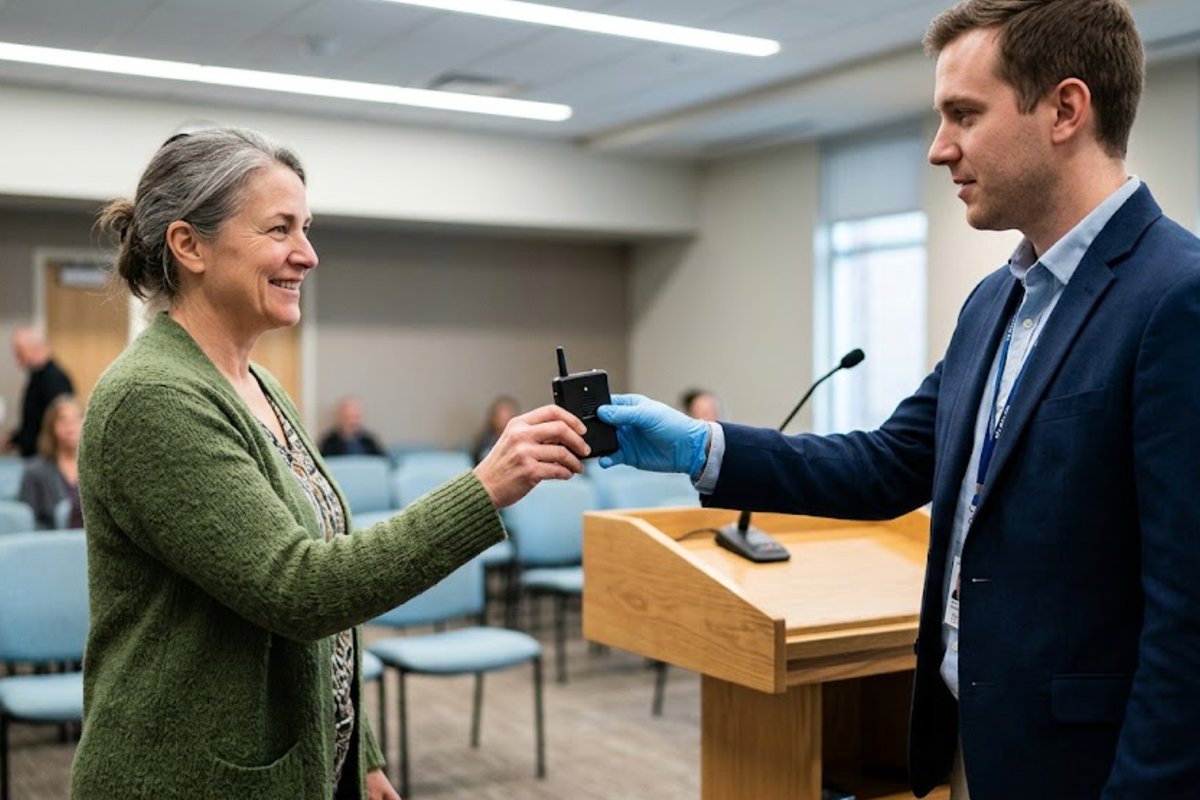
Hygiene is another important factor. Receivers and earphones can be collected and cleaned after each tour, while the guide transmitter remains with one operator. This is a significant improvement over shared handheld units in a sensitive production environment. In many plants I have visited, the tour coordinator assigns one receiver to each visitor at the entrance, collects them at the exit, and runs the units through a quick disinfectant wipe before the next group arrives. That simple workflow becomes impossible with fixed amplifiers or systems that require the visitor to hold a device near their mouth.

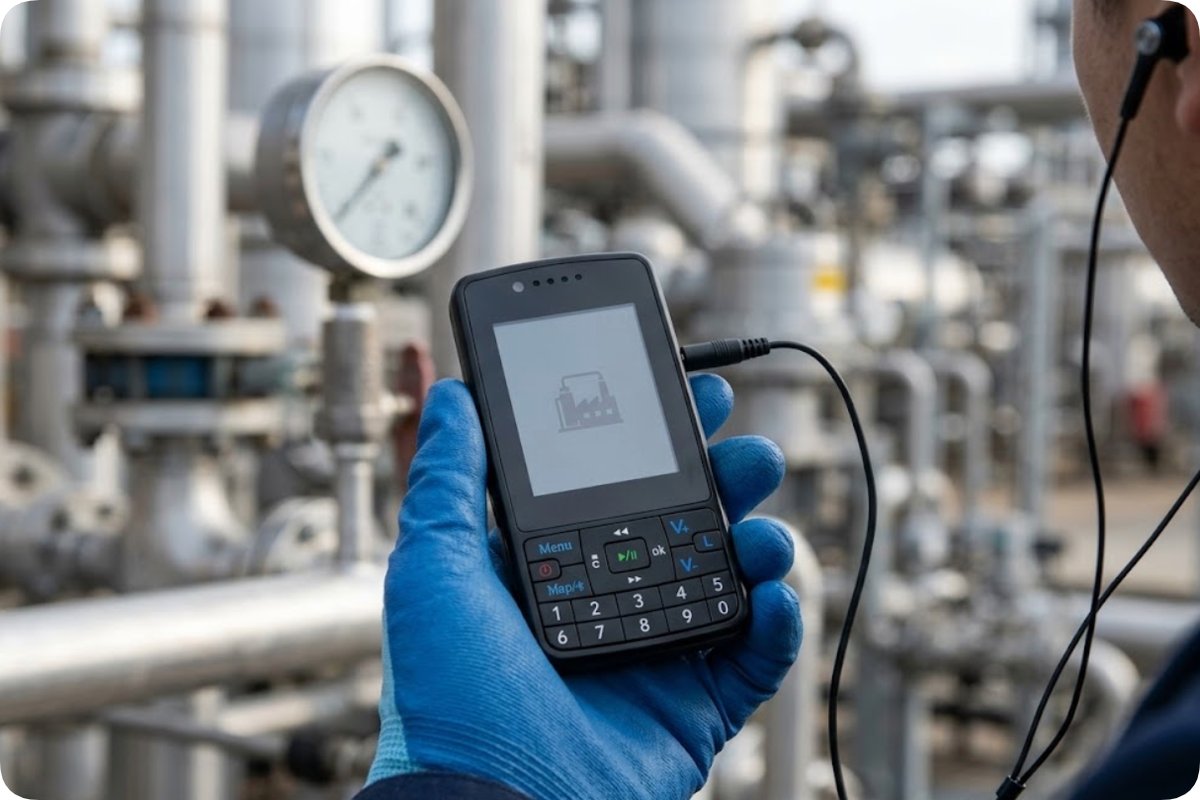
When the route includes an airlock, a cleanroom corridor, or a visual inspection area, the audio must remain consistent even as visitors walk through zones with different acoustic characteristics. A 2.4G wireless link is well suited for this because it travels through doorways and partial partitions without the need for line-of-sight between transmitter and receiver. The guide can be a few steps ahead of the group, which keeps the group compact and prevents visitors from straying toward equipment.

📱 RC2468: A Lightweight Pick for Compact Visitor Groups

For smaller groups and longer walking routes, my first choice is the RC2468. It weighs only 38 grams, which means visitors barely notice that they are carrying it. In a pharmaceutical factory, visitors often wear visitor gowns, safety glasses, hairnets, and shoe covers. The RC2468 clips onto a collar or pocket without causing snags or requiring a heavy neck strap. Its 2.4G signal remains clear over the typical distances used during a production-area tour, and the battery is designed to last through a full working day. I recommend it when your tour groups are small and the route moves between buildings, through covered walkways, or along open corridors.

The RC2468 was designed with minimalism in mind. There are no complicated menus, no screens to distract the visitor, and no dangling cables that could catch on a door handle. The single button and volume dial can be operated even with disposable gloves, which is exactly what a pharma environment requires. Because the receiver uses a standard earphone jack, you can pair it with disposable foam earbuds or over-ear headsets for groups that need extra hygiene.

Wireless Tour Guide System for Pharma Factory Tours: Meeting Compliance Standards with RC2468 and RC2402(图1)

🏭 RC2402: Dependable Sound Coverage for Mid-Size Teams

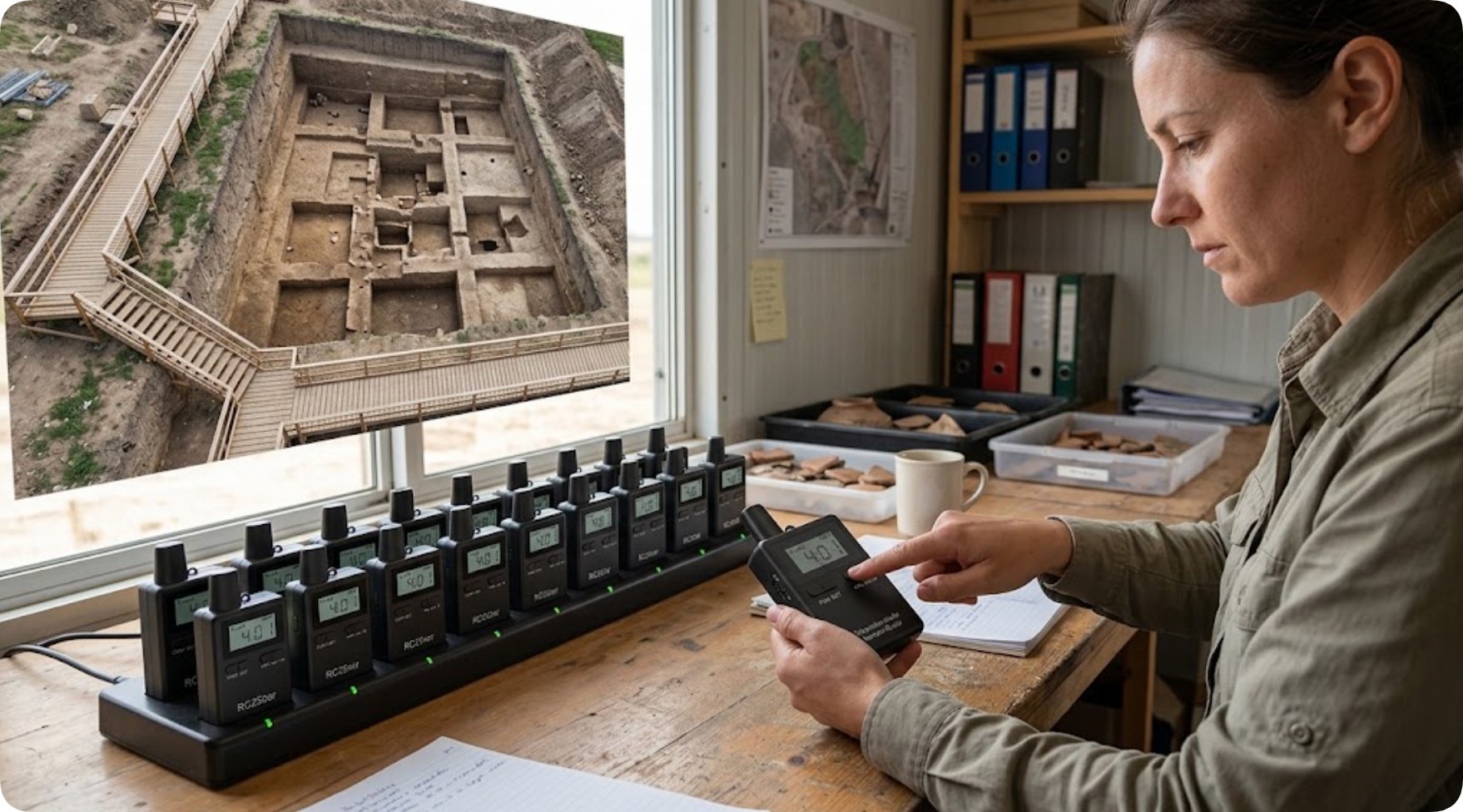
When the group size grows to 15 or 20 visitors, the RC2402 is the more natural fit. Each receiver weighs 60 grams, still light enough for a comfortable visit, but the slightly larger body allows for easier control, better grip, and a larger battery. In a pharma factory environment, the RC2402 handles mixed indoor and outdoor routes well. It keeps voice quality stable even when a tour passes through a machine hall, a warehouse, or the space between two production blocks. With up to 20 hours of battery life, tour operators can run multiple shifts without stopping to charge the units between groups.

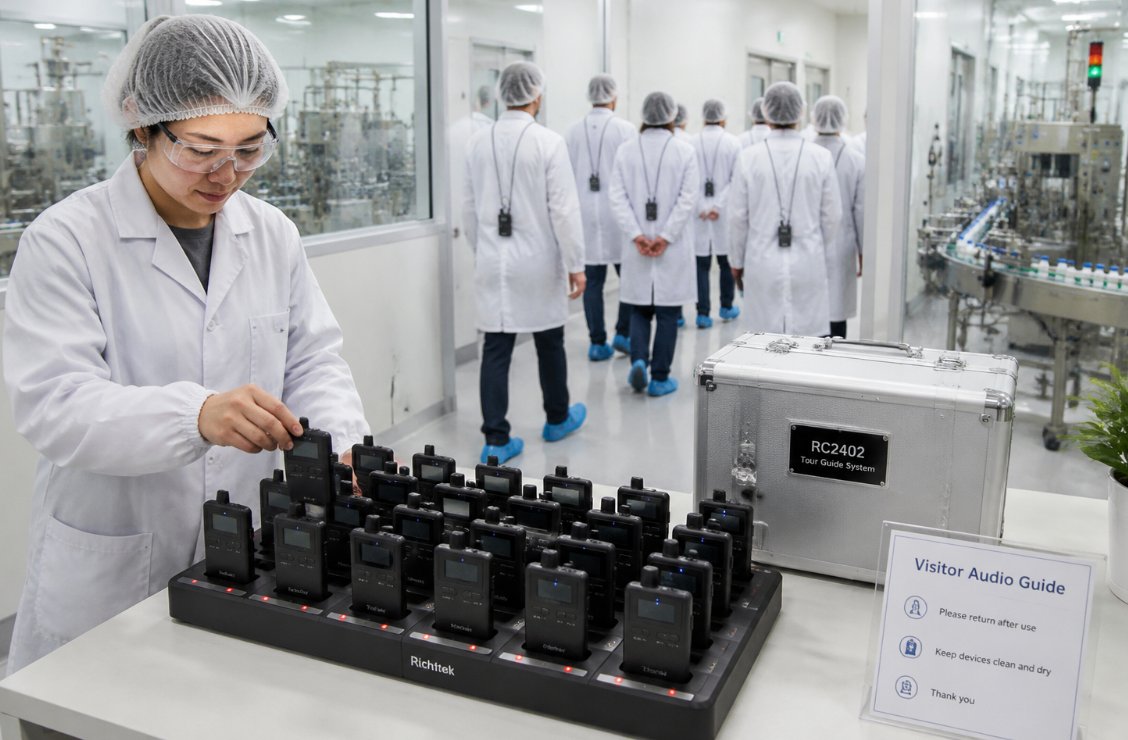
The RC2402’s housing has a higher resistance to accidental drops, which matters when visitors are walking through doorways or climbing staircases between production levels. I have seen tour staff collect twenty receivers at the end of a visit and quickly stack them on a charging tray, because the shape is slightly flatter than the RC2468. That operational convenience is often overlooked until you have to turn around a group every forty minutes.

Because the RC2468 series is built for fast deployment and simple battery management, it also pairs well with the RC2402 in a mixed-tour operation. The two models share the same operating logic, so staff can rotate receivers and transmitters between groups with minimal training.
Wireless Tour Guide System for Pharma Factory Tours: Meeting Compliance Standards with RC2468 and RC2402(图2)

⚖️ RC2468 vs RC2402: Side-by-Side Feature Comparison

Both models are built for clear 2.4G transmission, but they serve different tour formats. Here is a short comparison.

ModelWeightBattery LifeProtectionBest Use
RC246838 gUp to 24 hoursIP54Small-group factory walks, outdoor routes, gowning and cleanroom entries
RC240260 gUp to 20 hoursIP53Medium-group pharma tours, mixed indoor and outdoor routes

If you need to compare these units with other Richitek transmitters and receivers, our tour guide system comparison gives you the full picture. The comparison tool lets you check frequency range, operating temperature, and sensitivity figures side by side. I have used it many times when a client wants to see exactly what changes between the two receiver models.

🎯 How to Pick the Proper Unit for Your Visitor Group

The first question is group size. If your pharma tour is limited to ten visitors at a time, the RC2468 keeps the setup discreet and reduces the amount of equipment that has to be stored, charged, and cleaned. If you regularly receive groups of 15 to 20 visitors, the RC2402 offers a more durable and manageable design for those larger batches.

The second question is route. Tours that start in a visitor center and then enter a production building often require visitors to wait in airlocks and follow separation lines. In those situations, the RC2468’s lower weight is a clear advantage because visitors are already wearing protective clothing and need to move freely. Tours that include a longer walking section through open courtyards or between buildings are better served by the RC2402’s extended battery and robust receiver housing.

The third question is operational repeatability. The RC2402 is easier for a tour coordinator to manage when the same unit will be used by multiple groups during the day. The RC2468 is more discreet and easier to pair with a clean, minimal visitor setup. I have also seen teams use both models together: RC2468 for the guide and smaller VIP groups, RC2402 for the main visitor batches.

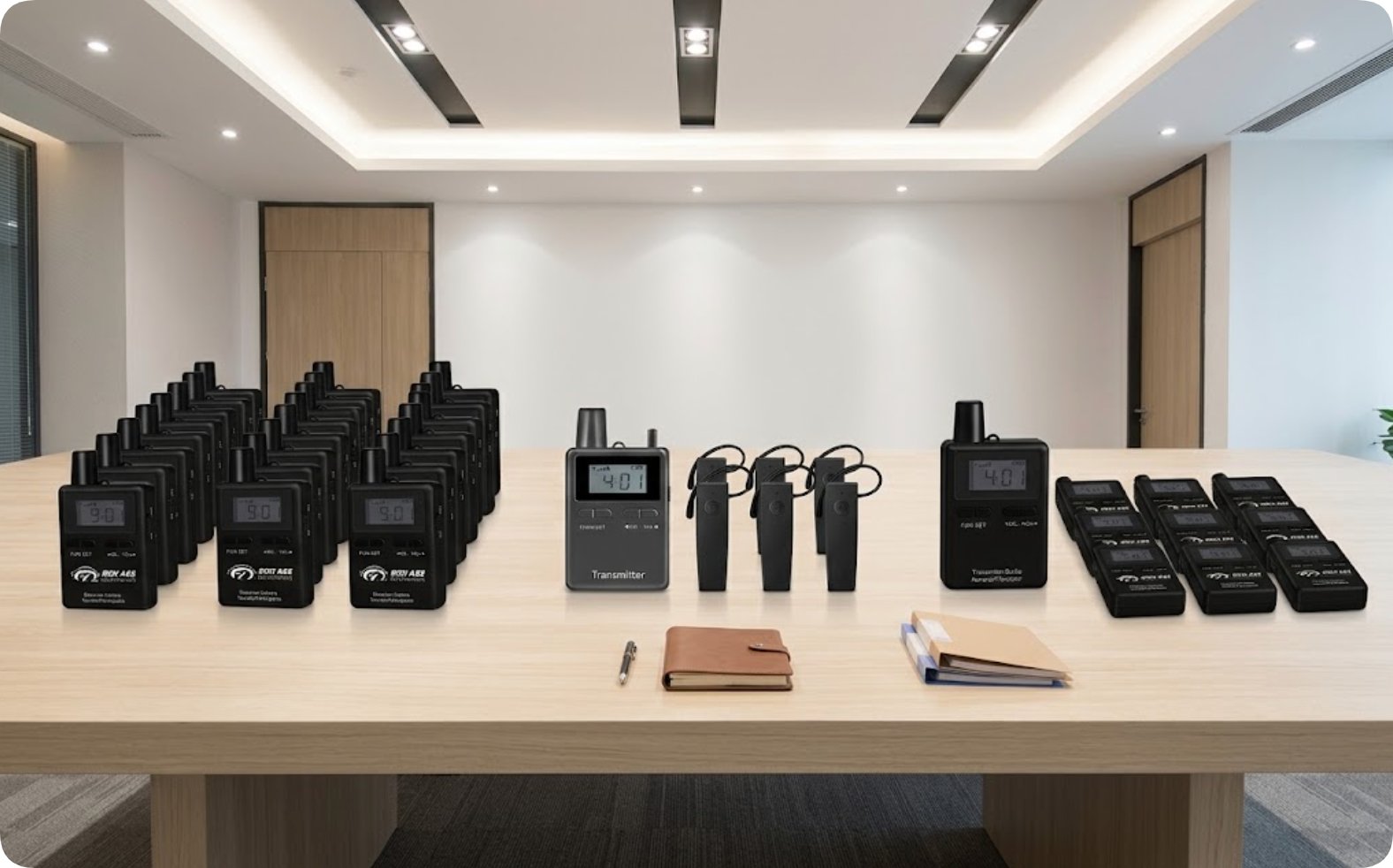
There is also a practical question about how the system is stored. Pharma facilities usually keep tour equipment in a dedicated cabinet near the reception area. The RC2468’s compact shape allows more units in the same charging drawer. The RC2402, on the other hand, can be stored with its earphone already attached, which speeds up distribution when a group arrives late. Neither approach is wrong; it depends on how fast you need to move visitors through the gowning procedure.

For an example of how a wireless audio system is deployed in an industrial environment, read our factory tour guide system case study and see the layout choices that make a factory tour safer and more informative. That case shows a typical setup where the guide wears the transmitter around the waist and visitors receive a receiver at the entry point. It also includes photos of the charging station and the storage procedure, which helps your own team visualize the workflow before you invest.

⚙️ Start With a Compliance-Ready Tour Setup

A pharma factory tour should feel orderly, quiet, and informative. The RC2468 and RC2402 both support that experience. If you are still deciding which model works best for your facility, talk to our team and we can advise you on group size, route, and hygiene requirements. You can also explore our solutions to see how Richitek systems are applied across different guided tour environments.

Contact us today to request a demo kit and test the RC2468 and RC2402 on your own factory floor. Once you hold the receiver in your hand and walk past a running packaging line, the difference is obvious. You will hear the guide clearly without straining, and your visitors will focus on the process instead of on the noise around them. That is the experience that keeps tour feedback scores high and compliance audits calm.

2026年08月17日 15:08
click: 353

Wireless Tour Guide System for Pharma Factory Tours: Meeting Compliance Standards with RC2468 and RC2402

time: 2026年08月17日 click:353

I have walked through enough pharma production lines to know that a visitor tour can turn into a compliance headache before anyone notices. Operators stay focused, visitors get curious, and every movement needs to be controlled. The moment a guide has to raise their voice over the hum of filling machines, the tour stops being a controlled process. That is why I treat a Wireless Tour Guide System as a compliance tool, not a convenience. It keeps the guide’s voice directly in each visitor’s ear while the whole group stays behind barriers, on walkways, or in gowning areas. Everyone still hears every instruction clearly, without crowding, without shared microphones, and without any need to lift a face shield or adjust a hairnet.

When the compliance standard is strict, a dedicated pharma factory tour solution should cover audio, hygiene, and visitor flow at the same time. A hand-held microphone has to be passed from person to person, while a fixed voice amplifier only works if the guide stays in front of the group. A wireless system with a separate receiver for each visitor avoids both problems. The guide speaks at a normal volume, the receivers reproduce every word through a lightweight earphone, and the group keeps moving along the approved route.

🏭 What Compliance Means on a Pharma Factory Floor

Pharmaceutical plants are governed by GMP principles, even during visitor tours. Entry points are controlled, operator schedules must not be disrupted, and equipment must not be contaminated. Sound is also part of that environment. A loud tour group can distract workers who need to follow strict procedures. The right wireless tour guide system lets the guide speak in a normal tone while each visitor hears the message through a lightweight earphone. There is no shouting, no crowding around a single point, and no shared microphone.

Hygiene is another important factor. Receivers and earphones can be collected and cleaned after each tour, while the guide transmitter remains with one operator. This is a significant improvement over shared handheld units in a sensitive production environment. In many plants I have visited, the tour coordinator assigns one receiver to each visitor at the entrance, collects them at the exit, and runs the units through a quick disinfectant wipe before the next group arrives. That simple workflow becomes impossible with fixed amplifiers or systems that require the visitor to hold a device near their mouth.

When the route includes an airlock, a cleanroom corridor, or a visual inspection area, the audio must remain consistent even as visitors walk through zones with different acoustic characteristics. A 2.4G wireless link is well suited for this because it travels through doorways and partial partitions without the need for line-of-sight between transmitter and receiver. The guide can be a few steps ahead of the group, which keeps the group compact and prevents visitors from straying toward equipment.

📱 RC2468: A Lightweight Pick for Compact Visitor Groups

For smaller groups and longer walking routes, my first choice is the RC2468. It weighs only 38 grams, which means visitors barely notice that they are carrying it. In a pharmaceutical factory, visitors often wear visitor gowns, safety glasses, hairnets, and shoe covers. The RC2468 clips onto a collar or pocket without causing snags or requiring a heavy neck strap. Its 2.4G signal remains clear over the typical distances used during a production-area tour, and the battery is designed to last through a full working day. I recommend it when your tour groups are small and the route moves between buildings, through covered walkways, or along open corridors.

The RC2468 was designed with minimalism in mind. There are no complicated menus, no screens to distract the visitor, and no dangling cables that could catch on a door handle. The single button and volume dial can be operated even with disposable gloves, which is exactly what a pharma environment requires. Because the receiver uses a standard earphone jack, you can pair it with disposable foam earbuds or over-ear headsets for groups that need extra hygiene.

Wireless Tour Guide System for Pharma Factory Tours: Meeting Compliance Standards with RC2468 and RC2402(图1)

🏭 RC2402: Dependable Sound Coverage for Mid-Size Teams

When the group size grows to 15 or 20 visitors, the RC2402 is the more natural fit. Each receiver weighs 60 grams, still light enough for a comfortable visit, but the slightly larger body allows for easier control, better grip, and a larger battery. In a pharma factory environment, the RC2402 handles mixed indoor and outdoor routes well. It keeps voice quality stable even when a tour passes through a machine hall, a warehouse, or the space between two production blocks. With up to 20 hours of battery life, tour operators can run multiple shifts without stopping to charge the units between groups.

The RC2402’s housing has a higher resistance to accidental drops, which matters when visitors are walking through doorways or climbing staircases between production levels. I have seen tour staff collect twenty receivers at the end of a visit and quickly stack them on a charging tray, because the shape is slightly flatter than the RC2468. That operational convenience is often overlooked until you have to turn around a group every forty minutes.

Because the RC2468 series is built for fast deployment and simple battery management, it also pairs well with the RC2402 in a mixed-tour operation. The two models share the same operating logic, so staff can rotate receivers and transmitters between groups with minimal training.

Wireless Tour Guide System for Pharma Factory Tours: Meeting Compliance Standards with RC2468 and RC2402(图2)

⚖️ RC2468 vs RC2402: Side-by-Side Feature Comparison

Both models are built for clear 2.4G transmission, but they serve different tour formats. Here is a short comparison.

ModelWeightBattery LifeProtectionBest Use
RC246838 gUp to 24 hoursIP54Small-group factory walks, outdoor routes, gowning and cleanroom entries
RC240260 gUp to 20 hoursIP53Medium-group pharma tours, mixed indoor and outdoor routes

If you need to compare these units with other Richitek transmitters and receivers, our tour guide system comparison gives you the full picture. The comparison tool lets you check frequency range, operating temperature, and sensitivity figures side by side. I have used it many times when a client wants to see exactly what changes between the two receiver models.

🎯 How to Pick the Proper Unit for Your Visitor Group

The first question is group size. If your pharma tour is limited to ten visitors at a time, the RC2468 keeps the setup discreet and reduces the amount of equipment that has to be stored, charged, and cleaned. If you regularly receive groups of 15 to 20 visitors, the RC2402 offers a more durable and manageable design for those larger batches.

The second question is route. Tours that start in a visitor center and then enter a production building often require visitors to wait in airlocks and follow separation lines. In those situations, the RC2468’s lower weight is a clear advantage because visitors are already wearing protective clothing and need to move freely. Tours that include a longer walking section through open courtyards or between buildings are better served by the RC2402’s extended battery and robust receiver housing.

The third question is operational repeatability. The RC2402 is easier for a tour coordinator to manage when the same unit will be used by multiple groups during the day. The RC2468 is more discreet and easier to pair with a clean, minimal visitor setup. I have also seen teams use both models together: RC2468 for the guide and smaller VIP groups, RC2402 for the main visitor batches.

There is also a practical question about how the system is stored. Pharma facilities usually keep tour equipment in a dedicated cabinet near the reception area. The RC2468’s compact shape allows more units in the same charging drawer. The RC2402, on the other hand, can be stored with its earphone already attached, which speeds up distribution when a group arrives late. Neither approach is wrong; it depends on how fast you need to move visitors through the gowning procedure.

For an example of how a wireless audio system is deployed in an industrial environment, read our factory tour guide system case study and see the layout choices that make a factory tour safer and more informative. That case shows a typical setup where the guide wears the transmitter around the waist and visitors receive a receiver at the entry point. It also includes photos of the charging station and the storage procedure, which helps your own team visualize the workflow before you invest.

⚙️ Start With a Compliance-Ready Tour Setup

A pharma factory tour should feel orderly, quiet, and informative. The RC2468 and RC2402 both support that experience. If you are still deciding which model works best for your facility, talk to our team and we can advise you on group size, route, and hygiene requirements. You can also explore our solutions to see how Richitek systems are applied across different guided tour environments.

Contact us today to request a demo kit and test the RC2468 and RC2402 on your own factory floor. Once you hold the receiver in your hand and walk past a running packaging line, the difference is obvious. You will hear the guide clearly without straining, and your visitors will focus on the process instead of on the noise around them. That is the experience that keeps tour feedback scores high and compliance audits calm.
×

Contact us

email:
name:
subject:
content: