
.webp)
A simultaneous interpretation setup fails in predictable ways, and almost none of them are about audio quality. The interpreter cannot see the speaker. The booth has no power at the desk. Two channels overlap because nobody wrote down the plan. Half the receivers are still in the box when doors open.
Every one of those failures is decided before the event, during installation. This guide walks through the physical decisions in the order they matter, for a two-transmitter setup built around the multilingual conference solutions approach: one transmitter covering the main hall, one covering the breakout and overflow spaces.
🎪 🏗️ Start with the Booth, Not the Devices
The booth is the only part of a simultaneous interpretation installation that cannot be fixed on the day. Once it is built in the wrong place, the interpreters work blind for the entire event, and no amount of equipment compensates.
Four conditions are non-negotiable:
Line of sight to the stage and the projection. Interpreters translate body language and slides as much as words. A booth behind a pillar or facing away from the screen forces them to guess.
Desk-level power and a clear cable path. Two interpreters share a desk and work in twenty to thirty minute rotations. Power strips and cabling belong under the desk, not trailing across the floor where the next person to walk past will find them.
Ventilation. A sealed booth with two people and lighting gets uncomfortable within the hour, and uncomfortable interpreters make errors. This is the most commonly skipped requirement and the most complained about.
A quiet position. Not inside the room's main speaker coverage, and not next to a door or a coffee station.
Get these four right and the electronics become straightforward.
🎧 The Listening Loop Comes First
Before any transmitter is mounted, confirm what each interpreter needs to hear. In most conferences that is two signals:
The floor channel - the original speaker, live.
A relay channel - when an interpreter works from another interpreter's output rather than from the source language. This is standard when no interpreter for a minority language is available on site, and it must be wired deliberately, not discovered at minute five.
The practical test is simple: sit in the booth, put on the headset, and listen to each channel in turn. If a channel is silent or noisy at the booth, everything downstream inherits the problem.
📡 Placing the Two Transmitters
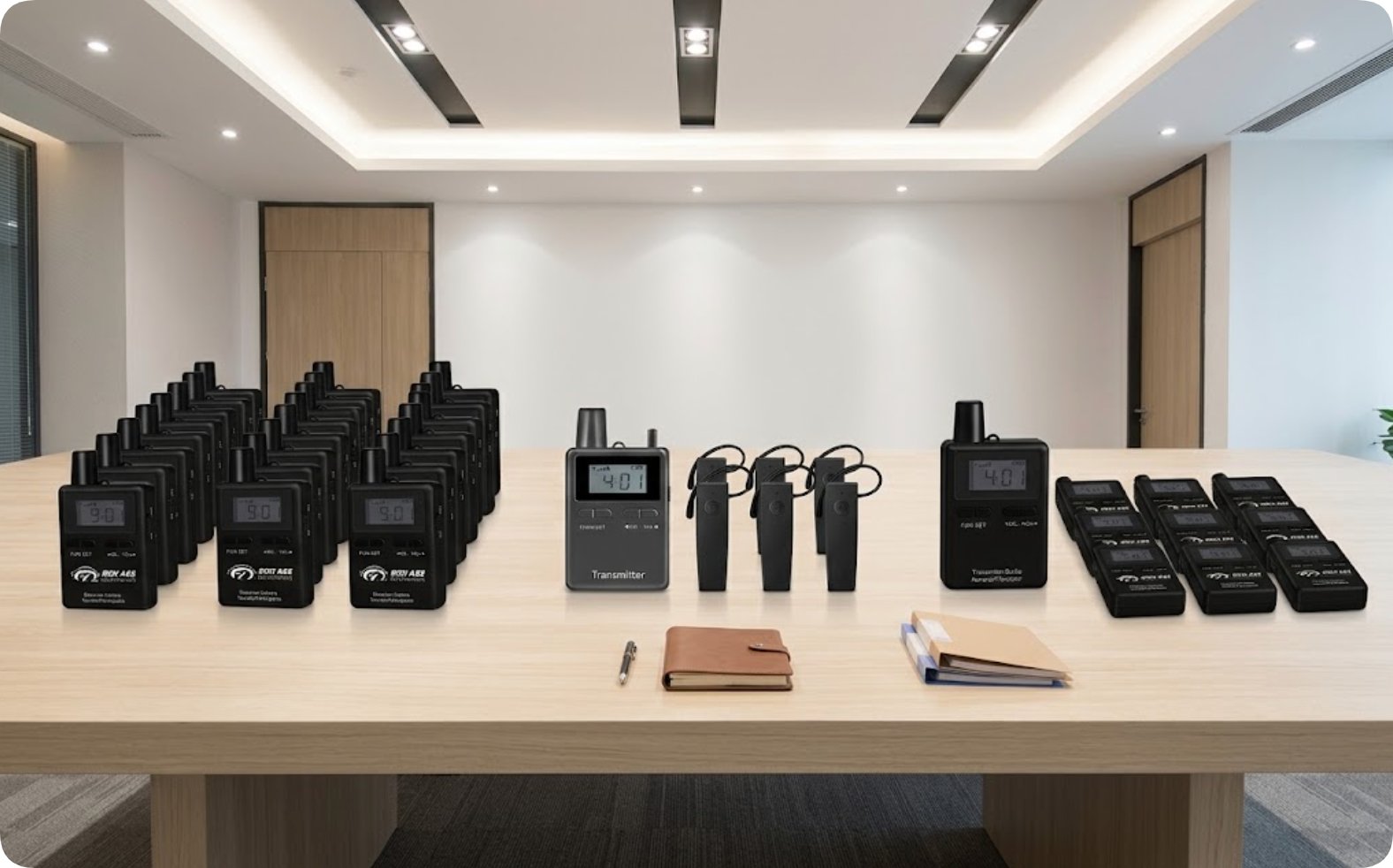
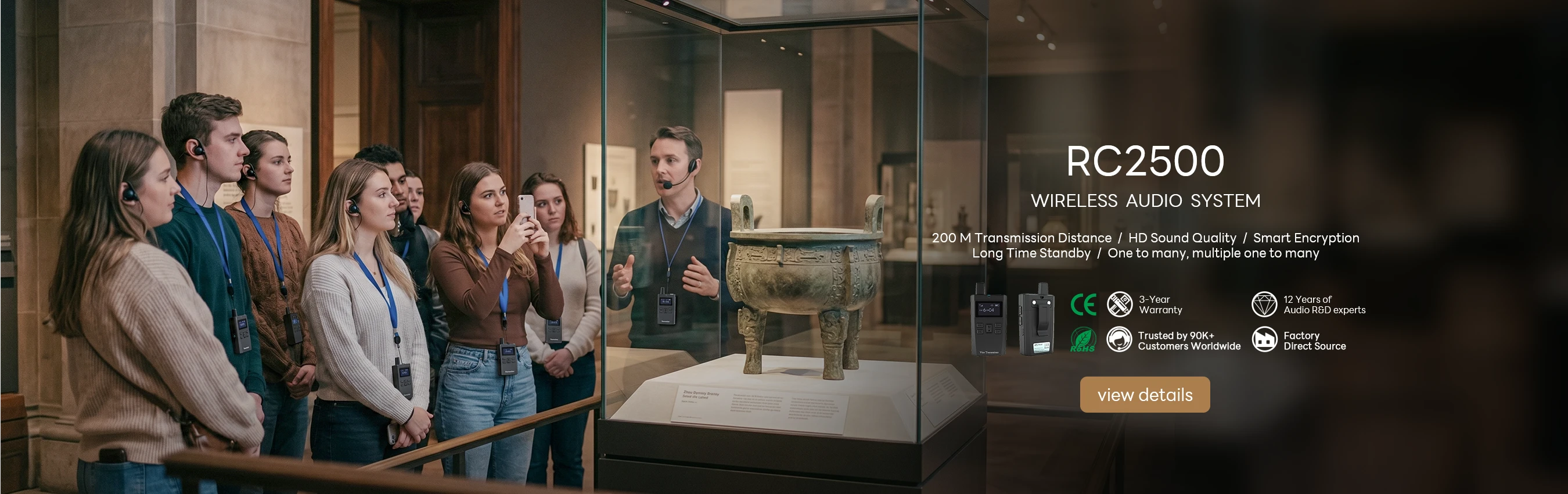
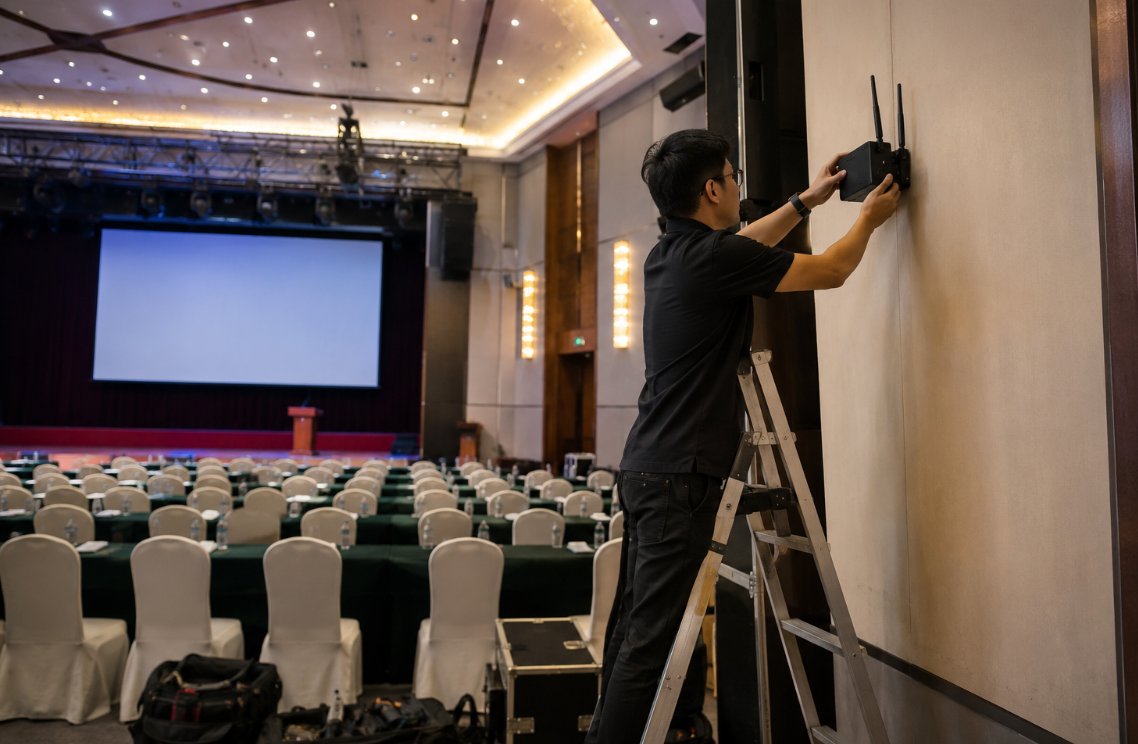
In a two-transmitter design, the split is usually by coverage rather than by redundancy. The RC2500 takes the main hall, where the constraint is distance: long rooms, high ceilings, and an audience spread across a large footprint. The RC2402 takes the breakout and overflow rooms, where the constraint is channel capacity: several language groups running side by side in adjacent spaces.
Placement rules that hold for both:
Height matters more than power. A transmitter at 1.5 to 2 metres, clear of the crowd, outperforms one sitting on a table at knee height.
Keep it out of metal. Inside a rack cabinet, behind a steel door, or against a structural column, the signal drops sharply. Outside the cabinet or on top of it is usually fine.
Avoid the obvious interferers. Large LED walls, microwave ovens, and dense Wi-Fi access point clusters all sit in the same part of the spectrum. Walk the room and note where they are before choosing a position.
Document the position. A photo and a note in the run sheet means the next technician does not start from zero.
🔢 Channel Assignment That Survives the Break
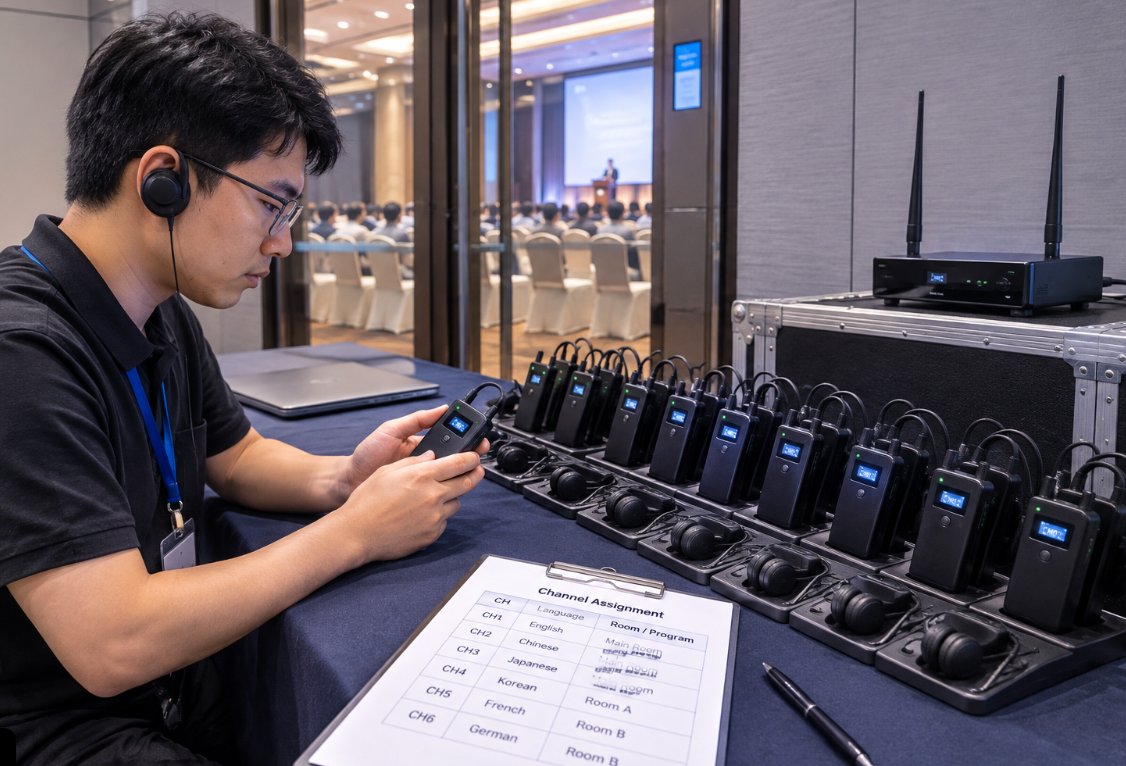
Most channel problems are bookkeeping problems. Write the plan down before the first transmitter is switched on, and keep the same plan for the whole event:
Assign one channel to the floor language, and one to each target language.
Space the channels apart rather than using adjacent ones - adjacent channels bleed into each other at close range.
If two halls run in parallel, leave a deliberate gap between the two sets rather than numbering them consecutively.
Decide now what happens at the coffee break: transmitters stay on, receivers stay with the delegates, and nothing gets renumbered mid-event.
Print the channel plan and tape it inside the booth. Interpreters will ask, and they will ask more than once.
🚶 The Distribution and Collection Flow
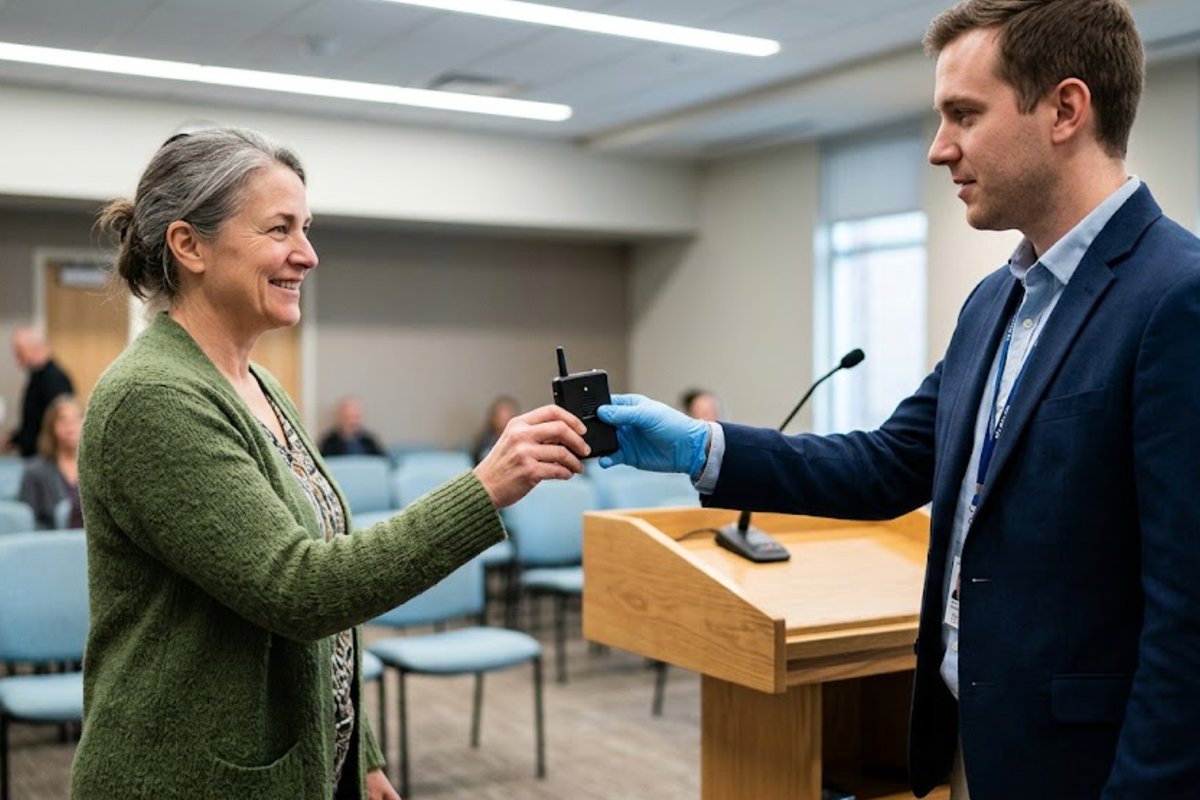
The receiver fleet is where events quietly lose time. A room of four hundred delegates collecting headsets from a single table produces a queue, and a queue at registration produces delegates who simply skip the device.
What works:
More than one distribution point for audiences above roughly two hundred, positioned at the actual entry doors rather than in a corner.
A one-for-one exchange - a badge, a business card, or a deposit slip - because an anonymous handout has no return path.
A counted spare pool of about ten percent, held back deliberately rather than handed out with the rest.
A collection point at the exit, staffed, with a running count. Reconciliation at the end of the day is much faster when the count starts during the event.
⏱️ Ninety Minutes Before Doors
Everything above should be finished well before this point. What remains is verification, and it has a fixed order because a fault found early is cheap and a fault found late is not:
Walk the furthest seat in the room with a receiver and listen to every channel.
Walk the breakout rooms the same way.
Confirm the relay channel at the booth, with a second person listening.
Check that the printed channel plan matches what the transmitters are actually doing.
Count the spare receivers and confirm they are charged.
Confirm who to call, and that the number is on the run sheet.
| When | Item | What to verify | Owner |
|---|---|---|---|
| Install day | Booth position | Sight line to stage and screen, desk power, ventilation | Venue + technician |
| Install day | Transmitter placement | Height 1.5-2 m, out of metal, away from LED walls and APs | Technician |
| Install day | Listening loop | Floor channel audible at booth, relay channel wired and tested | Technician + interpreter |
| T-90 min | Channel plan | Printed plan matches live configuration, gaps between parallel halls | Technician |
| T-90 min | Coverage walk | Every channel audible at the furthest seat and in breakouts | Technician |
| T-60 min | Receiver fleet | Charged, counted, spare pool of 10% held back | Registration team |
| T-30 min | Interpreter briefing | Channel plan handed over, rotation schedule agreed, contact number shared | Interpreter + technician |
| End of day | Collection | Count against distribution record, log any shortfall | Registration team |
🔮 Where the Design Pays Off
The point of splitting coverage between two transmitters is that the main hall and the breakout rooms have different problems. One needs reach, the other needs channel capacity. Treating them as the same problem is what produces the familiar result: excellent audio in the front third of the room and complaints from the back.
If a conference programme is on your calendar, our wireless tour guide system range covers both transmitter classes, and the solution library has further deployment notes from conference and training environments. Send us the room layout and the language list before the order goes in - the channel plan is worth agreeing on early, because it is the one decision that is expensive to change on site.