
A leading China factory specializing in Wireless Tour Guide Systems, Church Audio Guides, and Translation Headphones with premium OEM/ODM solutions.

Tel:+86 18922879583

Email:tiger.wang@richitek.com

RC2402 and RC9150: Cathedral Compliance Is a Calendar, Not a Certificate

The compliance conversation at a cathedral usually ends on the day the installation is signed off. An inspector visits, the paperwork is filed, and the matter is assumed closed for several years. What that misses is that a cathedral is not one venue with one use: it is a weekly service, a wedding venue, a concert hall and a pilgrimage destination, sometimes inside the same fortnight, and each use carries different obligations. Equipment that passed inspection on a quiet Tuesday in February has to keep satisfying those obligations at midnight on 24 December with the nave full to its licensed capacity. That gap between one approval and a repeating year is where most cathedral interpretation problems live. Before working through the cycle, start with church wireless audio solutions and map the outline against your own calendar.

💡 Why Approval Day Covers Almost Nothing

A sign-off records a state of affairs on one day: the equipment met the requirements when tested, in the configuration tested, at the occupancy present during the test. None of those three holds still at a working cathedral. The configuration changes when a second language channel is added for a visiting group. Occupancy changes by an order of magnitude between a weekday morning and a feast day. The acoustic environment changes entirely when staging, extra seating and a public address system come into the nave. A certificate answers the question asked on the day, not the question an inspector asks after an incident, which is what the position was at the moment it mattered. Insurers and heritage authorities are pushing administrators towards exactly that shift: from proving a system was compliant once, to showing it was compliant each time it was used. A small distinction on paper, but it changes what gets written down and how often.

Sunday Morning, Week After Week

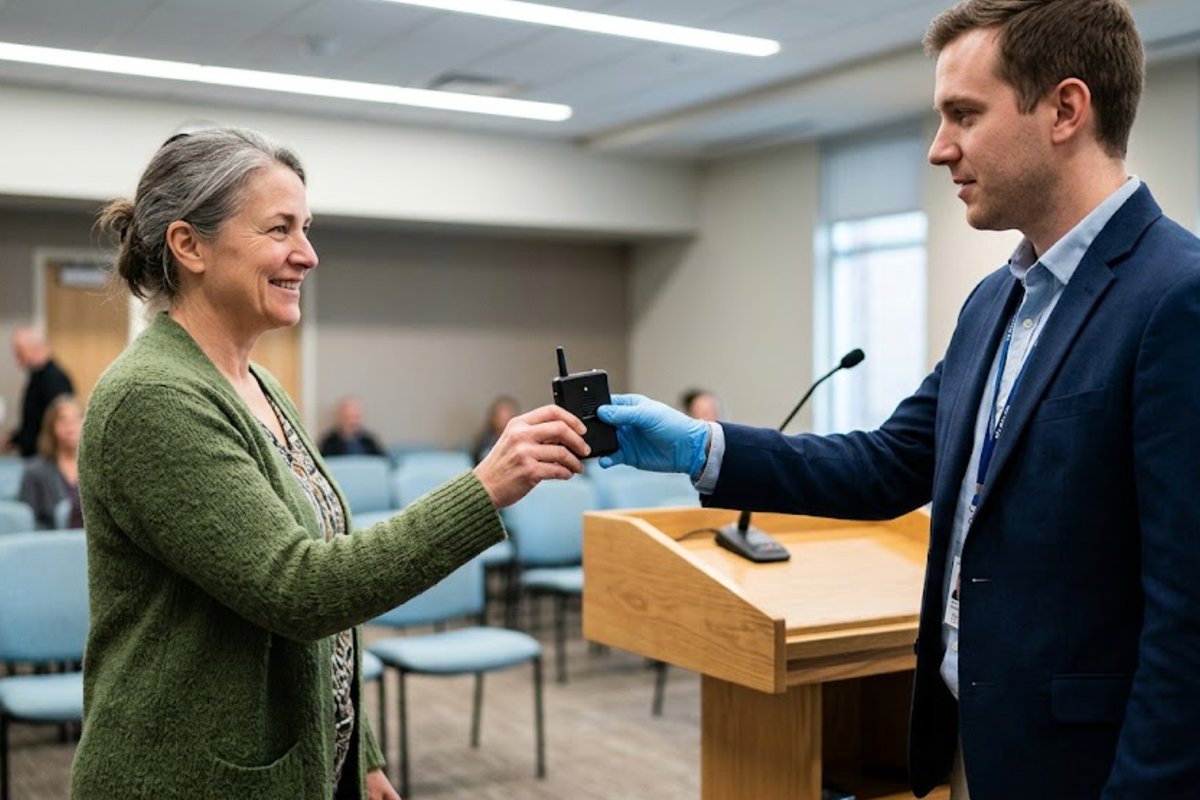
The most demanding use of an interpretation system in a cathedral is not the special event. It is the ordinary Sunday service, repeated fifty-two times a year, with volunteers who change, visitors who have never handled the equipment, and a window of perhaps four minutes between one service and the next. High frequency is a compliance issue twice over. Wear is cumulative in a way annual testing does not capture: a receiver issued and collected weekly accumulates damage far faster than one issued at a dozen conferences, and a cracked housing fails during a service rather than during a test. And issuing is part of the record, because receivers handed out uncounted leave the cathedral unable to show how many people were covered, which is precisely what an inspector asks after an evacuation. The RC2402 Wireless Tour Guide System is specified for this pattern because the shell tolerates daily handling and the charging routine fits a weekly cycle. A unit chosen for a conference is frequently wrong for a routine that repeats every seven days.
RC2402 and RC9150: Cathedral Compliance Is a Calendar, Not a Certificate(图1)

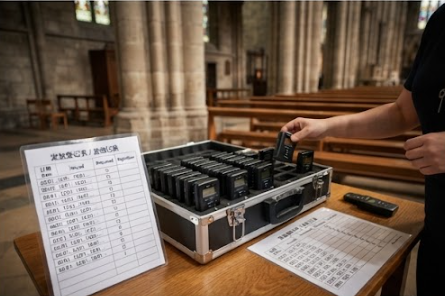
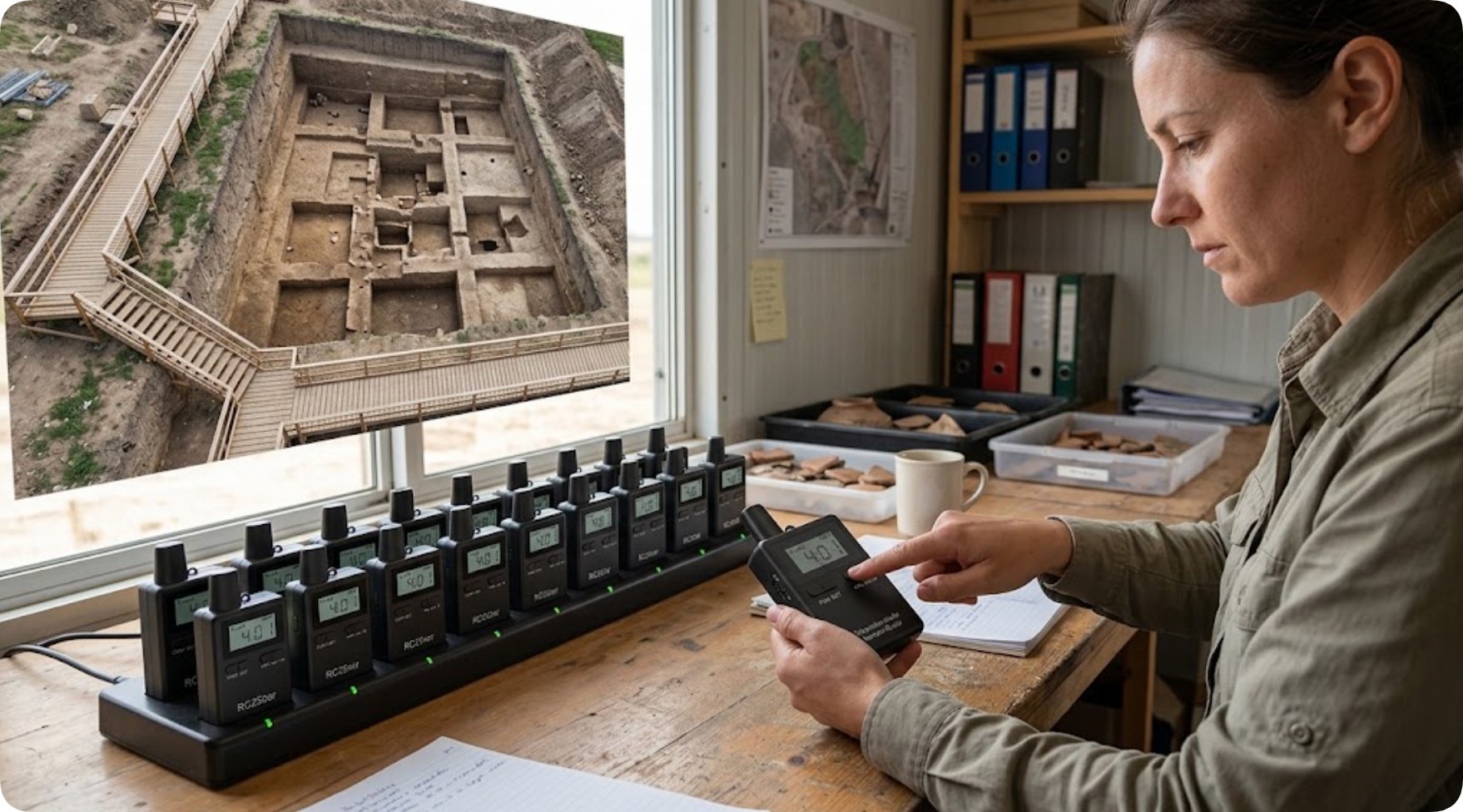
An RC2402 issuing station prepared ahead of a Sunday service, with units counted and logged rather than simply handed across a table.

Weddings, Funerals, No Second Take

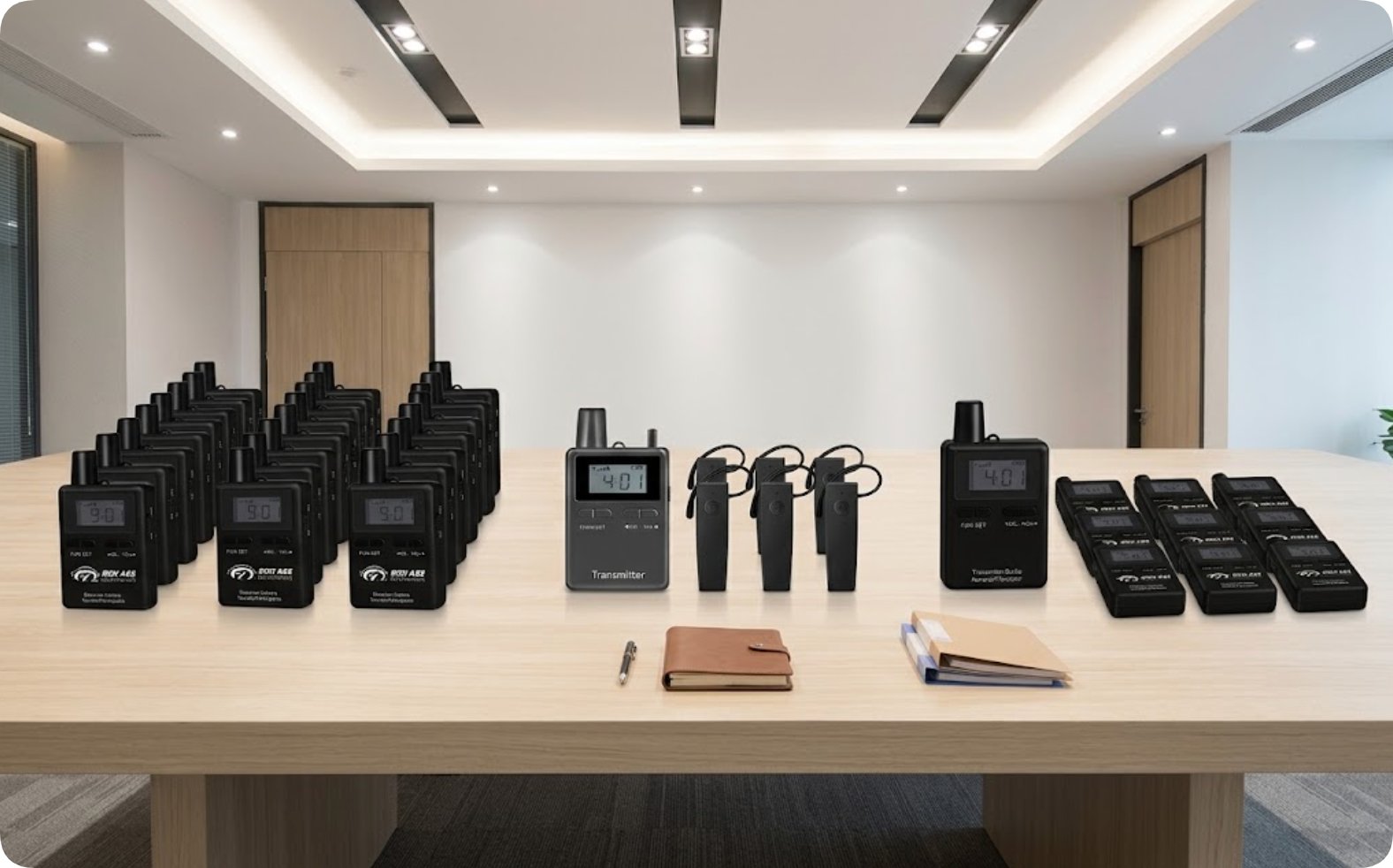
A wedding and a funeral share one property no other cathedral event has: neither can be repeated. If the interpretation fails during a lecture, the lecture can be given again; if it fails during a funeral, the moment is gone, and the complaint is not about audio quality but about whether the institution honoured an obligation it had been paid to meet. That irreversibility shapes the equipment choice. The device has to be unobtrusive, because a receiver conspicuous in a front-row photograph is one guests will decline, and a declined receiver is a person with no interpretation at all. It also has to work on first use, because in most cases there is no rehearsal. The RC9150 Wireless Audio Guide System is chosen for exactly that reason: light enough to wear without drawing attention, and a link stable from the moment it is switched on. The compliance point is narrow but worth recording: for an unrepeatable event, the entry must show the equipment was checked immediately before use, not merely tested sometime that quarter.
RC2402 and RC9150: Cathedral Compliance Is a Calendar, Not a Certificate(图2)

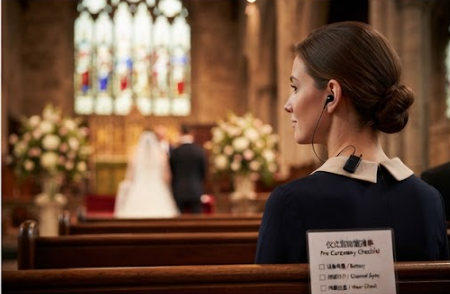
An RC9150 worn discreetly during a ceremony, light enough that guests keep it on instead of setting it aside.

💾 Midnight Mass: The Capacity Question

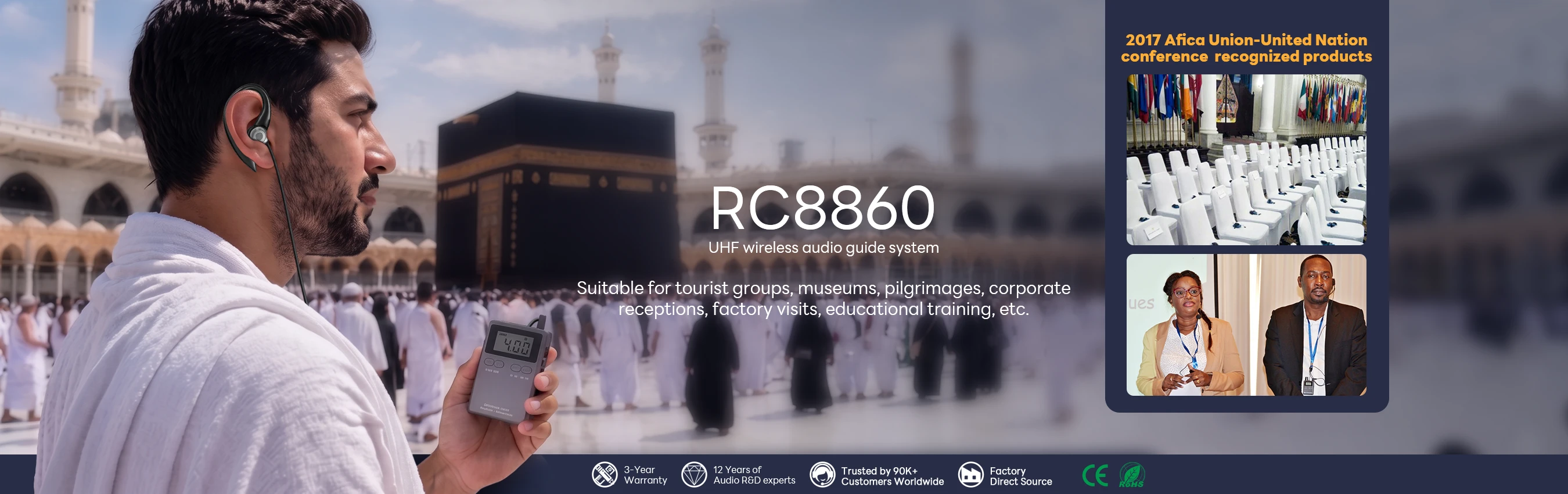
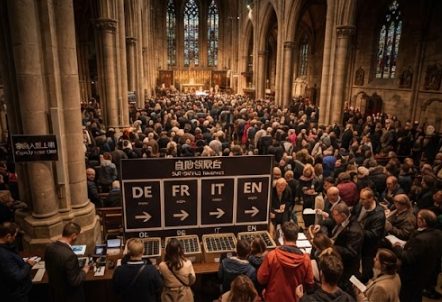
The two services a year that fill a cathedral to capacity break plans built around normal attendance. A nave holding four hundred on an ordinary Sunday may hold fifteen hundred at Midnight Mass, with seating in the aisles, overflow into the transepts and much of the congregation standing. Three assumptions fail at that scale. Single-channel fails, because a congregation of that size includes several language groups. Line-of-sight fails, because a transmitter covering the nave comfortably may not reach a transept full of standing people. And issuing fails, because volunteers cannot issue and explain equipment to fifteen hundred people in the time available, so self-service collection with printed instructions has to be planned in advance. The RC2500 Wireless Tour Guide System is specified where all three pressures arrive together: several language channels running at once, coverage holding into the parts of the building that only fill on feast days, and a channel plan simple enough to print on a card at the door. Capacity is a threshold rather than a preference, and the system has to be specified against the largest service of the year instead of the average one.
RC2402 and RC9150: Cathedral Compliance Is a Calendar, Not a Certificate(图3)

An RC2500 carrying multiple language channels during a feast-day service that fills the nave and both transepts.

Pilgrimage Season Brings Languages Nobody Planned For

Pilgrimage season inverts the language question. For most of the year a cathedral's needs are predictable: the languages of its own diocese and perhaps two others. During a season the congregation can include a dozen groups, arriving on coach schedules the cathedral does not control, in proportions nobody can forecast. The exposure is not technical: a cathedral that advertises interpretation in a set of languages and cannot deliver them has made a representation it cannot honour, which is consumer-facing rather than engineering. The answer is planning more than hardware: a written language plan stating which languages run on which days, a channel assignment that does not shift between services, and a fallback for languages requested but not covered. Where hardware matters is channel capacity, and how fast a channel can be added without re-tuning the rest. A system sized for four languages that cannot stretch to seven is quietly over-promising by August.

When the Nave Hosts Concerts Instead

Concert hire catches administrators out most often, because it looks like the same room doing the same thing and is not. When a nave is hired for a performance, the occupancy profile changes, the acoustic treatment changes, temporary cable routes appear, staging covers floor that was circulation, and in many jurisdictions the evacuation classification changes with the layout. An interpretation system approved for a seated congregation ends up used in a space that no longer matches. None of this argues against concert hire, which for many cathedrals is essential income. It argues for treating each hire as a separate configuration needing a short note: what changed, what the capacity was, which channels ran, and who signed that the equipment was re-checked against the altered layout. One line in an events log is usually sufficient. Nobody writes it unless the process asks, and the process rarely asks because the hire is managed by a different team from the one handling the audio.

What Every Gathering Leaves in the File

The organising principle is to stop thinking about one compliance file and start thinking about a short entry per gathering. Across cathedrals that handle this well, the pattern is five fields: date and type, attendance, channels run, any deviation from the standard configuration, and who checked the equipment beforehand. Five fields, recorded within a day, answer essentially every question an inspector or insurer asks afterwards. What makes it work is that the entry attaches to events the cathedral already schedules rather than being a separate exercise to remember.

GatheringThe obligation that changesWhat to record
Ordinary Sunday serviceCumulative wearUnits issued and returned; any withdrawn
Wedding or funeralUnrepeatablePre-event check signed and timed
Feast day at capacityLicensed occupancyAttendance, channels run, overflow covered
Pilgrimage groupAdvertised languagesLanguages offered versus provided
Concert hireLayout and evacuation classChange noted; system re-checked
Diocesan or civic eventVisiting officials, pressExtra channels, temporary equipment

Building One Record Chain Inspectors Follow

The value of a record lies not in any single entry but in the chain. An inspector reviewing interpretation provision is not trying to catch the institution out; they are establishing whether the approved system is still the one in use, and whether anyone would have noticed if it stopped being compliant. Six months of consistent entries answers that immediately. A folder of certificates with nothing in between does not. The same applies when equipment is upgraded, which is where the chain most often breaks: a receiver model is swapped, the log does not record it, and the next inspection proceeds from a document describing hardware no longer in the cupboard. If you are reviewing provision for the coming year, our wireless tour guide system range covers the spread from weekly services to feast-day capacity, and the pattern above is the one recorded in a monastery deployment where the event calendar drove the specification, where the sequence of gatherings rather than the building itself proved the harder constraint.

2026年09月03日 10:54
click: 141

RC2402 and RC9150: Cathedral Compliance Is a Calendar, Not a Certificate

time: 2026年09月03日 click:141

The compliance conversation at a cathedral usually ends on the day the installation is signed off. An inspector visits, the paperwork is filed, and the matter is assumed closed for several years. What that misses is that a cathedral is not one venue with one use: it is a weekly service, a wedding venue, a concert hall and a pilgrimage destination, sometimes inside the same fortnight, and each use carries different obligations. Equipment that passed inspection on a quiet Tuesday in February has to keep satisfying those obligations at midnight on 24 December with the nave full to its licensed capacity. That gap between one approval and a repeating year is where most cathedral interpretation problems live. Before working through the cycle, start with church wireless audio solutions and map the outline against your own calendar.

💡 Why Approval Day Covers Almost Nothing

A sign-off records a state of affairs on one day: the equipment met the requirements when tested, in the configuration tested, at the occupancy present during the test. None of those three holds still at a working cathedral. The configuration changes when a second language channel is added for a visiting group. Occupancy changes by an order of magnitude between a weekday morning and a feast day. The acoustic environment changes entirely when staging, extra seating and a public address system come into the nave. A certificate answers the question asked on the day, not the question an inspector asks after an incident, which is what the position was at the moment it mattered. Insurers and heritage authorities are pushing administrators towards exactly that shift: from proving a system was compliant once, to showing it was compliant each time it was used. A small distinction on paper, but it changes what gets written down and how often.

Sunday Morning, Week After Week

The most demanding use of an interpretation system in a cathedral is not the special event. It is the ordinary Sunday service, repeated fifty-two times a year, with volunteers who change, visitors who have never handled the equipment, and a window of perhaps four minutes between one service and the next. High frequency is a compliance issue twice over. Wear is cumulative in a way annual testing does not capture: a receiver issued and collected weekly accumulates damage far faster than one issued at a dozen conferences, and a cracked housing fails during a service rather than during a test. And issuing is part of the record, because receivers handed out uncounted leave the cathedral unable to show how many people were covered, which is precisely what an inspector asks after an evacuation. The RC2402 Wireless Tour Guide System is specified for this pattern because the shell tolerates daily handling and the charging routine fits a weekly cycle. A unit chosen for a conference is frequently wrong for a routine that repeats every seven days.

RC2402 and RC9150: Cathedral Compliance Is a Calendar, Not a Certificate(图1)

An RC2402 issuing station prepared ahead of a Sunday service, with units counted and logged rather than simply handed across a table.

Weddings, Funerals, No Second Take

A wedding and a funeral share one property no other cathedral event has: neither can be repeated. If the interpretation fails during a lecture, the lecture can be given again; if it fails during a funeral, the moment is gone, and the complaint is not about audio quality but about whether the institution honoured an obligation it had been paid to meet. That irreversibility shapes the equipment choice. The device has to be unobtrusive, because a receiver conspicuous in a front-row photograph is one guests will decline, and a declined receiver is a person with no interpretation at all. It also has to work on first use, because in most cases there is no rehearsal. The RC9150 Wireless Audio Guide System is chosen for exactly that reason: light enough to wear without drawing attention, and a link stable from the moment it is switched on. The compliance point is narrow but worth recording: for an unrepeatable event, the entry must show the equipment was checked immediately before use, not merely tested sometime that quarter.

RC2402 and RC9150: Cathedral Compliance Is a Calendar, Not a Certificate(图2)

An RC9150 worn discreetly during a ceremony, light enough that guests keep it on instead of setting it aside.

💾 Midnight Mass: The Capacity Question

The two services a year that fill a cathedral to capacity break plans built around normal attendance. A nave holding four hundred on an ordinary Sunday may hold fifteen hundred at Midnight Mass, with seating in the aisles, overflow into the transepts and much of the congregation standing. Three assumptions fail at that scale. Single-channel fails, because a congregation of that size includes several language groups. Line-of-sight fails, because a transmitter covering the nave comfortably may not reach a transept full of standing people. And issuing fails, because volunteers cannot issue and explain equipment to fifteen hundred people in the time available, so self-service collection with printed instructions has to be planned in advance. The RC2500 Wireless Tour Guide System is specified where all three pressures arrive together: several language channels running at once, coverage holding into the parts of the building that only fill on feast days, and a channel plan simple enough to print on a card at the door. Capacity is a threshold rather than a preference, and the system has to be specified against the largest service of the year instead of the average one.

RC2402 and RC9150: Cathedral Compliance Is a Calendar, Not a Certificate(图3)

An RC2500 carrying multiple language channels during a feast-day service that fills the nave and both transepts.

Pilgrimage Season Brings Languages Nobody Planned For

Pilgrimage season inverts the language question. For most of the year a cathedral's needs are predictable: the languages of its own diocese and perhaps two others. During a season the congregation can include a dozen groups, arriving on coach schedules the cathedral does not control, in proportions nobody can forecast. The exposure is not technical: a cathedral that advertises interpretation in a set of languages and cannot deliver them has made a representation it cannot honour, which is consumer-facing rather than engineering. The answer is planning more than hardware: a written language plan stating which languages run on which days, a channel assignment that does not shift between services, and a fallback for languages requested but not covered. Where hardware matters is channel capacity, and how fast a channel can be added without re-tuning the rest. A system sized for four languages that cannot stretch to seven is quietly over-promising by August.

When the Nave Hosts Concerts Instead

Concert hire catches administrators out most often, because it looks like the same room doing the same thing and is not. When a nave is hired for a performance, the occupancy profile changes, the acoustic treatment changes, temporary cable routes appear, staging covers floor that was circulation, and in many jurisdictions the evacuation classification changes with the layout. An interpretation system approved for a seated congregation ends up used in a space that no longer matches. None of this argues against concert hire, which for many cathedrals is essential income. It argues for treating each hire as a separate configuration needing a short note: what changed, what the capacity was, which channels ran, and who signed that the equipment was re-checked against the altered layout. One line in an events log is usually sufficient. Nobody writes it unless the process asks, and the process rarely asks because the hire is managed by a different team from the one handling the audio.

What Every Gathering Leaves in the File

The organising principle is to stop thinking about one compliance file and start thinking about a short entry per gathering. Across cathedrals that handle this well, the pattern is five fields: date and type, attendance, channels run, any deviation from the standard configuration, and who checked the equipment beforehand. Five fields, recorded within a day, answer essentially every question an inspector or insurer asks afterwards. What makes it work is that the entry attaches to events the cathedral already schedules rather than being a separate exercise to remember.

GatheringThe obligation that changesWhat to record
Ordinary Sunday serviceCumulative wearUnits issued and returned; any withdrawn
Wedding or funeralUnrepeatablePre-event check signed and timed
Feast day at capacityLicensed occupancyAttendance, channels run, overflow covered
Pilgrimage groupAdvertised languagesLanguages offered versus provided
Concert hireLayout and evacuation classChange noted; system re-checked
Diocesan or civic eventVisiting officials, pressExtra channels, temporary equipment

Building One Record Chain Inspectors Follow

The value of a record lies not in any single entry but in the chain. An inspector reviewing interpretation provision is not trying to catch the institution out; they are establishing whether the approved system is still the one in use, and whether anyone would have noticed if it stopped being compliant. Six months of consistent entries answers that immediately. A folder of certificates with nothing in between does not. The same applies when equipment is upgraded, which is where the chain most often breaks: a receiver model is swapped, the log does not record it, and the next inspection proceeds from a document describing hardware no longer in the cupboard. If you are reviewing provision for the coming year, our wireless tour guide system range covers the spread from weekly services to feast-day capacity, and the pattern above is the one recorded in a monastery deployment where the event calendar drove the specification, where the sequence of gatherings rather than the building itself proved the harder constraint.

×

Contact us

email:
name:
subject:
content: