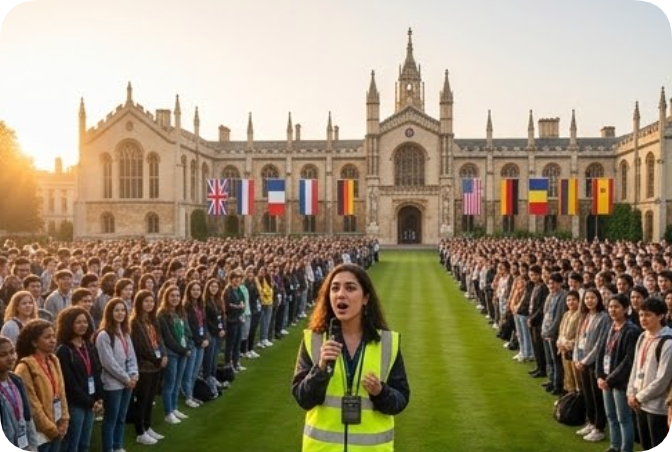

University campus tours used to be a season. A few open days in the autumn, a spring visit weekend, and the rest of the year quiet. That pattern is disappearing. Admissions teams now run campus experiences across the whole calendar, including summer outreach, department open evenings, donor walks, and international family visits that arrive outside any published schedule. When the tour becomes a year-round operation, the buying decision changes: the question stops being how many units we need for open day and becomes which units survive twelve months of weekly use. Two Richitek units sit at the centre of that shift for different reasons: the RC2468 for the guides who walk every day, and the RC9150 for the long days that never let a battery sit still. The same campus tour planning applies whether the institution runs a single campus or several sites.
From Open Days to a Rolling Programme
The shift is visible in how admissions offices now schedule. Instead of concentrating visits into two weekends, they spread them across the year to keep enquiry-to-application conversion steady, and they add audience-specific events that did not exist before: a parents-only evening, a scholarship candidate day, a faculty recruitment walk. Each event is smaller than the old open day but there are many more of them, which means the guide team works far more days per year on far less notice. Equipment that was adequate for two big weekends starts to fail under weekly use, not because it breaks but because it was never specified for the duty cycle. Year-round operation is a specification change, not just a scheduling one.
📱 Why Lightweight Became the Deciding Factor
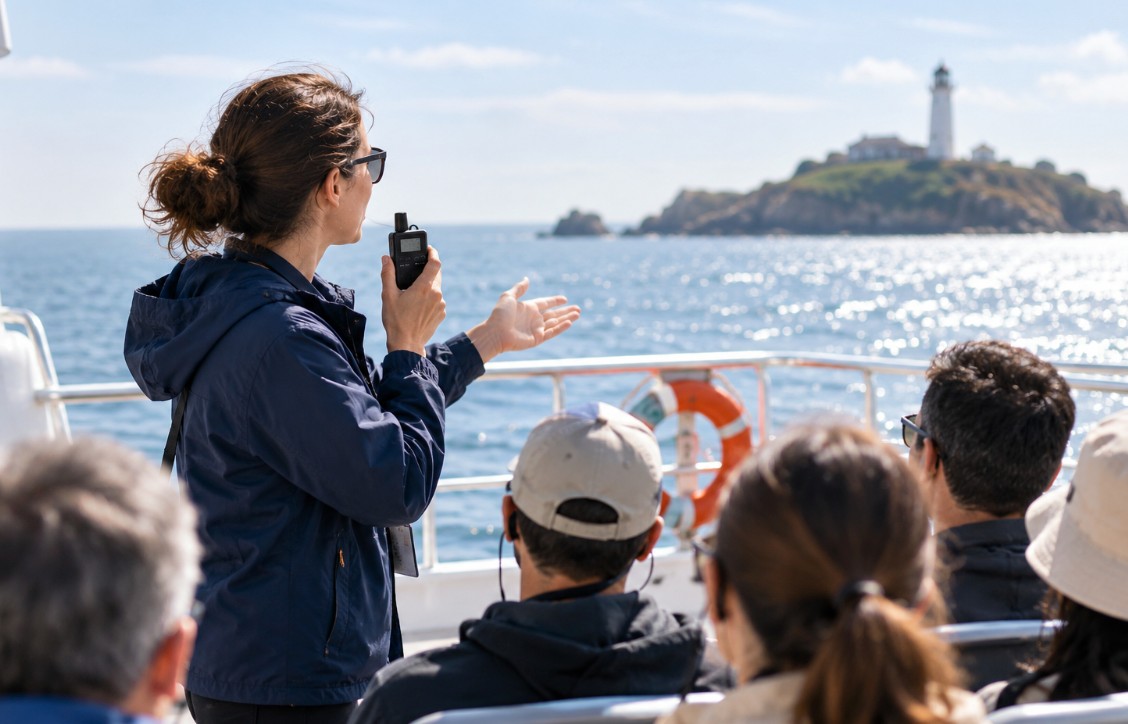
When guides walk several times a week instead of twice a year, the weight of the transmitter stops being a footnote and becomes the main comfort complaint. A unit that felt fine for a two-hour open day becomes tiring on the third tour of a week, and guides start setting it down between groups, which is how units get left behind in lecture theatres. The RC2468 answers this with its ultra-light body, and the practical effect is that guides keep it on through the whole day rather than putting it down between groups. That single behaviour change removes the most common loss pattern in a campus fleet, which is not theft but misplacement during a busy day.
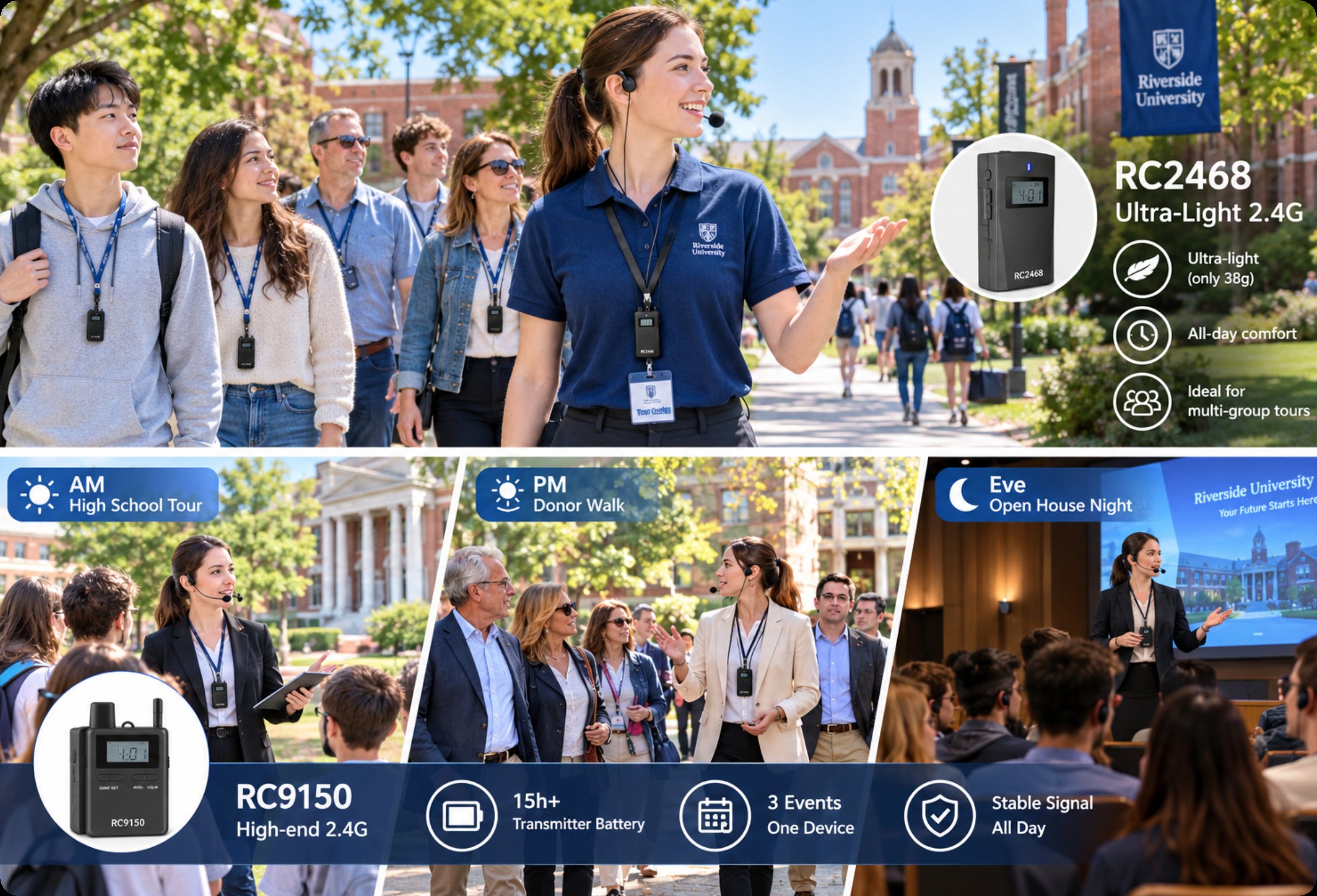
The daily-walk pattern above is where the RC2468 earns its place in a year-round programme: a guide wearing the unit continuously through several tours a day, because a transmitter light enough to forget about is one that never gets set down between groups.
Multi-Language Families and the Channel Question
International recruitment has changed the audience as much as the calendar has. A Saturday visit now routinely includes families who want the tour in their own language, and a single guide cannot deliver that without help. The common answer is to run two or more language channels at once, with a second guide translating into a second transmitter while both groups walk the same route. That pattern needs enough channel capacity to keep the groups from bleeding into each other, and it needs receivers that stay comfortable for a full visit. Planning channel capacity for a multilingual Saturday, rather than for a single-language open day, is one of the specification changes the year-round model forces.
Accessibility Is Now a Procurement Requirement
Accessibility has moved from a nice-to-have to a line item in the procurement document. Campuses that receive public funding or that answer to accessibility auditors increasingly need to demonstrate that a visitor with a hearing impairment can follow a guided tour, and a tour guide system with a proper receiver is the simplest way to satisfy that. The requirement also covers visitors who simply struggle with distance and background noise, which on a campus means traffic, construction, and wind across open quads. Specifying the system as an accessibility provision rather than as an admissions gadget changes both the funding route and the internal approval path, and it is one reason campus audio buys are being approved more often than they were a few years ago.
🔍 The Long Day Problem: Battery Across Three Events
A year-round programme also produces long days that a single open day never did: a morning school visit, an afternoon donor walk, and an evening department open house can all fall on the same date with the same fleet. The RC9150 is the unit that covers that shape of day, because its endurance matches a schedule that runs from morning to evening without a reliable charging window. The planning rule is simple: specify the battery for the longest day in the calendar, not the average one. A fleet that dies at the evening event is worse than no fleet at all, because the evening event is often the one with the highest-value audience in the room.
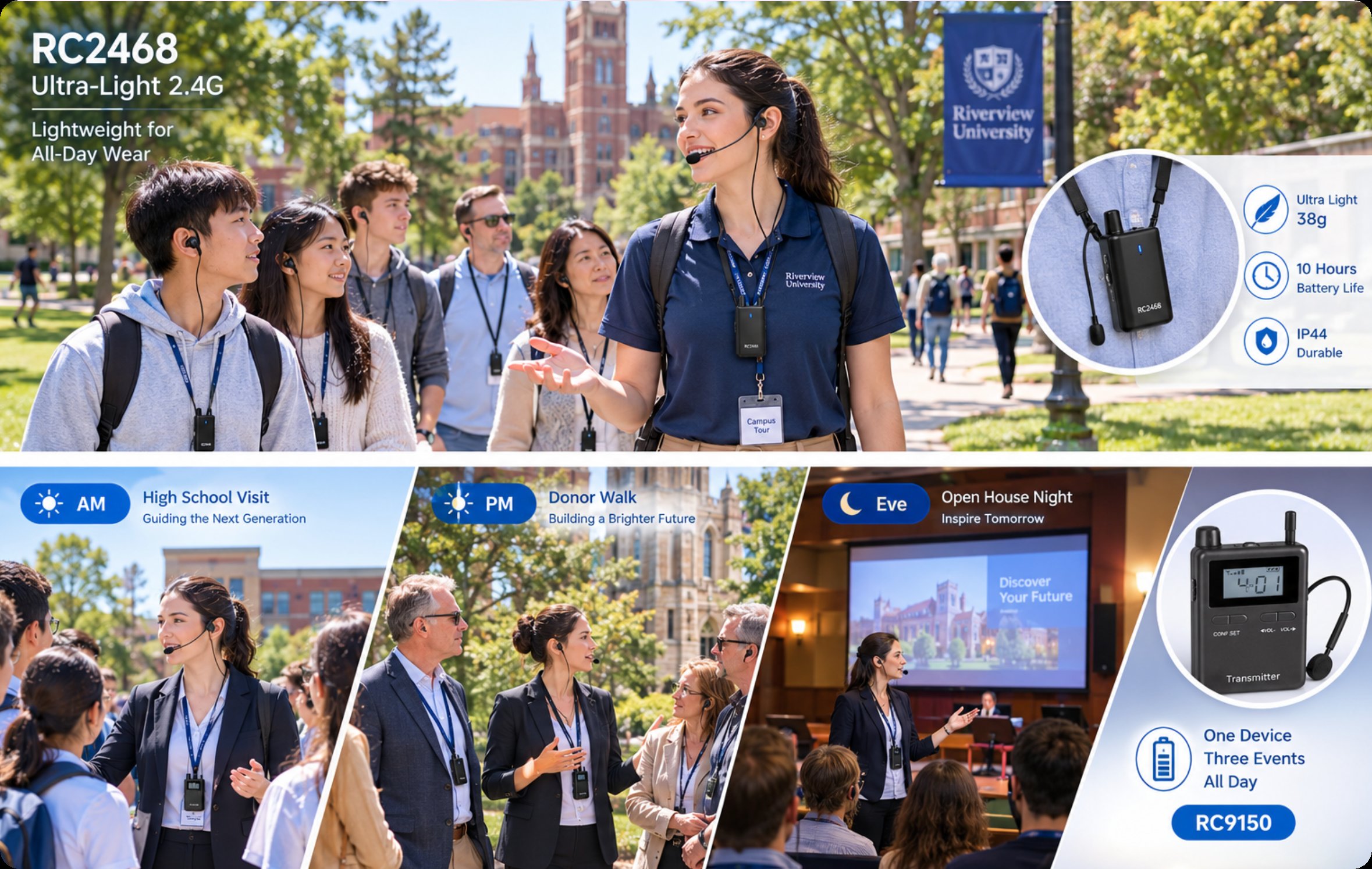
The long-day pattern above shows why the RC9150 sits alongside the lighter unit rather than replacing it: one fleet for the guides who walk every day, and the same fleet able to carry a schedule that runs from a morning school visit through to an evening open house without a charging break.
What Buyers Are Asking For Now
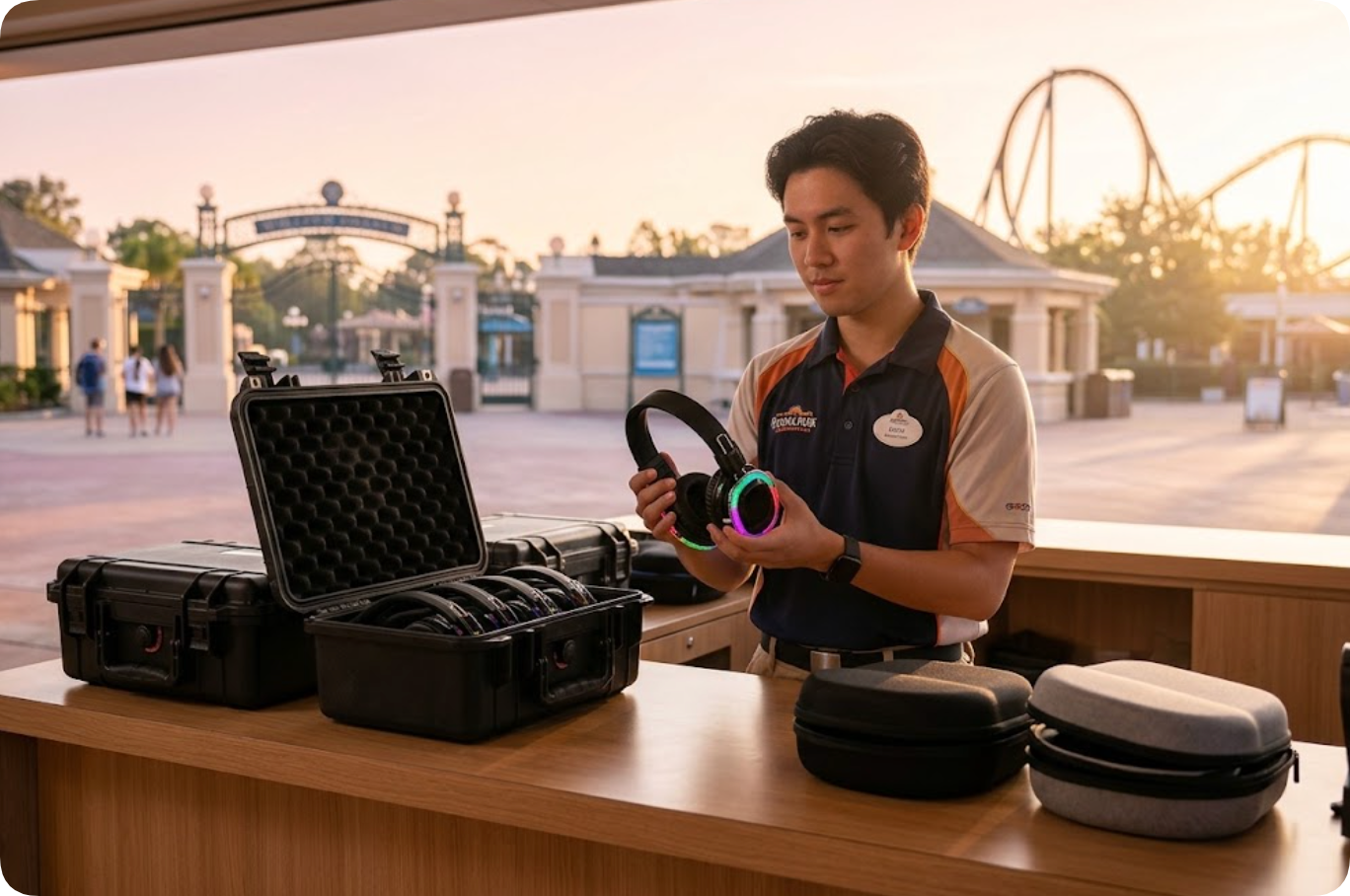
The requests reaching suppliers have changed in a way that reflects all of this. Buyers ask less about unit count for one event and more about duty cycle, spares policy, and what happens when a unit goes missing midweek. They ask for a fleet that can be split across several sites on the same day, and for a charging setup that works in an admissions office rather than a dedicated store room. They ask whether the receivers are comfortable enough for a two-hour walk in summer, and whether the language channels can run in parallel. Those questions are the year-round model expressing itself as a specification, and a supplier that answers them well is answering the actual buying decision rather than the invoice line.
| Change in the programme | What it does to the spec | Unit that answers it |
|---|---|---|
| Visits spread across the whole year | Duty cycle matters more than peak count | RC2468 (light, worn all day) |
| Multilingual Saturday groups | Parallel channel capacity | Both units, channel-planned |
| Accessibility as a procurement line | Receiver comfort and clarity | Both units, receiver-first |
| Three events in one date | Battery for the longest day | RC9150 (long endurance) |
| Fleet split across sites | Spares and charging in an office | Both units, managed as one fleet |
The table collects the shift into one view: each change in how campuses schedule tours pushes a specific line in the specification, and each line has a unit or a planning rule that answers it. Reading the table before writing a purchase request is the fastest way to avoid buying for a season that no longer exists.
Planning a Fleet for the Whole Calendar
The practical planning sequence follows the calendar rather than the catalogue. List every visit type across twelve months, note the longest day and the highest channel count, and check whether any date runs three events back to back. That set of numbers selects the fleet: the RC2468 for the daily walking duty, the RC9150 where the day runs long, and a channel plan that covers the multilingual Saturday. Add a spares margin for the midweek loss that a year-round programme makes likely, and a charging position in the admissions office rather than a distant store room. A related campus case study built around a full calendar shows the same planning applied to a single institution, the wider tour guide system comparison covers how the two units sit in the rest of the range, and the full wireless tour guide system range carries the charging and storage accessories that a year-round fleet needs.