
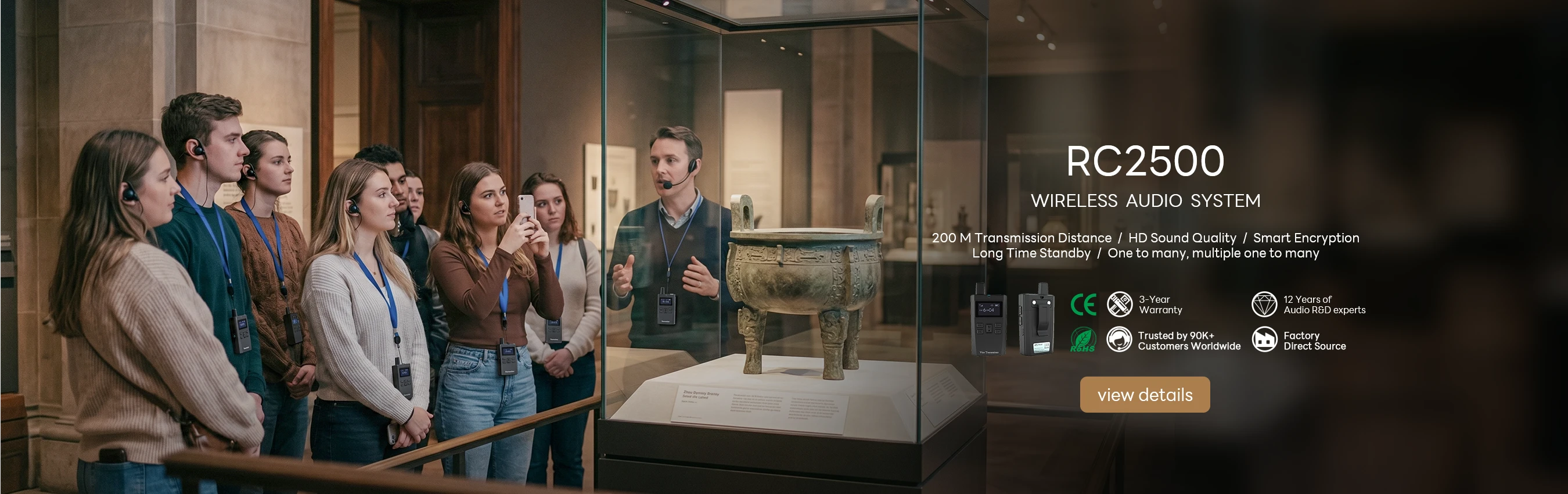

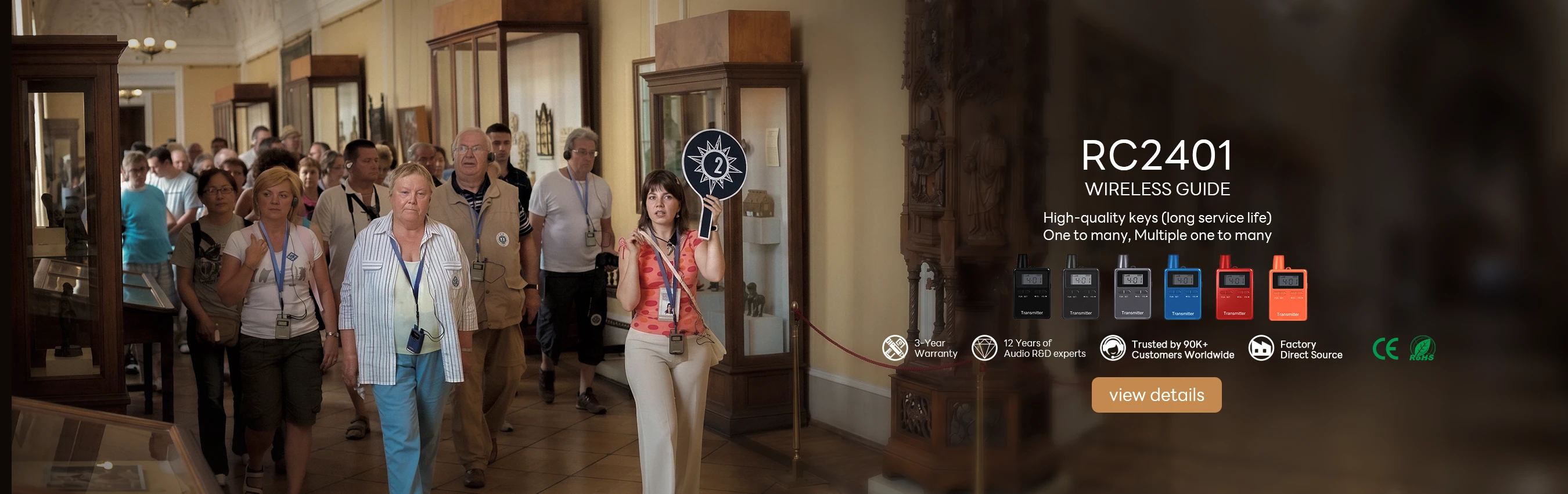
An outdoor walking tour fails in only a few ways, and almost all of them are predictable. The group rounds a bend and the back half stops hearing the guide. Wind picks up on an exposed stretch and the commentary disappears under it. The last climb takes longer than planned and the transmitter dies before the group reaches the end. Indoor venues rarely surface these problems, because walls and short distances hide them. On a trail or an open site they arrive in the first hour and repeat all season. This troubleshooting guide walks through the three failures in the order they actually happen, using three Richitek units that cover the different failure modes: the RC2468 for the guide who carries it all day, the RC2401 as the compact backup, and the RC085 where distance and interference are the real problem. The same city tour wireless guide logic covers urban walks as well as open ground.
Reading the Symptom Before Reaching for the Spare
The first troubleshooting habit is to name the symptom precisely, because the three failures look similar from the guide's side and have different causes. A listener who hears nothing at all has a link problem. A listener who hears the guide but cannot make out the words has a level or noise problem. A unit that works in the morning and stops in the afternoon has a power problem. Reaching for a spare receiver without separating those three wastes the ten minutes when the group is standing still, and it usually fails to fix the actual cause. Naming the symptom first turns a vague complaint into one of three known checks, each of which takes under a minute to run on the trail.
Failure One: The Back of the Group Drops Out
Link loss at the back of the group is the most common outdoor failure, and the cause is almost always geometry rather than a faulty unit. On a trail the group stretches out, and the visitors at the back are both farther away and off the transmitter's direct path. The check is to stop the group, have the guide turn to face the back of the line, and ask the last visitor whether the audio returns. If it does, the problem is body position and terrain, not range. If it does not, walk the last visitor forward until the audio returns and note that distance, because that number tells you whether the route needs a longer-reaching transmitter or simply a different walking order. Many link complaints are solved by putting the fastest walkers at the back rather than the front, which costs nothing and keeps the group inside the working range all day.
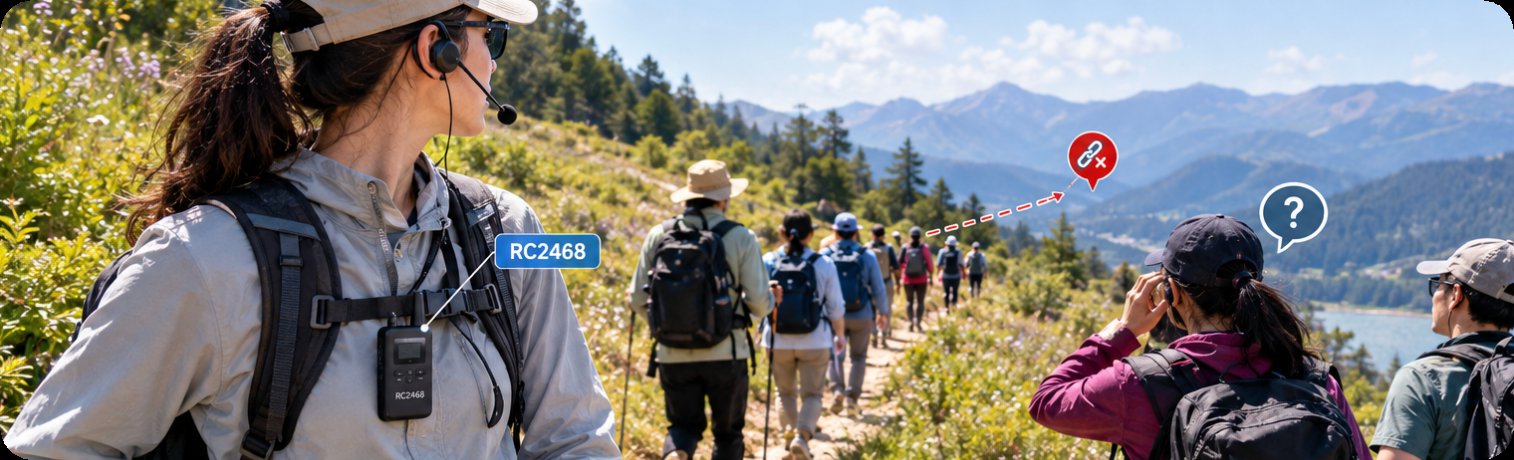
The trail pattern above shows the failure at its clearest: a guide at the front of a stretched group with the back of the line out of the working path. The fix is usually a walking-order change or a guide position change, not a new unit, which is why the check comes before the spare.
Failure Two: Wind Takes the Commentary
Wind is the second failure, and it is a level problem rather than a link one. The transmitter is still connected, but the guide's microphone is picking up wind noise that sits on top of the voice and buries the consonants that make speech intelligible. The check is to cup a hand over the microphone or turn the guide's back to the wind for a sentence and ask whether clarity returns. If it does, the fix is microphone position and wind protection rather than volume, because turning the volume up amplifies the wind along with the voice. On exposed sections, schedule the commentary for sheltered spots and walk the exposed stretches in silence, which is a route-planning answer to a problem that no amount of gain will solve. Keeping a windscreen on the microphone through the whole season prevents most of these calls.
🔋 Failure Three: The Long Climb Outlasts the Battery
The third failure is power, and it is the one that strands a group farthest from help. A transmitter that started the morning at full charge can still die on an afternoon climb if the route ran longer than planned or if the unit spent the day at high output. The check is to make battery a scheduled item rather than a surprise: note the charge level at the start of the walk and again at the halfway point, and carry a compact backup for the second half of the day. This is where the RC2401 earns its place in the kit. As a smaller second unit it is easy to carry in a pocket and quick to hand over when the primary transmitter runs low, and it turns a power failure into a ten-second swap instead of a walk back to the car.
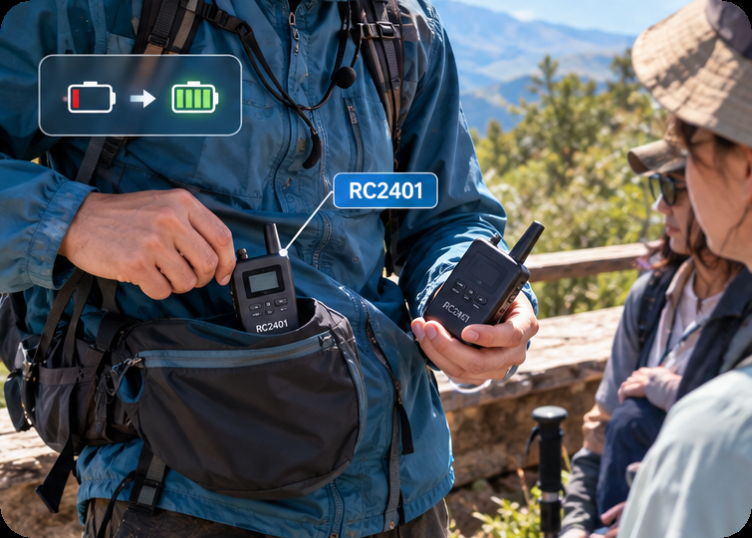
The backup above is the answer to the power failure: a compact unit carried in a pocket and swapped in at the halfway point rather than discovered missing at the top of the climb. A scheduled battery check at the midpoint makes the swap planned rather than emergency.
🔍 Where Interference, Not Distance, Is the Real Problem
Some outdoor failures are neither geometry nor weather but interference, and they are worth separating because they need a different unit rather than a different habit. Sites near radio installations, event sites with several crews working at once, and any location with heavy equipment can produce a noisy band where a clean link indoors becomes unreliable outside. The symptom is intermittent dropouts that do not correlate with distance or wind, and the check is to change channel and see whether the dropouts follow the channel or stay with the position. If they follow the channel, the fix is a different frequency. If they stay with the position, the site has a local source and the route needs a unit with better interference behaviour on that stretch, which is the case the RC085 is built for.
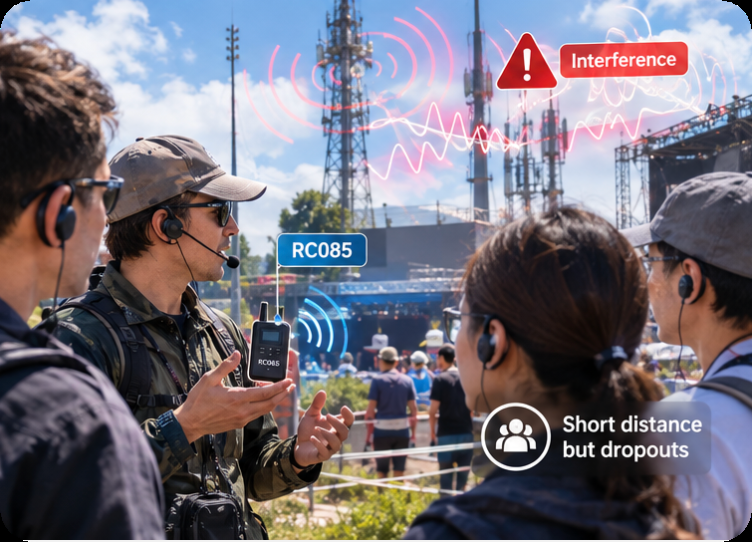
The site above is the interference case rather than the distance case: a location where dropouts track the position and not the walking order, so no amount of repositioning fixes them. This is the stretch where the RC085's behaviour on a noisy band matters, and swapping it in for that section is faster than fighting the channel selection all afternoon.
A Two-Minute Trail Checklist
Everything above compresses into a short checklist that a guide can run before and during a walk. Before setting out: check the charge level, confirm the microphone windscreen is fitted, and agree the walking order with the fastest walkers at the back. At the first stop: ask the last visitor directly whether the audio is clear, which catches a link problem while the group is still near the start. At the halfway point: check the charge again and swap to the backup before the level becomes critical. On an exposed section: turn the guide's back to the wind and keep the microphone shielded. Those four checks take under two minutes in total and prevent almost every failure that strands an outdoor group.
| Symptom | Likely cause | First check | Fix |
|---|---|---|---|
| Back of group hears nothing | Geometry, not range | Guide turns to face the back | Walking order or guide position |
| Words heard but unclear | Wind on the microphone | Shield the mic, turn from wind | Windscreen, sheltered commentary spots |
| Unit dies mid-route | Power, not range | Charge level at halfway | Planned swap to a compact backup |
| Dropouts unrelated to distance | Local interference | Change channel, see if it follows | Different frequency or a better-behaved unit |
The table is the whole guide in one view: name the symptom, run the matching check, apply the fix. A guide who can read this table on the trail prevents most of the failures that turn a good walk into a complaint.
What to Carry and What to Check Back at Base
The kit that prevents these failures is small: a windscreen on every microphone, a compact backup transmitter for the second half of the day, and a note of the charge level at the start and midpoint of every walk. Back at base, the useful habit is to log which routes produced which failure, because the log turns an occasional problem into a predictable one that can be planned around. If the same bend loses the back of the group every week, the walking order changes permanently rather than being fixed on the day. For more on how the three units compare when the route is planned in advance rather than fixed on the trail, the related outdoor comparison across route conditions covers the planning side, and the full wireless tour guide system range carries the windscreens, spare batteries, and backup units that make the checklist work.