

RC2402, RC2500 and RC2468: Setting Up Tour Audio on a Site With No Fixed Route
Most installation instructions quietly assume a drawing exists. There is a rack position, a cable path, a power outlet, and a route the group will follow because the building says so. Plenty of working venues have none of that. A courtyard that hosts temporary markets, a mountain trail with no marked line, an old industrial ground where nobody has ever defined a visitor path — these places still need a group to hear their guide, and they still need someone to set the equipment up.
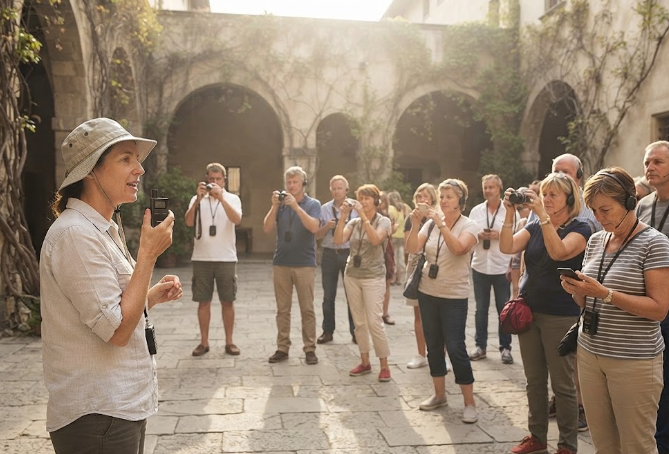
What changes on an unmarked ground is the order of work. On a drawn site you install first and test afterwards. On an open one you measure first, decide second, and install almost as an afterthought. The outdoor and city tour audio solutions that work in these places are the ones designed around carrying, not mounting, which is what makes the four steps below different from a standard deployment.
💡 Why an Unmarked Venue Breaks a Normal Plan
Three things are missing at once, and each of them removes an assumption. There is no fixed path, so the coverage problem is changing shape all day. There is usually no power on the route, so anything that needs a socket is out. And there is rarely a ceiling or a wall to work against, so a design that relied on reflections indoors has nothing to bounce from.
The practical consequence is that the first visit to the ground is not an installation visit at all. It is a measurement visit, and the numbers it produces are what the later decisions hang on.
⚡ Step One: Walk the Ground Before Choosing Anything
Walk the intended circuit at the pace the group will walk it, and write down four things. Total distance, which sets how long the group stays spread out. Obstacles, meaning walls, tree canopy, slopes and doorways that will sit between a guide and the back of the group. Noise sources, which are usually traffic, machinery, water and wind rather than crowds. And stopping points, the two or three places a guide will naturally pause and speak at length.
Those four numbers decide nearly everything that follows. A circuit under roughly two hundred metres with clear sightlines behaves like a small room. A circuit that stretches to half a kilometre with a hill in the middle does not, and no amount of transmitter power will make it behave like one.
Step Two: Cut the Circuit Into Zones
Split the walk into three or four zones and give each one its own decision instead of treating the whole ground as a single coverage problem. The useful habit is to cut at the loudest point rather than in even lengths, because the noisy section is where a group falls apart and where a guide starts repeating themselves.
Each zone should also carry a named stopping point, so the person leading knows where to gather the group before they move on. On grounds with no marked path this is the only structure the visit has, and it is worth writing down rather than improvising on the day.
Step Three: Kit That Travels, Not Kit That Installs
Because there is no cabinet to lock and no cable to run, everything has to arrive in a bag and leave in the same bag. That single constraint pushes three specifications to the front. Weight, because the person carrying the transmitter may also be carrying a first-aid kit and a flag. Runtime, because a day on an open ground rarely offers a charging window. And ingress protection, because a route with no roof meets rain, dust or both. The wireless tour guide system range is built around those three numbers rather than around output power.
Runtime deserves a closer look than it usually gets. Twelve hours sounds generous until the guide is also briefing before the first group and closing down after the last one, which easily turns into a fourteen-hour day. Charging between groups only works if there is somewhere to charge, and on an unmarked ground there usually is not.
Step Four: The Ten-Minute Check Before the Group Arrives
Because the layout is improvised, the check cannot be skipped. Ten minutes before the group forms, the person leading should walk to the furthest point of the first zone while speaking normally, and have someone at the back confirm they can hear. Then the same at the loudest point. Anything that fails here is a decision to retake, not a fault to repair, and retaking it takes minutes rather than the twenty it would take after the group has set off.
Two things are worth checking every morning on an open ground. Battery state, because the previous day may have run longer than planned. And channel agreement between transmitter and receivers, because a group that used a different setting yesterday will have been handed back without anyone resetting it.
What Each Unit Is Actually For
The three units below cover the range of what an open ground asks for, from a steady medium group to a weight-sensitive trail walk.
RC2402 is the steady middle of the range and the one to reach for when the group is a normal size and the ground is mixed. It weighs 60 grams, runs 12 hours, and carries an IP42 rating, which covers the light rain and dust that a route without a roof will eventually produce. Its value on an unmarked ground is that it behaves the same on the third zone as it did on the first.
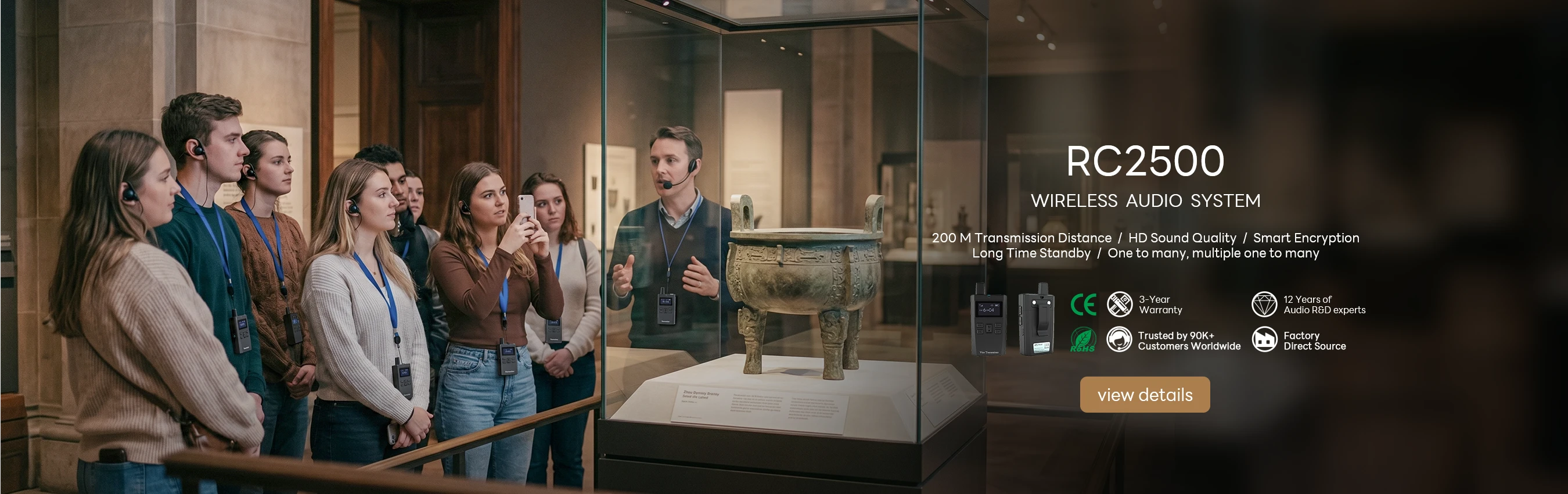
RC2500 covers the smaller end. At 55 grams with the same 12 hours and IP42 protection, it suits groups of eight to fifteen where the guide would rather not hand out anything bulky. On a heritage interior or a short courtyard circuit it keeps the kit unobtrusive, which matters when visitors are also carrying cameras.

RC2468 is the one built for distance and for carrying. At 38 grams and IP44 it is the lightest of the three and the most resistant to weather, which is why it tends to appear on trail walks and long outdoor circuits where the guide walks the whole route rather than standing at stops. Its 10-hour runtime is the shortest here, and on a full-day trail that is the number to check first.

A Specification Comparison for Planners
| Model | Best fit on an open ground | Weight | Runtime | Ingress rating |
|---|---|---|---|---|
| RC2402 | Mixed ground, normal group size, multi-zone circuit | 60 g | 12 hours | IP42 |
| RC2500 | Small to medium group, short or interior circuit | 55 g | 12 hours | IP42 |
| RC2468 | Trail walking, long outdoor circuit, weight-sensitive | 38 g | 10 hours | IP44 |
Reading the table by column matters more than reading by row. If the circuit keeps a guide moving for most of the day, weight and runtime decide the choice. If it keeps them standing at a few stops, the choice barely matters and the cheapest suitable unit wins.
Mistakes That Show Up on the First Morning
The most common error is treating the ground as one zone and buying one long-range answer for all of it. The second is skipping the walk in favour of a map, which on an unmarked ground is usually out of date. The third is assuming the group will stay together, when in practice it strings out exactly where the noise is worst. A short look at how other open-air sites handle this makes the pattern obvious.
None of this is complicated, and none of it needs equipment beyond what a normal tour already carries. It needs the order of work to be right: measure the ground, cut it into zones, choose kit that travels, and check it ten minutes before anyone arrives.