A leading China factory specializing in Wireless Tour Guide Systems, Church Audio Guides, and Translation Headphones with premium OEM/ODM solutions.

Tel:+86 13825295213

Email:tiger.wang@richitek.com

RC2501, RC9150 and RC2406: Inside an Investor Day Where Three Tours Ran at Once

RC2501, RC9150 and RC2406: Inside an Investor Day Where Three Tours Ran at Once

An investor visit has a problem that ordinary site tours do not. Everyone in the room has to hear exactly the same words at exactly the same time, because the numbers and the claims are being recorded by people who will compare notes afterwards. Nobody can be told something slightly different because they happened to be standing at the back.

We ran one of these events for a manufacturing client last quarter, with three groups moving through a plant in parallel and two languages in play. It is the kind of setup where you learn what actually matters, and the lessons were less about radio performance than about how a group is split. The investor site visit audio solutions behind it ran on three units playing three distinct roles.

💡 Why an Investor Visit Is Not a Normal Site Walk

A normal visit tolerates improvisation. A group slows down, someone repeats a line, a guide answers a question. An investor event does not, because the schedule is published in advance and the content is being evaluated rather than enjoyed. Every minute behind schedule is a minute that has to come out of the Q&A at the end.

The second difference is recording. Analysts take notes, and notes that contradict each other across groups are a problem for the company, not just for the tour organiser. The technical requirement this creates is not better audio. It is identical audio to every listener, at the same moment, regardless of which group they are walking with.

🔍 The Problem: Everyone Has to Hear the Same Thing

Splitting into groups solves crowd control and creates a content problem. If each group has its own guide, each group hears a different explanation of the same line, and the differences become the story rather than the plant. If everyone shares one channel, the groups are effectively one group again and the split was pointless.

The configuration that works is one main commentary feed carried to all groups, with each group's guide able to speak privately to their own group in between the scheduled stops. That means the system needs both a shared layer and a private layer running at the same time, which is a channel question before it is anything else.

Splitting One Event Into Three Parallel Groups

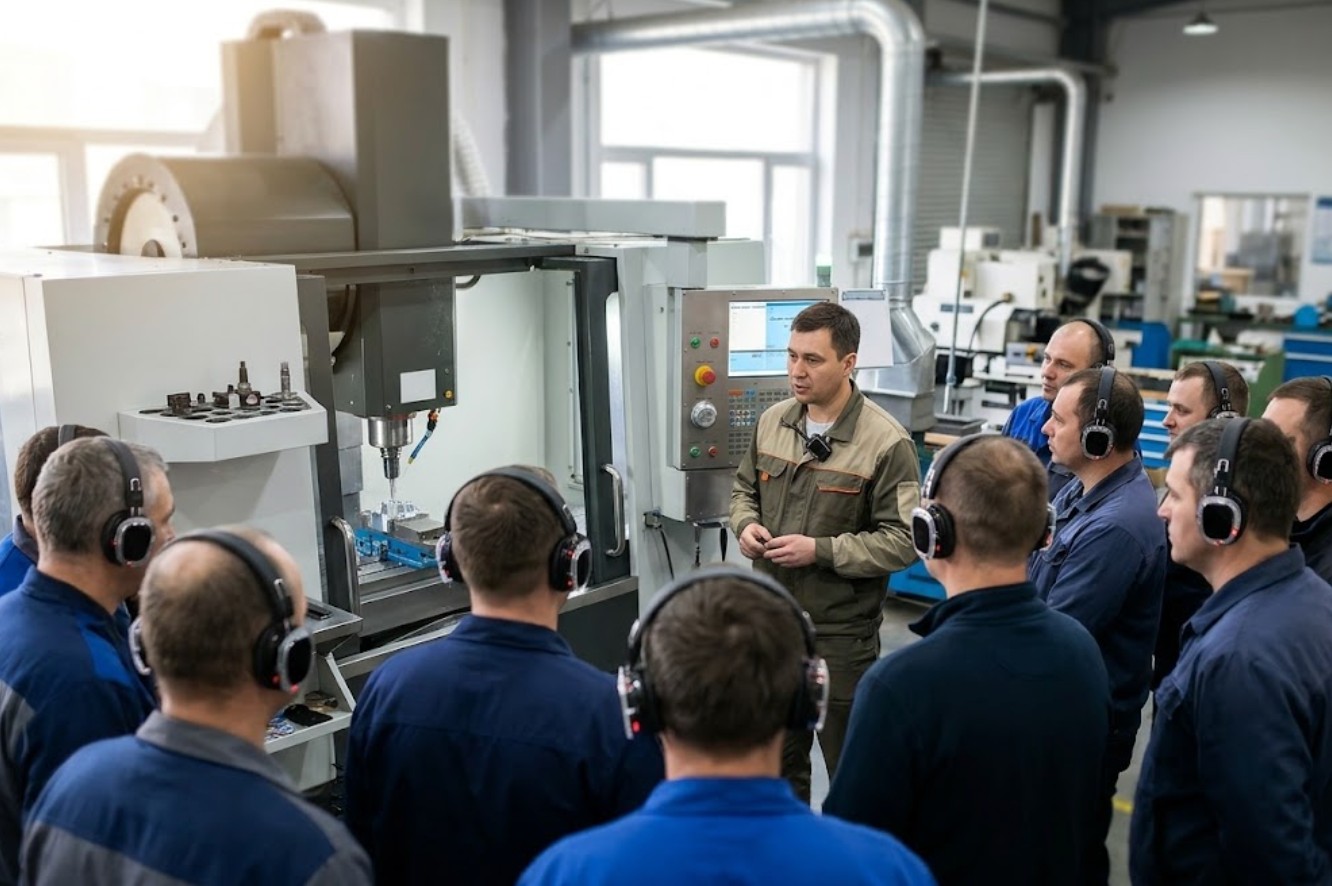
We settled on three groups of about fourteen, staggered by four minutes so they never arrived at the same station together. Group one carried the English commentary directly from the host. Groups two and three followed the same feed with a translator working live, each on their own channel so the two translations never overlapped.

Staggering matters more than it sounds. Four minutes is enough for the previous group to clear a station and not enough for the gap to become visible, and it keeps all three groups on the same running order without anyone waiting.

The Interpreter's Position Is the Whole Design

The single largest decision was where the interpreters stood. Putting them with a group meant they could not hear the host clearly over machinery noise. Putting them at the back of the plant meant their translation arrived after the host had already moved on.

The answer was a fixed position at the first station, where the host opened with the key figures, with a clear sightline and a direct channel to all three groups. Everything after that station was supporting detail that the group guides could carry on their own. Finding that one anchor point is worth more than any equipment upgrade.

⚙️ What Each Unit Does in This Setup

The three units came from the same wireless tour guide system range but were not interchangeable, and matching them to roles was the part that made the schedule hold.

RC2501 was the visitor-side unit. At 48 grams with 10 hours of runtime and an IP20 rating it is built for long, quiet listening rather than rough handling, which is exactly the profile of someone walking a plant for two hours in a suit. Its light weight is the specification that matters when forty-two people are wearing it through a morning without a break.

RC2501, RC9150 and RC2406: Inside an Investor Day Where Three Tours Ran at Once(图1)

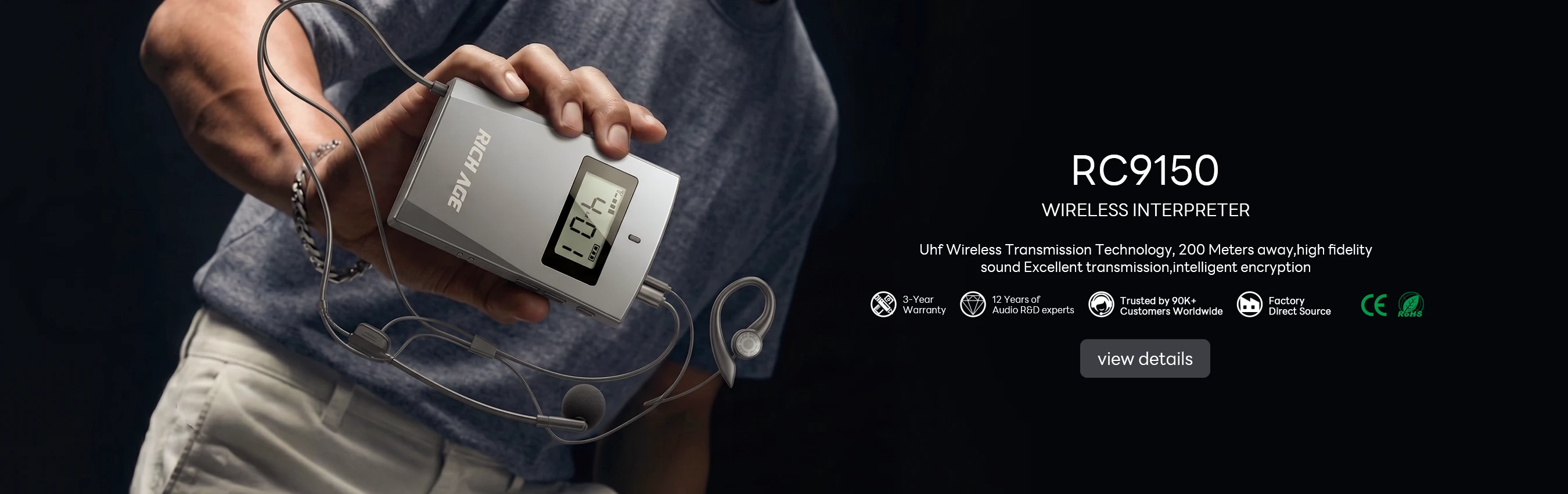
RC9150 was the interpretation unit, and its 15 hours of runtime is the number that decided it. Translation is continuous work and the unit cannot be swapped mid-session, so the longest battery in the set belonged with the interpreter. At 75 grams and IP54 it also handles being set down on a plant surface between sessions.

RC2501, RC9150 and RC2406: Inside an Investor Day Where Three Tours Ran at Once(图2)

RC2406 was the unit that made the parallel structure possible. Its 80-channel capacity is what allows three groups, two languages and a private guide channel each to coexist without anyone borrowing a channel from someone else. At 65 grams, 12 hours and IP42 it sits between the other two in every respect, which is why it carried the most complex role.

RC2501, RC9150 and RC2406: Inside an Investor Day Where Three Tours Ran at Once(图3)

A Configuration Comparison

ModelRole on the dayWeightRuntimeIngress ratingChannels
RC2501Visitor receiver, worn for the full session48 g10 hoursIP20Standard
RC9150Interpreter unit, continuous live translation75 g15 hoursIP54High-end 2.4G
RC2406Multi-group hub, three groups and two languages65 g12 hoursIP4280 channels

Reading the runtime column next to the role column is the whole exercise. The unit with the longest session behind it got the longest battery, and the visitor units traded runtime for weight because they were worn rather than held.

What Actually Went Wrong on the Day

Two things, and neither was the equipment. The first was that group three's guide started answering questions during a scheduled stop, which put them ninety seconds behind for the rest of the morning and required a longer pause at the furnace station to recover. The second was that we handed out units before briefing the visitors on how to change channels, so two people spent ten minutes on the wrong translation.

The second problem is the easier fix. A two-minute channel briefing at handover costs less than a single confused investor, and it should happen before the first unit leaves the table.

🔮 What We Would Change Next Time

The structure would stay the same. What we would add is a fifth channel reserved for the organiser, so that the person watching the clock can relay a quiet instruction to the three group guides without it reaching the visitors. That is a scheduling improvement rather than a technical one, and it needs exactly the kind of channel headroom the multi-group unit already provides.

Events like this are worth documenting, and we keep a record of comparable deployments on the tour case study pages for anyone planning a similar format.

2026年09月12日 11:02
click: 21

RC2501, RC9150 and RC2406: Inside an Investor Day Where Three Tours Ran at Once

time: 2026年09月12日 click:21

RC2501, RC9150 and RC2406: Inside an Investor Day Where Three Tours Ran at Once

An investor visit has a problem that ordinary site tours do not. Everyone in the room has to hear exactly the same words at exactly the same time, because the numbers and the claims are being recorded by people who will compare notes afterwards. Nobody can be told something slightly different because they happened to be standing at the back.

We ran one of these events for a manufacturing client last quarter, with three groups moving through a plant in parallel and two languages in play. It is the kind of setup where you learn what actually matters, and the lessons were less about radio performance than about how a group is split. The investor site visit audio solutions behind it ran on three units playing three distinct roles.

💡 Why an Investor Visit Is Not a Normal Site Walk

A normal visit tolerates improvisation. A group slows down, someone repeats a line, a guide answers a question. An investor event does not, because the schedule is published in advance and the content is being evaluated rather than enjoyed. Every minute behind schedule is a minute that has to come out of the Q&A at the end.

The second difference is recording. Analysts take notes, and notes that contradict each other across groups are a problem for the company, not just for the tour organiser. The technical requirement this creates is not better audio. It is identical audio to every listener, at the same moment, regardless of which group they are walking with.

🔍 The Problem: Everyone Has to Hear the Same Thing

Splitting into groups solves crowd control and creates a content problem. If each group has its own guide, each group hears a different explanation of the same line, and the differences become the story rather than the plant. If everyone shares one channel, the groups are effectively one group again and the split was pointless.

The configuration that works is one main commentary feed carried to all groups, with each group's guide able to speak privately to their own group in between the scheduled stops. That means the system needs both a shared layer and a private layer running at the same time, which is a channel question before it is anything else.

Splitting One Event Into Three Parallel Groups

We settled on three groups of about fourteen, staggered by four minutes so they never arrived at the same station together. Group one carried the English commentary directly from the host. Groups two and three followed the same feed with a translator working live, each on their own channel so the two translations never overlapped.

Staggering matters more than it sounds. Four minutes is enough for the previous group to clear a station and not enough for the gap to become visible, and it keeps all three groups on the same running order without anyone waiting.

The Interpreter's Position Is the Whole Design

The single largest decision was where the interpreters stood. Putting them with a group meant they could not hear the host clearly over machinery noise. Putting them at the back of the plant meant their translation arrived after the host had already moved on.

The answer was a fixed position at the first station, where the host opened with the key figures, with a clear sightline and a direct channel to all three groups. Everything after that station was supporting detail that the group guides could carry on their own. Finding that one anchor point is worth more than any equipment upgrade.

⚙️ What Each Unit Does in This Setup

The three units came from the same wireless tour guide system range but were not interchangeable, and matching them to roles was the part that made the schedule hold.

RC2501 was the visitor-side unit. At 48 grams with 10 hours of runtime and an IP20 rating it is built for long, quiet listening rather than rough handling, which is exactly the profile of someone walking a plant for two hours in a suit. Its light weight is the specification that matters when forty-two people are wearing it through a morning without a break.

RC2501, RC9150 and RC2406: Inside an Investor Day Where Three Tours Ran at Once(图1)

RC9150 was the interpretation unit, and its 15 hours of runtime is the number that decided it. Translation is continuous work and the unit cannot be swapped mid-session, so the longest battery in the set belonged with the interpreter. At 75 grams and IP54 it also handles being set down on a plant surface between sessions.

RC2501, RC9150 and RC2406: Inside an Investor Day Where Three Tours Ran at Once(图2)

RC2406 was the unit that made the parallel structure possible. Its 80-channel capacity is what allows three groups, two languages and a private guide channel each to coexist without anyone borrowing a channel from someone else. At 65 grams, 12 hours and IP42 it sits between the other two in every respect, which is why it carried the most complex role.

RC2501, RC9150 and RC2406: Inside an Investor Day Where Three Tours Ran at Once(图3)

A Configuration Comparison

ModelRole on the dayWeightRuntimeIngress ratingChannels
RC2501Visitor receiver, worn for the full session48 g10 hoursIP20Standard
RC9150Interpreter unit, continuous live translation75 g15 hoursIP54High-end 2.4G
RC2406Multi-group hub, three groups and two languages65 g12 hoursIP4280 channels

Reading the runtime column next to the role column is the whole exercise. The unit with the longest session behind it got the longest battery, and the visitor units traded runtime for weight because they were worn rather than held.

What Actually Went Wrong on the Day

Two things, and neither was the equipment. The first was that group three's guide started answering questions during a scheduled stop, which put them ninety seconds behind for the rest of the morning and required a longer pause at the furnace station to recover. The second was that we handed out units before briefing the visitors on how to change channels, so two people spent ten minutes on the wrong translation.

The second problem is the easier fix. A two-minute channel briefing at handover costs less than a single confused investor, and it should happen before the first unit leaves the table.

🔮 What We Would Change Next Time

The structure would stay the same. What we would add is a fifth channel reserved for the organiser, so that the person watching the clock can relay a quiet instruction to the three group guides without it reaching the visitors. That is a scheduling improvement rather than a technical one, and it needs exactly the kind of channel headroom the multi-group unit already provides.

Events like this are worth documenting, and we keep a record of comparable deployments on the tour case study pages for anyone planning a similar format.

×

Contact us

email:
name:
subject:
content: