
.webp)
I have sat through more factory walkthroughs than I can count, and the pattern is almost always the same. The host company buys one audio kit, hands it to whoever is guiding that day, and assumes a single specification will survive every corner of the plant. It rarely does. A casting bay and a finished-goods warehouse are different acoustic and physical worlds, and the people walking them — a certification auditor, a purchasing team, a busload of vocational students — want completely different things from the equipment hanging around their necks.
This is the account of one customer who learned that the slow way. They run a precision metal components plant in southern China, they host somewhere north of forty visit batches a year, and they spent two years going from one frustrated trial to a kit that is deliberately uneven. All three units they settled on are ours, but they were not chosen together, and the reasons are more interesting than any spec sheet.
The Trial Run That Nearly Ended the Deal
The first order was small: twenty identical receiver units and two transmitters, bought on price, configured as one fleet. It lasted eleven weeks. The complaints arrived in a predictable order.
Week two, the guides reported neck fatigue. Their walk route is about 1.4 km end to end and runs close to two hours once you include the meeting room wrap-up, and a 65 g unit on a lanyard is fine for thirty minutes and genuinely annoying at the ninety-minute mark. Week five, three earpieces came back from the grinding bay packed with conductive dust that no amount of wiping removed. Week nine, an auditor taking notes one-handed asked whether the receiver could be clipped to a belt instead, because it kept swinging into the clipboard.
None of those are defects. They are mismatches. The buyer had solved for "everyone can hear" and had not solved for "everyone can hear while doing something else with their hands, in a specific room, for a specific length of time."
What saved the relationship was not a discount. It was a conversation where we stopped talking about products and started mapping their visit calendar against their floor plan. That mapping is the whole story below, and it is the exercise I would recommend to any plant that hosts visitors more than once a month. If your visitor programme depends on audio that behaves the same in a press shop and a showroom, it is worth reading how dedicated factory tour solutions are usually structured before you buy anything at all.
💡 Why a Single Model Could Not Cover Every Zone
The plant divides, roughly, into four acoustic environments. Press and forging runs 88–95 dB(A) continuous with impact peaks. CNC and grinding sit around 78–84 dB(A) with coolant mist and metal particulate in the air. Assembly is a comparatively calm 68–72 dB(A). The warehouse and dispatch area is quiet but physically large, roughly the length of a football pitch, with visitors straggling twenty metres behind the guide.
Once those numbers were on paper, the "one fleet" idea collapsed on its own. High-output zones need receivers that tolerate particulate and moisture. Long quiet stretches need units light enough to forget. Multi-group days need channel headroom. Those requirements pull in different directions, so the answer is not a better single product — it is three products assigned on purpose.
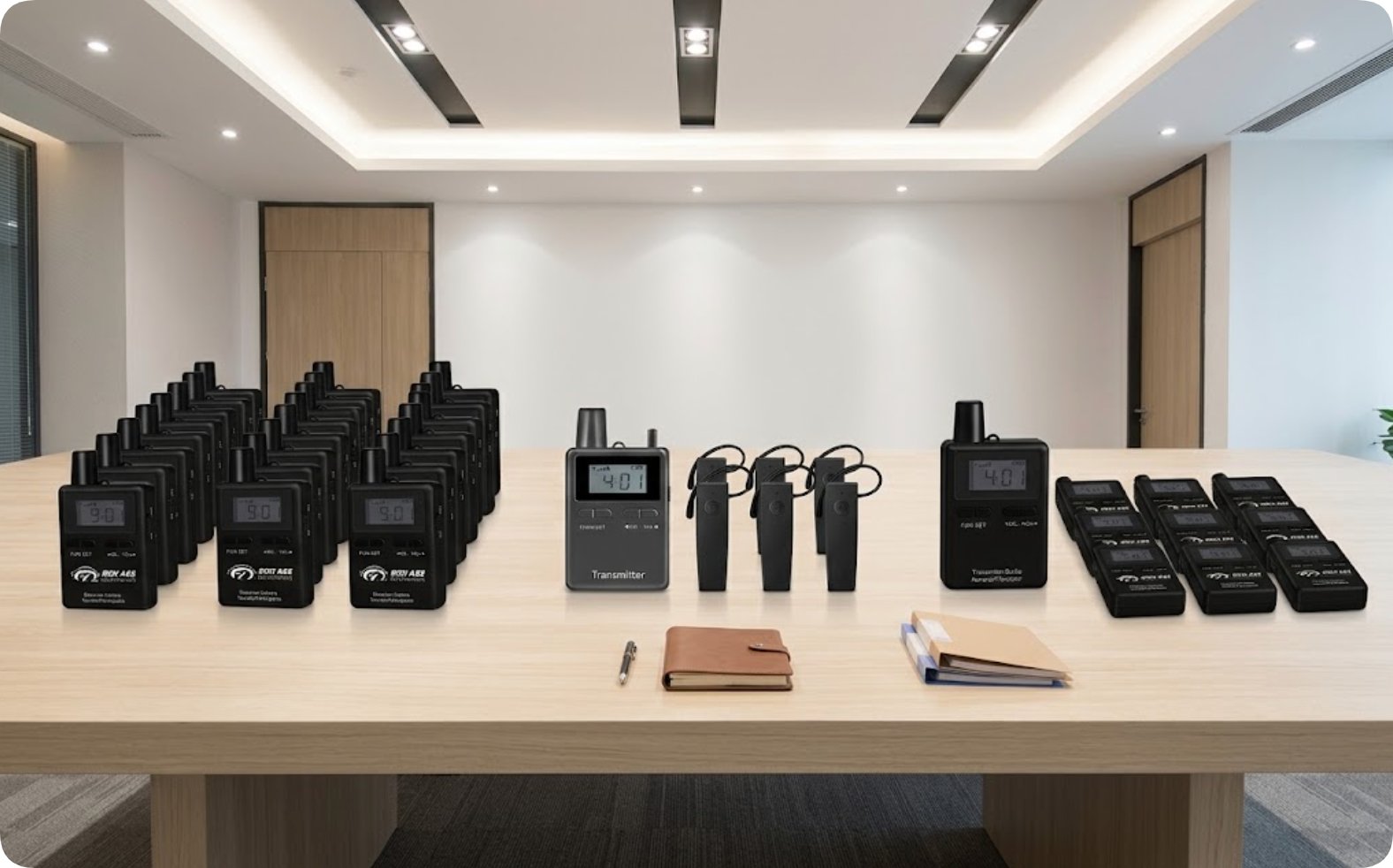
| Unit | Weight | Battery | Ingress rating | Role in this plant |
|---|---|---|---|---|
| RC2468 | 38 g | 10 hours | IP44 | Full-route auditor and buyer visits |
| RC8860 | 59 g | 12 hours | IP54 | Casting, forging and grinding bays |
| RC2406 | 65 g | 12 hours | IP42 | Multi-group student and trainee days |
🗺️ Assigning the Kit by Visitor Type
The first deliberate change was to stop assigning equipment by visit date and start assigning it by visitor. Certification auditors and serious buyers get the long route — raw material intake through to dispatch, two hours, with a notebook or tablet in hand for most of it. For them the plant now issues the RC2468, and the deciding factor was mass, not audio quality.
At 38 g the RC2468 is roughly two-thirds the weight of a standard receiver, which sounds like a trivial difference until you wear it for a hundred and twenty minutes under a safety helmet with the strap already pulling at your neck. The guides tell us unprompted that auditors stop touching the unit partway through — no repositioning, no hitching it back onto a shoulder. Ten hours of battery covers a full day of back-to-back visits without a mid-day recharge, which matters because the charging cabinet lives in the admin block, a six-minute walk from the route start.
IP44 is enough for this route. These visitors stay behind the yellow lines, they are not standing next to the coolant nozzles, and ten hours is longer than any single visit they run. Paying for protection they never need would have been money spent on the wrong axis.

Auditor route: RC2468 clipped under a helmet strap for the full 1.4 km walk.
🎯 Where Dust and Coolant Mist Decide the Spec
The grinding and casting bays are where the first fleet died, and the replacement logic there had nothing to do with comfort. Airborne metal particulate plus coolant mist is a nasty combination for anything with an earpiece socket and a rotary control, and IP44 will not hold that line for a year.
Those bays now run the RC8860, which is sealed to IP54. We developed it for equestrian coaching — outdoor arenas, dust kicked up by hooves, sweat, rain, instructors moving constantly — and the same sealing that survives an arena survives a grinding bay. In practice the plant reports that units from those zones come back wipeable rather than condemned, and their annual replacement count for that area went from three units to zero across the last four quarters.
The second reason is the transmitter side. Guides in the high-noise bays tend to gesture, turn away, and lean over machinery while explaining, and the RC8860's microphone handling tolerates a guide who is not facing the group. Twelve hours of runtime also means a unit can start the morning shift, cover two bay visits, and still be handed to the afternoon shift without touching a charger.
Cost per unit is higher than the entry-level option, and the plant still came out ahead, because they stopped buying replacements for the two zones that destroy hardware.

Grinding and casting: RC8860 IP54 sealing is the reason these units survive.
🎓 Running Three Student Groups at Once
Four or five times a year the plant hosts a vocational college cohort — anywhere from forty to seventy students, split into rotating groups that move through the same route on a staggered schedule. Two groups are frequently inside the same hall, fifteen metres apart, with two different instructors saying two different things.
This is a channel problem, not a ruggedness problem. The RC2406 carries eighty selectable channels, which is enormous headroom for three or four concurrent groups and, more usefully, lets the plant pin a fixed channel to each instructor for the whole academic year. The safety officer knows that Group 2 is always on channel 22. If a student wanders, staff can tell from the LED which group they belong to without asking anyone.
At 65 g it is the heaviest of the three, and that is the right trade here: student visits run forty to fifty minutes, not two hours, and nobody in that group is writing notes for a living. IP42 is fine because these groups are routed around the wet bays entirely.

Cohort days: fixed channels per instructor make supervision straightforward.
The Certification Audit That Settled It
The moment the plant stopped thinking of this as an experiment was a two-day surveillance audit in the second year. The auditor was a single person, moving at their own pace, doubling back twice to re-examine a heat-treatment record, and asking questions continuously while walking.
Continuous questioning is the hardest use case for any guide system, because the transmitter is live for the entire route and every interruption in audio reads as evasion, however innocent the cause. The RC2468 held two days without a dropout and without a battery swap, and the plant passed with two minor observations, neither of which involved communication.
I want to be careful about causality here: the audio did not make their quality system better. What it removed was a category of friction the audit did not need — the guide raising their voice, the auditor asking for a repeat, the small pauses where someone is straining to hear a number and misses the next sentence. Over two days, that adds up to a calmer room and a cleaner record.
Numbers the Plant Manager Tracked Alone
The plant manager kept his own spreadsheet from month one, which is more useful than anything we could have produced. These are his figures, not ours.
| Period | Setup | Visit batches | Audio interruptions logged | Units replaced |
|---|---|---|---|---|
| Year 1, Q1 (11 weeks) | One uniform fleet | 9 | 17 | 3 |
| Year 1, Q3 | Two-tier split (RC2468 + RC8860) | 11 | 4 | 1 |
| Year 2, Q2 | Three-tier, assigned by visitor | 12 | 1 | 0 |
| Year 2, Q4 | Same, plus fixed student channels | 13 | 0 | 0 |
His own note in the margin of the last row reads "guide stopped repeating himself," which is, as far as I am concerned, the entire point. Interruptions are not just an audio metric — each one costs the guide a sentence, the group thirty seconds, and the host company a little credibility.
There is a fuller write-up of how this kind of staged rollout compares with other plants in our factory tour guide case page, including the two cases where a staged approach was the wrong call.
Where We Would Trim on a Repeat Order
Having watched this for two years, I would change three things if the plant were starting today.
First, buy fewer units than instinct suggests. Their peak concurrent need is thirty receivers, and they initially budgeted for sixty on the theory that a group might arrive unannounced. In twenty-four months that never happened once, and the surplus sat in a cabinet degrading. Second, put the charging cabinet near the route start rather than in the admin block. The six-minute walk sounds trivial and it is the single most common reason a guide starts a tour on a half-charged transmitter. Third, label every unit with its home zone in a colour that survives industrial washing — a surprising amount of the Year 1 mixing happened because two black receivers look identical at a glance.
The one thing I would not change is the unevenness. A single uniform specification is easier to buy, easier to train on, and easier to explain in a procurement meeting, and it is simply wrong for a site with this much internal variation.
Who Should Copy This Arrangement
This three-model split makes sense if your site has genuine environmental variation — a wet or dusty zone alongside a clean one — and if your visitor types differ in how long they stay and what they do with their hands. A machining plant, a food processor with both raw and packed areas, a ceramics works: all good candidates.
It is overkill if you run one visitor type through one environment. A single-spec fleet is cheaper to own and perfectly adequate when the use case really is uniform, and we will say so rather than sell you three product lines. The test is simple: write down your visitor types in one column and your noisiest, dustiest, longest routes in another. If the two columns do not line up one to one, you have the same problem this plant had, and splitting the kit is cheaper than replacing it twice.
If you are at that mapping stage now, browse the full range and send us the floor plan and the visit calendar. We will tell you where a single model is enough, and where it is not.