

.webp)
Most maintenance schedules for shared audio equipment are written as if every week looked the same: wipe the units monthly, charge them weekly, test them quarterly. A corporate training fleet has never actually behaved that way. It sits idle for six weeks over the summer, then runs four back-to-back sessions a day for a fortnight when the graduate intake arrives, then goes quiet again. The wear is not spread evenly across the year, and a schedule that ignores that either over-services a fleet that has not moved or, far worse, sends units into the busiest fortnight of the year having been checked last in the quiet one. This article rewrites the maintenance question around the training calendar instead of the clock: what to do before the peak, what a heavy week actually costs the fleet, how to handle handovers between sessions, how to store units properly through the quiet months, and how to bring them back without surprises. If you own a shared fleet, start from corporate training wireless audio solutions and then map the work to your busiest fortnight rather than to the first of the month.
💡 Why Fixed Service Intervals Miss the Point
A monthly checklist is easy to write and easy to delegate, which is why it survives in most organisations long after it stops matching reality. The problem is that equipment wear tracks hours of use and handling events, not calendar days. A receiver issued twice a day for a fortnight accumulates more contact wear, more charge cycles and more opportunity for damage than one that sits in a case for three months. Servicing both on the same monthly tick means the hard-worked unit is under-serviced and the idle one is being wiped for no reason. The alternative is not more frequent checks, it is checks timed against the workload: a readiness pass before the peak, a lighter touch during it, and a proper storage routine at the end.
Readying the Fleet Before the Peak
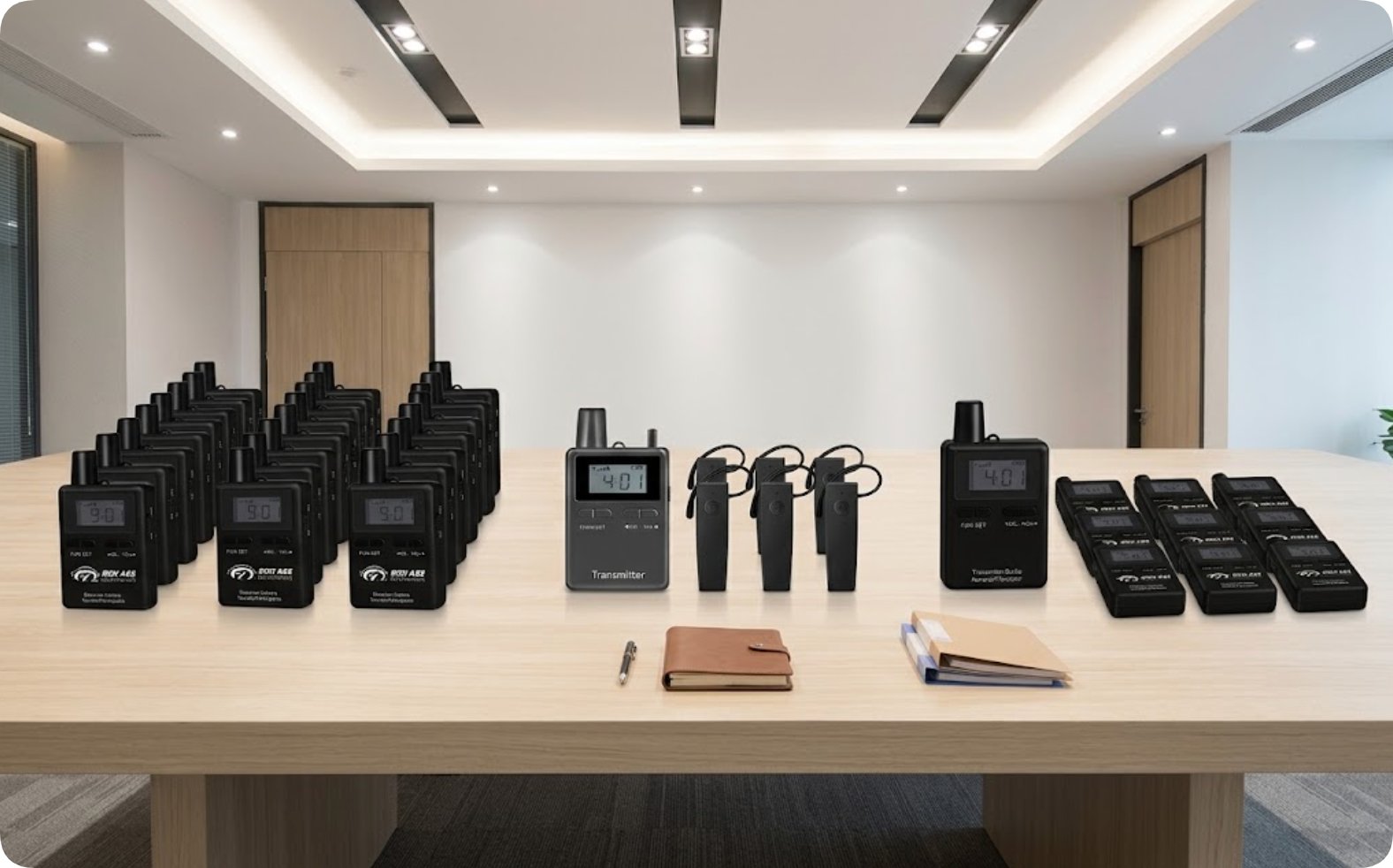
The readiness pass is the one that pays for itself, and it happens two weeks before the first heavy session, not on the morning of it. The sequence is dull and effective. Every unit gets charged and then timed on a discharge run, so the ones with tired cells are identified while there is still time to replace them. Every transmitter gets paired with a receiver on each channel the programme will actually use, because a channel that worked last quarter and was never re-tested is a channel you cannot promise. Firmware is brought to a single known version across the fleet, since a mixed fleet is the most common cause of an intermittent fault nobody can reproduce. The RC2401 transmitter that leads a training cohort should be on that bench first, because the whole session collapses if the trainer's unit fails and a single spare is cheap insurance against the most visible failure there is.
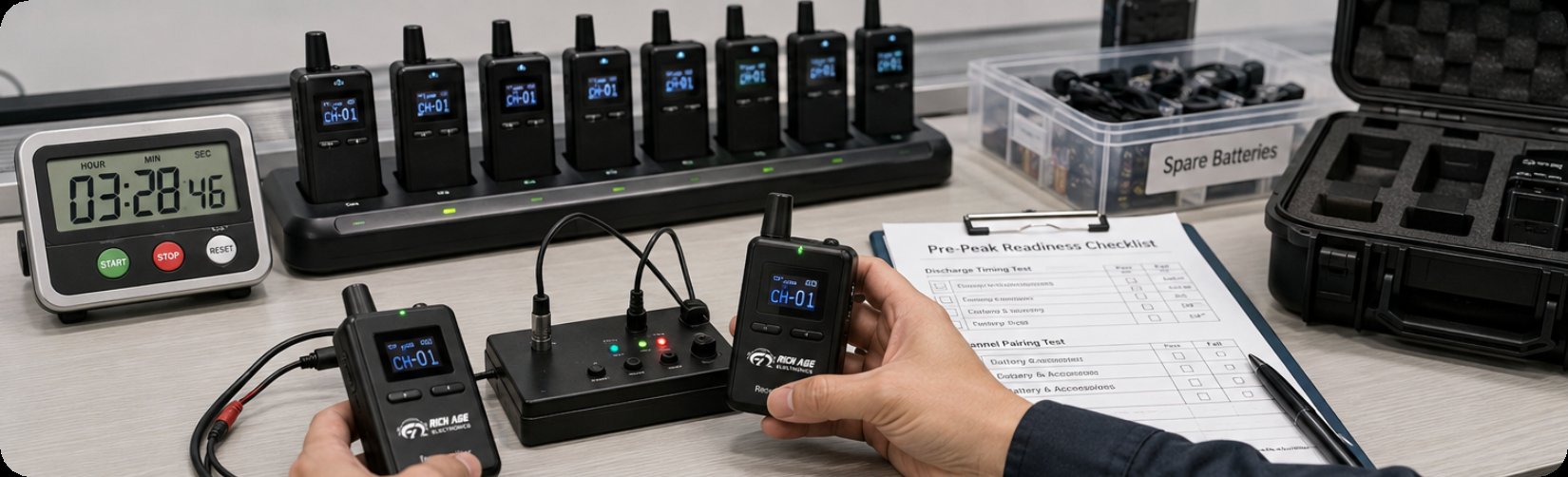
RC2401 transmitters on a readiness bench before the peak intake, where discharge timing and channel pairing catch problems while there is still time to fix them.
What One Heavy Week Actually Does
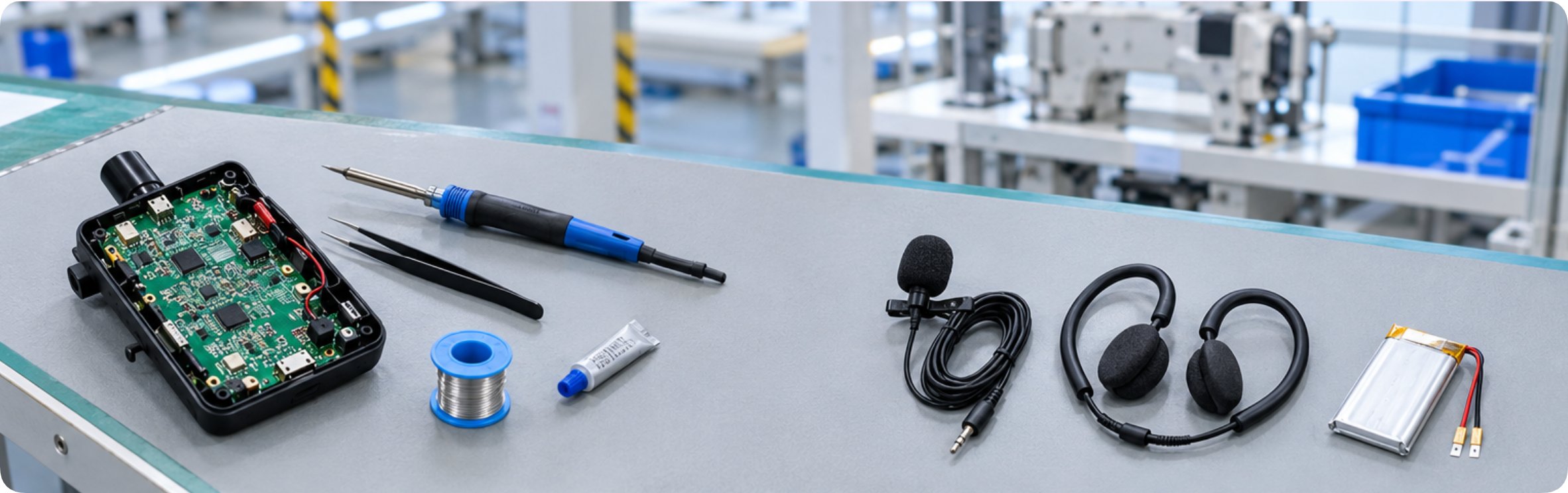
The damage during a peak fortnight is rarely dramatic. It is the slow accumulation of things that individually look trivial. Lanyards get twisted and the connector takes the strain instead of the cord. Units get stacked in a box rather than placed in a cradle, and a screen gets scratched by a neighbouring unit's clip. Batteries go from full to flat twice a day, which is a charge cycle count that quietly consumes a meaningful fraction of their life in a fortnight. Earpads and earhooks, which are the only part most users actually touch, degrade faster than anything else on the device and are the single most common reason a participant says the audio was poor. None of this needs a technician on site. It needs someone to look at the consumables during the peak rather than after it.
Handovers Across Back-to-Back Sessions
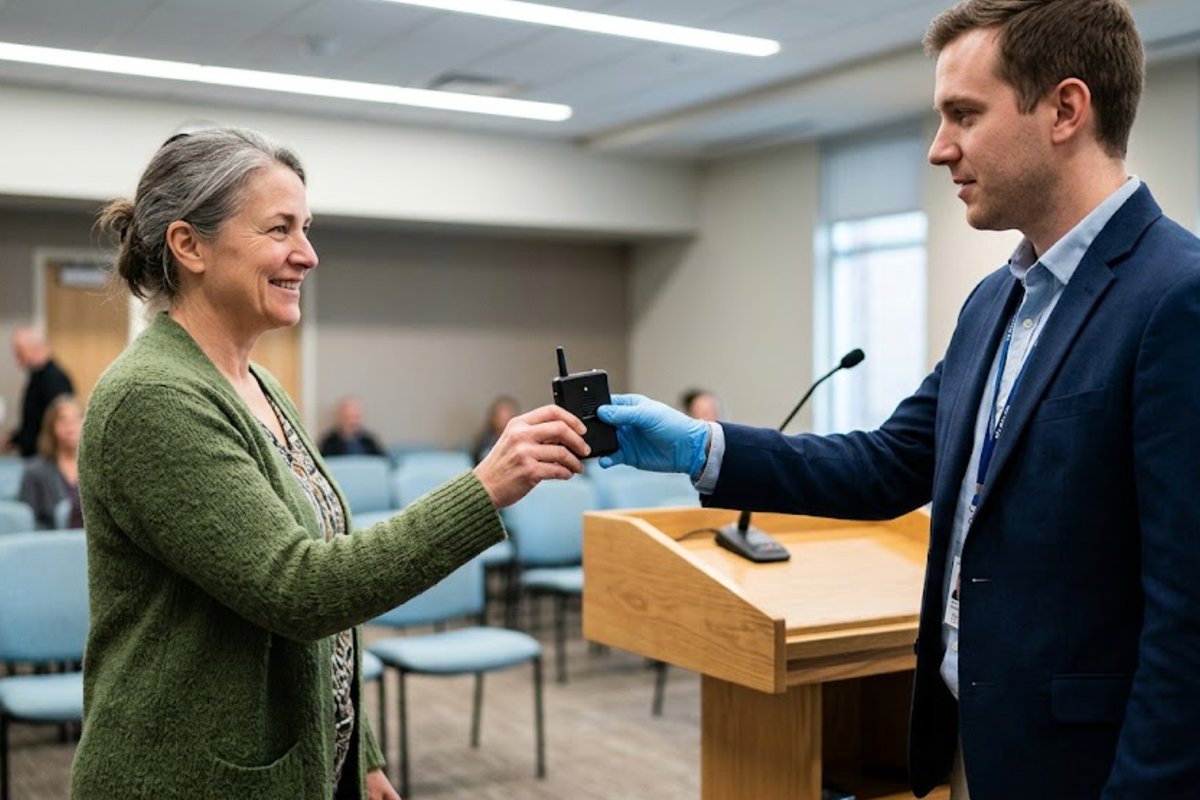
The riskiest moment in a training day is not the session itself, it is the ten minutes between two of them. Units come back in a heap, the next cohort is already in the room, and the choice is between issuing unchecked equipment or delaying the start. The fleets that handle this well make the handover a physical routine rather than a judgement call: a numbered return slot for each unit so a missing one is obvious immediately, a visual pass for damaged earhooks while the unit is dropped in, and a cradle that shows charge state at a glance rather than requiring each unit to be powered on. The RC2402 receiver suits this rhythm because its light shell and simple controls survive being handled quickly, and a coordinator can spot a problem unit without stopping to test it. A handover that takes ninety seconds and catches one broken unit is worth more than a deep service that happens once a quarter.
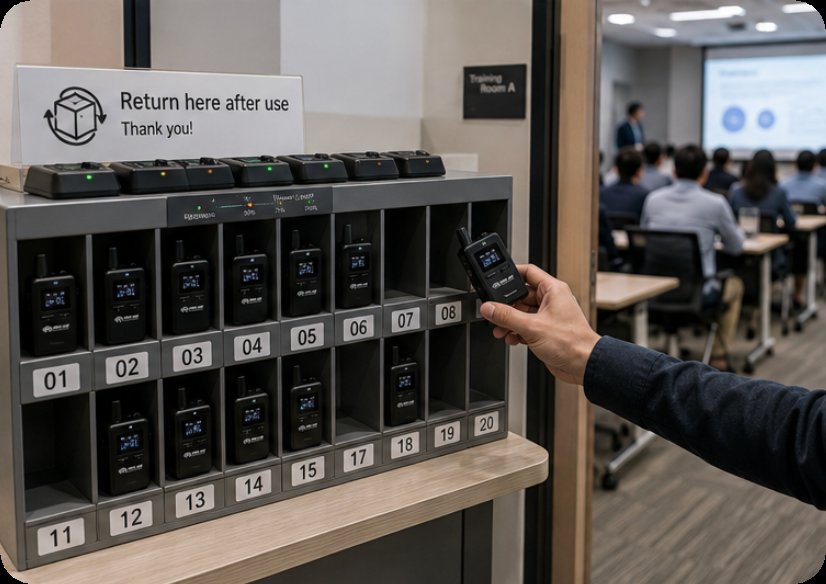
RC2402 receivers dropping into numbered return slots between sessions, where a missing or damaged unit is obvious without powering anything on.
Putting Units Away for the Quiet Months
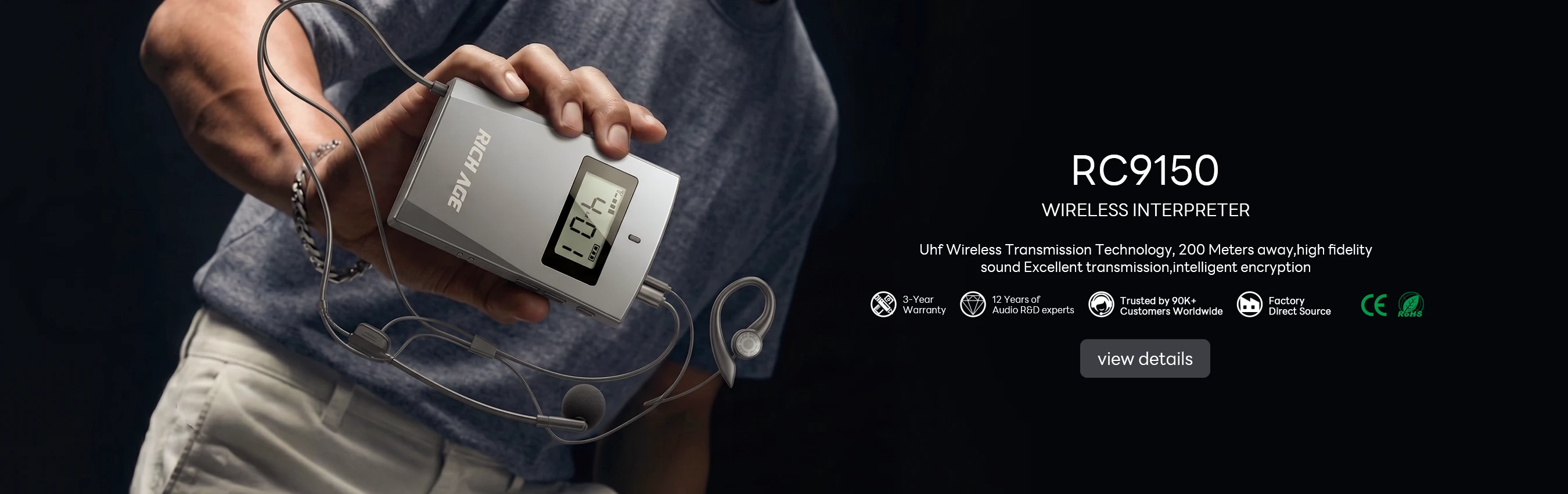
Storage is where most fleets are quietly damaged, because it is the one task nobody is watching. Three mistakes account for nearly all of it. The first is storing units fully discharged, which is harder on lithium cells than any amount of use and is the reason a fleet emerges from a quiet quarter with a third of its batteries unable to hold a charge. The second is storing them in a case with the earhooks still attached and coiled, which sets a permanent bend in the cord at the strain point. The third is a cupboard near a heat source or in a damp room, since neither extreme announces itself until the units are needed again. The correct routine is unglamorous: charge to roughly half, detach the consumables, box them loosely in a dry room at normal temperature, and write the date on the outside of the box. The premium units in the fleet deserve one extra step, because a display left in a standby state for months is the most common cause of a dim screen on return: power the RC9150 receiver fully down rather than leaving it sleeping.
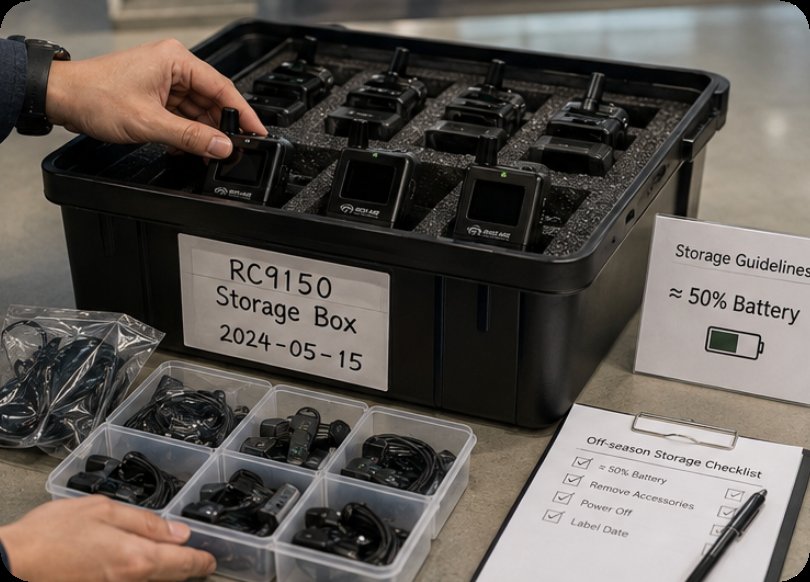
RC9150 receivers prepared for quiet-season storage at partial charge with consumables detached, dated on the outside of the case.
Bringing Them Back Without Surprises
Re-commissioning is the mirror of the readiness pass and gets skipped just as often, because a fleet that was working when it was put away is assumed to be working now. It usually is, with three exceptions worth checking for. Batteries that were stored correctly will recover, but the ones that were not will show a normal voltage and collapse under load, which only a discharge test reveals. Dust or residue on charging contacts builds up quietly over months and produces intermittent charging that looks like a battery fault. And any firmware that was updated on part of the fleet before storage but not all of it will leave the units unable to pair. Ten minutes with a test receiver and a discharge check catches all three before the first cohort arrives.
The Spares Drawer Nobody Inventories
Every fleet has a spares drawer and almost none of them are inventoried, which means the drawer contains exactly what someone happened to order two years ago. The consumables that actually run out are known in advance: earhooks and earpads, lanyards, batteries past their cycle count, and the occasional cracked case. The right stocking level is a function of the peak rather than of the fleet size, because consumption happens during the busy fortnight and a reorder raised then arrives after it. The table below maps each phase of the calendar to the work that belongs in it and the consumable that runs out, which is the whole schedule on one page.
| Calendar phase | What gets done | Who does it | Consumable that runs out |
|---|---|---|---|
| Two weeks before peak | Discharge timing, channel pairing, firmware alignment | coordinator plus AV | spare batteries identified |
| During the peak | Ninety-second handover check between sessions | session coordinator | earhooks and earpads |
| End of the peak | Full count, damage pass, consumable replacement | coordinator | lanyards |
| Start of quiet period | Partial charge, detach consumables, date and box | whoever closes the room | storage cases |
| Two weeks before return | Discharge test, contact clean, pair check | coordinator plus AV | batteries past cycle count |
🔮 Building the Rota for the Next Coordinator
The point of writing any of this down is that the person running the fleet will change. Training coordinators move roles, AV support rotates, and the person who knew that the third cradle is unreliable takes that knowledge with them. A one-page rota, pinned inside the storage cupboard and reviewed once a year, survives that turnover and stops the fleet from being rediscovered as a problem every peak. The wider wireless tour guide system range covers the transmitter, the lightweight receiver and the premium unit discussed above, and RC2401 and RC2402 measured on the training floor shows what the fleet actually delivers when it has been maintained this way. Send us your training calendar and your fleet size and we will tell you what the readiness pass should contain and what belongs in the spares drawer.