City tourism is the one guided-tour setting where the rules change when you cross a bridge. A walking tour in one country runs on a licence-free band, in the next it may be capped at a fraction of that power, and in a third the noise ordinance forbids anything that looks like a loudspeaker in a public square. Operators learn this the hard way, usually when a guide is told to stop using a megaphone mid-tour, or when a shipment of equipment is held at a border because the paperwork describes a radio the customs form has never seen. I have planned enough city routes to treat regulatory fit as the first buying question, not the last. The three units I would build a compliant operation around are the RC2406 for multi-group days, the RC2501 for quiet indoor sections, and the RC9150 where interpretation quality cannot be compromised. Each answers a different part of the rulebook, and this guide shows which part, so the equipment list survives contact with a real itinerary. Operators running mixed urban routes often start from the city tour guide systems range because it spans both the multi-group and the quiet-tour requirement.
Spectrum Rules That Change at Every Border
The first compliance layer is the radio itself, and it is the layer most often ignored until something goes wrong. Licence-free bands are not globally identical, and the two that matter for guided tours behave differently in practice. A 2.4 GHz system generally travels well between countries because the band is open in most markets, but the permitted transmit power still varies, and a device set for a generous domestic output may exceed the limit elsewhere. UHF inverts the problem: it often gives better range and wall penetration, but in many countries it needs a licence, and an unlicensed transmitter is a regulatory breach regardless of how well it performs. The practical rule is to choose a system whose power setting can be reduced on the device, not only at the factory, because a setting you can prove on site beats a specification sheet that assumes one market.
Power Limits and What They Mean on the Street
Transmit power sounds like a technical footnote until you connect it to group behaviour. A city walk mixes open squares with narrow streets, and the guide constantly moves ahead of the group, so coverage has to hold across twenty or thirty metres with bodies in between. The RC2406 is built for exactly this working pattern: a 65 g transmitter with an 80-channel layout and a 12-hour battery, which means a single day can run several groups through the same district without collision. That channel headroom is also a compliance asset, because a group that reliably holds its own channel does not need to push power or reposition equipment to be heard. Where regulation tightens the output ceiling, the group that manages channels well keeps working. Sealing matters here too, at IP42, because a street tour meets light rain far more often than a coach tour does.

The multi-group street scene above is where channel planning pays for itself. Three parties, three channels, one district, and no guide raising a voice or a power setting to stay ahead of the others.
Noise Ordinances and the Whisper Advantage
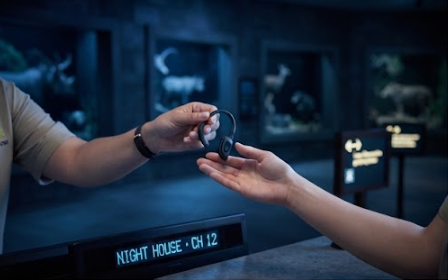
The second layer is not electrical at all, and it is the one that ends tours. Many historic centres restrict amplified sound in public space, and some go further by requiring that guides not address a group through any device that projects into the open air. This is precisely where a whisper-style system stops being a convenience and becomes the compliant option. The RC2501 weighs 48 g and is designed around lightweight headsets worn by the whole party, so the commentary reaches the group without ever being projected outward. At an IP20 rating it is an indoor-leaning unit, which is a fair description of how it gets used: museum wings, covered passages, gallery rooms and any stretch where a raised voice would draw attention from residents or officials. Running ten hours on a charge, it covers a normal sightseeing day and pairs naturally with a separate outdoor unit for the open sections.

The quiet group above is not being discreet for its own sake. In a regulated historic centre this is simply the permitted way to run commentary, and a light headset is what makes visitors keep it on for the whole morning.
Crew Size and Channel Discipline
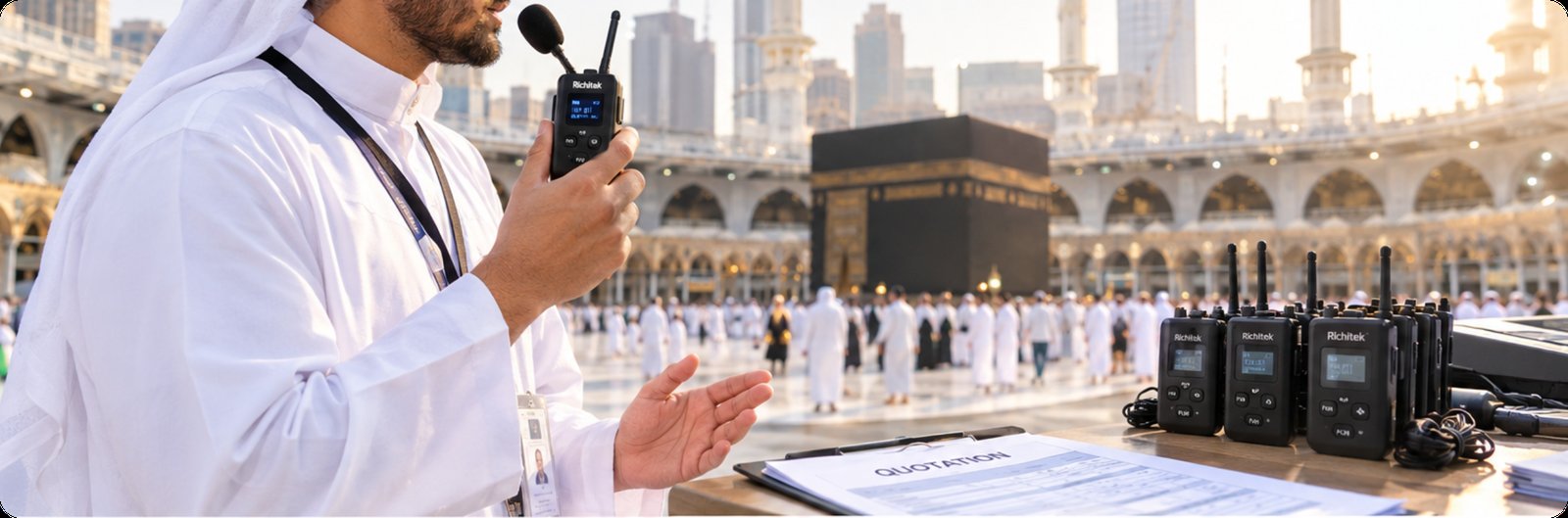
The third layer is interpretation quality, which becomes a compliance question the moment a route is sold as multilingual. Once a site runs two languages at once, the equipment has to separate them cleanly, because a crossed channel is not merely annoying, it invalidates the service the visitor paid for. The RC9150 sits at the top of this range: a 75 g unit rated IP54 with a 15-hour battery, positioned for simultaneous interpretation rather than one-way guiding. The longer runtime matters when a single escort covers a full day across several venues, and the higher sealing rating matters when that day includes an open-air stop in changeable weather. The compliance point is less about the hardware than the discipline it enables: assigning a channel plan before the season starts and treating it as operating procedure rather than something the guide improvises on the morning.

The interpretation scene above shows why separation is the whole product. Two languages on one route only works when the channel plan is fixed in advance and the equipment holds it without a technician standing by.
Listener Hearing Levels
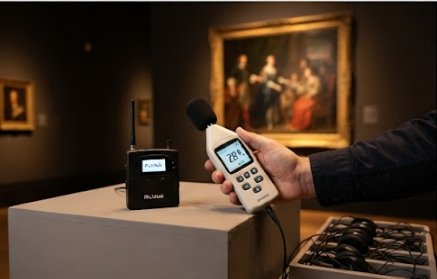
One requirement that rarely appears on a purchasing checklist concerns the people wearing the receivers. Prolonged exposure to high output through a headset is a genuine health consideration, and some venues now expect operators to be able to state the maximum level their equipment delivers to the ear. This is where a light, single-ear receiver design is easier to justify than a large over-ear headphone, because visitors wear it for hours and because the guide can be heard without the volume being pushed up. The practical test is whether a visitor can still hear traffic and their own group while wearing the receiver, since a design that blocks ambient sound is both a safety problem on a city street and a complaint waiting to happen.
A Reference Table for Planners
| Planning factor | RC2406 | RC2501 | RC9150 |
|---|---|---|---|
| Unit weight | 65 g | 48 g | 75 g |
| Battery life | 12 hours | 10 hours | 15 hours |
| Sealing rating | IP42 | IP20 | IP54 |
| Primary fit | Multi-group street sections | Quiet indoor and regulated zones | Simultaneous interpretation |
| Compliance focus | Channel planning within power limits | No projected sound in public space | Clean language separation |
The table is ordered the way a route is walked, from the busy open sections to the quiet interior and back out again. Reading down the fourth row gives the assignment for a three-part itinerary, and reading across the last row shows the compliance question each unit is actually answering. The wider wireless tour guide system family covers the models either side of these three when a route needs a different balance of weight and runtime.
Crossing Borders with the Kit
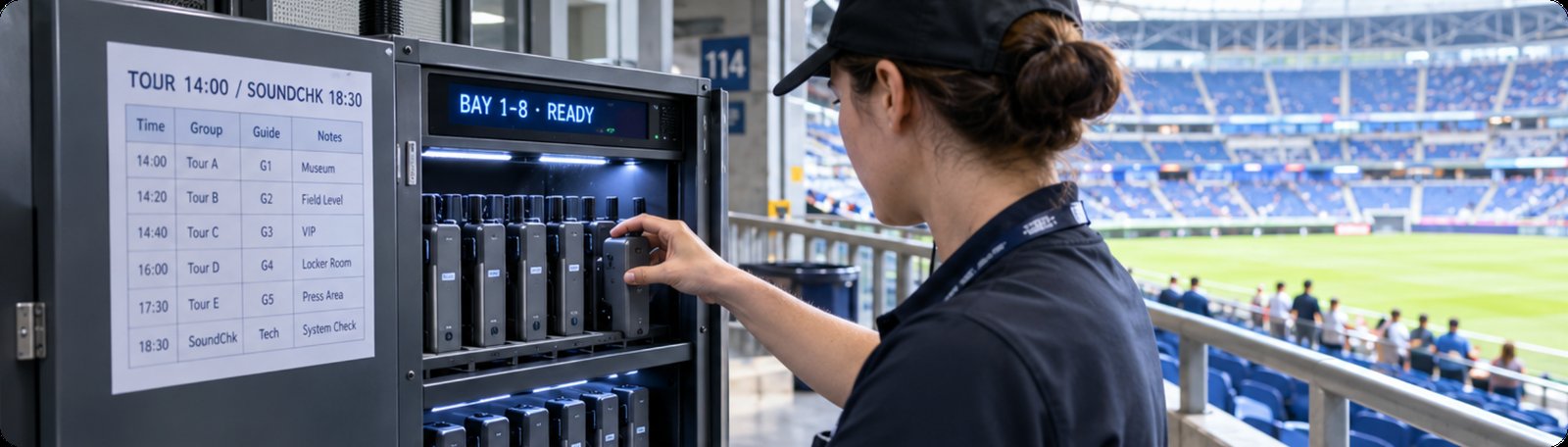
For operators who move equipment between countries, the practical difficulty is rarely the tour itself and almost always the entry process. A radio is a regulated item in most jurisdictions, and travelling with a case of transmitters without documentation is the fastest way to lose a day at a border. What helps is a consistent equipment list, a clear statement of what each unit is, and manufacturer documentation stating the frequency band and power class. That is easier to assemble when an operation standardises on a small number of models rather than accumulating whatever was on offer each season, because the paperwork can be written once and reused. Chargers and spare batteries deserve the same treatment, since battery transport rules are their own regime and are frequently what causes a hold-up. A kit documented before departure rarely becomes a conversation at the border.
Paperwork Before the Season Starts
The last step is the least glamorous and the one that protects the whole season: write the compliance file before the first departure. It should name the band and power setting used in each region, record the channel plan for each route, note which sections run on a whisper system, and hold the manufacturer documentation for every model. A related city walking tour operations case shows what happens when those details are decided on the day rather than in advance, which is the pattern most operators eventually learn to avoid. What I would not do is treat regulation as a fixed cost of doing business. Routes change, bands get reallocated, and the operator who can show a plan and adjust it quickly is the one still running tours when a rule tightens. The deciding question is not which unit is most advanced. It is whether the operation can be explained, on paper, to someone who has never walked the route.